




Simone Zaccaria
@zaccasimo.bsky.social
CRUK Career Development Fellow
Group Leader of @ccg-ucl.bsky.social at the UCL Cancer Institute, @CRUKLungCentre, and Visiting Scientist at the Francis Crick
W: http://www.ucl.ac.uk/cancer/zaccaria-lab
W: https://sites.google.com/view/ccgresearchgroup
Group Leader of @ccg-ucl.bsky.social at the UCL Cancer Institute, @CRUKLungCentre, and Visiting Scientist at the Francis Crick
W: http://www.ucl.ac.uk/cancer/zaccaria-lab
W: https://sites.google.com/view/ccgresearchgroup
This is also the first step and output of my @cancerresearchuk.org Career Development Fellowship, and you can read its overall vision and goal in a recent
@cancerresearchuk.org 's blog post 👇
news.cancerresearchuk.org/2024/02/27/u...
@cancerresearchuk.org 's blog post 👇
news.cancerresearchuk.org/2024/02/27/u...
November 29, 2024 at 1:25 PM
This is also the first step and output of my @cancerresearchuk.org Career Development Fellowship, and you can read its overall vision and goal in a recent
@cancerresearchuk.org 's blog post 👇
news.cancerresearchuk.org/2024/02/27/u...
@cancerresearchuk.org 's blog post 👇
news.cancerresearchuk.org/2024/02/27/u...
📰Read full story 👉 rdcu.be/d1S6m
🖥️SPRINTER is fully available in GitHub 👉 github.com/zaccaria-lab...
🚆Distributed through Bioconda (with also related container) 👉 bioconda.github.io/recipes/spri...
💾also with a reproducible capsule in CodeOcean👉 doi.org/10.24433/CO.... pic.x.com/zpL2rhbRhl
🖥️SPRINTER is fully available in GitHub 👉 github.com/zaccaria-lab...
🚆Distributed through Bioconda (with also related container) 👉 bioconda.github.io/recipes/spri...
💾also with a reproducible capsule in CodeOcean👉 doi.org/10.24433/CO.... pic.x.com/zpL2rhbRhl
November 29, 2024 at 1:25 PM
📰Read full story 👉 rdcu.be/d1S6m
🖥️SPRINTER is fully available in GitHub 👉 github.com/zaccaria-lab...
🚆Distributed through Bioconda (with also related container) 👉 bioconda.github.io/recipes/spri...
💾also with a reproducible capsule in CodeOcean👉 doi.org/10.24433/CO.... pic.x.com/zpL2rhbRhl
🖥️SPRINTER is fully available in GitHub 👉 github.com/zaccaria-lab...
🚆Distributed through Bioconda (with also related container) 👉 bioconda.github.io/recipes/spri...
💾also with a reproducible capsule in CodeOcean👉 doi.org/10.24433/CO.... pic.x.com/zpL2rhbRhl
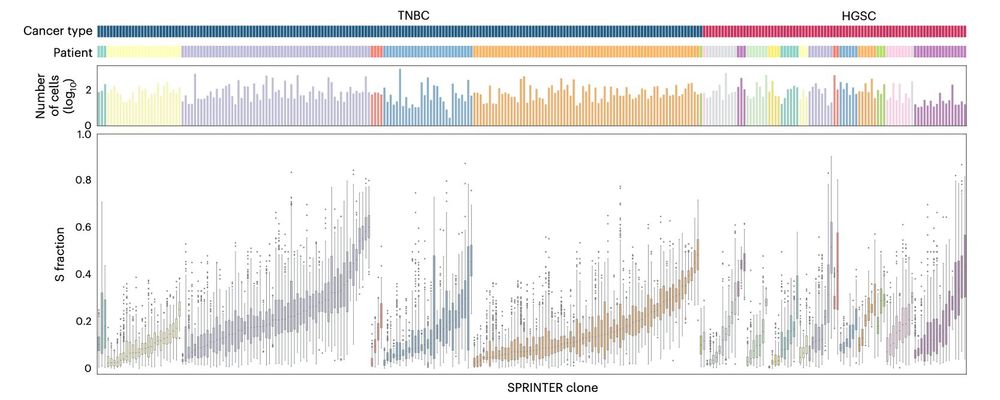
Finally, we proved SPRINTER’s broad applicability on prev datasets of 61,914 TNBC and HGSC cells and found other key insights for high prolif clones:
❗️Increased single-cell rates of genomic variants
‼️Enrichment of prolif-related gene amplifications
❔-> Evolutionary advantage?
❗️Increased single-cell rates of genomic variants
‼️Enrichment of prolif-related gene amplifications
❔-> Evolutionary advantage?
November 29, 2024 at 1:25 PM
Finally, we proved SPRINTER’s broad applicability on prev datasets of 61,914 TNBC and HGSC cells and found other key insights for high prolif clones:
❗️Increased single-cell rates of genomic variants
‼️Enrichment of prolif-related gene amplifications
❔-> Evolutionary advantage?
❗️Increased single-cell rates of genomic variants
‼️Enrichment of prolif-related gene amplifications
❔-> Evolutionary advantage?
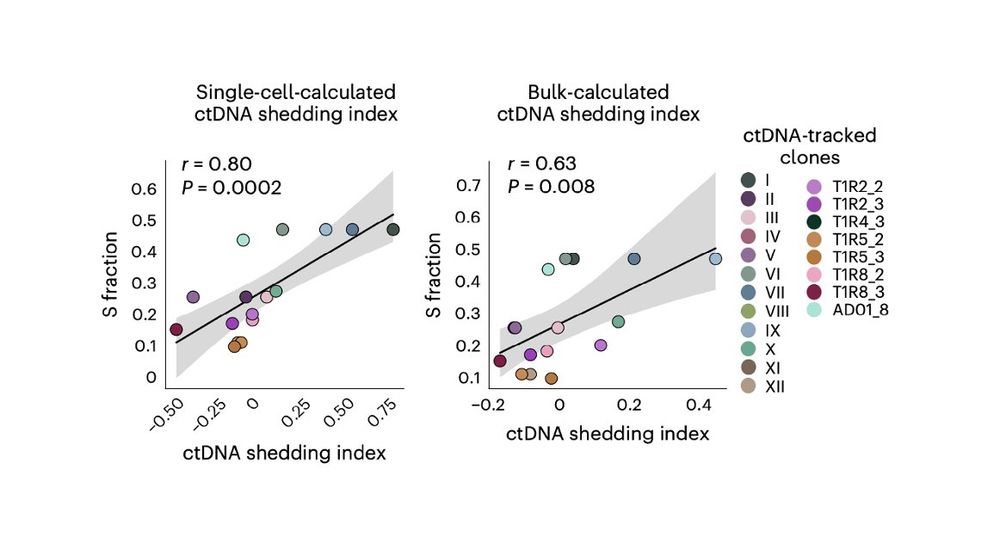
When integrating serial ctDNA samples across 4 timepoints, we found differential ctDNA shedding between clones, with high prolif clones shedding more ctDNA
🚨It shows that previous similar observations obtained across different tumors also hold for distinct clones within a tumor
🚨It shows that previous similar observations obtained across different tumors also hold for distinct clones within a tumor
November 29, 2024 at 1:25 PM
When integrating serial ctDNA samples across 4 timepoints, we found differential ctDNA shedding between clones, with high prolif clones shedding more ctDNA
🚨It shows that previous similar observations obtained across different tumors also hold for distinct clones within a tumor
🚨It shows that previous similar observations obtained across different tumors also hold for distinct clones within a tumor
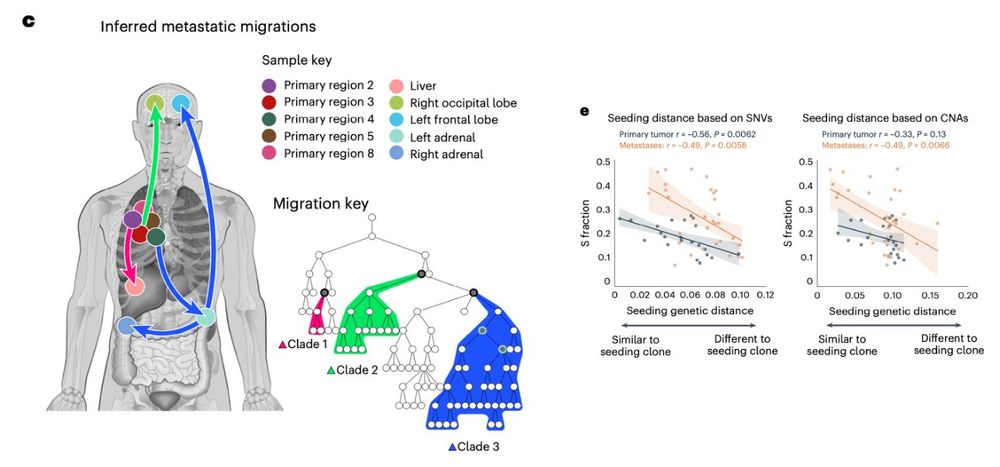
What's their role? We reconstructed met dissemination patterns and found that:
1. high prolif clones seeded most mets disseminating from other mets
2. met-seeding clones had high proliferation
❔-> association between high prolif and met seeding potential of individual clones
1. high prolif clones seeded most mets disseminating from other mets
2. met-seeding clones had high proliferation
❔-> association between high prolif and met seeding potential of individual clones
November 29, 2024 at 1:25 PM
What's their role? We reconstructed met dissemination patterns and found that:
1. high prolif clones seeded most mets disseminating from other mets
2. met-seeding clones had high proliferation
❔-> association between high prolif and met seeding potential of individual clones
1. high prolif clones seeded most mets disseminating from other mets
2. met-seeding clones had high proliferation
❔-> association between high prolif and met seeding potential of individual clones
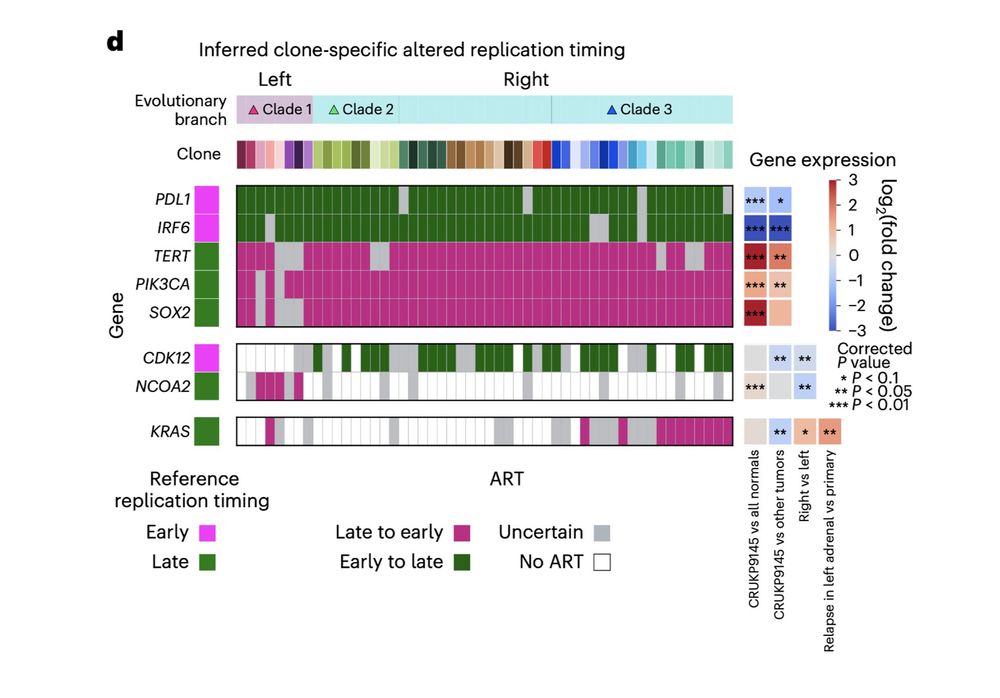
Maybe non-genetic? Leveraging SPRINTER, we developed an approach to identify clone-specific altered replication timing (ART)
‼️ We found ART unique to the high prolif and metastatic clones affecting key genes like KRAS, and with associated expression changes from matched RNA-seq
‼️ We found ART unique to the high prolif and metastatic clones affecting key genes like KRAS, and with associated expression changes from matched RNA-seq
November 29, 2024 at 1:25 PM
Maybe non-genetic? Leveraging SPRINTER, we developed an approach to identify clone-specific altered replication timing (ART)
‼️ We found ART unique to the high prolif and metastatic clones affecting key genes like KRAS, and with associated expression changes from matched RNA-seq
‼️ We found ART unique to the high prolif and metastatic clones affecting key genes like KRAS, and with associated expression changes from matched RNA-seq
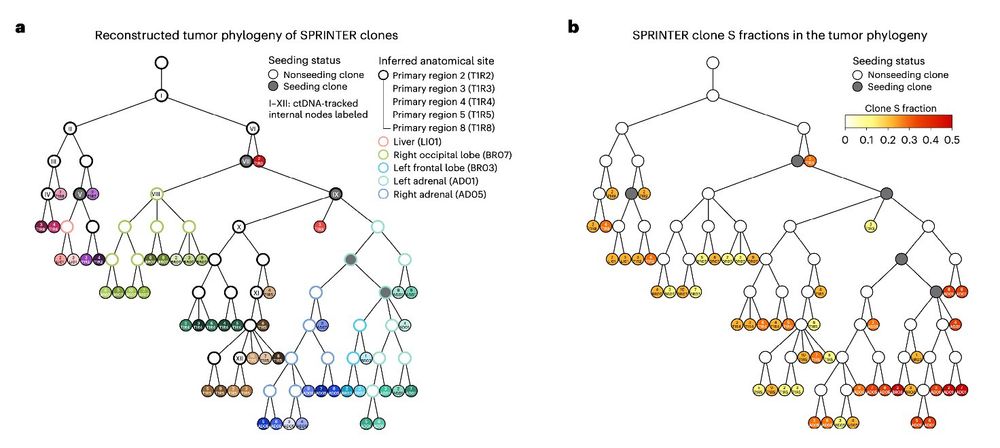
To find potential causes of these proliferation differences, we performed a detailed phylogenetic analysis of both SNVs and CNAs, as SPRINTER now enables the simultaneous analysis of clones' evolution and their proliferation.
⛔️ No clearly associated genetic driver was found
⛔️ No clearly associated genetic driver was found
November 29, 2024 at 1:25 PM
To find potential causes of these proliferation differences, we performed a detailed phylogenetic analysis of both SNVs and CNAs, as SPRINTER now enables the simultaneous analysis of clones' evolution and their proliferation.
⛔️ No clearly associated genetic driver was found
⛔️ No clearly associated genetic driver was found
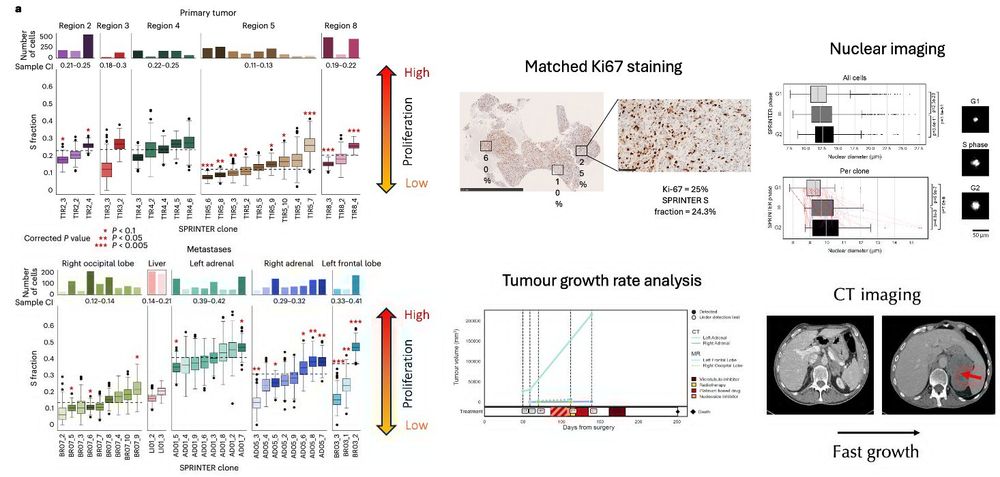
SPRINTER revealed widespread proliferation heterogeneity both in primary tumor and mets, and both between and within samples. We validated these with orthogonal analyses, including Ki-67 staining, nuclei imaging and clinical imaging.
❓-> Yes, clones can proliferate differently
❓-> Yes, clones can proliferate differently
November 29, 2024 at 1:25 PM
SPRINTER revealed widespread proliferation heterogeneity both in primary tumor and mets, and both between and within samples. We validated these with orthogonal analyses, including Ki-67 staining, nuclei imaging and clinical imaging.
❓-> Yes, clones can proliferate differently
❓-> Yes, clones can proliferate differently
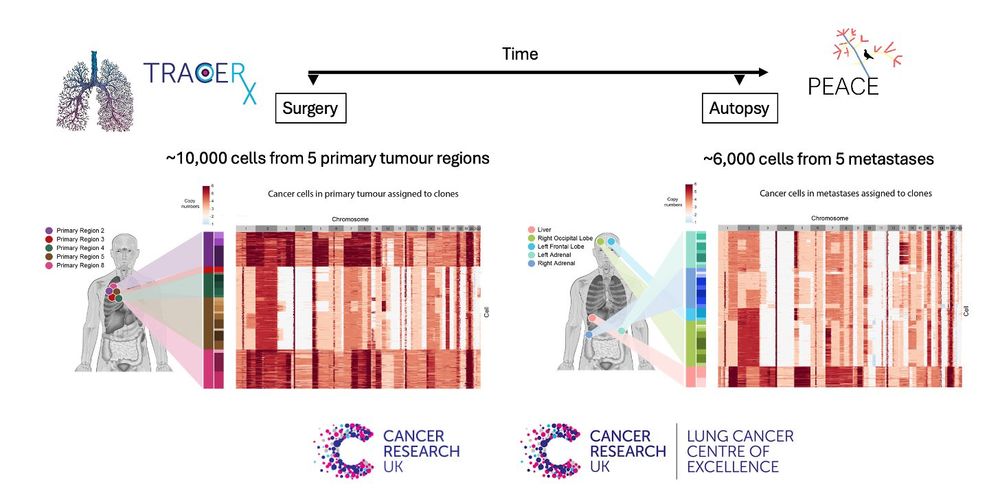
To answer the initial questions ❓ and ❔, we generated a unique scDNA, longitudinal, primary-metastasis-matched dataset of 14,994 non-small cell lung cancer cells from a patient enrolled in the #TRACERx and #PEACEautopsy studies, and we applied SPRINTER to it
November 29, 2024 at 1:25 PM
To answer the initial questions ❓ and ❔, we generated a unique scDNA, longitudinal, primary-metastasis-matched dataset of 14,994 non-small cell lung cancer cells from a patient enrolled in the #TRACERx and #PEACEautopsy studies, and we applied SPRINTER to it
Using this ground truth dataset, we demonstrated that SPRINTER exhibits high accuracy and sensitivity, improving the power of S-phase identification compared to previous approaches and, especially, enabling accurate assignment of replicating cells to corresponding clones

November 29, 2024 at 1:25 PM
Using this ground truth dataset, we demonstrated that SPRINTER exhibits high accuracy and sensitivity, improving the power of S-phase identification compared to previous approaches and, especially, enabling accurate assignment of replicating cells to corresponding clones
To evaluate SPRINTER’s performance, we used a recent and accurate FACS approach incorporating EdU to generate a ground truth scDNA dataset of 8,844 diploid and tetraploid cancer cells separated into 5 known cell cycle phases


November 29, 2024 at 1:25 PM
To evaluate SPRINTER’s performance, we used a recent and accurate FACS approach incorporating EdU to generate a ground truth scDNA dataset of 8,844 diploid and tetraploid cancer cells separated into 5 known cell cycle phases
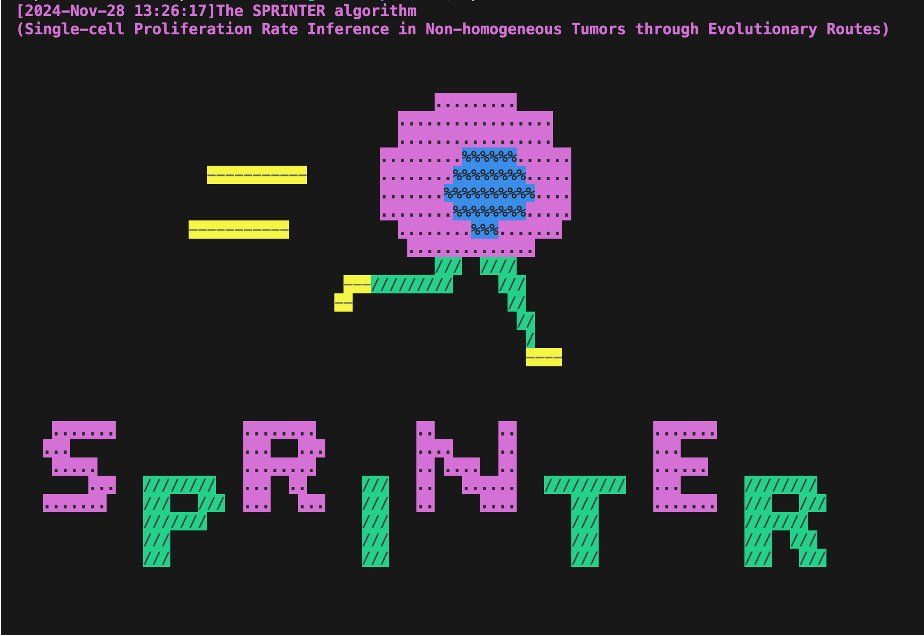
💡 To overcome this, we introduced SPRINTER, an algorithm that uses scDNA data to enable accurate identification and clone assignment of S- and G2-phase cells, providing a proxy to estimate clone-specific proliferation rates

November 29, 2024 at 1:25 PM
💡 To overcome this, we introduced SPRINTER, an algorithm that uses scDNA data to enable accurate identification and clone assignment of S- and G2-phase cells, providing a proxy to estimate clone-specific proliferation rates
🚨 With 💪 single-cell whole-genome DNA sequencing (scDNA) like DLP+, we jointly identify clones and replicating cells
⚠️ But estimating clone proliferation remains challenging due to lack of formal methods for clone assignment of replicating cells and low identification power
⚠️ But estimating clone proliferation remains challenging due to lack of formal methods for clone assignment of replicating cells and low identification power

November 29, 2024 at 1:25 PM
🚨 With 💪 single-cell whole-genome DNA sequencing (scDNA) like DLP+, we jointly identify clones and replicating cells
⚠️ But estimating clone proliferation remains challenging due to lack of formal methods for clone assignment of replicating cells and low identification power
⚠️ But estimating clone proliferation remains challenging due to lack of formal methods for clone assignment of replicating cells and low identification power
⚠️High proliferation is a key hallmark of cancer and is linked to worse clinical outcomes
❓Can it also differ between distinct clones co-existing within a tumor?
❔If so, do proliferation differences associate with more aggressive phenotypes or other properties of these clones?
❓Can it also differ between distinct clones co-existing within a tumor?
❔If so, do proliferation differences associate with more aggressive phenotypes or other properties of these clones?

November 29, 2024 at 1:25 PM
⚠️High proliferation is a key hallmark of cancer and is linked to worse clinical outcomes
❓Can it also differ between distinct clones co-existing within a tumor?
❔If so, do proliferation differences associate with more aggressive phenotypes or other properties of these clones?
❓Can it also differ between distinct clones co-existing within a tumor?
❔If so, do proliferation differences associate with more aggressive phenotypes or other properties of these clones?