




Vladimir Zabolotskiy
@zabolotskiy.bsky.social
Applied and Political Economics
Postdoc at Free University of Bozen-Bolzano
PhD in Economics from University of Bologna
📍 Based in Florence
🌐 zabolotskiy.com
Postdoc at Free University of Bozen-Bolzano
PhD in Economics from University of Bologna
📍 Based in Florence
🌐 zabolotskiy.com
Happy to have made it to #EPSA2025 in beautiful Madrid!
If you are there and undecided where to spend the second sesh today—drop by our panel on authoritarian rule, protest and legitimacy in 1A.13 at 11:20. Excited to present our paper on war and propaganda as part of this excellent lineup!👇
If you are there and undecided where to spend the second sesh today—drop by our panel on authoritarian rule, protest and legitimacy in 1A.13 at 11:20. Excited to present our paper on war and propaganda as part of this excellent lineup!👇


June 26, 2025 at 7:45 AM
Happy to have made it to #EPSA2025 in beautiful Madrid!
If you are there and undecided where to spend the second sesh today—drop by our panel on authoritarian rule, protest and legitimacy in 1A.13 at 11:20. Excited to present our paper on war and propaganda as part of this excellent lineup!👇
If you are there and undecided where to spend the second sesh today—drop by our panel on authoritarian rule, protest and legitimacy in 1A.13 at 11:20. Excited to present our paper on war and propaganda as part of this excellent lineup!👇

We also analyze the obituaries with a GPT model to better understand how the deaths of the soldiers are framed and how it impacts engagement:
📌 High-grief = more engagement
📌 Nationalistic propaganda = less engagement even when high-grief
📌 Authorities mentioned = even less engagement
(7/8)
📌 High-grief = more engagement
📌 Nationalistic propaganda = less engagement even when high-grief
📌 Authorities mentioned = even less engagement
(7/8)

May 16, 2025 at 6:31 AM
We also analyze the obituaries with a GPT model to better understand how the deaths of the soldiers are framed and how it impacts engagement:
📌 High-grief = more engagement
📌 Nationalistic propaganda = less engagement even when high-grief
📌 Authorities mentioned = even less engagement
(7/8)
📌 High-grief = more engagement
📌 Nationalistic propaganda = less engagement even when high-grief
📌 Authorities mentioned = even less engagement
(7/8)
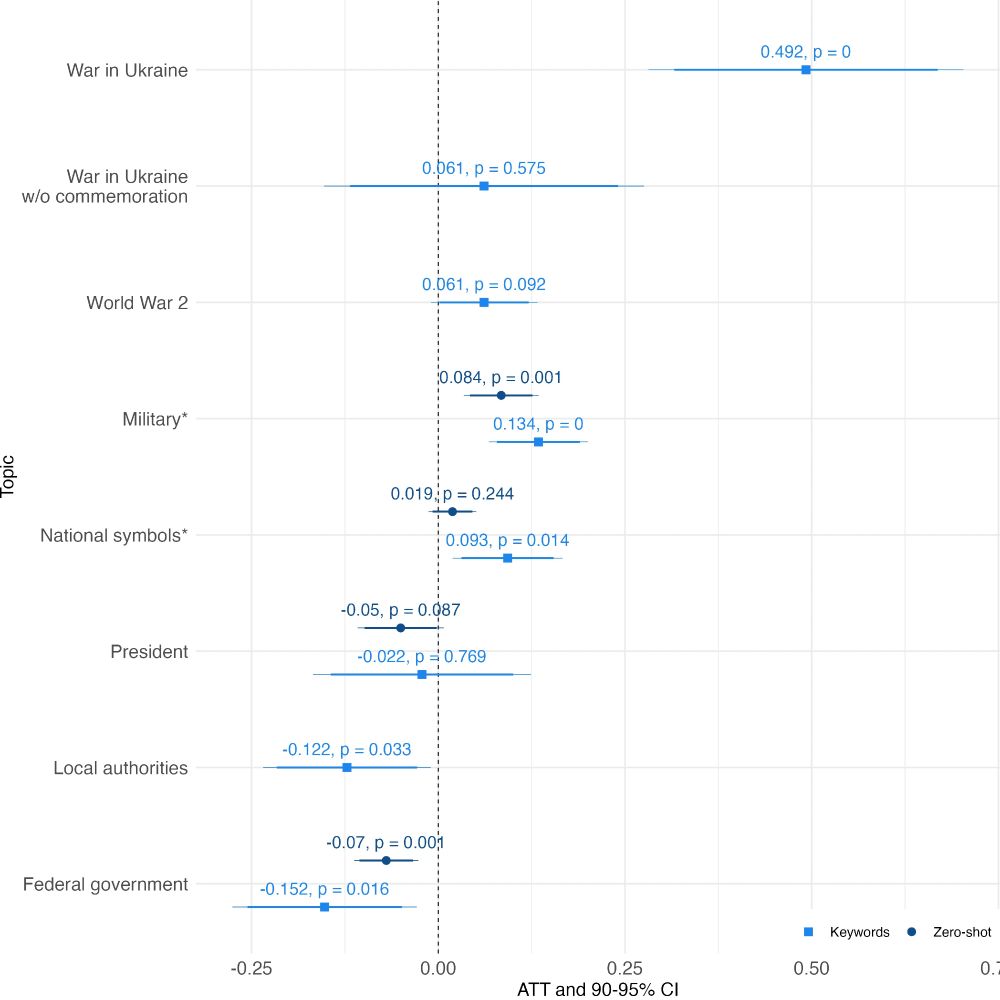
Engagement with content related to the Russia-Ukraine war also increases after the KIA reports but this is due to engagement with obituaries and personal stories of the deceased soldiers on VK rather than a surge in pro-war likes: Null effect when we remove the obituaries from the sample.
(6/8)
(6/8)
May 16, 2025 at 6:31 AM
Engagement with content related to the Russia-Ukraine war also increases after the KIA reports but this is due to engagement with obituaries and personal stories of the deceased soldiers on VK rather than a surge in pro-war likes: Null effect when we remove the obituaries from the sample.
(6/8)
(6/8)
Main result: After the first KIA report in the municipality, engagement with patriotic/military propaganda increases, but drops for posts promoting the government or the president. Similar dynamics in comments, shares, but also views.
(5/8)
(5/8)
May 16, 2025 at 6:31 AM
Main result: After the first KIA report in the municipality, engagement with patriotic/military propaganda increases, but drops for posts promoting the government or the president. Similar dynamics in comments, shares, but also views.
(5/8)
(5/8)
We link the relative engagement to the data on Russian war fatalities (KIA), which was kindly shared by
@en.zona.media. This allows us to check how engagement changes pre/post (first) fatality report in municipality. The plot below shows the distribution of the KIA reports dates:
(4/8)
@en.zona.media. This allows us to check how engagement changes pre/post (first) fatality report in municipality. The plot below shows the distribution of the KIA reports dates:
(4/8)

May 16, 2025 at 6:31 AM
We link the relative engagement to the data on Russian war fatalities (KIA), which was kindly shared by
@en.zona.media. This allows us to check how engagement changes pre/post (first) fatality report in municipality. The plot below shows the distribution of the KIA reports dates:
(4/8)
@en.zona.media. This allows us to check how engagement changes pre/post (first) fatality report in municipality. The plot below shows the distribution of the KIA reports dates:
(4/8)
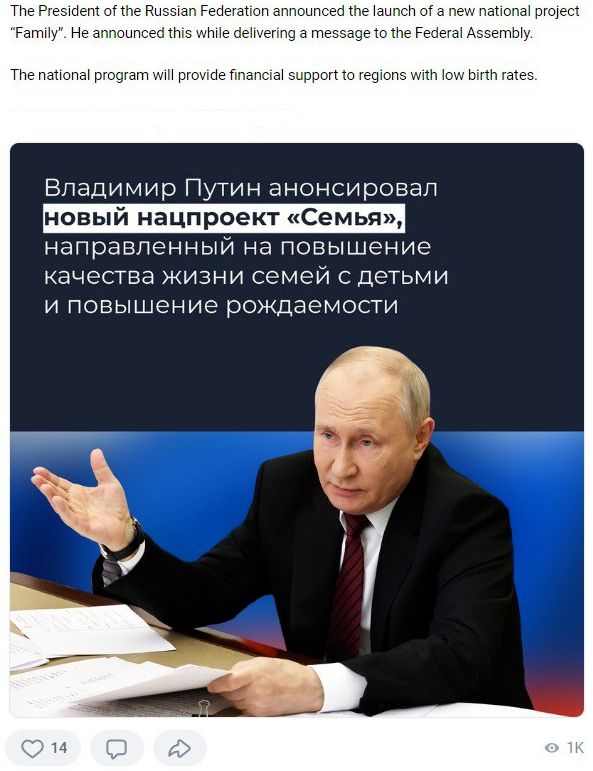
We classify the posts from these groups with keywords/LLM, and aggregate the engagement metrics—likes, shares, views, comments—by topic. We then separately look at engagement with (i) pro-regime and (ii) patriotic propaganda, relative to neutral engagement. An example of a pro-regime post:
(3/8)
(3/8)
May 16, 2025 at 6:31 AM
We classify the posts from these groups with keywords/LLM, and aggregate the engagement metrics—likes, shares, views, comments—by topic. We then separately look at engagement with (i) pro-regime and (ii) patriotic propaganda, relative to neutral engagement. An example of a pro-regime post:
(3/8)
(3/8)
First, data: We analyze 28M+ posts from 36K+ VKontakte groups run by Russian public schools. Why schools? They are widespread, geolocatable, not targeted by bots, and mix propaganda with neutral content on school life. Below is the map of groups active on the eve of the Russian invasion:
(2/8)
(2/8)

May 16, 2025 at 6:31 AM
First, data: We analyze 28M+ posts from 36K+ VKontakte groups run by Russian public schools. Why schools? They are widespread, geolocatable, not targeted by bots, and mix propaganda with neutral content on school life. Below is the map of groups active on the eve of the Russian invasion:
(2/8)
(2/8)
Me and @ifomichev.bsky.social deciding who's the first author in the only appropriate way
April 18, 2025 at 4:12 PM
Me and @ifomichev.bsky.social deciding who's the first author in the only appropriate way
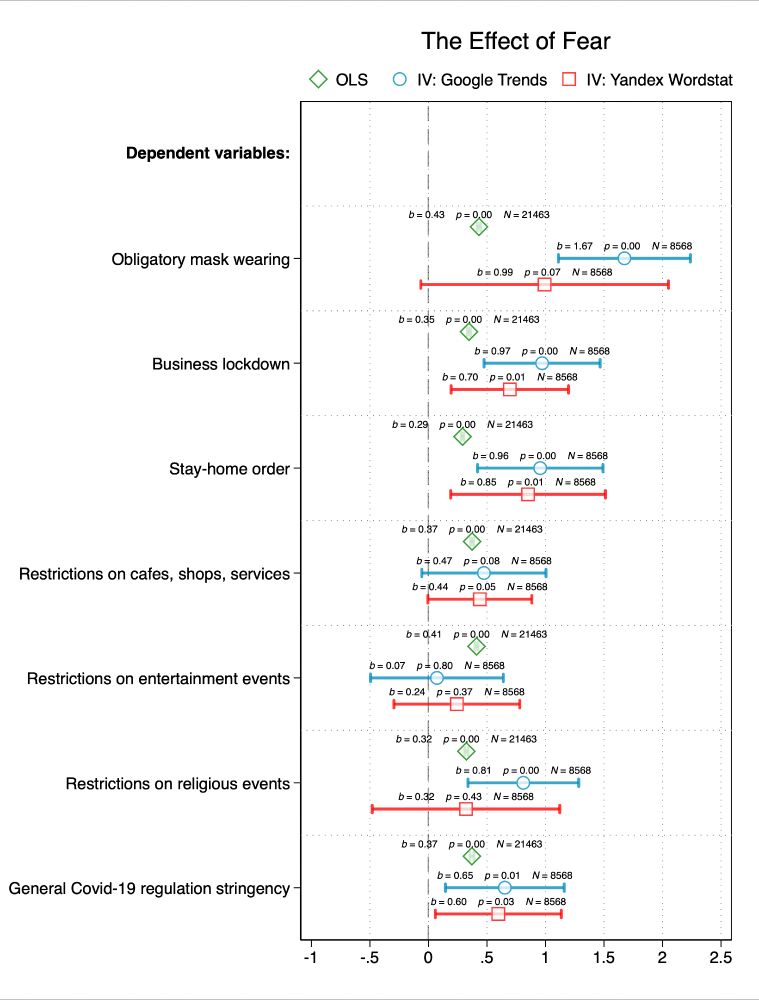
Disaggregating the effect, we find that it is highest for regulations people usually oppose, like wearing medical masks, business lockdowns, or stay-home orders. The effect is still there for the other pandemic regulations, but smaller and less significant.
(5/7)
(5/7)
March 31, 2025 at 3:25 PM
Disaggregating the effect, we find that it is highest for regulations people usually oppose, like wearing medical masks, business lockdowns, or stay-home orders. The effect is still there for the other pandemic regulations, but smaller and less significant.
(5/7)
(5/7)
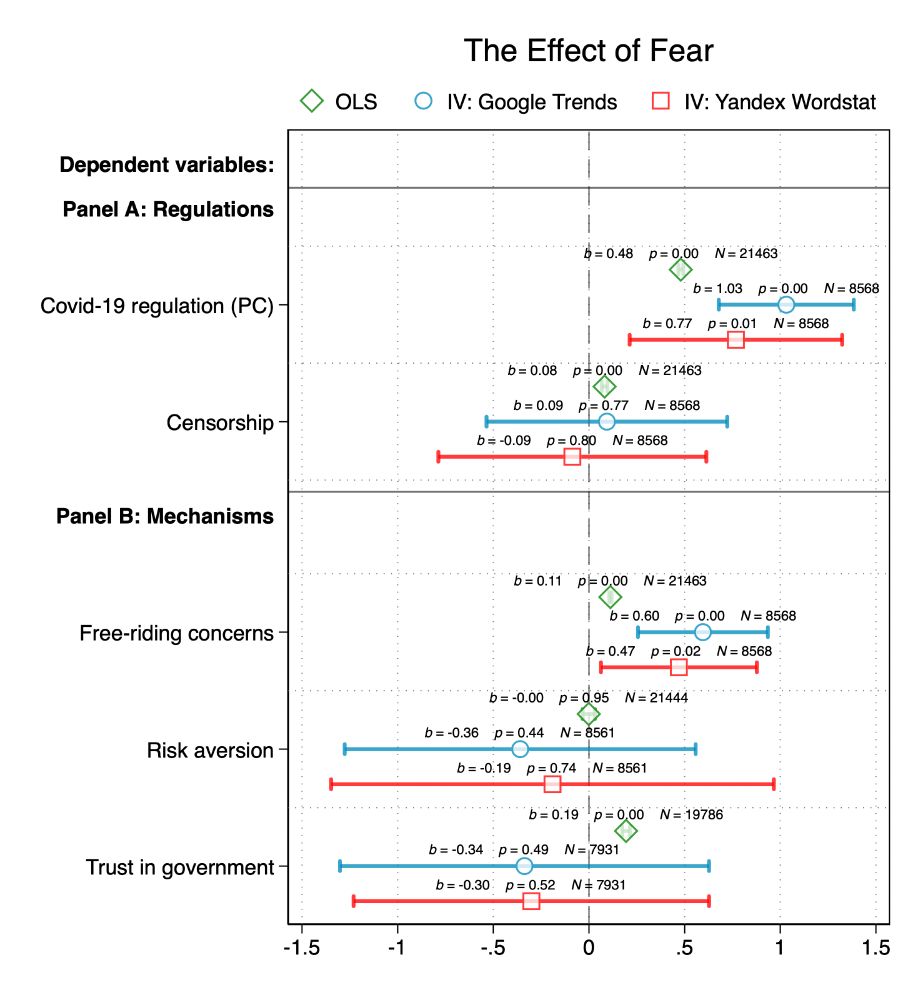
Instrumenting fear of getting infected with this shock, we find:
1. A positive effect of fear on demand for COVID-19 regulations and relief policies
2. Null effect on demand for regulations that were not related to the pandemic, like censorship or housing
(4/7)
1. A positive effect of fear on demand for COVID-19 regulations and relief policies
2. Null effect on demand for regulations that were not related to the pandemic, like censorship or housing
(4/7)
March 31, 2025 at 3:25 PM
Instrumenting fear of getting infected with this shock, we find:
1. A positive effect of fear on demand for COVID-19 regulations and relief policies
2. Null effect on demand for regulations that were not related to the pandemic, like censorship or housing
(4/7)
1. A positive effect of fear on demand for COVID-19 regulations and relief policies
2. Null effect on demand for regulations that were not related to the pandemic, like censorship or housing
(4/7)
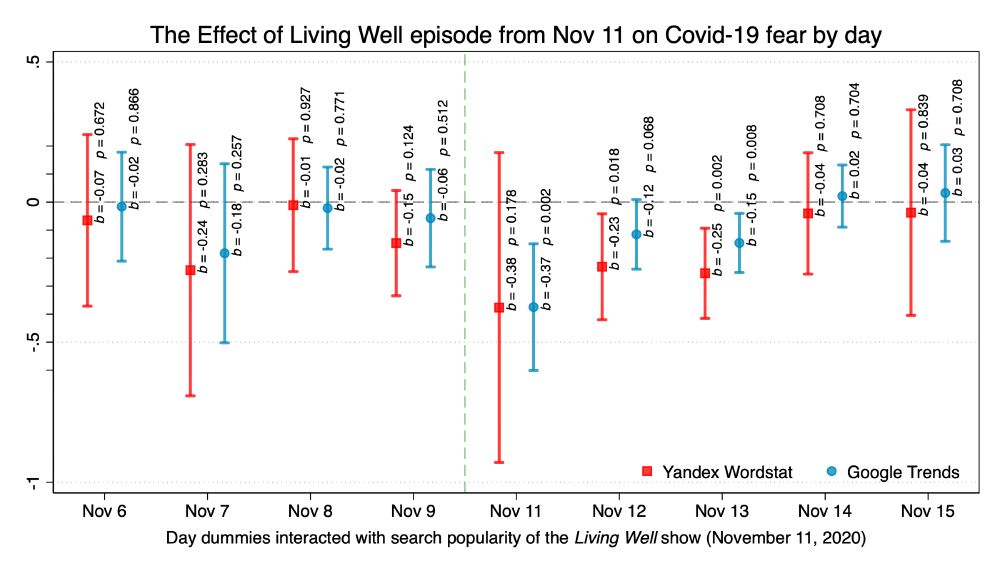
During our survey on COVID and political attitudes, a popular health TV show in Russia aired an episode saying that the probability of dying from the virus is lower than from being struck by lightning (literally). Using shift-share, we show that this episode decreased fear of the infection.
(3/7)
(3/7)
March 31, 2025 at 3:25 PM
During our survey on COVID and political attitudes, a popular health TV show in Russia aired an episode saying that the probability of dying from the virus is lower than from being struck by lightning (literally). Using shift-share, we show that this episode decreased fear of the infection.
(3/7)
(3/7)
Excited to be (finally) presenting my work @unibz.bsky.social – it's been long overdue; and cherry blossoms on the piazza Università are definitely a nice touch to already wonderful workshop


March 27, 2025 at 2:17 PM
Excited to be (finally) presenting my work @unibz.bsky.social – it's been long overdue; and cherry blossoms on the piazza Università are definitely a nice touch to already wonderful workshop