



Yi Zhang
@yizhang96.bsky.social
Social psychology PhD student @USC studying social cognition, moral psychology, and social networks 🧠☁️
yizhang96.github.io
yizhang96.github.io
Grateful for the support from my advisor
@leorhackel.bsky.social and the USC SLAC Lab.
Feedback, critiques, collab ideas welcome! 💬
📃Link to paper: authors.elsevier.com/a/1lq3x51f8w...
🔧Materials, code, & preregistrations:
osf.io/r52jv/
@leorhackel.bsky.social and the USC SLAC Lab.
Feedback, critiques, collab ideas welcome! 💬
📃Link to paper: authors.elsevier.com/a/1lq3x51f8w...
🔧Materials, code, & preregistrations:
osf.io/r52jv/
OSF | Sign in
osf.io
September 24, 2025 at 5:28 AM
Grateful for the support from my advisor
@leorhackel.bsky.social and the USC SLAC Lab.
Feedback, critiques, collab ideas welcome! 💬
📃Link to paper: authors.elsevier.com/a/1lq3x51f8w...
🔧Materials, code, & preregistrations:
osf.io/r52jv/
@leorhackel.bsky.social and the USC SLAC Lab.
Feedback, critiques, collab ideas welcome! 💬
📃Link to paper: authors.elsevier.com/a/1lq3x51f8w...
🔧Materials, code, & preregistrations:
osf.io/r52jv/
👉 Finally, in real-world student orgs, we saw similar patterns: positive interaction with one member led people to anticipate positivity from that person's friends.
Together, we show how knowledge of network ties support the generalization of relational value and partner choice.
Together, we show how knowledge of network ties support the generalization of relational value and partner choice.
September 24, 2025 at 5:28 AM
👉 Finally, in real-world student orgs, we saw similar patterns: positive interaction with one member led people to anticipate positivity from that person's friends.
Together, we show how knowledge of network ties support the generalization of relational value and partner choice.
Together, we show how knowledge of network ties support the generalization of relational value and partner choice.
👉 Importantly, we ruled out pure associative learning. Generalization only occurred when network ties reflected friendship, not arbitrary pairing.
This suggests people generalize based on inferences about meaningful social relationship-not just spreading value by co-occurrence.
This suggests people generalize based on inferences about meaningful social relationship-not just spreading value by co-occurrence.

September 24, 2025 at 5:28 AM
👉 Importantly, we ruled out pure associative learning. Generalization only occurred when network ties reflected friendship, not arbitrary pairing.
This suggests people generalize based on inferences about meaningful social relationship-not just spreading value by co-occurrence.
This suggests people generalize based on inferences about meaningful social relationship-not just spreading value by co-occurrence.
We found:
👉 People avoid those closer to a rejector & approach those closer to an accepter.
👉 This creates a gradient across network distance. (See plot 📊)
👉 People avoid those closer to a rejector & approach those closer to an accepter.
👉 This creates a gradient across network distance. (See plot 📊)

September 24, 2025 at 5:28 AM
We found:
👉 People avoid those closer to a rejector & approach those closer to an accepter.
👉 This creates a gradient across network distance. (See plot 📊)
👉 People avoid those closer to a rejector & approach those closer to an accepter.
👉 This creates a gradient across network distance. (See plot 📊)
Past work shows we generalize traits (e.g., trustworthiness) from one person to their friends.
But our question was different: can people also generalize *relational value*—how much others value us?
We tested this in two lab experiments and one longitudinal network study.
But our question was different: can people also generalize *relational value*—how much others value us?
We tested this in two lab experiments and one longitudinal network study.
September 24, 2025 at 5:28 AM
Past work shows we generalize traits (e.g., trustworthiness) from one person to their friends.
But our question was different: can people also generalize *relational value*—how much others value us?
We tested this in two lab experiments and one longitudinal network study.
But our question was different: can people also generalize *relational value*—how much others value us?
We tested this in two lab experiments and one longitudinal network study.
Huge thanks to my advisor @leorhackel.bsky.social and the USC Social Learning & Choice Lab. Excited to keep exploring empathy through a learning lens—feedback, critiques, collab ideas welcome! 💬
👉Materials, code, & preregistrations: osf.io/58wsu
👉Article: doi.org/10.1177/0956...
👉Materials, code, & preregistrations: osf.io/58wsu
👉Article: doi.org/10.1177/0956...
OSF
osf.io
July 30, 2025 at 12:35 AM
Huge thanks to my advisor @leorhackel.bsky.social and the USC Social Learning & Choice Lab. Excited to keep exploring empathy through a learning lens—feedback, critiques, collab ideas welcome! 💬
👉Materials, code, & preregistrations: osf.io/58wsu
👉Article: doi.org/10.1177/0956...
👉Materials, code, & preregistrations: osf.io/58wsu
👉Article: doi.org/10.1177/0956...
💡Empathy isn't just a motivated process driven by in-group love or out-group hate; it can also arise without explicit motives: Pavlovian learning links others' abstract mental states to reward, promoting congruent or incongruent feelings that generalize to new situations.
July 30, 2025 at 12:35 AM
💡Empathy isn't just a motivated process driven by in-group love or out-group hate; it can also arise without explicit motives: Pavlovian learning links others' abstract mental states to reward, promoting congruent or incongruent feelings that generalize to new situations.
✅We also observed classic PIT effects: participants worked harder to obtain reward when they saw the mental states of the target that had predicted monetary gain. This indicates they found the target's mental states intrinsically rewarding.

July 30, 2025 at 12:35 AM
✅We also observed classic PIT effects: participants worked harder to obtain reward when they saw the mental states of the target that had predicted monetary gain. This indicates they found the target's mental states intrinsically rewarding.
Result:
✅Congruent learning led to greater empathy: In novel contexts, people reported more empathy for the target if the target's happiness had been previously rewarding.
✅Congruent learning led to greater empathy: In novel contexts, people reported more empathy for the target if the target's happiness had been previously rewarding.

July 30, 2025 at 12:35 AM
Result:
✅Congruent learning led to greater empathy: In novel contexts, people reported more empathy for the target if the target's happiness had been previously rewarding.
✅Congruent learning led to greater empathy: In novel contexts, people reported more empathy for the target if the target's happiness had been previously rewarding.
In the test phase, participants reported empathy when viewing images depicting the character's emotions in novel situations.
In addition, participants completed a Pavlovian-Instrumental-Transfer (PIT) task, where they pressed keys to earn rewards while viewing those images.
In addition, participants completed a Pavlovian-Instrumental-Transfer (PIT) task, where they pressed keys to earn rewards while viewing those images.

July 30, 2025 at 12:35 AM
In the test phase, participants reported empathy when viewing images depicting the character's emotions in novel situations.
In addition, participants completed a Pavlovian-Instrumental-Transfer (PIT) task, where they pressed keys to earn rewards while viewing those images.
In addition, participants completed a Pavlovian-Instrumental-Transfer (PIT) task, where they pressed keys to earn rewards while viewing those images.
To test this, we conducted 4 preregistered online experiments (N = 1,500).
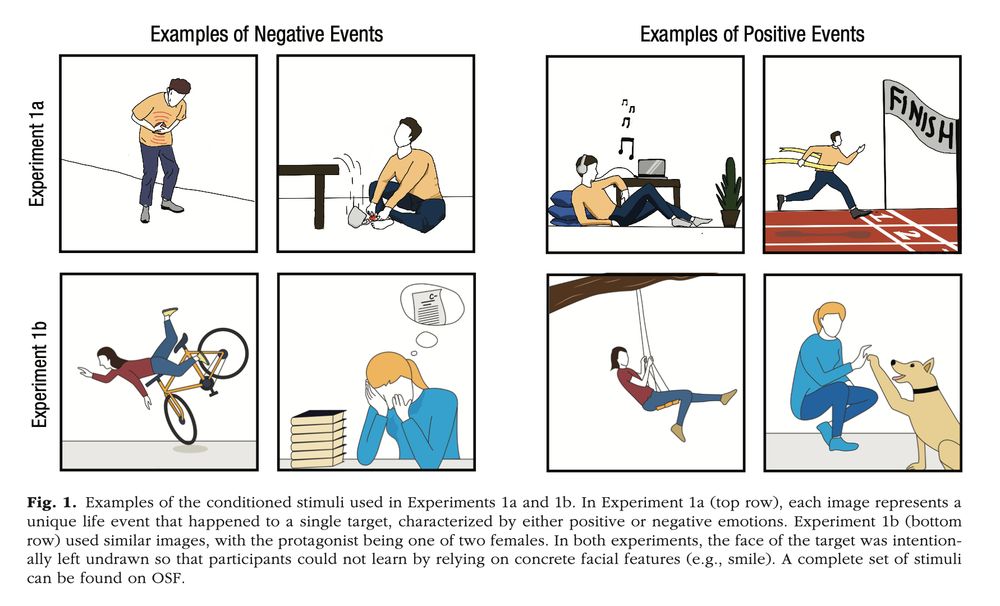
In the learning phase, participants saw images of a character feeling happy😁/ sad😞 predicting their own monetary gain or loss in either a congruent or incongruent manner.
In the learning phase, participants saw images of a character feeling happy😁/ sad😞 predicting their own monetary gain or loss in either a congruent or incongruent manner.
July 30, 2025 at 12:35 AM
To test this, we conducted 4 preregistered online experiments (N = 1,500).
In the learning phase, participants saw images of a character feeling happy😁/ sad😞 predicting their own monetary gain or loss in either a congruent or incongruent manner.
In the learning phase, participants saw images of a character feeling happy😁/ sad😞 predicting their own monetary gain or loss in either a congruent or incongruent manner.
How do we come to empathize with others' welfare-feeling happy when others thrive?
Here, we show that via Pavlovian learning, people can link another person's *abstract mental states*—e.g. "feeling happy/sad"—with reward, which in turn shapes empathy for them in new situations.
Here, we show that via Pavlovian learning, people can link another person's *abstract mental states*—e.g. "feeling happy/sad"—with reward, which in turn shapes empathy for them in new situations.
July 30, 2025 at 12:35 AM
How do we come to empathize with others' welfare-feeling happy when others thrive?
Here, we show that via Pavlovian learning, people can link another person's *abstract mental states*—e.g. "feeling happy/sad"—with reward, which in turn shapes empathy for them in new situations.
Here, we show that via Pavlovian learning, people can link another person's *abstract mental states*—e.g. "feeling happy/sad"—with reward, which in turn shapes empathy for them in new situations.