


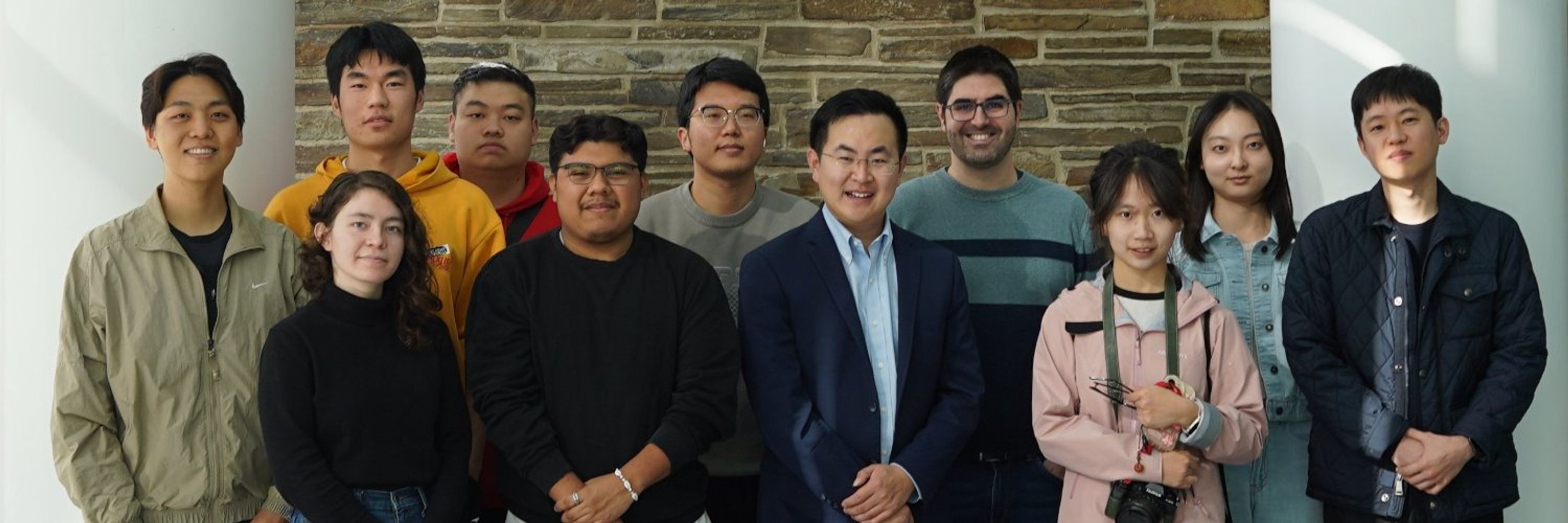

Yang Group @ Cornell
@yaoyang-cornell.bsky.social
Student run account for the Yao Yang group at Cornell Chemistry; We develop operando methods to probe electrochemical dynamics at energy material interfaces
We had fun these past few days at the 2025 MRS Fall Meeting! Prof. Yao Yang, Dr. Sungin Kim, Zora, and Wenqi gave talks, and we had many insightful conversations throughout the conference. Definitely a great learning experience. Huge congrats to everyone who presented! 👏🥳


December 8, 2025 at 6:32 AM
We had fun these past few days at the 2025 MRS Fall Meeting! Prof. Yao Yang, Dr. Sungin Kim, Zora, and Wenqi gave talks, and we had many insightful conversations throughout the conference. Definitely a great learning experience. Huge congrats to everyone who presented! 👏🥳
Our group is attending the Materials Research Society (MRS) Fall Meeting in Boston! 🏙️ Please check below the time and place for our oral presentations. We are looking forward to seeing you there!

November 30, 2025 at 2:22 PM
Our group is attending the Materials Research Society (MRS) Fall Meeting in Boston! 🏙️ Please check below the time and place for our oral presentations. We are looking forward to seeing you there!
Welcome our new PhD students Jingzhi Hu, Haichuan Zhang and Adam Silvernail! Their research will include single crystals electrochemistry, STEM, operando EC-TEM and DFT calculations applied to energy materials and CO2 reduction reaction. You can check our updated group photos!🍁


November 25, 2025 at 4:01 PM
Welcome our new PhD students Jingzhi Hu, Haichuan Zhang and Adam Silvernail! Their research will include single crystals electrochemistry, STEM, operando EC-TEM and DFT calculations applied to energy materials and CO2 reduction reaction. You can check our updated group photos!🍁
Big congrats to Ritwick Sinha, visiting PhD student, for the award of the Cornell Engineering OIE Graduate Mentorship Fellow! 🎉 Congratulations also to Sean McInnis, senior undergraduate, for winning the OIE Aizen Climate Research Scholars Fund! 👏🏻


October 11, 2025 at 1:21 PM
Big congrats to Ritwick Sinha, visiting PhD student, for the award of the Cornell Engineering OIE Graduate Mentorship Fellow! 🎉 Congratulations also to Sean McInnis, senior undergraduate, for winning the OIE Aizen Climate Research Scholars Fund! 👏🏻
Our new @jacs.acspublications.org paper is out! We demonstrate the formation of active Cu nanograins from single-atom catalysts under CO2 reduction conditions by different experimental techniques, including operando XAS and EC-TEM. @runofthephill.bsky.social
Click📰:
pubs.acs.org/doi/10.1021/...
Click📰:
pubs.acs.org/doi/10.1021/...

Dynamic Evolution from Single-Atom Catalysts to Active Nanograins for CO2 Reduction
Understanding dynamic catalyst evolution, particularly Cu-based single-atom catalysts, faces tremendous challenges of tracking rapid and nanoscale evolution and uncontrolled catalyst reoxidation durin...
pubs.acs.org
October 4, 2025 at 8:13 PM
Our new @jacs.acspublications.org paper is out! We demonstrate the formation of active Cu nanograins from single-atom catalysts under CO2 reduction conditions by different experimental techniques, including operando XAS and EC-TEM. @runofthephill.bsky.social
Click📰:
pubs.acs.org/doi/10.1021/...
Click📰:
pubs.acs.org/doi/10.1021/...
@luolab-utah.bsky.social Thank you for this great collaboration! Ellis, Sungin and Wenqi used 4D-STEM to probe the catalyst degradation mechanism 🔬
Check out our new @jacs.acspublications.org paper on #Electrosynthesis of Agrochemicals via #AC-Driven Selective, Continuous Dehalogenation @utahchemistry.bsky.social ! Great
@nsf-csoe.bsky.social Teamwork and collaboration with @yaoyang-cornell.bsky.social and PNNL!
pubs.acs.org/doi/full/10....
@nsf-csoe.bsky.social Teamwork and collaboration with @yaoyang-cornell.bsky.social and PNNL!
pubs.acs.org/doi/full/10....

Electrosynthesis of Agrochemicals via Alternating-Current-Driven Selective, Continuous Dehalogenation
Dehalogenation is a critical transformation in chemical synthesis but remains limited by catalyst deactivation and low selectivity in industrial processes. Here, we report an alternating current (AC) ...
pubs.acs.org
September 30, 2025 at 3:39 PM
@luolab-utah.bsky.social Thank you for this great collaboration! Ellis, Sungin and Wenqi used 4D-STEM to probe the catalyst degradation mechanism 🔬
Reposted by Yang Group @ Cornell

Check out our new @jacs.acspublications.org paper on #Electrosynthesis of Agrochemicals via #AC-Driven Selective, Continuous Dehalogenation @utahchemistry.bsky.social ! Great
@nsf-csoe.bsky.social Teamwork and collaboration with @yaoyang-cornell.bsky.social and PNNL!
pubs.acs.org/doi/full/10....
@nsf-csoe.bsky.social Teamwork and collaboration with @yaoyang-cornell.bsky.social and PNNL!
pubs.acs.org/doi/full/10....
Electrosynthesis of Agrochemicals via Alternating-Current-Driven Selective, Continuous Dehalogenation
Dehalogenation is a critical transformation in chemical synthesis but remains limited by catalyst deactivation and low selectivity in industrial processes. Here, we report an alternating current (AC) ...
pubs.acs.org
September 30, 2025 at 3:20 PM
Check out our new @jacs.acspublications.org paper on #Electrosynthesis of Agrochemicals via #AC-Driven Selective, Continuous Dehalogenation @utahchemistry.bsky.social ! Great
@nsf-csoe.bsky.social Teamwork and collaboration with @yaoyang-cornell.bsky.social and PNNL!
pubs.acs.org/doi/full/10....
@nsf-csoe.bsky.social Teamwork and collaboration with @yaoyang-cornell.bsky.social and PNNL!
pubs.acs.org/doi/full/10....
Our paper “The (mis)uses of Tafel slope” is now out in Nature Catalysis @natcatal.nature.com ! We hope it will serve as useful tutorial for applying reliably the Tafel slope kinetic analysis in electrocatalysis research.
www.nature.com/articles/s41...
www.nature.com/articles/s41...

The (mis)uses of Tafel slope - Nature Catalysis
Tafel slope analysis, first proposed by Julius Tafel in 1905 and supported by the Butler–Volmer equation, is widely used to elucidate electrocatalytic mechanisms and evaluate kinetics. However, some misuses still frequently occur in the literature, calling for rigorous mechanistic investigations at single-crystal electrodes and under well defined mass-transport conditions.
www.nature.com
September 25, 2025 at 3:49 AM
Our paper “The (mis)uses of Tafel slope” is now out in Nature Catalysis @natcatal.nature.com ! We hope it will serve as useful tutorial for applying reliably the Tafel slope kinetic analysis in electrocatalysis research.
www.nature.com/articles/s41...
www.nature.com/articles/s41...
Kicking off the semester with a nice BBQ and hiking at the Robert H. Treman State Park!🏞️ Welcome our new postdoc, Dr. Ellis Rae Kennedy (Schmidt AI Fellow), who will work on (S)TEM methods combined with big data analysis🔬 in our group. Stay tuned for new exciting research!⚡️


September 16, 2025 at 11:46 PM
Kicking off the semester with a nice BBQ and hiking at the Robert H. Treman State Park!🏞️ Welcome our new postdoc, Dr. Ellis Rae Kennedy (Schmidt AI Fellow), who will work on (S)TEM methods combined with big data analysis🔬 in our group. Stay tuned for new exciting research!⚡️
Our group is attending ACS Fall 2025!🧪 Please find next the schedule of our presentations. Looking forward to seeing you there! 🤝

August 17, 2025 at 12:15 AM
Our group is attending ACS Fall 2025!🧪 Please find next the schedule of our presentations. Looking forward to seeing you there! 🤝
Our work on operando electrochemical transmission electron microscopy appears on the JACS @jacs.acspublications.org cover for July 2025! The art depicts the different growth of copper depending on the temperature as studied by the operando TEM technique. Check it out!
pubs.acs.org/toc/jacsat/1...
pubs.acs.org/toc/jacsat/1...

July 14, 2025 at 12:57 PM
Our work on operando electrochemical transmission electron microscopy appears on the JACS @jacs.acspublications.org cover for July 2025! The art depicts the different growth of copper depending on the temperature as studied by the operando TEM technique. Check it out!
pubs.acs.org/toc/jacsat/1...
pubs.acs.org/toc/jacsat/1...
Summer arrived in Ithaca! 🌞 The group recently enjoyed a wonderful hike at the nearby Watkins Glen State Park with its beautiful waterfalls 🌄 We also had some fun during a great music concert at Treleaven 🎶 Cornell surroundings are plenty of possibilities this time of the year!


July 1, 2025 at 9:32 PM
Summer arrived in Ithaca! 🌞 The group recently enjoyed a wonderful hike at the nearby Watkins Glen State Park with its beautiful waterfalls 🌄 We also had some fun during a great music concert at Treleaven 🎶 Cornell surroundings are plenty of possibilities this time of the year!
Reposted by Yang Group @ Cornell
Hello BlueSky 🦋 I'm the Director of Graduate Studies in Cornell Chemistry. We're hiring a new Graduate Field Coordinator to help support our graduate program. Please apply or repost if you know someone great! tinyurl.com/3znxx4bh

Graduate Field Coordinator-Department of Chemistry and Chemical Biology
Graduate Field Coordinator-Department of Chemistry and Chemical Biology The Opportunity The Department of Chemistry and Chemical Biology is seeking a dedicated and detail-oriented Graduate Field Coord...
cornell.wd1.myworkdayjobs.com
June 10, 2025 at 11:42 PM
Hello BlueSky 🦋 I'm the Director of Graduate Studies in Cornell Chemistry. We're hiring a new Graduate Field Coordinator to help support our graduate program. Please apply or repost if you know someone great! tinyurl.com/3znxx4bh
Reposted by Yang Group @ Cornell
Happy to see our first collaboration with the Yang group come through!
Who wants to study chemistry like watching movies? Operando electrochemical STEM offers a new opportunity! In our group's first publication, we probe the evolution of energy materials in real time at extreme temperatures🌡️
pubs.acs.org/doi/10.1021/...
@erikhthiede.bsky.social
pubs.acs.org/doi/10.1021/...
@erikhthiede.bsky.social

Operando Heating and Cooling Electrochemical 4D-STEM Probing Nanoscale Dynamics at Solid–Liquid Interfaces
Operando/in situ methods have revolutionized our fundamental understanding of molecular and structural changes at solid–liquid interfaces and enabled the vision of “watching chemistry in action”. Operando transmission electron microscopy (TEM) emerges as a powerful tool to interrogate time-resolved nanoscale dynamics, which involve local electrical fields and charge transfer kinetics distinctly different from those of their bulk counterparts. Despite early reports on electrochemical or heating liquid-cell TEM, developing operando TEM with simultaneous electrochemical and thermal control remains a formidable challenge. Here, we developed operando heating and cooling electrochemical liquid-cell scanning TEM (EC-STEM). By integrating a three-electrode electrochemical circuit and an additional two-electrode thermal circuit, we can investigate heterogeneous electrochemical kinetics across a wide temperature range of −50 to 300 °C. We used Cu electrodeposition/stripping processes as a model system to demonstrate quantitative electrochemistry from −40 to 95 °C in both transient and steady states in aqueous and organic solutions, which paves the way for investigating energy materials operating in extreme climates. Machine learning-assisted quantitative 4D-STEM structural analysis in cold liquids (−40 °C) reveals a distinct two-stage growth of nanometer-scale mossy Cu nanoislands with random orientations followed by μm-scale Cu dendrites with preferential orientations. This work benchmarked electrochemistry in the three-electrode EC-STEM and systematically investigated the temperature and pH dependence of the Pt pseudoreference electrode (RE). At room temperature, the Pt pseudo-RE shows a reliable potential of 0.8 ± 0.1 V vs the standard hydrogen electrode and remains pH-independent on the reversible hydrogen electrode scale. We anticipate that operando heating/cooling EC-STEM will become invaluable for understanding fundamental temperature-controlled nanoscale electrochemistry and advancing renewable energy technologies (e.g., catalysts and batteries) in realistic climates.
pubs.acs.org
May 26, 2025 at 2:50 PM
Happy to see our first collaboration with the Yang group come through!
Who wants to study chemistry like watching movies? Operando electrochemical STEM offers a new opportunity! In our group's first publication, we probe the evolution of energy materials in real time at extreme temperatures🌡️
pubs.acs.org/doi/10.1021/...
@erikhthiede.bsky.social
pubs.acs.org/doi/10.1021/...
@erikhthiede.bsky.social
Operando Heating and Cooling Electrochemical 4D-STEM Probing Nanoscale Dynamics at Solid–Liquid Interfaces
Operando/in situ methods have revolutionized our fundamental understanding of molecular and structural changes at solid–liquid interfaces and enabled the vision of “watching chemistry in action”. Operando transmission electron microscopy (TEM) emerges as a powerful tool to interrogate time-resolved nanoscale dynamics, which involve local electrical fields and charge transfer kinetics distinctly different from those of their bulk counterparts. Despite early reports on electrochemical or heating liquid-cell TEM, developing operando TEM with simultaneous electrochemical and thermal control remains a formidable challenge. Here, we developed operando heating and cooling electrochemical liquid-cell scanning TEM (EC-STEM). By integrating a three-electrode electrochemical circuit and an additional two-electrode thermal circuit, we can investigate heterogeneous electrochemical kinetics across a wide temperature range of −50 to 300 °C. We used Cu electrodeposition/stripping processes as a model system to demonstrate quantitative electrochemistry from −40 to 95 °C in both transient and steady states in aqueous and organic solutions, which paves the way for investigating energy materials operating in extreme climates. Machine learning-assisted quantitative 4D-STEM structural analysis in cold liquids (−40 °C) reveals a distinct two-stage growth of nanometer-scale mossy Cu nanoislands with random orientations followed by μm-scale Cu dendrites with preferential orientations. This work benchmarked electrochemistry in the three-electrode EC-STEM and systematically investigated the temperature and pH dependence of the Pt pseudoreference electrode (RE). At room temperature, the Pt pseudo-RE shows a reliable potential of 0.8 ± 0.1 V vs the standard hydrogen electrode and remains pH-independent on the reversible hydrogen electrode scale. We anticipate that operando heating/cooling EC-STEM will become invaluable for understanding fundamental temperature-controlled nanoscale electrochemistry and advancing renewable energy technologies (e.g., catalysts and batteries) in realistic climates.
pubs.acs.org
May 26, 2025 at 12:19 PM
Who wants to study chemistry like watching movies? Operando electrochemical STEM offers a new opportunity! In our group's first publication, we probe the evolution of energy materials in real time at extreme temperatures🌡️
pubs.acs.org/doi/10.1021/...
@erikhthiede.bsky.social
pubs.acs.org/doi/10.1021/...
@erikhthiede.bsky.social