




Water Chem @ UMass Amherst
@waterchem.bsky.social
Graduate students at UMass Amherst exploring the science of water chemistry. From water quality and sustainability to the latest research, join us as we dive into the complexities of water and its vital role in our world.
These anodes are readily available and used in pipelines, water heaters, boat hulls, or really any important metal devices used in water. You can take advantage of this chemistry trick for use with tools, bikes, or any metal you want to keep from rusting. Learn more about the Chemistry below! (3/3)

Sacrificial Anode
Sacrificial Anodes are highly active metals that are used to prevent a less active material surface from corroding. Sacrificial Anodes are created from a metal alloy with a more negative …
chem.libretexts.org
May 9, 2025 at 5:38 PM
These anodes are readily available and used in pipelines, water heaters, boat hulls, or really any important metal devices used in water. You can take advantage of this chemistry trick for use with tools, bikes, or any metal you want to keep from rusting. Learn more about the Chemistry below! (3/3)
These anodes are made from metals like zinc, magnesium, or aluminum that oxidize more readily than iron or steel. When attached to a structure, they give up electrons, keeping the protected metal in a reduced (non-corroded) state while they slowly corrode instead. (2/3)
May 9, 2025 at 5:37 PM
These anodes are made from metals like zinc, magnesium, or aluminum that oxidize more readily than iron or steel. When attached to a structure, they give up electrons, keeping the protected metal in a reduced (non-corroded) state while they slowly corrode instead. (2/3)

The vibrant colors associated with hydrothermal parks are linked to the presence of cyanobacteria and other organisms that form microbial mats. These organisms thrive in the warm, mineral rich water of hot springs. The water may appear bright blue due to a high concentration of silica. (4/5)
May 7, 2025 at 3:59 PM
The vibrant colors associated with hydrothermal parks are linked to the presence of cyanobacteria and other organisms that form microbial mats. These organisms thrive in the warm, mineral rich water of hot springs. The water may appear bright blue due to a high concentration of silica. (4/5)
When this water moves to the surface, it can form precipitates, such as siliceous sinter (geyserite). If the energy released during the water to steam transition exceeds the confining force of the subsurface, an explosion will occur (eg. a geyser). (3/5)
May 7, 2025 at 3:58 PM
When this water moves to the surface, it can form precipitates, such as siliceous sinter (geyserite). If the energy released during the water to steam transition exceeds the confining force of the subsurface, an explosion will occur (eg. a geyser). (3/5)
The waters of these regions are a mix of meteoric water (rain and snow) as well as hydrothermal fluids and gases The composition is affected by fluid-rock interactions, phase-separation, mineral precipitation, and microbial activity. (2/5)
May 7, 2025 at 3:58 PM
The waters of these regions are a mix of meteoric water (rain and snow) as well as hydrothermal fluids and gases The composition is affected by fluid-rock interactions, phase-separation, mineral precipitation, and microbial activity. (2/5)
Image Source: www.ysi.com/parameters/o...
ORP Oxidation Reduction Potential or Redox Measurement in Water Explained
Oxidation-reduction potential (ORP) is a measurement that determines water’s oxidizing or reducing potential, quantifying a solution’s electron transfer capacity. ORP is valuable for assessing the pre...
www.ysi.com
May 6, 2025 at 4:39 PM
Image Source: www.ysi.com/parameters/o...
Much like other parameters like temperature, pH and turbidity, ORP is an important parameter used in water quality analysis to determine the health of a water system. (4/4)
May 6, 2025 at 4:38 PM
Much like other parameters like temperature, pH and turbidity, ORP is an important parameter used in water quality analysis to determine the health of a water system. (4/4)
Larger values are typically seen as favorable, as they indicate a well-aerated system, whereas lower values can be problematic, possibly indicating pollution or eutrophication within the waters being measured. (3/4)
May 6, 2025 at 4:38 PM
Larger values are typically seen as favorable, as they indicate a well-aerated system, whereas lower values can be problematic, possibly indicating pollution or eutrophication within the waters being measured. (3/4)
ORP is typically measured in millivolts (mV) using a specialized probe. A negative ORP shows that there are more electrons available to be transferred, showing a higher potential for oxidation. Conversely, a positive ORP shows a higher potential for reduction. (2/4)
May 6, 2025 at 4:38 PM
ORP is typically measured in millivolts (mV) using a specialized probe. A negative ORP shows that there are more electrons available to be transferred, showing a higher potential for oxidation. Conversely, a positive ORP shows a higher potential for reduction. (2/4)
Result: 35% increase in degradation kinetics for pollutants like BPS vs. traditional methods. Optimal at pH 7, deviation reduces efficacy. EPR confirms ROS dynamics. Applicable to surface/groundwater remediation.
April 30, 2025 at 12:38 PM
Result: 35% increase in degradation kinetics for pollutants like BPS vs. traditional methods. Optimal at pH 7, deviation reduces efficacy. EPR confirms ROS dynamics. Applicable to surface/groundwater remediation.
Synergistic Oxidation-Coagulation Mechanism: Fe²⁺-oxalate activated by MNB-enhanced O₂ generates radicals (·OH/O₂⁻) for oxidative degradation (78%). Concurrently, Fe³⁺ hydrolysis forms hydroxide complexes, enabling coagulation (22%).
April 30, 2025 at 12:37 PM
Synergistic Oxidation-Coagulation Mechanism: Fe²⁺-oxalate activated by MNB-enhanced O₂ generates radicals (·OH/O₂⁻) for oxidative degradation (78%). Concurrently, Fe³⁺ hydrolysis forms hydroxide complexes, enabling coagulation (22%).
Reference: www.mdpi.com/2073-4441/16...
www.mdpi.com
April 29, 2025 at 11:49 PM
Reference: www.mdpi.com/2073-4441/16...
Carbon’s Role: Fueling Microbial Cleanup Crews
Roots secrete glucose (C₆H₁₂O₆), heterotrophs need C:N ≥5 for ΔG < -50 kJ/mol.
Low carbon → Denitrifying microbes can’t efficiently convert NO₂⁻ → N₂ , NO₂⁻ accumulates. >90% N removal in summer and 55% in winter!
Roots secrete glucose (C₆H₁₂O₆), heterotrophs need C:N ≥5 for ΔG < -50 kJ/mol.
Low carbon → Denitrifying microbes can’t efficiently convert NO₂⁻ → N₂ , NO₂⁻ accumulates. >90% N removal in summer and 55% in winter!
April 29, 2025 at 11:39 PM
Carbon’s Role: Fueling Microbial Cleanup Crews
Roots secrete glucose (C₆H₁₂O₆), heterotrophs need C:N ≥5 for ΔG < -50 kJ/mol.
Low carbon → Denitrifying microbes can’t efficiently convert NO₂⁻ → N₂ , NO₂⁻ accumulates. >90% N removal in summer and 55% in winter!
Roots secrete glucose (C₆H₁₂O₆), heterotrophs need C:N ≥5 for ΔG < -50 kJ/mol.
Low carbon → Denitrifying microbes can’t efficiently convert NO₂⁻ → N₂ , NO₂⁻ accumulates. >90% N removal in summer and 55% in winter!
pH Balance & Metal Trapping in Wetlands:
Low pH dissolves metals (e.g., Pb) into H₂O! Wetland plants buffer pH via ROL, stabilizing metals as solids.
Pb²⁺ + 2OH⁻ → Pb(OH)₂ ↓
Low pH dissolves metals (e.g., Pb) into H₂O! Wetland plants buffer pH via ROL, stabilizing metals as solids.
Pb²⁺ + 2OH⁻ → Pb(OH)₂ ↓
April 29, 2025 at 11:38 PM
pH Balance & Metal Trapping in Wetlands:
Low pH dissolves metals (e.g., Pb) into H₂O! Wetland plants buffer pH via ROL, stabilizing metals as solids.
Pb²⁺ + 2OH⁻ → Pb(OH)₂ ↓
Low pH dissolves metals (e.g., Pb) into H₂O! Wetland plants buffer pH via ROL, stabilizing metals as solids.
Pb²⁺ + 2OH⁻ → Pb(OH)₂ ↓
Hard water is not inherently bad; it can reduce pipe corrosion, be an important source of dietary minerals, and even have better taste. But overly hard water can cause too much limescale buildup, and reduce the water pressure and useful life of hot water heaters and other plumbing features. (5/5)
Corrosivity - MSU Extension Water Quality | Montana State University
An informational resource page on corrosivity of drinking water.
waterquality.montana.edu
April 27, 2025 at 7:15 PM
Hard water is not inherently bad; it can reduce pipe corrosion, be an important source of dietary minerals, and even have better taste. But overly hard water can cause too much limescale buildup, and reduce the water pressure and useful life of hot water heaters and other plumbing features. (5/5)
Water hardness is related to the concentration of not only dissolved calcium, but also magnesium and other trace amounts of metals, and therefore also describes the potential for limescale to develop. (4/5)
April 27, 2025 at 7:14 PM
Water hardness is related to the concentration of not only dissolved calcium, but also magnesium and other trace amounts of metals, and therefore also describes the potential for limescale to develop. (4/5)
CaCO3 acts as a base in water, where the CO32- anion reacts with free H+ cations, reducing their concentration. The presence of limescale on plumbing fixtures thus works doubly to raise pH and reduce corrosivity by creating a barrier on the metal surface. (3/5)
April 27, 2025 at 7:14 PM
CaCO3 acts as a base in water, where the CO32- anion reacts with free H+ cations, reducing their concentration. The presence of limescale on plumbing fixtures thus works doubly to raise pH and reduce corrosivity by creating a barrier on the metal surface. (3/5)
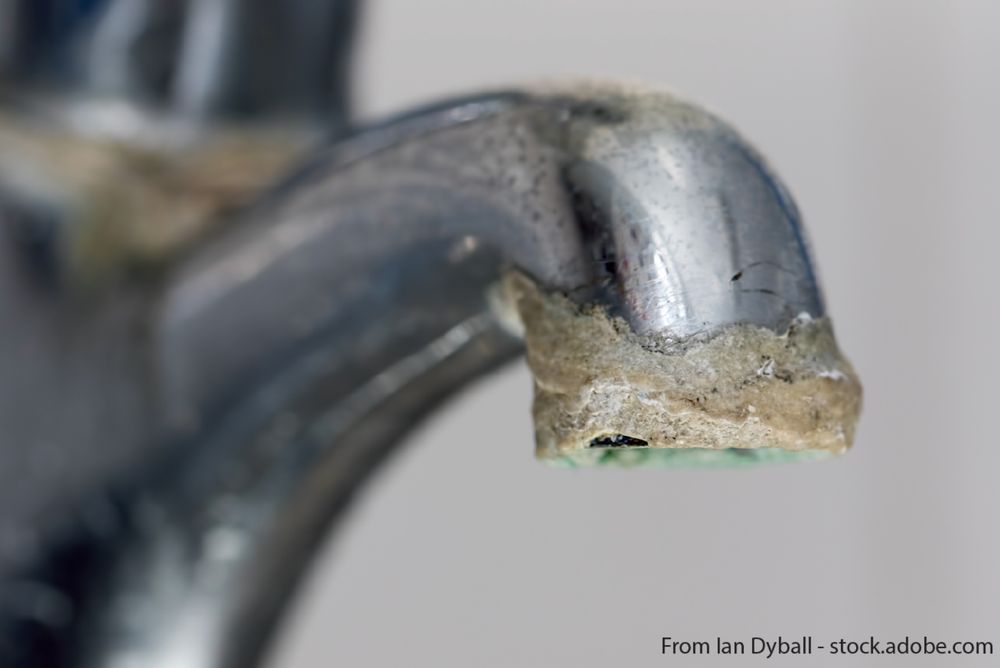
A lower Langelier Index value indicates the water is undersaturated with CaCO3 and has higher corrosion potential. A higher index value indicates oversaturation, and CaCO3 can precipitate on plumbing through what is called lime scaling, a chalk-like substance often found on faucets (2/5).
April 27, 2025 at 7:14 PM
A lower Langelier Index value indicates the water is undersaturated with CaCO3 and has higher corrosion potential. A higher index value indicates oversaturation, and CaCO3 can precipitate on plumbing through what is called lime scaling, a chalk-like substance often found on faucets (2/5).