



Valeria Guinder
@valeriaguinder.bsky.social
🌊Marine biologist.🌊Head of the Microbial Plankton Lab 🔬 at the Instituto Argentino de Oceanografía (IADO), CONICET. Interested in protist biodiversity and phytoplankton blooms in the Southwestern Atlantic Ocean, Patagonian continental Shelf.
Pinned

Extraordinary bloom of toxin-producing phytoplankton enhanced by strong retention on the offshore Patagonian shelf
Abstract. The extensive Patagonian continental shelf in the Atlantic Ocean is renowned for its high productivity associated with nutrient-rich waters that fertilize massive phytoplankton blooms, espec...
bg.copernicus.org
Happy to share our last work!!
🌊🔬A survey with two vessels in the Argentine Sea caught a massive toxic phytoplankton bloom retained for 10 days in a mesoscale eddy. Interdisciplinary approaches shed light on the biophysical coupling behind its development.🌊⛵⛵
bg.copernicus.org/articles/22/...
🌊🔬A survey with two vessels in the Argentine Sea caught a massive toxic phytoplankton bloom retained for 10 days in a mesoscale eddy. Interdisciplinary approaches shed light on the biophysical coupling behind its development.🌊⛵⛵
bg.copernicus.org/articles/22/...
¡Increíble campaña multidisciplinaria explorando la alta productividad del margen continental del Mar Argentino! 🇦🇷🌊
Con el apoyo de @schmidtocean.bsky.social y CONICET.
📷 Fotos: Bernarda Cornejo Pintos SOI)
#EcosDe2Cañones
Con el apoyo de @schmidtocean.bsky.social y CONICET.
📷 Fotos: Bernarda Cornejo Pintos SOI)
#EcosDe2Cañones


November 3, 2025 at 2:38 PM
¡Increíble campaña multidisciplinaria explorando la alta productividad del margen continental del Mar Argentino! 🇦🇷🌊
Con el apoyo de @schmidtocean.bsky.social y CONICET.
📷 Fotos: Bernarda Cornejo Pintos SOI)
#EcosDe2Cañones
Con el apoyo de @schmidtocean.bsky.social y CONICET.
📷 Fotos: Bernarda Cornejo Pintos SOI)
#EcosDe2Cañones
🌊En “The southern gap in ocean microbiome science” destacamos la gran brecha geográfica en la investigación del microbioma oceánico.
Desde el sur, aportamos nuestra voz para promover colaboraciones más equitativas, fortalecer redes y construir una ciencia oceánica verdaderamente inclusiva 🌊
Desde el sur, aportamos nuestra voz para promover colaboraciones más equitativas, fortalecer redes y construir una ciencia oceánica verdaderamente inclusiva 🌊

The southern gap in ocean microbiome science - Ocean Microbiology
The ocean microbiome is at the forefront of science, and although most of the global ocean lies in the southern hemisphere, research efforts have historically been concentrated in the northern hemisph...
omjournal.biomedcentral.com
November 3, 2025 at 2:11 PM
🌊En “The southern gap in ocean microbiome science” destacamos la gran brecha geográfica en la investigación del microbioma oceánico.
Desde el sur, aportamos nuestra voz para promover colaboraciones más equitativas, fortalecer redes y construir una ciencia oceánica verdaderamente inclusiva 🌊
Desde el sur, aportamos nuestra voz para promover colaboraciones más equitativas, fortalecer redes y construir una ciencia oceánica verdaderamente inclusiva 🌊
Reposted by Valeria Guinder

The #Ecosde2Cañones team collected oceanographic data to better understand how the shape of the seafloor & powerful currents influence productivity in Argentina; they will return home w/new questions & the memory of seeing life pulsing through these canyons.
youtu.be/LLTMc704rVA?...
youtu.be/LLTMc704rVA?...

Complexity in Nature | A Tale of Two Canyons
YouTube video by Schmidt Ocean
youtu.be
October 29, 2025 at 8:38 PM
The #Ecosde2Cañones team collected oceanographic data to better understand how the shape of the seafloor & powerful currents influence productivity in Argentina; they will return home w/new questions & the memory of seeing life pulsing through these canyons.
youtu.be/LLTMc704rVA?...
youtu.be/LLTMc704rVA?...
Reposted by Valeria Guinder
...like water or glass that turns into anything,
into smoke, into a spiral,
into a building, a fish, a stone, a rose.
I am different from me, so different...
“Song” by Poet Silvina Ocampo, transl. by Jason Weiss; full poem: granta.com/song/
#Ecosde2CañonesSouth, American sea nettle, 324m
into smoke, into a spiral,
into a building, a fish, a stone, a rose.
I am different from me, so different...
“Song” by Poet Silvina Ocampo, transl. by Jason Weiss; full poem: granta.com/song/
#Ecosde2CañonesSouth, American sea nettle, 324m
October 23, 2025 at 8:24 PM
...like water or glass that turns into anything,
into smoke, into a spiral,
into a building, a fish, a stone, a rose.
I am different from me, so different...
“Song” by Poet Silvina Ocampo, transl. by Jason Weiss; full poem: granta.com/song/
#Ecosde2CañonesSouth, American sea nettle, 324m
into smoke, into a spiral,
into a building, a fish, a stone, a rose.
I am different from me, so different...
“Song” by Poet Silvina Ocampo, transl. by Jason Weiss; full poem: granta.com/song/
#Ecosde2CañonesSouth, American sea nettle, 324m
Reposted by Valeria Guinder
The #Ecosde2Cañones team is studying the intricate interplay of ocean features such as currents, wind, circulation, density, temperature, and salinity as they examine the exchange of energy between the atmosphere, the Ocean, and the Earth.
youtu.be/pf8cIYFeYJM?...
youtu.be/pf8cIYFeYJM?...

Studying the Invisible | A Tale of Two Canyons
YouTube video by Schmidt Ocean
youtu.be
October 21, 2025 at 5:07 PM
The #Ecosde2Cañones team is studying the intricate interplay of ocean features such as currents, wind, circulation, density, temperature, and salinity as they examine the exchange of energy between the atmosphere, the Ocean, and the Earth.
youtu.be/pf8cIYFeYJM?...
youtu.be/pf8cIYFeYJM?...
Fitoplancton: el bosque invisible que respira el océano 😍🌊
Estudiar los microorganismos del plancton 🔬 implica no sólo identificar sus increíbles formas, tamaños y comportamiento, sino también comprender sus pulsos de productividad 🦀🦐🐳🐠 regulados por la mezcla vertical y las corrientes oceánicas🌊🌊🚢
Estudiar los microorganismos del plancton 🔬 implica no sólo identificar sus increíbles formas, tamaños y comportamiento, sino también comprender sus pulsos de productividad 🦀🦐🐳🐠 regulados por la mezcla vertical y las corrientes oceánicas🌊🌊🚢


September 8, 2025 at 5:05 PM
Fitoplancton: el bosque invisible que respira el océano 😍🌊
Estudiar los microorganismos del plancton 🔬 implica no sólo identificar sus increíbles formas, tamaños y comportamiento, sino también comprender sus pulsos de productividad 🦀🦐🐳🐠 regulados por la mezcla vertical y las corrientes oceánicas🌊🌊🚢
Estudiar los microorganismos del plancton 🔬 implica no sólo identificar sus increíbles formas, tamaños y comportamiento, sino también comprender sus pulsos de productividad 🦀🦐🐳🐠 regulados por la mezcla vertical y las corrientes oceánicas🌊🌊🚢
😍🌊🚢Excited to join the Falkor (too) expedition: A Tale of Two Submarine Canyons! From Sep 28 to Oct 30, 2025, we’ll be onboard this amazing scientific adventure exploring the outer Patagonian Shelf, SW Atlantic Ocean. 🌊🔬
👉 Follow the journey and get updates here: www.instagram.com/ecosde2canio...
👉 Follow the journey and get updates here: www.instagram.com/ecosde2canio...
September 5, 2025 at 3:47 PM
😍🌊🚢Excited to join the Falkor (too) expedition: A Tale of Two Submarine Canyons! From Sep 28 to Oct 30, 2025, we’ll be onboard this amazing scientific adventure exploring the outer Patagonian Shelf, SW Atlantic Ocean. 🌊🔬
👉 Follow the journey and get updates here: www.instagram.com/ecosde2canio...
👉 Follow the journey and get updates here: www.instagram.com/ecosde2canio...
Reposted by Valeria Guinder
#SciArtFriday ~"This is an emotional journey, for it brings together my two passions: art & marine biology,” said 2025 #ArtistAtSea Pablo Penchaszadeh. For him, being on Falkor (too) was a dream. #TaludContinental_IV
📷 Misha Vallejo Prut / Schmidt Ocean Institute
📷 Misha Vallejo Prut / Schmidt Ocean Institute


August 22, 2025 at 10:58 PM
#SciArtFriday ~"This is an emotional journey, for it brings together my two passions: art & marine biology,” said 2025 #ArtistAtSea Pablo Penchaszadeh. For him, being on Falkor (too) was a dream. #TaludContinental_IV
📷 Misha Vallejo Prut / Schmidt Ocean Institute
📷 Misha Vallejo Prut / Schmidt Ocean Institute
Reposted by Valeria Guinder
When Chief Scientist Daniel Lauretta & #TaludContinental_IV team encountered a seafloor blooming w/these animals, he nicknamed it: beet field. While rich in color, they're not related to the ruby red root vegetable & likely a type of Anthomastus, a genus of soft corals in the family Alcyoniidae.
August 13, 2025 at 12:11 AM
When Chief Scientist Daniel Lauretta & #TaludContinental_IV team encountered a seafloor blooming w/these animals, he nicknamed it: beet field. While rich in color, they're not related to the ruby red root vegetable & likely a type of Anthomastus, a genus of soft corals in the family Alcyoniidae.
Reposted by Valeria Guinder
Octopus locomotion 🐙
We believe this warty deep-sea octopus to be in the Graneledone genus of octopuses, and ROV pilots collected this footage in the #MarDelPlataCanyon in Argentina.
Richer details available via Insta: www.instagram.com/reel/DNHHFvq...
We believe this warty deep-sea octopus to be in the Graneledone genus of octopuses, and ROV pilots collected this footage in the #MarDelPlataCanyon in Argentina.
Richer details available via Insta: www.instagram.com/reel/DNHHFvq...
August 8, 2025 at 11:06 PM
Octopus locomotion 🐙
We believe this warty deep-sea octopus to be in the Graneledone genus of octopuses, and ROV pilots collected this footage in the #MarDelPlataCanyon in Argentina.
Richer details available via Insta: www.instagram.com/reel/DNHHFvq...
We believe this warty deep-sea octopus to be in the Graneledone genus of octopuses, and ROV pilots collected this footage in the #MarDelPlataCanyon in Argentina.
Richer details available via Insta: www.instagram.com/reel/DNHHFvq...
Reposted by Valeria Guinder
ROV pilots filmed these sea spiders in #MarDelPlataCanyon during #TaludContinental_IV expedition in Argentina, where Argentine people are teaching us all how to experience the wonder of all deep-sea animals, many-legged and otherwise. 🇦🇷 Read full caption on Insta: www.instagram.com/reel/DNBy1Bx...
August 6, 2025 at 9:47 PM
ROV pilots filmed these sea spiders in #MarDelPlataCanyon during #TaludContinental_IV expedition in Argentina, where Argentine people are teaching us all how to experience the wonder of all deep-sea animals, many-legged and otherwise. 🇦🇷 Read full caption on Insta: www.instagram.com/reel/DNBy1Bx...
Image of the month in AVISO!! Satellite Altimetry Data
"Filaments help in understanding a harmful algal bloom"
www.aviso.altimetry.fr/en/home.html...
"Filaments help in understanding a harmful algal bloom"
www.aviso.altimetry.fr/en/home.html...

August 5, 2025 at 5:38 PM
Image of the month in AVISO!! Satellite Altimetry Data
"Filaments help in understanding a harmful algal bloom"
www.aviso.altimetry.fr/en/home.html...
"Filaments help in understanding a harmful algal bloom"
www.aviso.altimetry.fr/en/home.html...
Revisando los resúmenes de la sesión de fitoplancton en el Mar Argentino! :-)
www.unp.edu.ar/XIIJNCM/inde...
www.unp.edu.ar/XIIJNCM/inde...

August 4, 2025 at 12:46 AM
Revisando los resúmenes de la sesión de fitoplancton en el Mar Argentino! :-)
www.unp.edu.ar/XIIJNCM/inde...
www.unp.edu.ar/XIIJNCM/inde...
Reposted by Valeria Guinder
“…I must sing my own song.
For me the earth is small
And could far larger be..."
Read the full excerpt, translated from “The Gaucho Martín Fierro” by José Hernández, 1872 on Insta: www.instagram.com/reel/DMtSsJz...
#MarDelPlataCanyon #TaludContinental4 #TaludContinental_IV
For me the earth is small
And could far larger be..."
Read the full excerpt, translated from “The Gaucho Martín Fierro” by José Hernández, 1872 on Insta: www.instagram.com/reel/DMtSsJz...
#MarDelPlataCanyon #TaludContinental4 #TaludContinental_IV
July 29, 2025 at 10:21 PM
“…I must sing my own song.
For me the earth is small
And could far larger be..."
Read the full excerpt, translated from “The Gaucho Martín Fierro” by José Hernández, 1872 on Insta: www.instagram.com/reel/DMtSsJz...
#MarDelPlataCanyon #TaludContinental4 #TaludContinental_IV
For me the earth is small
And could far larger be..."
Read the full excerpt, translated from “The Gaucho Martín Fierro” by José Hernández, 1872 on Insta: www.instagram.com/reel/DMtSsJz...
#MarDelPlataCanyon #TaludContinental4 #TaludContinental_IV
🌊 El mar profundo argentino cubre más del 70% del territorio marítimo nacional y alberga una biodiversidad única pero vulnerable al cambio climático. Un nuevo artículo destaca la urgencia de fortalecer el conocimiento científico y la gestión ecosistémica para su protección.🌊
doi.org/10.47193/maf...
doi.org/10.47193/maf...

El mar profundo argentino: nueva frontera estratégica para el desarrollo sustentable
Los ecosistemas del mar profundo argentino y su biodiversidad son sensibles a los efectos de la variación climática como el calentamiento, la pérdida de oxígeno y la acidificación oceánica. Esta vulne...
doi.org
July 24, 2025 at 3:37 PM
🌊 El mar profundo argentino cubre más del 70% del territorio marítimo nacional y alberga una biodiversidad única pero vulnerable al cambio climático. Un nuevo artículo destaca la urgencia de fortalecer el conocimiento científico y la gestión ecosistémica para su protección.🌊
doi.org/10.47193/maf...
doi.org/10.47193/maf...
Art in the seawater. We caught a massive toxic phytoplankton bloom retained for 10 days in a mesoscale eddy in the Argentine Sea. These nanodinoflagellates — Amphidomataceans — were super happy!


July 11, 2025 at 3:13 PM
Art in the seawater. We caught a massive toxic phytoplankton bloom retained for 10 days in a mesoscale eddy in the Argentine Sea. These nanodinoflagellates — Amphidomataceans — were super happy!
Happy to share our last work!!
🌊🔬A survey with two vessels in the Argentine Sea caught a massive toxic phytoplankton bloom retained for 10 days in a mesoscale eddy. Interdisciplinary approaches shed light on the biophysical coupling behind its development.🌊⛵⛵
bg.copernicus.org/articles/22/...
🌊🔬A survey with two vessels in the Argentine Sea caught a massive toxic phytoplankton bloom retained for 10 days in a mesoscale eddy. Interdisciplinary approaches shed light on the biophysical coupling behind its development.🌊⛵⛵
bg.copernicus.org/articles/22/...
Extraordinary bloom of toxin-producing phytoplankton enhanced by strong retention on the offshore Patagonian shelf
Abstract. The extensive Patagonian continental shelf in the Atlantic Ocean is renowned for its high productivity associated with nutrient-rich waters that fertilize massive phytoplankton blooms, espec...
bg.copernicus.org
July 11, 2025 at 2:54 PM
Happy to share our last work!!
🌊🔬A survey with two vessels in the Argentine Sea caught a massive toxic phytoplankton bloom retained for 10 days in a mesoscale eddy. Interdisciplinary approaches shed light on the biophysical coupling behind its development.🌊⛵⛵
bg.copernicus.org/articles/22/...
🌊🔬A survey with two vessels in the Argentine Sea caught a massive toxic phytoplankton bloom retained for 10 days in a mesoscale eddy. Interdisciplinary approaches shed light on the biophysical coupling behind its development.🌊⛵⛵
bg.copernicus.org/articles/22/...
🌊Integrative work like this by J. Cloern & A. Jassby, compiling global time series, is so valuable and needed.🌊 Glad I could contribute a drop to the ocean of what we still need to learn about aquatic systems!🌊
www.pnas.org/doi/10.1073/...
www.pnas.org/doi/10.1073/...
PNAS
Proceedings of the National Academy of Sciences (PNAS), a peer reviewed journal of the National Academy of Sciences (NAS) - an authoritative source of high-impact, original research that broadly spans...
www.pnas.org
July 9, 2025 at 8:36 AM
🌊Integrative work like this by J. Cloern & A. Jassby, compiling global time series, is so valuable and needed.🌊 Glad I could contribute a drop to the ocean of what we still need to learn about aquatic systems!🌊
www.pnas.org/doi/10.1073/...
www.pnas.org/doi/10.1073/...
Reposted by Valeria Guinder

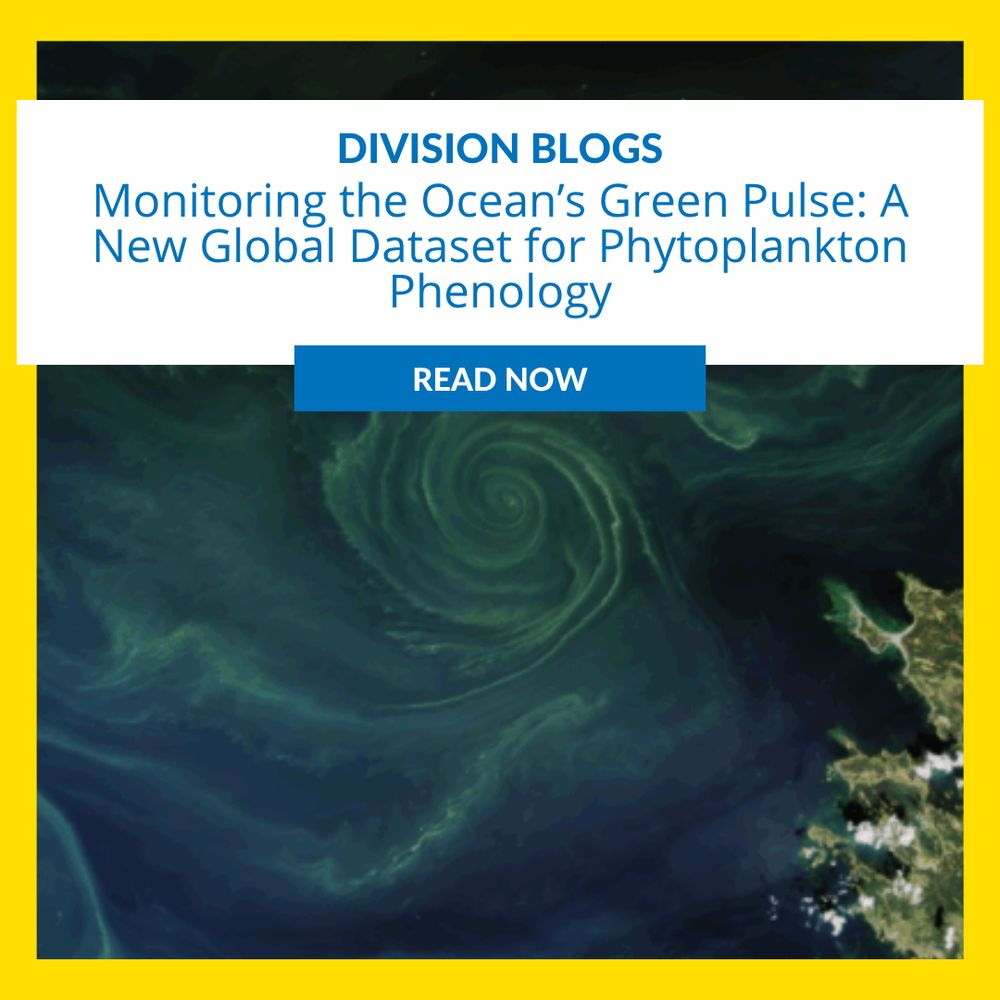
Ever wondered how we can track #phytoplankton across the vast, dynamic global #ocean? A new #satellite-derived dataset is making this task much easier. This blog post by the Ocean Sciences (OS) Division shares more details.
👉 Read more: egu.eu/2DGYB3
👉 Read more: egu.eu/2DGYB3
June 23, 2025 at 9:42 AM
Ever wondered how we can track #phytoplankton across the vast, dynamic global #ocean? A new #satellite-derived dataset is making this task much easier. This blog post by the Ocean Sciences (OS) Division shares more details.
👉 Read more: egu.eu/2DGYB3
👉 Read more: egu.eu/2DGYB3
🌊🌊🌊Bienvenidos a las XII Jornadas Nacionales de Ciencias del Mar - XX Coloquio de Oceanografía!! 🌊🌊🌊
Fitoplancton en el mar argentino: procesos, métodos y perspectivas multidisciplinarias 🔬⛵
www.unp.edu.ar/XIIJNCM/inde...
Fitoplancton en el mar argentino: procesos, métodos y perspectivas multidisciplinarias 🔬⛵
www.unp.edu.ar/XIIJNCM/inde...

May 21, 2025 at 11:40 AM
🌊🌊🌊Bienvenidos a las XII Jornadas Nacionales de Ciencias del Mar - XX Coloquio de Oceanografía!! 🌊🌊🌊
Fitoplancton en el mar argentino: procesos, métodos y perspectivas multidisciplinarias 🔬⛵
www.unp.edu.ar/XIIJNCM/inde...
Fitoplancton en el mar argentino: procesos, métodos y perspectivas multidisciplinarias 🔬⛵
www.unp.edu.ar/XIIJNCM/inde...
We are excited to be part of this remarkable global biodiversity initiative!
Our contribution includes long-term, high-frequency abundance data on protistan plankton from the Bahía Blanca Estuary and the El Rincón continental shelf area in the Argentine Sea.
onlinelibrary.wiley.com/doi/10.1111/...
Our contribution includes long-term, high-frequency abundance data on protistan plankton from the Bahía Blanca Estuary and the El Rincón continental shelf area in the Argentine Sea.
onlinelibrary.wiley.com/doi/10.1111/...

BioTIME 2.0: Expanding and Improving a Database of Biodiversity Time Series
Motivation Here, we make available a second version of the BioTIME database, which compiles records of abundance estimates for species in sample events of ecological assemblages through time. The up...
onlinelibrary.wiley.com
May 16, 2025 at 9:16 AM
We are excited to be part of this remarkable global biodiversity initiative!
Our contribution includes long-term, high-frequency abundance data on protistan plankton from the Bahía Blanca Estuary and the El Rincón continental shelf area in the Argentine Sea.
onlinelibrary.wiley.com/doi/10.1111/...
Our contribution includes long-term, high-frequency abundance data on protistan plankton from the Bahía Blanca Estuary and the El Rincón continental shelf area in the Argentine Sea.
onlinelibrary.wiley.com/doi/10.1111/...


Increase in records of toxic phytoplankton and associated toxins in the Patagonian Shelf (Argentina) over 40 years of field surveys
doi.org/10.1016/j.ha...
doi.org/10.1016/j.ha...

March 16, 2025 at 6:24 PM
Increase in records of toxic phytoplankton and associated toxins in the Patagonian Shelf (Argentina) over 40 years of field surveys
doi.org/10.1016/j.ha...
doi.org/10.1016/j.ha...