


Tom Mazanec
@tommazanec.bsky.social
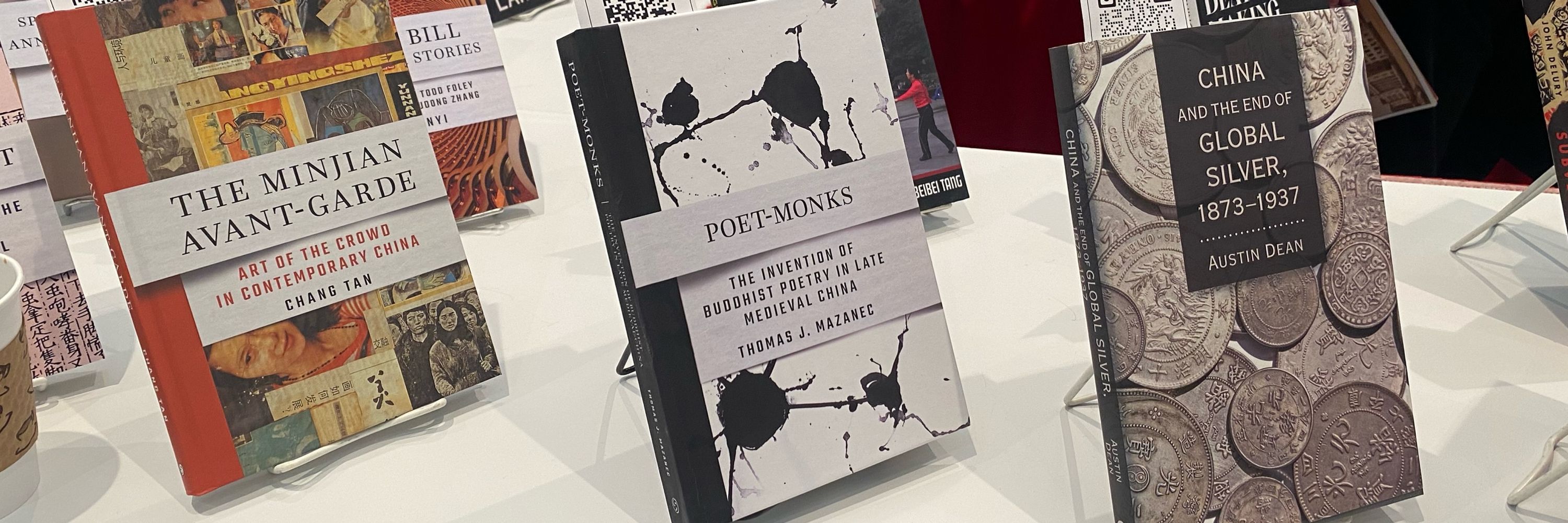
Author, Poet-Monks (Cornell UP). Assoc prof at UC Santa Barbara. Premodern Chinese lit & religion, translation, digital humanities. JAOS editor. Father of 2. Cantonese learner. Christ follower.
https://eastasian.ucsb.edu/people/faculty/thomas-mazanec
https://eastasian.ucsb.edu/people/faculty/thomas-mazanec
Bobson Dugnutt is a seriously good baseball name
February 2, 2026 at 8:57 PM
Bobson Dugnutt is a seriously good baseball name
Makes sense. Yeah, we usually only publish anything focused on the 20th century or later if it’s hardcore antiquarian
January 17, 2026 at 4:51 PM
Makes sense. Yeah, we usually only publish anything focused on the 20th century or later if it’s hardcore antiquarian
The repentance part of the text seems sincere, with some decent reflection on change in 心. And while his stated sins mostly reflect catalogs from that time, he does leave out drunkenness because he says he’s not a drinker by nature. So there’s some attempt to reflect reality
January 17, 2026 at 4:22 PM
The repentance part of the text seems sincere, with some decent reflection on change in 心. And while his stated sins mostly reflect catalogs from that time, he does leave out drunkenness because he says he’s not a drinker by nature. So there’s some attempt to reflect reality
Journal of the American Oriental Society, it dates back to 1842 (recently rechristened as Journal of the American Society for Premodern Asia). One of pillars of the field for premodern, up there with T’oung Pao, CLEAR, HJAS, JCLC, Asia Major, and the dynasty-specific journals
January 17, 2026 at 4:14 PM
Journal of the American Oriental Society, it dates back to 1842 (recently rechristened as Journal of the American Society for Premodern Asia). One of pillars of the field for premodern, up there with T’oung Pao, CLEAR, HJAS, JCLC, Asia Major, and the dynasty-specific journals
Shen Yue's confessions are particularly wild, ranging from stealing classical texts (性愛墳典, 苟得忘廉。取非其有, 卷將二百) to both hetero and homosexual love affairs (淇水上宮,誠無云幾;分桃斷袖,亦足稱多).
January 17, 2026 at 3:30 PM
Shen Yue's confessions are particularly wild, ranging from stealing classical texts (性愛墳典, 苟得忘廉。取非其有, 卷將二百) to both hetero and homosexual love affairs (淇水上宮,誠無云幾;分桃斷袖,亦足稱多).
At JAOS / JASPA, we recently published an essay by Tian Xiaofei on how the structure of the Buddhist confession / conversion narrative shaped autobiographical writing from the early medieval period on: lockwoodonlinejournals.com/index.php/ja...

JAOS
Early Chinese autobiographical writings tend to paint a still portrait of who the author is: his temperament, personality, and achievements. They operate on a model of being and, at best, of a continu...
lockwoodonlinejournals.com
January 17, 2026 at 3:11 PM
At JAOS / JASPA, we recently published an essay by Tian Xiaofei on how the structure of the Buddhist confession / conversion narrative shaped autobiographical writing from the early medieval period on: lockwoodonlinejournals.com/index.php/ja...
Haha, I have this on my syllabus for Classical Chinese! (This might actually be a screenshot of part of my syllabus?)
January 7, 2026 at 5:05 PM
Haha, I have this on my syllabus for Classical Chinese! (This might actually be a screenshot of part of my syllabus?)
Arthur Waley's translation, from A Hundred and Seventy Chinese Poems, dating to the 1920s.
I love how commentators all agree that the Ganyu poems are allegories, but strongly disagree as to what they're allegories for.
I love how commentators all agree that the Ganyu poems are allegories, but strongly disagree as to what they're allegories for.
January 5, 2026 at 10:08 PM
Arthur Waley's translation, from A Hundred and Seventy Chinese Poems, dating to the 1920s.
I love how commentators all agree that the Ganyu poems are allegories, but strongly disagree as to what they're allegories for.
I love how commentators all agree that the Ganyu poems are allegories, but strongly disagree as to what they're allegories for.
Review of Dictionary of Taoist Internal Alchemy by Fabrizio Pregadio
Tyler Feezell
5/end
Tyler Feezell
5/end
December 15, 2025 at 7:28 PM
Review of Dictionary of Taoist Internal Alchemy by Fabrizio Pregadio
Tyler Feezell
5/end
Tyler Feezell
5/end
Review of Twenty-Nine Goodbyes: An Introduction to Chinese Poetry by Timothy Billings
Lucas Klein
Review of A Catalog of Benevolent Items: Li Shizhen’s Compendium of Classical Chinese Knowledge. Selected Entries from the Ben Cao Gang Mu by Paul Unschuld
Yan Liu
4/
Lucas Klein
Review of A Catalog of Benevolent Items: Li Shizhen’s Compendium of Classical Chinese Knowledge. Selected Entries from the Ben Cao Gang Mu by Paul Unschuld
Yan Liu
4/
December 15, 2025 at 7:28 PM
Review of Twenty-Nine Goodbyes: An Introduction to Chinese Poetry by Timothy Billings
Lucas Klein
Review of A Catalog of Benevolent Items: Li Shizhen’s Compendium of Classical Chinese Knowledge. Selected Entries from the Ben Cao Gang Mu by Paul Unschuld
Yan Liu
4/
Lucas Klein
Review of A Catalog of Benevolent Items: Li Shizhen’s Compendium of Classical Chinese Knowledge. Selected Entries from the Ben Cao Gang Mu by Paul Unschuld
Yan Liu
4/
"Forming the Knowledge of Fragrance in Song Dynasty Catalogues of Incense"
Qian Jia
"The Travels of Tang Emperor Xuanzong (r. 712–756)"
Paul W. Kroll
Review of The Rise of Modern Chinese Thought by Wang Hui
Don J. Wyatt
3/
Qian Jia
"The Travels of Tang Emperor Xuanzong (r. 712–756)"
Paul W. Kroll
Review of The Rise of Modern Chinese Thought by Wang Hui
Don J. Wyatt
3/
December 15, 2025 at 7:28 PM
"Forming the Knowledge of Fragrance in Song Dynasty Catalogues of Incense"
Qian Jia
"The Travels of Tang Emperor Xuanzong (r. 712–756)"
Paul W. Kroll
Review of The Rise of Modern Chinese Thought by Wang Hui
Don J. Wyatt
3/
Qian Jia
"The Travels of Tang Emperor Xuanzong (r. 712–756)"
Paul W. Kroll
Review of The Rise of Modern Chinese Thought by Wang Hui
Don J. Wyatt
3/
Here is the East Asia content, which I edited.
"The Final Part of the Mongol Text of the 1413 Tyr Trilingual Inscription"
Pavel Rykin
"The Reconstructed Morphology of Old Chinese and Word Classes in Warring States Chinese"
Lukáš Zádrapa
2/
"The Final Part of the Mongol Text of the 1413 Tyr Trilingual Inscription"
Pavel Rykin
"The Reconstructed Morphology of Old Chinese and Word Classes in Warring States Chinese"
Lukáš Zádrapa
2/
December 15, 2025 at 7:28 PM
Here is the East Asia content, which I edited.
"The Final Part of the Mongol Text of the 1413 Tyr Trilingual Inscription"
Pavel Rykin
"The Reconstructed Morphology of Old Chinese and Word Classes in Warring States Chinese"
Lukáš Zádrapa
2/
"The Final Part of the Mongol Text of the 1413 Tyr Trilingual Inscription"
Pavel Rykin
"The Reconstructed Morphology of Old Chinese and Word Classes in Warring States Chinese"
Lukáš Zádrapa
2/
Of course, the e-version remains free, open-access. Download it here: www.cornellpress.cornell.edu/book/9781501...

Poet-Monks by Thomas J. Mazanec | eBook | Cornell University Press
Poet-Monks focuses on the literary and religious practices of Buddhist poet-monks in Tang-dynasty China to propose an alternative historical arc of medieval Chinese poetry. Combining large-scale quant...
www.cornellpress.cornell.edu
November 13, 2025 at 9:43 PM
Of course, the e-version remains free, open-access. Download it here: www.cornellpress.cornell.edu/book/9781501...
I was honored to work with someone as erudite as Prof. Zhou, and I am grateful to the Journal of Chinese Literature and Culture for the opportunity to work this out in print for their "Key Terms of Chinese Literary Theory" special issue.
3/3
3/3
October 21, 2025 at 3:07 PM
I was honored to work with someone as erudite as Prof. Zhou, and I am grateful to the Journal of Chinese Literature and Culture for the opportunity to work this out in print for their "Key Terms of Chinese Literary Theory" special issue.
3/3
3/3
We ask questions like: can you separate the art from the artist? Can immoral people create good poetry? Are good writers moral exemplars? How have the answers to these questions shaped Chinese literary history? What relevance do these questions have to our era of "cancel culture"?
2/3
2/3
October 21, 2025 at 3:07 PM
We ask questions like: can you separate the art from the artist? Can immoral people create good poetry? Are good writers moral exemplars? How have the answers to these questions shaped Chinese literary history? What relevance do these questions have to our era of "cancel culture"?
2/3
2/3