


Tiago Nunes
@tiagojnunes.bsky.social
This is Major Tom to ground control. Melting hadrons and gluing quarks. Theoretical and Computational Physicist. Leader of the Heavy Ion Physics group at Floripa. Sport Recife fan. Made in Pernambuco.
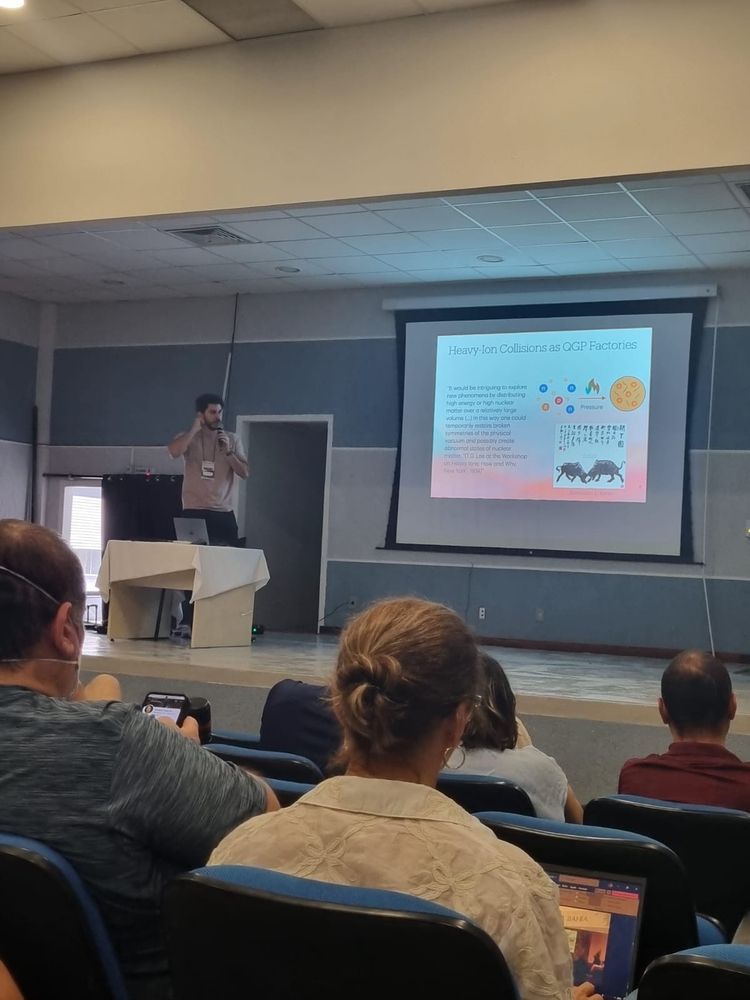
Today's presentation at the Nuclear Physics INCT symposium, in Rio. Talked about our new pre-equilibrium dynamics model and our new scheme for viscous corrections in particlization.
December 4, 2025 at 2:29 PM
Today's presentation at the Nuclear Physics INCT symposium, in Rio. Talked about our new pre-equilibrium dynamics model and our new scheme for viscous corrections in particlization.
Tau represents the time (in Milne coordinates).
We have now extended this study showing how the posterior distributions of transport coefficients and other model parameters are significantly changed when causality is enforced in such simulations. (7/8)
We have now extended this study showing how the posterior distributions of transport coefficients and other model parameters are significantly changed when causality is enforced in such simulations. (7/8)

December 9, 2024 at 6:00 PM
Tau represents the time (in Milne coordinates).
We have now extended this study showing how the posterior distributions of transport coefficients and other model parameters are significantly changed when causality is enforced in such simulations. (7/8)
We have now extended this study showing how the posterior distributions of transport coefficients and other model parameters are significantly changed when causality is enforced in such simulations. (7/8)
My former student R. Krupczak showed how this was connected to the relaxation time of the system: https://journals.aps.org/prc/abstract/10.1103/PhysRevC.109.034908
In the following figure, the red portion of the system is acausal, the purple is indeterminate, and the blue is causal. (6/8)
In the following figure, the red portion of the system is acausal, the purple is indeterminate, and the blue is causal. (6/8)

December 9, 2024 at 6:00 PM
My former student R. Krupczak showed how this was connected to the relaxation time of the system: https://journals.aps.org/prc/abstract/10.1103/PhysRevC.109.034908
In the following figure, the red portion of the system is acausal, the purple is indeterminate, and the blue is causal. (6/8)
In the following figure, the red portion of the system is acausal, the purple is indeterminate, and the blue is causal. (6/8)
The set of equations we solve in these simulations is called DNMR hydro. For the initiated, this is a second-order formalism for relativistic hydrodynamics, inspired by the Israel-Stewart theory, aiming at obtaining a version of hydro that is causal in the relativistic limit. (4/8)

December 9, 2024 at 6:00 PM
The set of equations we solve in these simulations is called DNMR hydro. For the initiated, this is a second-order formalism for relativistic hydrodynamics, inspired by the Israel-Stewart theory, aiming at obtaining a version of hydro that is causal in the relativistic limit. (4/8)
In my research, I use models based on relativistic hydrodynamics to study the properties and evolution of the QGP formed in collision experiments. I am especially interested in QGP formation in small systems, such as the collision between a single proton and lead nuclei. (11/12)

November 27, 2024 at 12:49 PM
In my research, I use models based on relativistic hydrodynamics to study the properties and evolution of the QGP formed in collision experiments. I am especially interested in QGP formation in small systems, such as the collision between a single proton and lead nuclei. (11/12)
You can think of these ultra-relativistic heavy-ion collisions as Brazilian carnival in Olinda: quarks and gluons arrive in closed groups, but once there are enough people and heat there is only a continuous of them, and no pairs and trios exist anymore. (10/12)

November 27, 2024 at 12:49 PM
You can think of these ultra-relativistic heavy-ion collisions as Brazilian carnival in Olinda: quarks and gluons arrive in closed groups, but once there are enough people and heat there is only a continuous of them, and no pairs and trios exist anymore. (10/12)
Thanks to our experimental colleagues working on large colliders, such as RHIC and the LHC, we can reproduce these conditions and produce "little bangs" by colliding ultra-fast beams of heavy ions, such as lead nuclei. (9/12)

November 27, 2024 at 12:49 PM
Thanks to our experimental colleagues working on large colliders, such as RHIC and the LHC, we can reproduce these conditions and produce "little bangs" by colliding ultra-fast beams of heavy ions, such as lead nuclei. (9/12)
The QGP behaves like a fluid. In fact, it is the most perfect fluid in the universe: a fundamental hot soup of quarks and gluons. This fluid behavior can be described by a relativistic version of viscous hydrodynamics.
(7/12)
(7/12)

November 27, 2024 at 12:49 PM
The QGP behaves like a fluid. In fact, it is the most perfect fluid in the universe: a fundamental hot soup of quarks and gluons. This fluid behavior can be described by a relativistic version of viscous hydrodynamics.
(7/12)
(7/12)
Unlike the usual electric charge, there are 3 possible values for this charge, which the physicists named after the primary colors: Red, Green, and Blue. The theory describing this force is called Quantum Chromodynamics. (4/12)

November 27, 2024 at 12:49 PM
Unlike the usual electric charge, there are 3 possible values for this charge, which the physicists named after the primary colors: Red, Green, and Blue. The theory describing this force is called Quantum Chromodynamics. (4/12)
Ordinary matter is composed of atoms, which are composed of a nucleus made of protons neutrons, and electrons. One key difference between these particles is that electrons are fundamental: as far as we know, they can't be split into even smaller particles. (2/12)

November 27, 2024 at 12:49 PM
Ordinary matter is composed of atoms, which are composed of a nucleus made of protons neutrons, and electrons. One key difference between these particles is that electrons are fundamental: as far as we know, they can't be split into even smaller particles. (2/12)
It's time for a proper introduction. I am a Brazilian theoretical physicist studying the (literally) hottest matter in Physics: the quark-gluon plasma (our beloved QGP). What is this "timey wimey wibbily wobbly" thing called the QGP? Allons-y! (1/12)

November 27, 2024 at 12:49 PM
It's time for a proper introduction. I am a Brazilian theoretical physicist studying the (literally) hottest matter in Physics: the quark-gluon plasma (our beloved QGP). What is this "timey wimey wibbily wobbly" thing called the QGP? Allons-y! (1/12)
Mais um dia com céu de Mad Max respirando fuligem. Cortesia dos piromaníacos do gado.

September 10, 2024 at 9:10 PM
Mais um dia com céu de Mad Max respirando fuligem. Cortesia dos piromaníacos do gado.
Sobrevoando Santa Catarina.

September 2, 2024 at 7:44 PM
Sobrevoando Santa Catarina.