




Juan I. Bravo, PhD
@the-te-guy.bsky.social
Postdoc in the Curran lab at the University of Southern California (USC), studying aging and transposons. The views expressed here are my own.
Reposted by Juan I. Bravo, PhD

A multi-omics analysis of human fibroblasts overexpressing an Alu transposon reveals widespread disruptions in aging-associated pathways https://www.biorxiv.org/content/10.1101/2025.07.11.664466v1
July 17, 2025 at 4:34 PM
A multi-omics analysis of human fibroblasts overexpressing an Alu transposon reveals widespread disruptions in aging-associated pathways https://www.biorxiv.org/content/10.1101/2025.07.11.664466v1
Reposted by Juan I. Bravo, PhD
🚨 Another preprint from the lab out today! 🚨
This work led by former trainee Dr. Juan Brado @the-te-guy.bsky.social and new grad student Ms. Eyael Tewelde, to undertstand how upregulation of a single retrotransposon (here, AluJB) impacts cellular phenotypes! A 🧵, 1/9
www.biorxiv.org/content/10.1...
This work led by former trainee Dr. Juan Brado @the-te-guy.bsky.social and new grad student Ms. Eyael Tewelde, to undertstand how upregulation of a single retrotransposon (here, AluJB) impacts cellular phenotypes! A 🧵, 1/9
www.biorxiv.org/content/10.1...

A multi-omics analysis of human fibroblasts overexpressing an Alu transposon reveals widespread disruptions in aging-associated pathways
During aging and cellular senescence, repetitive elements are frequently transcriptionally derepressed across species and cell types. Among these, the most abundant repeats by copy number in the human...
www.biorxiv.org
July 17, 2025 at 5:03 PM
🚨 Another preprint from the lab out today! 🚨
This work led by former trainee Dr. Juan Brado @the-te-guy.bsky.social and new grad student Ms. Eyael Tewelde, to undertstand how upregulation of a single retrotransposon (here, AluJB) impacts cellular phenotypes! A 🧵, 1/9
www.biorxiv.org/content/10.1...
This work led by former trainee Dr. Juan Brado @the-te-guy.bsky.social and new grad student Ms. Eyael Tewelde, to undertstand how upregulation of a single retrotransposon (here, AluJB) impacts cellular phenotypes! A 🧵, 1/9
www.biorxiv.org/content/10.1...
Reposted by Juan I. Bravo, PhD
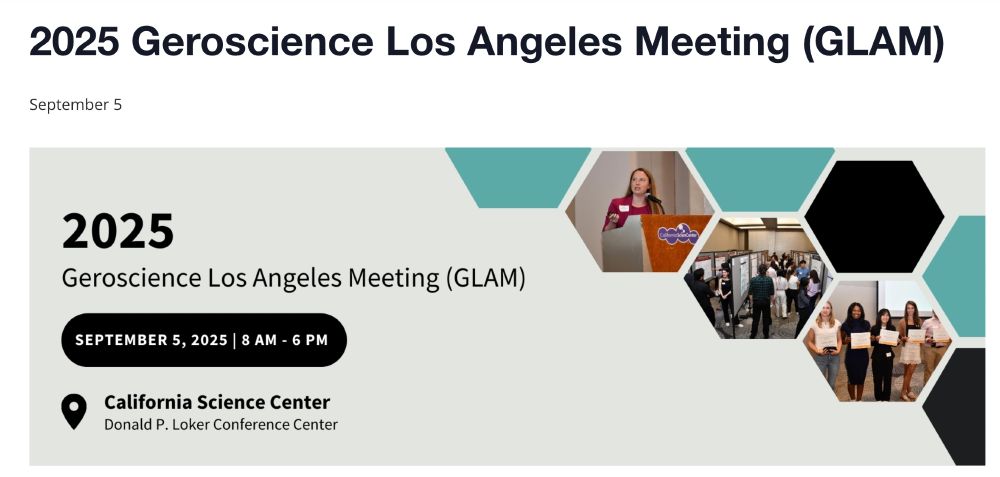
✨✨ #GLAM2025 ✨✨ is back 9/5/2025 to showcase #geroscience trainee research! Registration and poster submission are open (and #FlashTalk selection for #undergrads!).
Event website: gero.usc.edu/laara/event/...
Thanks to @activemotifusa.bsky.social, #Hevolution and #VWR for their support!
Event website: gero.usc.edu/laara/event/...
Thanks to @activemotifusa.bsky.social, #Hevolution and #VWR for their support!
July 11, 2025 at 3:21 PM
✨✨ #GLAM2025 ✨✨ is back 9/5/2025 to showcase #geroscience trainee research! Registration and poster submission are open (and #FlashTalk selection for #undergrads!).
Event website: gero.usc.edu/laara/event/...
Thanks to @activemotifusa.bsky.social, #Hevolution and #VWR for their support!
Event website: gero.usc.edu/laara/event/...
Thanks to @activemotifusa.bsky.social, #Hevolution and #VWR for their support!
Reposted by Juan I. Bravo, PhD

First up is @adaigle.bsky.social's preprint where we use Drosophila genomes that have been sequenced with both short and long reads to train a machine learning method to more accurately detect and genotype transposable element insertions: doi.org/10.1101/2025...

Leveraging long-read assemblies and machine learning to enhance short-read transposable element detection and genotyping
Transposable elements (TEs) are parasitic genomic elements that are ubiquitous across the tree of life and play a crucial role in genome evolution. Advances in long-read sequencing have allowed highly...
doi.org
March 24, 2025 at 10:53 PM
First up is @adaigle.bsky.social's preprint where we use Drosophila genomes that have been sequenced with both short and long reads to train a machine learning method to more accurately detect and genotype transposable element insertions: doi.org/10.1101/2025...
Reposted by Juan I. Bravo, PhD
Polymorphic transposable elements contribute to variation in recombination landscapes (drosohila 🪰) www.pnas.org/doi/full/10.... #TEsky
PNAS
Proceedings of the National Academy of Sciences (PNAS), a peer reviewed journal of the National Academy of Sciences (NAS) - an authoritative source of high-impact, original research that broadly spans...
www.pnas.org
March 24, 2025 at 9:01 PM
Polymorphic transposable elements contribute to variation in recombination landscapes (drosohila 🪰) www.pnas.org/doi/full/10.... #TEsky
Reposted by Juan I. Bravo, PhD
Glad to share that the final version of this study just came out in #TranslationalMedicineOfAging!
Congrats to @the-te-guy.bsky.social aka Dr. Juan Bravo for this proof-of-principle study showing that GWAS tools can be used to identify candidate #L1 regulators!
www.sciencedirect.com/science/arti...
Congrats to @the-te-guy.bsky.social aka Dr. Juan Bravo for this proof-of-principle study showing that GWAS tools can be used to identify candidate #L1 regulators!
www.sciencedirect.com/science/arti...
February 19, 2025 at 12:38 AM
Glad to share that the final version of this study just came out in #TranslationalMedicineOfAging!
Congrats to @the-te-guy.bsky.social aka Dr. Juan Bravo for this proof-of-principle study showing that GWAS tools can be used to identify candidate #L1 regulators!
www.sciencedirect.com/science/arti...
Congrats to @the-te-guy.bsky.social aka Dr. Juan Bravo for this proof-of-principle study showing that GWAS tools can be used to identify candidate #L1 regulators!
www.sciencedirect.com/science/arti...
Reposted by Juan I. Bravo, PhD
Genome-wide maps of highly-similar intrachromosomal repeats that can mediate ectopic recombination in three human genome assemblies doi.org/10.1016/j.xh...
Redirecting
doi.org
December 31, 2024 at 9:56 PM
Genome-wide maps of highly-similar intrachromosomal repeats that can mediate ectopic recombination in three human genome assemblies doi.org/10.1016/j.xh...
Reposted by Juan I. Bravo, PhD
Shareing the #Benayoun lab’s newest preprint (>2 months ago - I'm new to Bluesky 😅), where we use #1000GenomesProject data to identify putative regulatory loci of #LINE1 and #Alu copy numbers in diverse human populations, led by the talented Dr. Bravo 🧬 🖥️. A 🧵. 1/8 biorxiv.org/cgi/content/...

November 9, 2024 at 7:46 PM
Shareing the #Benayoun lab’s newest preprint (>2 months ago - I'm new to Bluesky 😅), where we use #1000GenomesProject data to identify putative regulatory loci of #LINE1 and #Alu copy numbers in diverse human populations, led by the talented Dr. Bravo 🧬 🖥️. A 🧵. 1/8 biorxiv.org/cgi/content/...