


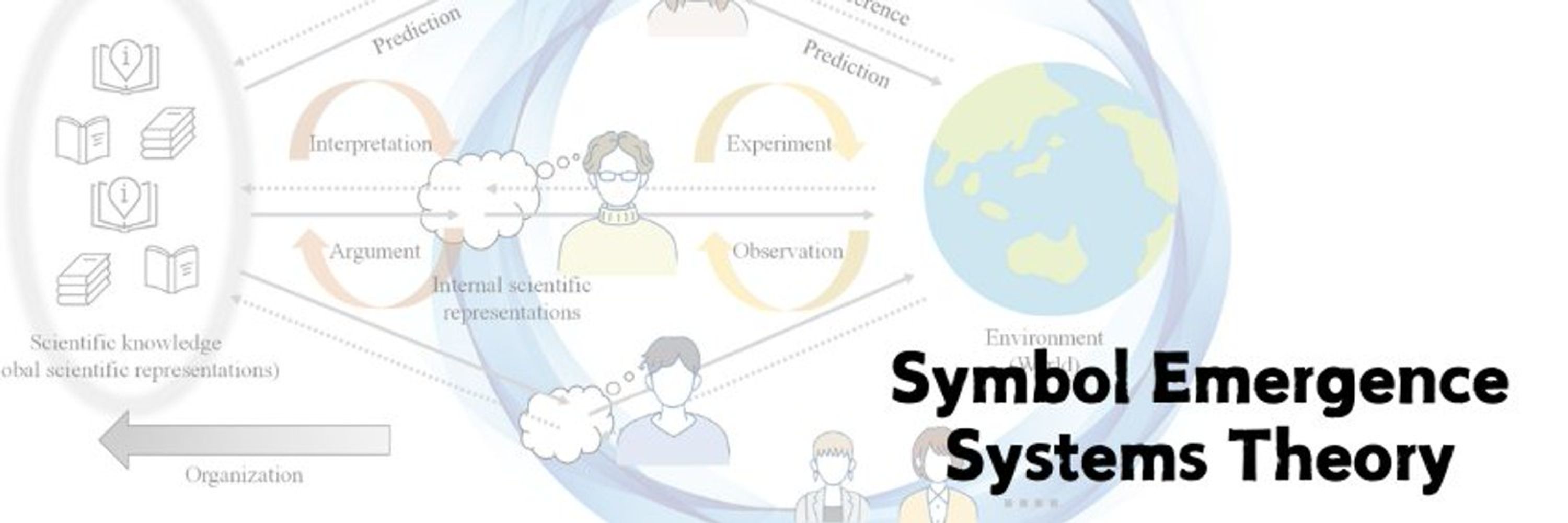

記号創発システム論
@symbolemerge.bsky.social
記号創発システム論の関連情報の発信や、アウトリーチ活動のお知らせを行うアカウントです。2025年2,3月は #記号創発クロストーク や #記号創発スタディノート を公開していきます。アウトリーチスタッフメンバーが投稿します。#記号創発システム論 に関連する質問・疑問、取材やメディア転載のご相談もお待ちしています。
We truly believe this is a really interesting avenue of research, so please dive in, and do reach out!
- Writer: @rmaruy.bsky.social
- Supervision: Tadahiro Taniguchi
- Design: Reira Endo, Masaya Shimizu
- Translation Support: Momoha Hirose
Thanks to all the people who gave us feedback!
- Writer: @rmaruy.bsky.social
- Supervision: Tadahiro Taniguchi
- Design: Reira Endo, Masaya Shimizu
- Translation Support: Momoha Hirose
Thanks to all the people who gave us feedback!
May 8, 2025 at 11:53 AM
We truly believe this is a really interesting avenue of research, so please dive in, and do reach out!
- Writer: @rmaruy.bsky.social
- Supervision: Tadahiro Taniguchi
- Design: Reira Endo, Masaya Shimizu
- Translation Support: Momoha Hirose
Thanks to all the people who gave us feedback!
- Writer: @rmaruy.bsky.social
- Supervision: Tadahiro Taniguchi
- Design: Reira Endo, Masaya Shimizu
- Translation Support: Momoha Hirose
Thanks to all the people who gave us feedback!
9/9
✨ The Collective Predictive Coding hypothesis suggests symbol systems emerge through decentralized Bayesian inference among agents—social representation learning that may explain the origins of language and shared meaning.
Read more: www.symbol-emergence.net/post/a-prime...
✨ The Collective Predictive Coding hypothesis suggests symbol systems emerge through decentralized Bayesian inference among agents—social representation learning that may explain the origins of language and shared meaning.
Read more: www.symbol-emergence.net/post/a-prime...

May 8, 2025 at 11:52 AM
9/9
✨ The Collective Predictive Coding hypothesis suggests symbol systems emerge through decentralized Bayesian inference among agents—social representation learning that may explain the origins of language and shared meaning.
Read more: www.symbol-emergence.net/post/a-prime...
✨ The Collective Predictive Coding hypothesis suggests symbol systems emerge through decentralized Bayesian inference among agents—social representation learning that may explain the origins of language and shared meaning.
Read more: www.symbol-emergence.net/post/a-prime...
8/9
🔮 Free energy principle has served as an integrating view that unifies perception, action, and learning as continuous prediction and error minimization. Representation learning must be constrained by symbol systems—but how?
🔮 Free energy principle has served as an integrating view that unifies perception, action, and learning as continuous prediction and error minimization. Representation learning must be constrained by symbol systems—but how?

May 8, 2025 at 11:52 AM
8/9
🔮 Free energy principle has served as an integrating view that unifies perception, action, and learning as continuous prediction and error minimization. Representation learning must be constrained by symbol systems—but how?
🔮 Free energy principle has served as an integrating view that unifies perception, action, and learning as continuous prediction and error minimization. Representation learning must be constrained by symbol systems—but how?
7/9
📊 Probabilistic generative models
To answer these questions, SEST uses Bayesian frameworks to model how agents form categories, predict sensory data, and learn language by inferring latent variables behind observations.
📊 Probabilistic generative models
To answer these questions, SEST uses Bayesian frameworks to model how agents form categories, predict sensory data, and learn language by inferring latent variables behind observations.

May 8, 2025 at 11:51 AM
7/9
📊 Probabilistic generative models
To answer these questions, SEST uses Bayesian frameworks to model how agents form categories, predict sensory data, and learn language by inferring latent variables behind observations.
📊 Probabilistic generative models
To answer these questions, SEST uses Bayesian frameworks to model how agents form categories, predict sensory data, and learn language by inferring latent variables behind observations.
6/9
🌐 Societal-level symbol emergence
How do bottom-up interactions self-organize into shared symbol systems, which then exert top-down influence on individual meaning-making via micro–macro loops?
🌐 Societal-level symbol emergence
How do bottom-up interactions self-organize into shared symbol systems, which then exert top-down influence on individual meaning-making via micro–macro loops?

May 8, 2025 at 11:51 AM
6/9
🌐 Societal-level symbol emergence
How do bottom-up interactions self-organize into shared symbol systems, which then exert top-down influence on individual meaning-making via micro–macro loops?
🌐 Societal-level symbol emergence
How do bottom-up interactions self-organize into shared symbol systems, which then exert top-down influence on individual meaning-making via micro–macro loops?
5/9
🧠 Agent-level symbol emergence
How do individuals learn internal representations—latent concepts that tie sensory inputs to symbols—through embodied interaction, unsupervised learning, and Bayesian inference?
🧠 Agent-level symbol emergence
How do individuals learn internal representations—latent concepts that tie sensory inputs to symbols—through embodied interaction, unsupervised learning, and Bayesian inference?

May 8, 2025 at 11:50 AM
5/9
🧠 Agent-level symbol emergence
How do individuals learn internal representations—latent concepts that tie sensory inputs to symbols—through embodied interaction, unsupervised learning, and Bayesian inference?
🧠 Agent-level symbol emergence
How do individuals learn internal representations—latent concepts that tie sensory inputs to symbols—through embodied interaction, unsupervised learning, and Bayesian inference?
4/9
🔄 From the classic “symbol grounding problem” (computer symbols only refer to other symbols) to the symbol emergence problem. Building on Peirce’s semiotics—sign, object, interpretant—SEST treats symbols as dynamic processes.
🔄 From the classic “symbol grounding problem” (computer symbols only refer to other symbols) to the symbol emergence problem. Building on Peirce’s semiotics—sign, object, interpretant—SEST treats symbols as dynamic processes.

May 8, 2025 at 11:50 AM
4/9
🔄 From the classic “symbol grounding problem” (computer symbols only refer to other symbols) to the symbol emergence problem. Building on Peirce’s semiotics—sign, object, interpretant—SEST treats symbols as dynamic processes.
🔄 From the classic “symbol grounding problem” (computer symbols only refer to other symbols) to the symbol emergence problem. Building on Peirce’s semiotics—sign, object, interpretant—SEST treats symbols as dynamic processes.
3/9
🤖 LLMs & Meaning
Large language models show that raw text alone can encode human knowledge—but they also raise questions: Where does meaning come from, and how do learners link words to concepts?
🤖 LLMs & Meaning
Large language models show that raw text alone can encode human knowledge—but they also raise questions: Where does meaning come from, and how do learners link words to concepts?

May 8, 2025 at 11:50 AM
3/9
🤖 LLMs & Meaning
Large language models show that raw text alone can encode human knowledge—but they also raise questions: Where does meaning come from, and how do learners link words to concepts?
🤖 LLMs & Meaning
Large language models show that raw text alone can encode human knowledge—but they also raise questions: Where does meaning come from, and how do learners link words to concepts?
2/9
🤔 What is a symbol?
SEST is an interdisciplinary science of meaning—asking how symbols (words, signs, gestures) acquire, evolve, and convey meaning in humans and embodied machines.
🤔 What is a symbol?
SEST is an interdisciplinary science of meaning—asking how symbols (words, signs, gestures) acquire, evolve, and convey meaning in humans and embodied machines.

May 8, 2025 at 11:49 AM
2/9
🤔 What is a symbol?
SEST is an interdisciplinary science of meaning—asking how symbols (words, signs, gestures) acquire, evolve, and convey meaning in humans and embodied machines.
🤔 What is a symbol?
SEST is an interdisciplinary science of meaning—asking how symbols (words, signs, gestures) acquire, evolve, and convey meaning in humans and embodied machines.
February 20, 2025 at 11:15 PM

February 20, 2025 at 11:15 PM

February 20, 2025 at 11:13 PM