



Sylvia Darling
@sylviadarli.ng
PhD researcher seating theories of information science, migration, and aspirations at her weird little dining table. If not wrangling a toddler, then writing in her cave.
https://sylviadarli.ng
https://sylviadarli.ng
Not an understatement: Since my early twenties, her writings have helped me see above the fray of fear and look to ourselves and our neighbors for strength. What a time to be alive, I mean it.
February 4, 2025 at 6:40 PM
Not an understatement: Since my early twenties, her writings have helped me see above the fray of fear and look to ourselves and our neighbors for strength. What a time to be alive, I mean it.
Bullseye from latest: "They're miscalculating the reactions from foreign nationals, from politicians, from federal workers, from ordinary people; they're underestimating solidarity, courage, principle, and misunderstanding power itself. They do not understand people, and this may be their downfall."
February 4, 2025 at 6:40 PM
Bullseye from latest: "They're miscalculating the reactions from foreign nationals, from politicians, from federal workers, from ordinary people; they're underestimating solidarity, courage, principle, and misunderstanding power itself. They do not understand people, and this may be their downfall."
I think you should still look pain in the eye, as Brene Brown would say, but the task of looking above it is just as crucial.
February 3, 2025 at 4:07 PM
I think you should still look pain in the eye, as Brene Brown would say, but the task of looking above it is just as crucial.
Particularly when your topic has been epistemically approached—at least as I can recall—through a language of deficits, pains, and inequities.
February 3, 2025 at 4:07 PM
Particularly when your topic has been epistemically approached—at least as I can recall—through a language of deficits, pains, and inequities.
Like, I study information, dude. And when I mean information, I mean localized knowledge like gossip and hearsay. "Chisme," as my fellow Spanish speakers know.
January 31, 2025 at 3:10 PM
Like, I study information, dude. And when I mean information, I mean localized knowledge like gossip and hearsay. "Chisme," as my fellow Spanish speakers know.
If I'm not an expert in these fields, then seeing a bunch of code or numbers won't make me feel better or equipped to find the solution—not on their own. Which is why context is everything. And yes, integrity. And yes, reliability. Transparency is part of the equation, I guess, but it's not all.
January 26, 2025 at 12:54 AM
If I'm not an expert in these fields, then seeing a bunch of code or numbers won't make me feel better or equipped to find the solution—not on their own. Which is why context is everything. And yes, integrity. And yes, reliability. Transparency is part of the equation, I guess, but it's not all.
I was listening to Adam Grant's recent interview with Rachel Botsman about this, and I see how it can apply to so many things: predictive algorithms, childcare & school monitoring, government spending, and even relationships.
January 26, 2025 at 12:54 AM
I was listening to Adam Grant's recent interview with Rachel Botsman about this, and I see how it can apply to so many things: predictive algorithms, childcare & school monitoring, government spending, and even relationships.
Reposted by Sylvia Darling
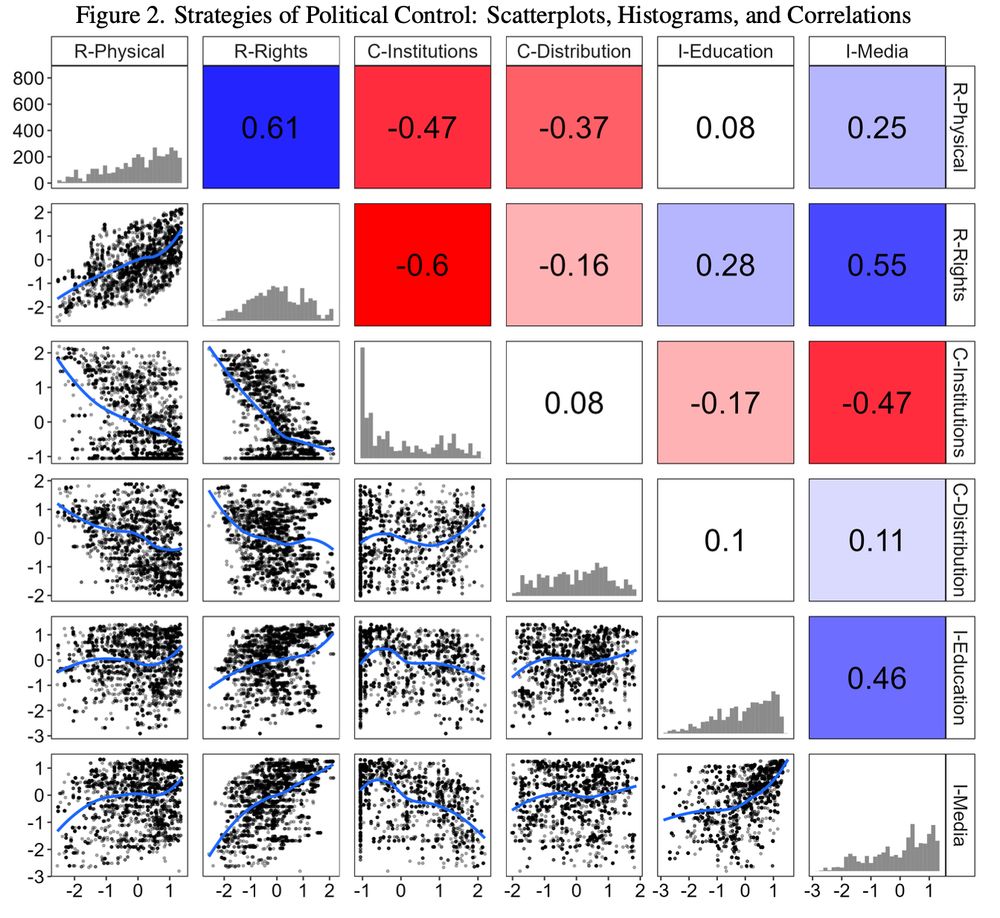
1/ Autocrats combine tools to stay in power, but most research looks at them in isolation. We map 6 strategies—repression of rights & physical integrity, co-optation through institutions & resource distribution, and indoctrination via education & media—for a full picture.
January 24, 2025 at 3:50 PM
1/ Autocrats combine tools to stay in power, but most research looks at them in isolation. We map 6 strategies—repression of rights & physical integrity, co-optation through institutions & resource distribution, and indoctrination via education & media—for a full picture.
Good question, and technically the first from a committee member. 😉 That "informational" process has a name, which I'll share and discuss at your lab! Please hit me with more questions!
January 24, 2025 at 1:23 PM
Good question, and technically the first from a committee member. 😉 That "informational" process has a name, which I'll share and discuss at your lab! Please hit me with more questions!
... It's a breakthrough. It's the satisfaction they gain from realizing their process of leveraging information has produced some gain — circumstantial, intrinsic, etc. — they couldn't have achieved otherwise. Especially while living under seemingly unrectifiable structural inequality.
January 24, 2025 at 1:23 PM
... It's a breakthrough. It's the satisfaction they gain from realizing their process of leveraging information has produced some gain — circumstantial, intrinsic, etc. — they couldn't have achieved otherwise. Especially while living under seemingly unrectifiable structural inequality.
But, he continues, once they decide what they want to do, they're likely to be very successful in achieving it. The framework still applies. So, for all my wanting to create a theory of social change premised on hope, I should, y'know, have faith.
January 23, 2025 at 9:03 PM
But, he continues, once they decide what they want to do, they're likely to be very successful in achieving it. The framework still applies. So, for all my wanting to create a theory of social change premised on hope, I should, y'know, have faith.
Which is why I'm hesitant to say the process helps them thrive. I'm stumped about this last person. I tell my advisor this. He tells me, it's true they are at a crossroads. They have an internal conflict—their public and private desires are at odds.
January 23, 2025 at 9:03 PM
Which is why I'm hesitant to say the process helps them thrive. I'm stumped about this last person. I tell my advisor this. He tells me, it's true they are at a crossroads. They have an internal conflict—their public and private desires are at odds.
Three peeps with different aspirations, different problems, and living at different junctures of their lives. Leveraging information gets them closer to where they want to be. One actually got there, one is practically there, but the other is not quite.
January 23, 2025 at 9:03 PM
Three peeps with different aspirations, different problems, and living at different junctures of their lives. Leveraging information gets them closer to where they want to be. One actually got there, one is practically there, but the other is not quite.
I'm basing it on the two years I spent in Honduras doing ethnographic fieldwork and hanging out with three soberingly extraordinary people who engaged in this process I'm trying to define as if I were panning for gold.
January 23, 2025 at 9:03 PM
I'm basing it on the two years I spent in Honduras doing ethnographic fieldwork and hanging out with three soberingly extraordinary people who engaged in this process I'm trying to define as if I were panning for gold.
Precarity can be uncomfortable, but some studies on neuroplasticity show that discomfort sits at the edge of better cognitive functions. So, I hold onto that.
January 23, 2025 at 6:06 PM
Precarity can be uncomfortable, but some studies on neuroplasticity show that discomfort sits at the edge of better cognitive functions. So, I hold onto that.