


Sydney Vach
@sydneyvach.bsky.social
she/her
phd student studying planets young enough to be claimed as dependents | eso & unisq, prev harvard cfa
sydvach.github.io
phd student studying planets young enough to be claimed as dependents | eso & unisq, prev harvard cfa
sydvach.github.io
The TIC 434398831 planets follow the trend of the youngest exoplanet population, lying above the Kepler distribution. Evolutionary modeling predicts both planets will likely continue to evolve down into the typical super-Earth to mini-Neptune regime!

July 30, 2024 at 2:34 AM
The TIC 434398831 planets follow the trend of the youngest exoplanet population, lying above the Kepler distribution. Evolutionary modeling predicts both planets will likely continue to evolve down into the typical super-Earth to mini-Neptune regime!
TIC 434398831 resides in the Theia 116 comoving group (see Kounkel & Covey 2019). We performed a lithium survey with a subset of members using TRES, and measured the rotation periods from members' CDIPS light curves to characterize the group's age.

July 30, 2024 at 2:33 AM
TIC 434398831 resides in the Theia 116 comoving group (see Kounkel & Covey 2019). We performed a lithium survey with a subset of members using TRES, and measured the rotation periods from members' CDIPS light curves to characterize the group's age.
TIC 434398831 b and c are a mini- and super-Neptune respectively, with orbital periods a near 5:3 mmr.

July 30, 2024 at 2:32 AM
TIC 434398831 b and c are a mini- and super-Neptune respectively, with orbital periods a near 5:3 mmr.

I was inspired by Harvard PhD candidate Claire Lamman, who I was lucky enough to have as a TF during my undergrad to "doodle my paper" to make it a bit easier to digest!
Full version at: sydvach.github.io#research
Full version at: sydvach.github.io#research


March 7, 2024 at 5:42 AM
I was inspired by Harvard PhD candidate Claire Lamman, who I was lucky enough to have as a TF during my undergrad to "doodle my paper" to make it a bit easier to digest!
Full version at: sydvach.github.io#research
Full version at: sydvach.github.io#research
shoutout to my cat, who decided to walk across my laptop keys at 4:59:59 am (Brisbane time) this morning as I was submitting to arXiv.... decided to take the 20 seconds to correct "accepted to AJ alboivjwaolsjikdhgn" so now I'm 9th on the astro-ph.EP page.

March 7, 2024 at 5:04 AM
shoutout to my cat, who decided to walk across my laptop keys at 4:59:59 am (Brisbane time) this morning as I was submitting to arXiv.... decided to take the 20 seconds to correct "accepted to AJ alboivjwaolsjikdhgn" so now I'm 9th on the astro-ph.EP page.
We performed two independent planet searches in both the TESS QLP and SPOC data, recovering all known planets and TOIs, as well as four new planet candidates not previously identified as TOIs!


March 7, 2024 at 4:33 AM
We performed two independent planet searches in both the TESS QLP and SPOC data, recovering all known planets and TOIs, as well as four new planet candidates not previously identified as TOIs!
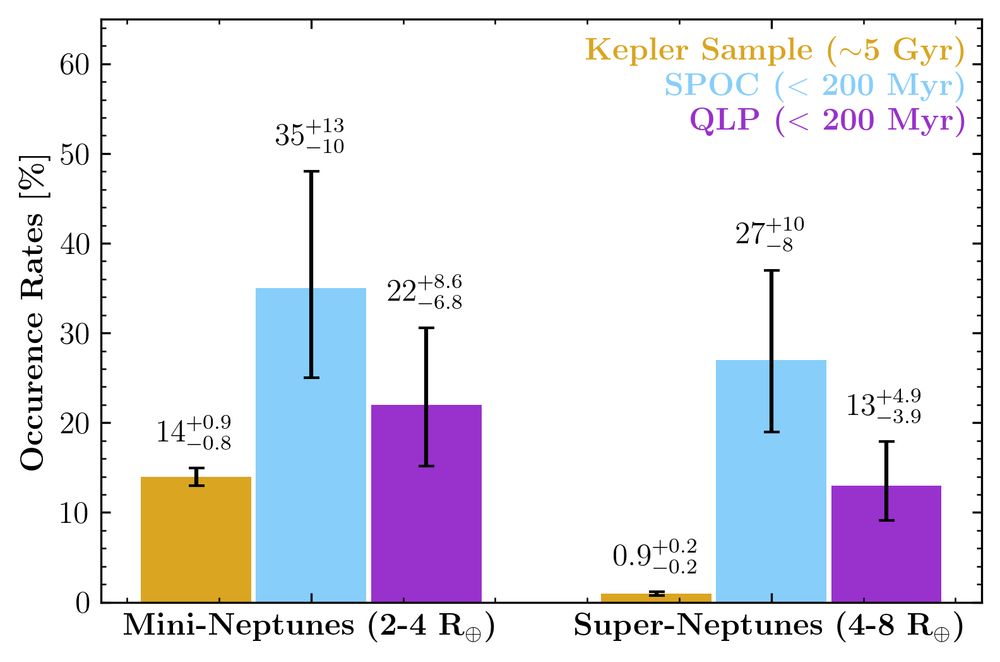
We compare the young planet population against planet yield predictions from Kepler statistics and planet evolution models. We find the young planet population is most consistent with that of H/He dominated atmospheres undergoing photoevaporative escape.

March 7, 2024 at 3:31 AM
We compare the young planet population against planet yield predictions from Kepler statistics and planet evolution models. We find the young planet population is most consistent with that of H/He dominated atmospheres undergoing photoevaporative escape.
Both water-worlds and H/He dominated worlds can explain the Kepler distribution of small planets. They are degenerate at a few Gyr, but the two models differ most when the planets are young. (art credit to my wonderful advisor @georgezhouastro.bsky.social )

March 7, 2024 at 3:30 AM
Both water-worlds and H/He dominated worlds can explain the Kepler distribution of small planets. They are degenerate at a few Gyr, but the two models differ most when the planets are young. (art credit to my wonderful advisor @georgezhouastro.bsky.social )
My first PhD paper on "The occurrence of small, short-period planets younger than 200 Myr with TESS" has been accepted to AJ and is now available on arXiv! I'll also be presenting a poster on the paper at #ExSSV (607.02)!
arxiv.org/abs/2403.03261
arxiv.org/abs/2403.03261
March 7, 2024 at 3:30 AM
My first PhD paper on "The occurrence of small, short-period planets younger than 200 Myr with TESS" has been accepted to AJ and is now available on arXiv! I'll also be presenting a poster on the paper at #ExSSV (607.02)!
arxiv.org/abs/2403.03261
arxiv.org/abs/2403.03261