




Spheon
@suipeng.bsky.social
Tropical ecologist 🌿🌴.
Small mammal enthusiast 🐿🐀
Small mammal enthusiast 🐿🐀
Pray for Sabah

Sabah landslides and floods kill 13 #news
September 15, 2025 at 4:00 PM
Pray for Sabah
Reposted by Spheon

Researchers, @emilywarner.bsky.social & @ellabrowning.bsky.social have just returned from fieldwork in #Scotland, where they are using passive acoustic monitoring to survey bats & birds, & trialling a method for assessing invertebrates. Their passion for their research comes across in this blog.
Oxford Biodiversity Network | Acoustic monitoring fieldwork in the Scottish Highlands
The Oxford Biodiversity Network is a network of researchers and practitioners in and around the University working on biodiversity. The network includes academics, senior researchers, students, and st...
www.biodiversity.ox.ac.uk
July 7, 2025 at 2:56 PM
Researchers, @emilywarner.bsky.social & @ellabrowning.bsky.social have just returned from fieldwork in #Scotland, where they are using passive acoustic monitoring to survey bats & birds, & trialling a method for assessing invertebrates. Their passion for their research comes across in this blog.
Reposted by Spheon

Pollinator decline has captured global attention, but another plant-animal mutualism is quietly unraveling.
Our new Nature Reviews Biodiversity article synthesizes global evidence on seed disperser decline and what it means for plant biodiversity, ecosystem recovery, and climate adaptation. 🧵
Our new Nature Reviews Biodiversity article synthesizes global evidence on seed disperser decline and what it means for plant biodiversity, ecosystem recovery, and climate adaptation. 🧵
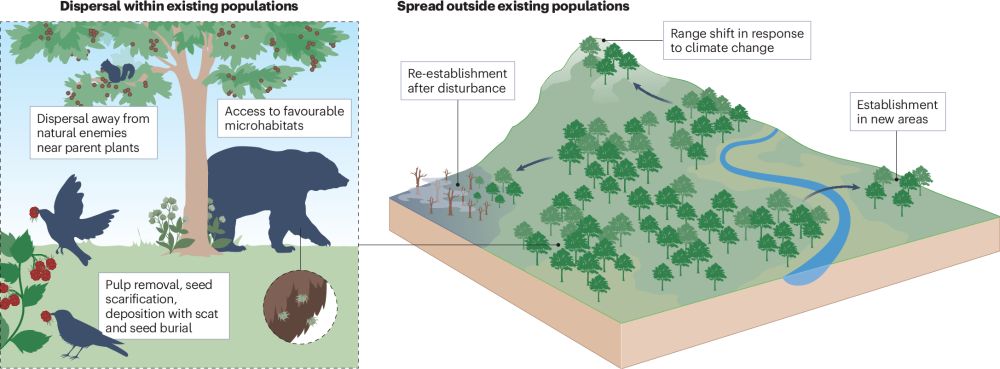
Drivers and impacts of global seed disperser decline
Nature Reviews Biodiversity - Many plants rely on animals to disperse their seeds, but some groups of these seed-dispersing animals are facing severe declines. This Review summarizes evidence of...
rdcu.be
May 19, 2025 at 1:35 AM
Pollinator decline has captured global attention, but another plant-animal mutualism is quietly unraveling.
Our new Nature Reviews Biodiversity article synthesizes global evidence on seed disperser decline and what it means for plant biodiversity, ecosystem recovery, and climate adaptation. 🧵
Our new Nature Reviews Biodiversity article synthesizes global evidence on seed disperser decline and what it means for plant biodiversity, ecosystem recovery, and climate adaptation. 🧵
Reposted by Spheon

Many long-tailed macaques imported into the United States from Southeast Asia were likely poached from the wild and then sold as captive-bred to medical research institutions, a recent report alleges.
Despite concerns, global wildlife trade regulator CITES did not ban the trade.
Despite concerns, global wildlife trade regulator CITES did not ban the trade.

Report alleges criminality in Cambodian, Vietnamese monkey trade
BANGKOK — Many long-tailed macaques imported into the United States from Southeast Asia were likely poached from the wild and then sold as captive-bred to medical research institutions, a recent…
news.mongabay.com
April 21, 2025 at 1:10 PM
Many long-tailed macaques imported into the United States from Southeast Asia were likely poached from the wild and then sold as captive-bred to medical research institutions, a recent report alleges.
Despite concerns, global wildlife trade regulator CITES did not ban the trade.
Despite concerns, global wildlife trade regulator CITES did not ban the trade.
Reposted by Spheon
[COMMENTARY]
As authorities have continued to criminalize great ape trafficking, “small apes” like gibbons, which are also coveted by the illegal pet trade, are likely to see an increasing threat to their long-term survival.
*The views expressed are those of the author, not necessarily Mongabay.
As authorities have continued to criminalize great ape trafficking, “small apes” like gibbons, which are also coveted by the illegal pet trade, are likely to see an increasing threat to their long-term survival.
*The views expressed are those of the author, not necessarily Mongabay.

Illegal trafficking of siamang gibbons is a concerning and underreported crisis (commentary)
Siamangs are the largest of the 20 gibbon species, and belong to their own genus, Symphalangus. Distributed across Sumatra, Peninsular Malaysia, and the southernmost part of Thailand, their…
news.mongabay.com
April 21, 2025 at 12:53 AM
[COMMENTARY]
As authorities have continued to criminalize great ape trafficking, “small apes” like gibbons, which are also coveted by the illegal pet trade, are likely to see an increasing threat to their long-term survival.
*The views expressed are those of the author, not necessarily Mongabay.
As authorities have continued to criminalize great ape trafficking, “small apes” like gibbons, which are also coveted by the illegal pet trade, are likely to see an increasing threat to their long-term survival.
*The views expressed are those of the author, not necessarily Mongabay.