




Society for Phenomenology and Existential Philosophy
@speporg.bsky.social
Inaugurated October 26, 1962 at Northwestern University, SPEP is a professional organization devoted to supporting philosophy inspired by continental European traditions. With over 2500 members SPEP is among the largest American philosophical societies.
this but unironically. Logicians barely even have a theory of hermeneutics smh and I'm supposed to listen to them?

September 23, 2025 at 12:35 AM
this but unironically. Logicians barely even have a theory of hermeneutics smh and I'm supposed to listen to them?
Next Wednesday SPEP hosts its inaugural webinar, this time on "Black Philosophy for Turbulent Times," in an ongoing series with updates to come; register for the April 23 evening event at this link! pomonacollege.zoom.us/webinar/regi...

April 15, 2025 at 5:09 PM
Next Wednesday SPEP hosts its inaugural webinar, this time on "Black Philosophy for Turbulent Times," in an ongoing series with updates to come; register for the April 23 evening event at this link! pomonacollege.zoom.us/webinar/regi...
On the French existentialists being based and epic: Sartre and de Beauvoir only caring about phenomenology insofar as it is in service of drinking cocktails

April 11, 2025 at 8:15 PM
On the French existentialists being based and epic: Sartre and de Beauvoir only caring about phenomenology insofar as it is in service of drinking cocktails
human resources v.s. ruthless critique of all existing things

March 24, 2025 at 5:49 PM
human resources v.s. ruthless critique of all existing things
Since getting to know this freest and mightiest of souls, I at least have come to feel what he felt about Plutarch: 'as soon as I glance at him I grow a leg or a wing.' If I were set the task, I could endeavour to make myself at home in the world with him.” Nietzsche by Munch:

February 28, 2025 at 5:12 PM
Since getting to know this freest and mightiest of souls, I at least have come to feel what he felt about Plutarch: 'as soon as I glance at him I grow a leg or a wing.' If I were set the task, I could endeavour to make myself at home in the world with him.” Nietzsche by Munch:
In her titular essay Virginia Woolf wrote “After all, in the whole of literature, how many people have succeeded in drawing themselves with a pen? Only Montaigne & Pepys & Rousseau perhaps [. . .] this art belonged to one man only: to Montaigne." Photographed by Gisèle Freund:

February 28, 2025 at 5:12 PM
In her titular essay Virginia Woolf wrote “After all, in the whole of literature, how many people have succeeded in drawing themselves with a pen? Only Montaigne & Pepys & Rousseau perhaps [. . .] this art belonged to one man only: to Montaigne." Photographed by Gisèle Freund:
Celebrated by the modernists, T.S. Eliot wrote of Pascal’s antagonism toward de Montaigne that “by the time a man knew Montaigne well enough to attack him, he would already be thoroughly infected by him.” Eliot photographed below diagramming his play The Cocktail Party:

February 28, 2025 at 5:12 PM
Celebrated by the modernists, T.S. Eliot wrote of Pascal’s antagonism toward de Montaigne that “by the time a man knew Montaigne well enough to attack him, he would already be thoroughly infected by him.” Eliot photographed below diagramming his play The Cocktail Party:
. . . a philosopher among fanatics, and who paints under his name our weaknesses and our follies–he is a man who will always be loved.” Voltaire depicted below in a bronze statue by the French rococo sculptor Jean-Antoine Houdon.

February 28, 2025 at 5:12 PM
. . . a philosopher among fanatics, and who paints under his name our weaknesses and our follies–he is a man who will always be loved.” Voltaire depicted below in a bronze statue by the French rococo sculptor Jean-Antoine Houdon.
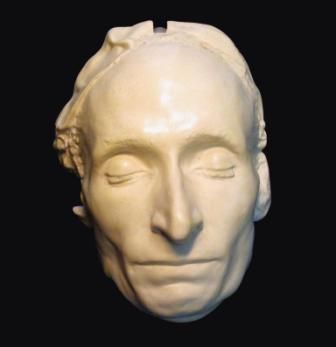
De Montaigne’s great peer in the French moralist tradition, Blaise Pascal, nursed a lifelong ambition to refute the man. In the Pensées, Pascal attacked de Montaigne for his unmethodical style, lack of piety, & literary conceit for self-exposition. See below Pascal's death mask.
February 28, 2025 at 5:12 PM
De Montaigne’s great peer in the French moralist tradition, Blaise Pascal, nursed a lifelong ambition to refute the man. In the Pensées, Pascal attacked de Montaigne for his unmethodical style, lack of piety, & literary conceit for self-exposition. See below Pascal's death mask.
Known by his motto, inscripted below, “What do I know?” (que sçay-je? in Middle-French, the language he wrote his Essays in, breaking from the prevailing Latin tradition).

February 28, 2025 at 5:12 PM
Known by his motto, inscripted below, “What do I know?” (que sçay-je? in Middle-French, the language he wrote his Essays in, breaking from the prevailing Latin tradition).
Died aged 59 in 1592. Famous as a statesman, later for popularizing the essay as a literary genre, de Montaigne’s influence extends beyond his towering stature in the Renaissance era, reaching philosophers as varied from Francis Bacon to Friedrich Nietzsche. Château de Montaigne:

February 28, 2025 at 5:12 PM
Died aged 59 in 1592. Famous as a statesman, later for popularizing the essay as a literary genre, de Montaigne’s influence extends beyond his towering stature in the Renaissance era, reaching philosophers as varied from Francis Bacon to Friedrich Nietzsche. Château de Montaigne:
Born February 28, 1533, at the Château de Montaigne in the Kingdom of France was Michel Eyquem, Seigneur de Montaigne, known today as celebrated man of letters Michel de Montaigne. Pictured below in a depiction by the famed portrait artist of 17th C Europe Daniel Dumonstier.

February 28, 2025 at 5:12 PM
Born February 28, 1533, at the Château de Montaigne in the Kingdom of France was Michel Eyquem, Seigneur de Montaigne, known today as celebrated man of letters Michel de Montaigne. Pictured below in a depiction by the famed portrait artist of 17th C Europe Daniel Dumonstier.