



SpaceAstronomer
@spaceastronomer.bsky.social
https://www.spaceastronomer.com/
SpaceAstronomer. Alfonso Fernandez-Barandiaran MSc in Physics, Computer Science professional & amateur astronomer. Astronomy, Space, Astronomía, Espacio
SpaceAstronomer. Alfonso Fernandez-Barandiaran MSc in Physics, Computer Science professional & amateur astronomer. Astronomy, Space, Astronomía, Espacio
AstroBin's Image of the Day: "LDN1622" by 盘尼西林Peniciliao
www.astrobin.com/z7expt/
www.astrobin.com/z7expt/

November 28, 2025 at 12:19 PM
AstroBin's Image of the Day: "LDN1622" by 盘尼西林Peniciliao
www.astrobin.com/z7expt/
www.astrobin.com/z7expt/
#PPOD: NASA’s JWST observed Herbig-Haro 49/50, an outflow from a nearby still-forming star, in high-resolution near- and mid-infrared light. The young star is off to the lower right corner of the Webb image. Credit: NASA, ESA, CSA, STScI 🧪 🔭 by @setiinstitute.bsky.social

November 17, 2025 at 5:22 PM
#PPOD: NASA’s JWST observed Herbig-Haro 49/50, an outflow from a nearby still-forming star, in high-resolution near- and mid-infrared light. The young star is off to the lower right corner of the Webb image. Credit: NASA, ESA, CSA, STScI 🧪 🔭 by @setiinstitute.bsky.social
AstroBin's Image of the Day: "A deep look at the Milky Way Core | 135mm HaRGB Mosaic" by Jakob Sahner
www.astrobin.com/kgjlxo/
#astrophotography by @astrobin.com
www.astrobin.com/kgjlxo/
#astrophotography by @astrobin.com

November 2, 2025 at 8:43 AM
AstroBin's Image of the Day: "A deep look at the Milky Way Core | 135mm HaRGB Mosaic" by Jakob Sahner
www.astrobin.com/kgjlxo/
#astrophotography by @astrobin.com
www.astrobin.com/kgjlxo/
#astrophotography by @astrobin.com
AstroBin's Image of the Day: "Exploring in detail the Western Veil in SHO with RGB stars" by Nicola Beltraminelli
www.astrobin.com/zecrfo/
#astrophotography
www.astrobin.com/zecrfo/
#astrophotography

October 21, 2025 at 12:47 PM
AstroBin's Image of the Day: "Exploring in detail the Western Veil in SHO with RGB stars" by Nicola Beltraminelli
www.astrobin.com/zecrfo/
#astrophotography
www.astrobin.com/zecrfo/
#astrophotography
AstroBin's Image of the Day: "Beneath the Lagoon" by Wolfgang Promper
www.astrobin.com/iut7qp/
#astrophotography
By @astrobin.com
www.astrobin.com/iut7qp/
#astrophotography
By @astrobin.com

August 10, 2025 at 10:06 AM
AstroBin's Image of the Day: "Beneath the Lagoon" by Wolfgang Promper
www.astrobin.com/iut7qp/
#astrophotography
By @astrobin.com
www.astrobin.com/iut7qp/
#astrophotography
By @astrobin.com
The planet Saturn taken by the James Webb Space Telescope!!

July 24, 2025 at 1:02 PM
The planet Saturn taken by the James Webb Space Telescope!!
Download and print a mini poster featuring an infrared image of PLCK G165.7 captured in 2023 by the James Webb Space Telescope. Perfect for posting at home, school, work, or around your neighborhood! 🔭 🧪 #AAS246
➡️ webbtelescope.pub/4dW0H8f by @stsci.edu
➡️ webbtelescope.pub/4dW0H8f by @stsci.edu

June 10, 2025 at 5:23 PM
Download and print a mini poster featuring an infrared image of PLCK G165.7 captured in 2023 by the James Webb Space Telescope. Perfect for posting at home, school, work, or around your neighborhood! 🔭 🧪 #AAS246
➡️ webbtelescope.pub/4dW0H8f by @stsci.edu
➡️ webbtelescope.pub/4dW0H8f by @stsci.edu
The Pillars of Creation, seen here in mid-infrared by #NASAWebb, adds to decades of research about star formation by helping astronomers analyze the densest dusts and gases of the region, and improving the precision of their star-formation models: bit.ly/45ayCYi by @stsci.edu

June 9, 2025 at 5:01 PM
The Pillars of Creation, seen here in mid-infrared by #NASAWebb, adds to decades of research about star formation by helping astronomers analyze the densest dusts and gases of the region, and improving the precision of their star-formation models: bit.ly/45ayCYi by @stsci.edu
The galaxy catalogued as UGC 1810 by itself, but with its collisional partner, it is known as Arp 273. The overall shape of the UGC 1810 -- in particular its blue outer ring -- is likely a result of wild and violent gravitational interactions. By @setiinstitute.bsky.social

June 7, 2025 at 6:16 PM
The galaxy catalogued as UGC 1810 by itself, but with its collisional partner, it is known as Arp 273. The overall shape of the UGC 1810 -- in particular its blue outer ring -- is likely a result of wild and violent gravitational interactions. By @setiinstitute.bsky.social
The gruesome palette of these galaxies is owed to a mix of mid-infrared light from NASA’s James Webb Space Telescope and visible and ultraviolet light from NASA’s Hubble Space Telescope. The pair grazed one another millions of years ago. Credit: NASA, ESA, CSA, STScI
(by @setiinstitute.bsky.social)
(by @setiinstitute.bsky.social)

May 30, 2025 at 4:50 PM
The gruesome palette of these galaxies is owed to a mix of mid-infrared light from NASA’s James Webb Space Telescope and visible and ultraviolet light from NASA’s Hubble Space Telescope. The pair grazed one another millions of years ago. Credit: NASA, ESA, CSA, STScI
(by @setiinstitute.bsky.social)
(by @setiinstitute.bsky.social)
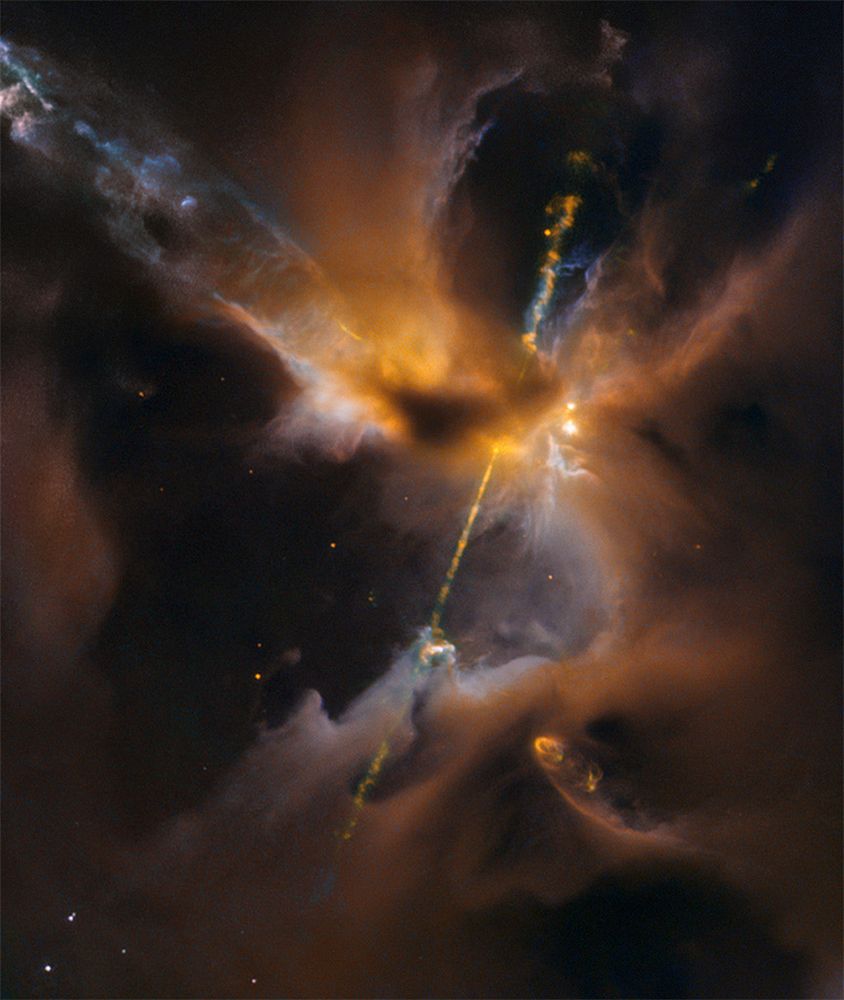
Herbig-Haro 24
APOD 2025 May 28
Image Credit: NASA
This might look like a double-bladed lightsaber, but these two cosmic jets actually beam outward from a newborn star in a galaxy near you.
APOD 2025 May 28
Image Credit: NASA
This might look like a double-bladed lightsaber, but these two cosmic jets actually beam outward from a newborn star in a galaxy near you.
May 28, 2025 at 8:34 AM
Herbig-Haro 24
APOD 2025 May 28
Image Credit: NASA
This might look like a double-bladed lightsaber, but these two cosmic jets actually beam outward from a newborn star in a galaxy near you.
APOD 2025 May 28
Image Credit: NASA
This might look like a double-bladed lightsaber, but these two cosmic jets actually beam outward from a newborn star in a galaxy near you.
Messier 101.
Big, beautiful spiral galaxy M101 is one of the last entries in Charles Messier's famous catalog, but definitely not one of the least. About 170,000 light-years across, this galaxy is enormous, almost twice the size of our own Milky Way.
#APOD 2025 May 16
Image Credit: NASA
Big, beautiful spiral galaxy M101 is one of the last entries in Charles Messier's famous catalog, but definitely not one of the least. About 170,000 light-years across, this galaxy is enormous, almost twice the size of our own Milky Way.
#APOD 2025 May 16
Image Credit: NASA

May 16, 2025 at 7:30 AM
Messier 101.
Big, beautiful spiral galaxy M101 is one of the last entries in Charles Messier's famous catalog, but definitely not one of the least. About 170,000 light-years across, this galaxy is enormous, almost twice the size of our own Milky Way.
#APOD 2025 May 16
Image Credit: NASA
Big, beautiful spiral galaxy M101 is one of the last entries in Charles Messier's famous catalog, but definitely not one of the least. About 170,000 light-years across, this galaxy is enormous, almost twice the size of our own Milky Way.
#APOD 2025 May 16
Image Credit: NASA
NASA/ESA Hubble Space Telescope Picture of the Week: a dwarf galaxy called the Large Magellanic Cloud. Located 160 000 light-years away in the constellations Dorado and Mensa, it is the largest of the Milky Way’s many small satellite galaxies.
Credit: ESA/Hubble & NASA, C. Murray
Credit: ESA/Hubble & NASA, C. Murray

May 12, 2025 at 2:30 PM
NASA/ESA Hubble Space Telescope Picture of the Week: a dwarf galaxy called the Large Magellanic Cloud. Located 160 000 light-years away in the constellations Dorado and Mensa, it is the largest of the Milky Way’s many small satellite galaxies.
Credit: ESA/Hubble & NASA, C. Murray
Credit: ESA/Hubble & NASA, C. Murray
Galaxy Wars: M81 versus M82
In the upper left corner, surrounded by blue arms and dotted with red nebulas, is spiral galaxy M81. In the lower right corner, by a light central line and by red glowing gas, is irregular galaxy M82.
Image Credit & Copyright: Collaborative Astrophotography Team (CAT)
In the upper left corner, surrounded by blue arms and dotted with red nebulas, is spiral galaxy M81. In the lower right corner, by a light central line and by red glowing gas, is irregular galaxy M82.
Image Credit & Copyright: Collaborative Astrophotography Team (CAT)

May 10, 2025 at 6:12 PM
Galaxy Wars: M81 versus M82
In the upper left corner, surrounded by blue arms and dotted with red nebulas, is spiral galaxy M81. In the lower right corner, by a light central line and by red glowing gas, is irregular galaxy M82.
Image Credit & Copyright: Collaborative Astrophotography Team (CAT)
In the upper left corner, surrounded by blue arms and dotted with red nebulas, is spiral galaxy M81. In the lower right corner, by a light central line and by red glowing gas, is irregular galaxy M82.
Image Credit & Copyright: Collaborative Astrophotography Team (CAT)
Hubble Images a Peculiar Spiral www.nasa.gov/image-detail... vía @NASA

Hubble Images a Peculiar Spiral - NASA
This NASA/ESA Hubble Space Telescope image features a peculiar spiral galaxy called Arp 184 or NGC 1961.
www.nasa.gov
May 9, 2025 at 3:27 PM
Hubble Images a Peculiar Spiral www.nasa.gov/image-detail... vía @NASA

Happy 35th birthday, Hubble Telescope! 10 times the iconic observatory blew astronomers' minds (photos).
Every modern astronomy textbook includes contributions from Hubble.
www.space.com/space-explor...
Every modern astronomy textbook includes contributions from Hubble.
www.space.com/space-explor...

Happy 35th birthday, Hubble Telescope! 10 times the iconic observatory blew astronomers' minds (photos)
"Every modern astronomy textbook includes contributions from Hubble."
www.space.com
April 24, 2025 at 3:19 PM
Happy 35th birthday, Hubble Telescope! 10 times the iconic observatory blew astronomers' minds (photos).
Every modern astronomy textbook includes contributions from Hubble.
www.space.com/space-explor...
Every modern astronomy textbook includes contributions from Hubble.
www.space.com/space-explor...
NASA Takes Advantage of Planetary Alignment to Take a Peek at Uranus.
A stellar occultation this month gave scientists an opportunity to scrutinize the seventh planet from the Sun.
gizmodo.com/nasa-takes-a...
A stellar occultation this month gave scientists an opportunity to scrutinize the seventh planet from the Sun.
gizmodo.com/nasa-takes-a...

NASA Takes Advantage of Planetary Alignment to Take a Peek at Uranus
A stellar occultation this month gave scientists an opportunity to scrutinize the seventh planet from the Sun.
gizmodo.com
April 24, 2025 at 11:03 AM
NASA Takes Advantage of Planetary Alignment to Take a Peek at Uranus.
A stellar occultation this month gave scientists an opportunity to scrutinize the seventh planet from the Sun.
gizmodo.com/nasa-takes-a...
A stellar occultation this month gave scientists an opportunity to scrutinize the seventh planet from the Sun.
gizmodo.com/nasa-takes-a...

April 23, 2025 at 10:47 AM
Terminator Moon: A Moonscape of Shadows
What's different about this Moon? It's the terminators. In the featured image, you can't directly see any terminator -- the line that divides the light of day from the dark of night.
Image Credit & Copyright: Rich Addis
#APOD 2025 April 22
What's different about this Moon? It's the terminators. In the featured image, you can't directly see any terminator -- the line that divides the light of day from the dark of night.
Image Credit & Copyright: Rich Addis
#APOD 2025 April 22

April 22, 2025 at 10:54 AM
Terminator Moon: A Moonscape of Shadows
What's different about this Moon? It's the terminators. In the featured image, you can't directly see any terminator -- the line that divides the light of day from the dark of night.
Image Credit & Copyright: Rich Addis
#APOD 2025 April 22
What's different about this Moon? It's the terminators. In the featured image, you can't directly see any terminator -- the line that divides the light of day from the dark of night.
Image Credit & Copyright: Rich Addis
#APOD 2025 April 22
At 160,000 light-years away, NGC 1850 shines in this image from Hubble's 33rd year.
Like most globular clusters, NGC 1850 is a spherical collection of packed stars held together by gravity. However, unlike similar clusters, its stars are younger: go.nasa.gov/3Ey8bkm by NASAhubble
Like most globular clusters, NGC 1850 is a spherical collection of packed stars held together by gravity. However, unlike similar clusters, its stars are younger: go.nasa.gov/3Ey8bkm by NASAhubble

April 21, 2025 at 9:07 PM
At 160,000 light-years away, NGC 1850 shines in this image from Hubble's 33rd year.
Like most globular clusters, NGC 1850 is a spherical collection of packed stars held together by gravity. However, unlike similar clusters, its stars are younger: go.nasa.gov/3Ey8bkm by NASAhubble
Like most globular clusters, NGC 1850 is a spherical collection of packed stars held together by gravity. However, unlike similar clusters, its stars are younger: go.nasa.gov/3Ey8bkm by NASAhubble
Butterfly Nebula
Shared in Hubble's 31st year, this image shows a nebula across a broad spectrum of light – ranging from ultraviolet to near-infrared.
Shared in Hubble's 31st year, this image shows a nebula across a broad spectrum of light – ranging from ultraviolet to near-infrared.

April 19, 2025 at 5:56 PM
Butterfly Nebula
Shared in Hubble's 31st year, this image shows a nebula across a broad spectrum of light – ranging from ultraviolet to near-infrared.
Shared in Hubble's 31st year, this image shows a nebula across a broad spectrum of light – ranging from ultraviolet to near-infrared.
Planetary Nebula NGC 1514 from Webb
Image Credit: NASA, ESA, CSA, M. E. Ressler (JPL) et al.; Processing: Judy Schmidt
By @apod.shinyakato.dev
Image Credit: NASA, ESA, CSA, M. E. Ressler (JPL) et al.; Processing: Judy Schmidt
By @apod.shinyakato.dev

April 18, 2025 at 10:57 PM
Planetary Nebula NGC 1514 from Webb
Image Credit: NASA, ESA, CSA, M. E. Ressler (JPL) et al.; Processing: Judy Schmidt
By @apod.shinyakato.dev
Image Credit: NASA, ESA, CSA, M. E. Ressler (JPL) et al.; Processing: Judy Schmidt
By @apod.shinyakato.dev
The blue star cluster shining in the center of the Tarantula Nebula—seen in this #NASAWebb image, was born within the ribbons of silk-like dust that surround it. In time, all of this dust will either be blown away by or absorbed into new stars & planets bit.ly/4bI5Tv5 by @spacetelescope.bsky.social

April 18, 2025 at 4:49 PM
The blue star cluster shining in the center of the Tarantula Nebula—seen in this #NASAWebb image, was born within the ribbons of silk-like dust that surround it. In time, all of this dust will either be blown away by or absorbed into new stars & planets bit.ly/4bI5Tv5 by @spacetelescope.bsky.social
This gorgeous Hubble image displays the galaxies NGC 4302 — seen edge-on — and NGC 4298, both located about 55 million light-years away. By @mariolivio.bsky.social

April 14, 2025 at 7:55 AM
This gorgeous Hubble image displays the galaxies NGC 4302 — seen edge-on — and NGC 4298, both located about 55 million light-years away. By @mariolivio.bsky.social