



Society of Nematologists
@son-nemaweb.bsky.social
We are excited to announce that the application window for the new Richard Sikora Travel Award is now open! This travel award is for SON members grad students and/or postdocs presenting about Integrated Nematode Management. Scan the QR code for details or here: www.nematologists.org/SON2025-Trav...

March 10, 2025 at 11:09 PM
We are excited to announce that the application window for the new Richard Sikora Travel Award is now open! This travel award is for SON members grad students and/or postdocs presenting about Integrated Nematode Management. Scan the QR code for details or here: www.nematologists.org/SON2025-Trav...
#WormFactWednesday is arriving early this week and we're talking about Trichosomoides crassicauda and endoparasitic males!
Trichosomoides crassicauda, a parasite that lives in the urinary bladder of rats, especially Epimys norvegicus, has an unusual relationship between the sexes.
Trichosomoides crassicauda, a parasite that lives in the urinary bladder of rats, especially Epimys norvegicus, has an unusual relationship between the sexes.

March 5, 2025 at 12:06 AM
#WormFactWednesday is arriving early this week and we're talking about Trichosomoides crassicauda and endoparasitic males!
Trichosomoides crassicauda, a parasite that lives in the urinary bladder of rats, especially Epimys norvegicus, has an unusual relationship between the sexes.
Trichosomoides crassicauda, a parasite that lives in the urinary bladder of rats, especially Epimys norvegicus, has an unusual relationship between the sexes.
This week the Career Development workshop organized by the SON Industry & Grad-student committees provided career path insights to SON members around the world, supporting the society’s vision to advance the science of nematology. Like this post if you'd like another workshop!

March 3, 2025 at 10:13 PM
This week the Career Development workshop organized by the SON Industry & Grad-student committees provided career path insights to SON members around the world, supporting the society’s vision to advance the science of nematology. Like this post if you'd like another workshop!
#WormFactWednesday this week is all about how epigenetics can impact inheritance and gene expression in nematodes!
The environment can alter gene expression from minor and reversible short-term changes to the DNA of the sperm and eggs.
The environment can alter gene expression from minor and reversible short-term changes to the DNA of the sperm and eggs.

February 26, 2025 at 6:31 PM
#WormFactWednesday this week is all about how epigenetics can impact inheritance and gene expression in nematodes!
The environment can alter gene expression from minor and reversible short-term changes to the DNA of the sperm and eggs.
The environment can alter gene expression from minor and reversible short-term changes to the DNA of the sperm and eggs.
Because it is similar to sleep in other animals as demonstrated by many behavioral and molecular characteristics such as periods of frequently interrupted movements, this quiescence is considered as a state of sleep in nematodes.

February 19, 2025 at 6:03 PM
Because it is similar to sleep in other animals as demonstrated by many behavioral and molecular characteristics such as periods of frequently interrupted movements, this quiescence is considered as a state of sleep in nematodes.
#WormFactWednesday is all about two things we love - sleep & nematodes!
Most nematodes including Caenorhabditis elegans molt four times producing four juvenile stages before becoming an adult. Lethargus is a period of quiescence between the juvenile stages.
Most nematodes including Caenorhabditis elegans molt four times producing four juvenile stages before becoming an adult. Lethargus is a period of quiescence between the juvenile stages.

February 19, 2025 at 6:03 PM
#WormFactWednesday is all about two things we love - sleep & nematodes!
Most nematodes including Caenorhabditis elegans molt four times producing four juvenile stages before becoming an adult. Lethargus is a period of quiescence between the juvenile stages.
Most nematodes including Caenorhabditis elegans molt four times producing four juvenile stages before becoming an adult. Lethargus is a period of quiescence between the juvenile stages.
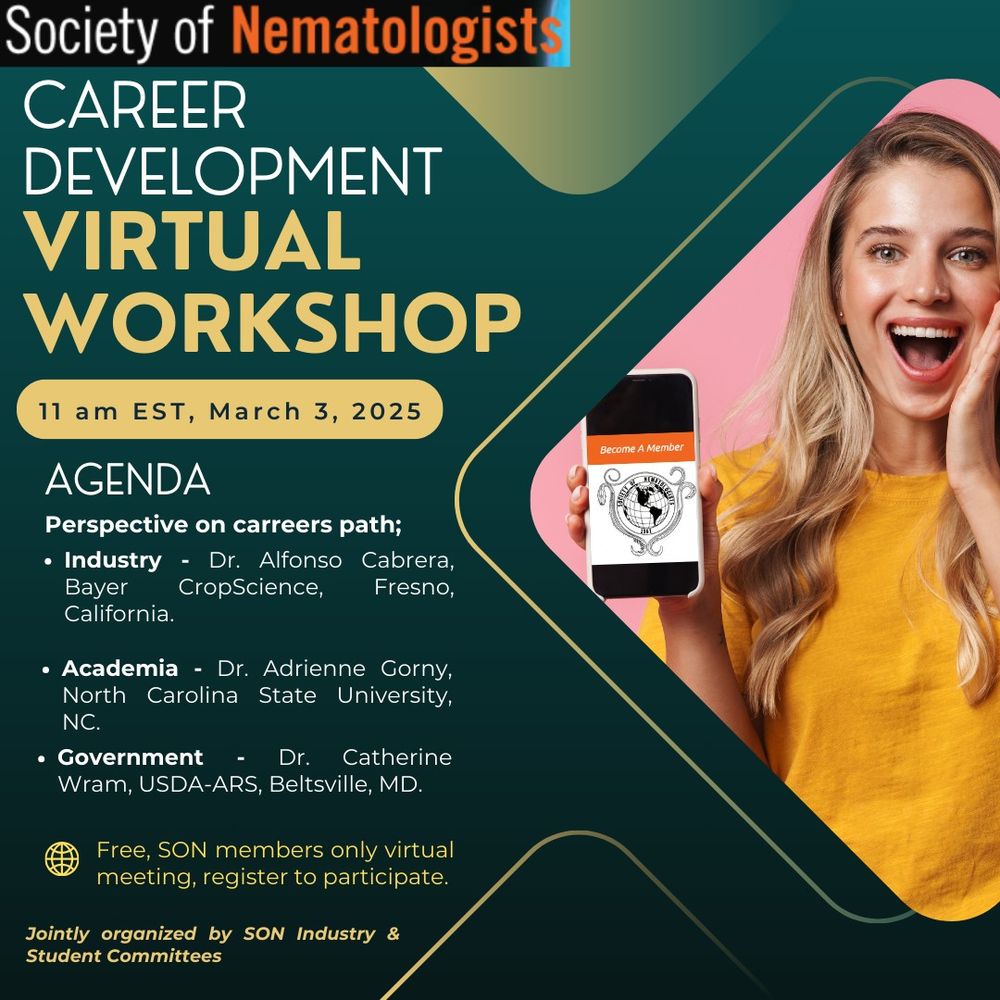
Very exciting Career Development workshop provided by the SON Industry & Student committees!
Registration & event information can be found here: nematologists.org/event-6040380
Hope to see you there!
Registration & event information can be found here: nematologists.org/event-6040380
Hope to see you there!
February 18, 2025 at 6:23 PM
Very exciting Career Development workshop provided by the SON Industry & Student committees!
Registration & event information can be found here: nematologists.org/event-6040380
Hope to see you there!
Registration & event information can be found here: nematologists.org/event-6040380
Hope to see you there!

This week our #WormFactWednesday is dedicated to one of the Pioneers of Nematode Management, Amegda Jack Overman (1920 - 2011).
"An outstanding agriculturist, she developed fumigation practices that allowed the reuse of old land for growing vegetables and ornamentals.
"An outstanding agriculturist, she developed fumigation practices that allowed the reuse of old land for growing vegetables and ornamentals.

February 12, 2025 at 7:06 PM
This week our #WormFactWednesday is dedicated to one of the Pioneers of Nematode Management, Amegda Jack Overman (1920 - 2011).
"An outstanding agriculturist, she developed fumigation practices that allowed the reuse of old land for growing vegetables and ornamentals.
"An outstanding agriculturist, she developed fumigation practices that allowed the reuse of old land for growing vegetables and ornamentals.
Exciting postdoc opportunity to work on the beech leaf nematode with Dr. Kantor at Penn State!
The role will include designing, conducting, and analyzing a comparative greenhouse host-range test of beech leaf nematode, Litylenchus crenatae spp. mccanii (Lcm), on native tree species.
The role will include designing, conducting, and analyzing a comparative greenhouse host-range test of beech leaf nematode, Litylenchus crenatae spp. mccanii (Lcm), on native tree species.

February 7, 2025 at 10:33 PM
Exciting postdoc opportunity to work on the beech leaf nematode with Dr. Kantor at Penn State!
The role will include designing, conducting, and analyzing a comparative greenhouse host-range test of beech leaf nematode, Litylenchus crenatae spp. mccanii (Lcm), on native tree species.
The role will include designing, conducting, and analyzing a comparative greenhouse host-range test of beech leaf nematode, Litylenchus crenatae spp. mccanii (Lcm), on native tree species.
The 1st #WormFactWednesday of February is all about the synergistic interactions of nematodes and fungus!
Nematode-fungus disease interactions have been known since the descriptions of the genus Meloidogyne by Emilio Goeldi and M. arenaria by Atkinson, both in 1892.
Nematode-fungus disease interactions have been known since the descriptions of the genus Meloidogyne by Emilio Goeldi and M. arenaria by Atkinson, both in 1892.

February 5, 2025 at 7:08 PM
The 1st #WormFactWednesday of February is all about the synergistic interactions of nematodes and fungus!
Nematode-fungus disease interactions have been known since the descriptions of the genus Meloidogyne by Emilio Goeldi and M. arenaria by Atkinson, both in 1892.
Nematode-fungus disease interactions have been known since the descriptions of the genus Meloidogyne by Emilio Goeldi and M. arenaria by Atkinson, both in 1892.
Here you can see an example of different giant cells from the paper "Host-specific signatures of the cell wall changes induced by the plant parasitic nematode, Meloidogyne incognita" (Bozbuga et al. 2018)
www.nature.com/articles/s41...
www.nature.com/articles/s41...

January 30, 2025 at 5:23 AM
Here you can see an example of different giant cells from the paper "Host-specific signatures of the cell wall changes induced by the plant parasitic nematode, Meloidogyne incognita" (Bozbuga et al. 2018)
www.nature.com/articles/s41...
www.nature.com/articles/s41...
#WormFactWednesday is coming in hot this week with a fact about the metabolic sinks root-knot nematodes create with their feeding sites!
"The giant cells of root-knot nematodes are hypermetabolic feeding sites that are located in the middle of the vascular cylinder within the roots.
"The giant cells of root-knot nematodes are hypermetabolic feeding sites that are located in the middle of the vascular cylinder within the roots.

January 30, 2025 at 5:23 AM
#WormFactWednesday is coming in hot this week with a fact about the metabolic sinks root-knot nematodes create with their feeding sites!
"The giant cells of root-knot nematodes are hypermetabolic feeding sites that are located in the middle of the vascular cylinder within the roots.
"The giant cells of root-knot nematodes are hypermetabolic feeding sites that are located in the middle of the vascular cylinder within the roots.
An incredible example of worm-stars can be seen in Antunes et al. 2015 www.researchgate.net/publication/...

January 22, 2025 at 7:46 PM
An incredible example of worm-stars can be seen in Antunes et al. 2015 www.researchgate.net/publication/...
This #WormFactWednesday is all about nematode defense through autonomy with card #33!
"Worm-stars, produced from numerous juvenile worms stuck together at their tails by Microbacterium nematophilum, can escape by splitting in half (autonomy).
"Worm-stars, produced from numerous juvenile worms stuck together at their tails by Microbacterium nematophilum, can escape by splitting in half (autonomy).

January 22, 2025 at 7:46 PM
This #WormFactWednesday is all about nematode defense through autonomy with card #33!
"Worm-stars, produced from numerous juvenile worms stuck together at their tails by Microbacterium nematophilum, can escape by splitting in half (autonomy).
"Worm-stars, produced from numerous juvenile worms stuck together at their tails by Microbacterium nematophilum, can escape by splitting in half (autonomy).
Exciting job opportunity to be a Nematology Research Scientist at the Division of Plant Industry in Gainesville, Florida! 🐊
Application closes Sunday February 9, 2025 and more information about the position can be found here: jobs.myflorida.com/job/GAINESVI...
Application closes Sunday February 9, 2025 and more information about the position can be found here: jobs.myflorida.com/job/GAINESVI...

January 17, 2025 at 6:33 PM
Exciting job opportunity to be a Nematology Research Scientist at the Division of Plant Industry in Gainesville, Florida! 🐊
Application closes Sunday February 9, 2025 and more information about the position can be found here: jobs.myflorida.com/job/GAINESVI...
Application closes Sunday February 9, 2025 and more information about the position can be found here: jobs.myflorida.com/job/GAINESVI...
There are many species of Nepovirus with some examples being Cherry leaf roll virus, Potato virus U, Raspberry ringspot virus, Tobacco ringspot virus, and Tomato ringspot virus (image).

January 15, 2025 at 6:33 PM
There are many species of Nepovirus with some examples being Cherry leaf roll virus, Potato virus U, Raspberry ringspot virus, Tobacco ringspot virus, and Tomato ringspot virus (image).
There are 3 species of Tobravirus - Pea early-browning virus (left), Pepper ringspot virus, and Tobacco rattle virus (right).


January 15, 2025 at 6:33 PM
There are 3 species of Tobravirus - Pea early-browning virus (left), Pepper ringspot virus, and Tobacco rattle virus (right).
Another Wednesday means another Worm Fact!
Today we're discussing the role nematodes can play in vectoring the soil-borne plant viruses, the Tobra and Nepo Viruses! Nematodes are able to vector soil-borne viruses because their protein coat makes them stick to the stoma and esophageal lumen lining.
Today we're discussing the role nematodes can play in vectoring the soil-borne plant viruses, the Tobra and Nepo Viruses! Nematodes are able to vector soil-borne viruses because their protein coat makes them stick to the stoma and esophageal lumen lining.

January 15, 2025 at 6:33 PM
Another Wednesday means another Worm Fact!
Today we're discussing the role nematodes can play in vectoring the soil-borne plant viruses, the Tobra and Nepo Viruses! Nematodes are able to vector soil-borne viruses because their protein coat makes them stick to the stoma and esophageal lumen lining.
Today we're discussing the role nematodes can play in vectoring the soil-borne plant viruses, the Tobra and Nepo Viruses! Nematodes are able to vector soil-borne viruses because their protein coat makes them stick to the stoma and esophageal lumen lining.
You can see an incredible example of their hearing capabilities in this video from Iliff et al. 2021!
www.sciencedirect.com/science/arti...
www.sciencedirect.com/science/arti...
January 8, 2025 at 8:50 PM
You can see an incredible example of their hearing capabilities in this video from Iliff et al. 2021!
www.sciencedirect.com/science/arti...
www.sciencedirect.com/science/arti...
#WormFactWednesday is here again with Card #37 discussing the sensory perception capabilities of C. elegans!
Earless nematodes hear sounds through their skin. In addition to hearing, nematodes can also taste, tough, smell, perceive light, and sense their body posture (prioception).
Earless nematodes hear sounds through their skin. In addition to hearing, nematodes can also taste, tough, smell, perceive light, and sense their body posture (prioception).

January 8, 2025 at 8:50 PM
#WormFactWednesday is here again with Card #37 discussing the sensory perception capabilities of C. elegans!
Earless nematodes hear sounds through their skin. In addition to hearing, nematodes can also taste, tough, smell, perceive light, and sense their body posture (prioception).
Earless nematodes hear sounds through their skin. In addition to hearing, nematodes can also taste, tough, smell, perceive light, and sense their body posture (prioception).
Happy New Year AND Worm Fact Wednesday!!! 🎉
We're kicking off 2025 by highlighting one of the Father's of Nematology, Karl Joseph Eberth!
A pathologist and bacteriologist, he wrote a treatise on nematodes entitled, "Untersuchungen über nematoden" or "Studies on Nematodes", (1/4)
We're kicking off 2025 by highlighting one of the Father's of Nematology, Karl Joseph Eberth!
A pathologist and bacteriologist, he wrote a treatise on nematodes entitled, "Untersuchungen über nematoden" or "Studies on Nematodes", (1/4)

January 2, 2025 at 10:57 PM
Happy New Year AND Worm Fact Wednesday!!! 🎉
We're kicking off 2025 by highlighting one of the Father's of Nematology, Karl Joseph Eberth!
A pathologist and bacteriologist, he wrote a treatise on nematodes entitled, "Untersuchungen über nematoden" or "Studies on Nematodes", (1/4)
We're kicking off 2025 by highlighting one of the Father's of Nematology, Karl Joseph Eberth!
A pathologist and bacteriologist, he wrote a treatise on nematodes entitled, "Untersuchungen über nematoden" or "Studies on Nematodes", (1/4)
Exciting Post-Doc Position Opportunity!
Dr. Kantor of Penn State has a 3-year post-doc position available to work on biological control strategies for managing the North American beech leaf nematode.
U.S. citizenship is NOT required and the deadline to apply is January 15th, 2025
Dr. Kantor of Penn State has a 3-year post-doc position available to work on biological control strategies for managing the North American beech leaf nematode.
U.S. citizenship is NOT required and the deadline to apply is January 15th, 2025

December 20, 2024 at 7:29 PM
Exciting Post-Doc Position Opportunity!
Dr. Kantor of Penn State has a 3-year post-doc position available to work on biological control strategies for managing the North American beech leaf nematode.
U.S. citizenship is NOT required and the deadline to apply is January 15th, 2025
Dr. Kantor of Penn State has a 3-year post-doc position available to work on biological control strategies for managing the North American beech leaf nematode.
U.S. citizenship is NOT required and the deadline to apply is January 15th, 2025
You can find more information and images of mutant phenotypes of C. elegans in "A Transparent Window into Biology: A Primer on Caenorhabditis elegans" by Corsi, Wightman, and Chalfie (2015)

December 18, 2024 at 7:03 PM
You can find more information and images of mutant phenotypes of C. elegans in "A Transparent Window into Biology: A Primer on Caenorhabditis elegans" by Corsi, Wightman, and Chalfie (2015)
#WormFactWednesday is here to present you with card #30 - Mutant Phenotype Biology of Caenorhabditis elegans !!

December 18, 2024 at 7:03 PM
#WormFactWednesday is here to present you with card #30 - Mutant Phenotype Biology of Caenorhabditis elegans !!