


Sim
@simkoning.bsky.social
I finally found a copy! What a beautiful book

June 9, 2025 at 10:02 PM
I finally found a copy! What a beautiful book
Noticed this in the Predator Badlands trailer:

April 23, 2025 at 5:40 PM
Noticed this in the Predator Badlands trailer:
@markwitton.bsky.social I was wondering, did you know about the exoparia discovery in advance? Because it looks like you factored it in here. Or are you just that good? lol

April 1, 2025 at 6:31 PM
@markwitton.bsky.social I was wondering, did you know about the exoparia discovery in advance? Because it looks like you factored it in here. Or are you just that good? lol

Mundplatte is synonymous with "rictal plate". Here is another example from a paper on Sphenodon by a different author. The same muscles attach to the corner of your mouth and allow facial expressions, so it's not strange that they attach to the rictal plate in squamates...

April 1, 2025 at 3:56 PM
Mundplatte is synonymous with "rictal plate". Here is another example from a paper on Sphenodon by a different author. The same muscles attach to the corner of your mouth and allow facial expressions, so it's not strange that they attach to the rictal plate in squamates...
The external appearance, whether we're talking about birds or lizards, is a question of if it's covered in scales/feathers, naked skin, or what at least looks like a continuation of the oral mucosa. The last one is what I'm talking about. It's what is being mistakenly called "exposed muscle".

April 1, 2025 at 1:52 PM
The external appearance, whether we're talking about birds or lizards, is a question of if it's covered in scales/feathers, naked skin, or what at least looks like a continuation of the oral mucosa. The last one is what I'm talking about. It's what is being mistakenly called "exposed muscle".
The levator anguli oris also attaches to the corner of our mouths and is used for facial expressions. I only mentioned this to point that the underlying structure may be quite different from the exoparia. However, I've since learned it's not relevant...

April 1, 2025 at 1:52 PM
The levator anguli oris also attaches to the corner of our mouths and is used for facial expressions. I only mentioned this to point that the underlying structure may be quite different from the exoparia. However, I've since learned it's not relevant...
Found another one. Though this is more intermediate in that it just lacks feathers.

April 1, 2025 at 2:42 AM
Found another one. Though this is more intermediate in that it just lacks feathers.
I've since found some counter examples. Some birds do in fact have a "lizard-like" gape.

April 1, 2025 at 12:49 AM
I've since found some counter examples. Some birds do in fact have a "lizard-like" gape.

I've managed to find some counter examples in birds in the middle of the conversation. Oral mucosal tissue extends around the corner of the mouth in some birds as in some lizards.

April 1, 2025 at 12:44 AM
I've managed to find some counter examples in birds in the middle of the conversation. Oral mucosal tissue extends around the corner of the mouth in some birds as in some lizards.

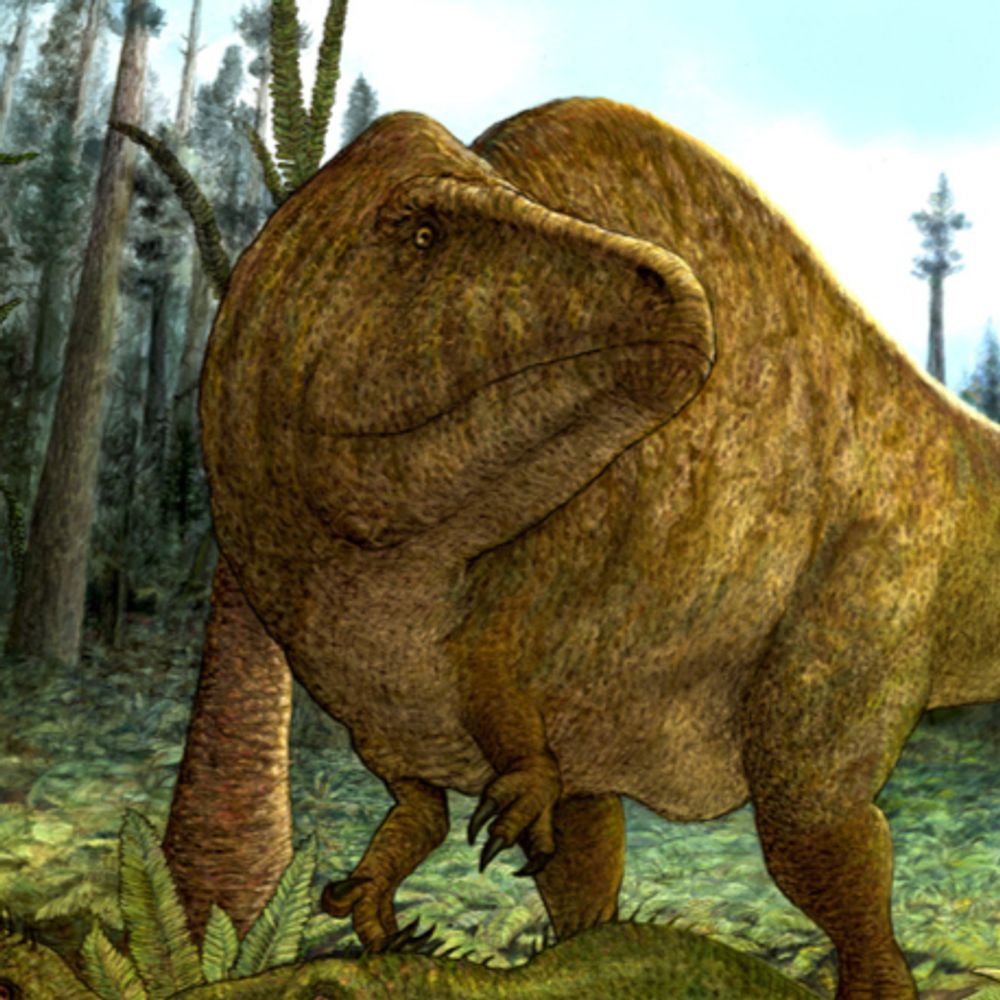
Here's an example of what I suspect is wrong. I would restore a theropod like this with a feathered rictus as in birds.

March 31, 2025 at 5:44 PM
Here's an example of what I suspect is wrong. I would restore a theropod like this with a feathered rictus as in birds.
In lizards, muscles do insert into the rictal plate, and in many lizards, like varanids, the rictus appears to be covered in mucosal tissue like the inside of the mouth. The latter isn't always true with lizards either, e.g. agamids with scaly "cheeks".

March 31, 2025 at 5:32 PM
In lizards, muscles do insert into the rictal plate, and in many lizards, like varanids, the rictus appears to be covered in mucosal tissue like the inside of the mouth. The latter isn't always true with lizards either, e.g. agamids with scaly "cheeks".