


@siddhant-arora.bsky.social
🔗 Resources for ESPnet-SDS:
📂 Codebase (part of ESPnet): github.com/espnet/espnet
📖 README & User Guide: github.com/espnet/espne...
🎥 Demo Video: www.youtube.com/watch?v=kI_D...
📂 Codebase (part of ESPnet): github.com/espnet/espnet
📖 README & User Guide: github.com/espnet/espne...
🎥 Demo Video: www.youtube.com/watch?v=kI_D...
March 17, 2025 at 2:29 PM
🔗 Resources for ESPnet-SDS:
📂 Codebase (part of ESPnet): github.com/espnet/espnet
📖 README & User Guide: github.com/espnet/espne...
🎥 Demo Video: www.youtube.com/watch?v=kI_D...
📂 Codebase (part of ESPnet): github.com/espnet/espnet
📖 README & User Guide: github.com/espnet/espne...
🎥 Demo Video: www.youtube.com/watch?v=kI_D...
This was joint work with my co-authors at
@ltiatcmu.bsky.social , Sony Japan and Hugging Face ( @shinjiw.bsky.social @pengyf.bsky.social @jiatongs.bsky.social @wanchichen.bsky.social @shikharb.bsky.social @emonosuke.bsky.social @cromz22.bsky.social @reach-vb.hf.co @wavlab.bsky.social ).
@ltiatcmu.bsky.social , Sony Japan and Hugging Face ( @shinjiw.bsky.social @pengyf.bsky.social @jiatongs.bsky.social @wanchichen.bsky.social @shikharb.bsky.social @emonosuke.bsky.social @cromz22.bsky.social @reach-vb.hf.co @wavlab.bsky.social ).
March 17, 2025 at 2:29 PM
This was joint work with my co-authors at
@ltiatcmu.bsky.social , Sony Japan and Hugging Face ( @shinjiw.bsky.social @pengyf.bsky.social @jiatongs.bsky.social @wanchichen.bsky.social @shikharb.bsky.social @emonosuke.bsky.social @cromz22.bsky.social @reach-vb.hf.co @wavlab.bsky.social ).
@ltiatcmu.bsky.social , Sony Japan and Hugging Face ( @shinjiw.bsky.social @pengyf.bsky.social @jiatongs.bsky.social @wanchichen.bsky.social @shikharb.bsky.social @emonosuke.bsky.social @cromz22.bsky.social @reach-vb.hf.co @wavlab.bsky.social ).
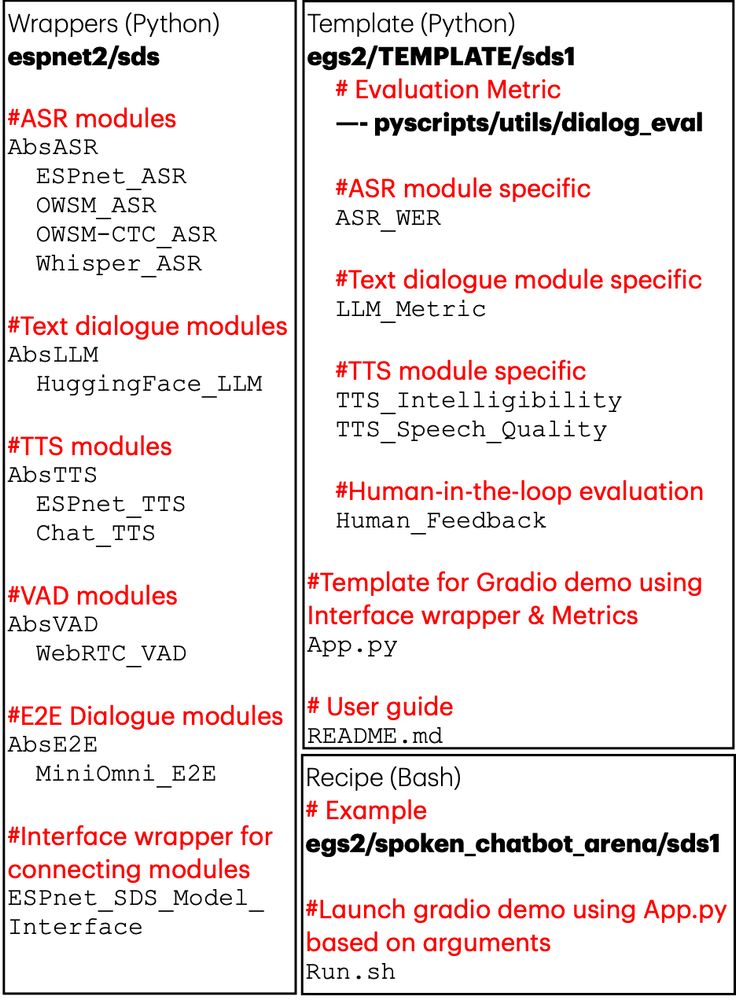
ESPnet-SDS provides:
✅ Unified Web UI with support for both cascaded & E2E models
✅ Real-time evaluation of latency, semantic coherence, audio quality & more
✅ Mechanism for collecting user feedback
✅ Open-source with modular code -> could easily incorporate new systems!
✅ Unified Web UI with support for both cascaded & E2E models
✅ Real-time evaluation of latency, semantic coherence, audio quality & more
✅ Mechanism for collecting user feedback
✅ Open-source with modular code -> could easily incorporate new systems!
March 17, 2025 at 2:29 PM
ESPnet-SDS provides:
✅ Unified Web UI with support for both cascaded & E2E models
✅ Real-time evaluation of latency, semantic coherence, audio quality & more
✅ Mechanism for collecting user feedback
✅ Open-source with modular code -> could easily incorporate new systems!
✅ Unified Web UI with support for both cascaded & E2E models
✅ Real-time evaluation of latency, semantic coherence, audio quality & more
✅ Mechanism for collecting user feedback
✅ Open-source with modular code -> could easily incorporate new systems!
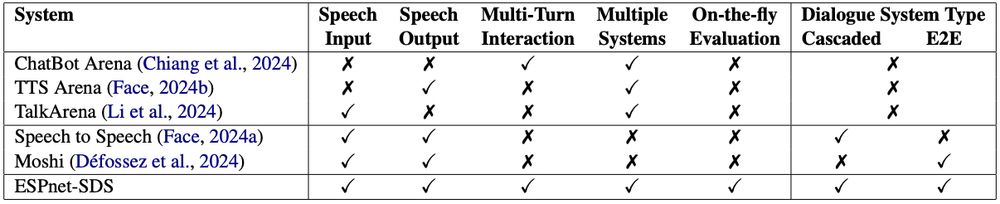
Spoken dialogue systems (SDS) are everywhere, with many new systems emerging.
But evaluating and comparing them is challenging:
❌ No standardized interface—different frontends & backends
❌ Complex and inconsistent evaluation metrics
ESPnet-SDS aims to fix this!
But evaluating and comparing them is challenging:
❌ No standardized interface—different frontends & backends
❌ Complex and inconsistent evaluation metrics
ESPnet-SDS aims to fix this!
March 17, 2025 at 2:29 PM
Spoken dialogue systems (SDS) are everywhere, with many new systems emerging.
But evaluating and comparing them is challenging:
❌ No standardized interface—different frontends & backends
❌ Complex and inconsistent evaluation metrics
ESPnet-SDS aims to fix this!
But evaluating and comparing them is challenging:
❌ No standardized interface—different frontends & backends
❌ Complex and inconsistent evaluation metrics
ESPnet-SDS aims to fix this!
This work was done during my internship at Apple with Zhiyun Lu, Chung-Cheng Chiu, @ruomingpang.bsky.social
along with co-authors @ltiatcmu.bsky.social ( @shinjiw.bsky.social @wavlab.bsky.social).
(9/9)
along with co-authors @ltiatcmu.bsky.social ( @shinjiw.bsky.social @wavlab.bsky.social).
(9/9)
March 5, 2025 at 4:03 PM
This work was done during my internship at Apple with Zhiyun Lu, Chung-Cheng Chiu, @ruomingpang.bsky.social
along with co-authors @ltiatcmu.bsky.social ( @shinjiw.bsky.social @wavlab.bsky.social).
(9/9)
along with co-authors @ltiatcmu.bsky.social ( @shinjiw.bsky.social @wavlab.bsky.social).
(9/9)
GPT-4o rarely backchannels and interrupt but shows strong turn-taking capabilities. More analyses of audio FM ability to understand and predict turn taking events can be found in our full paper.
We’re open-sourcing our evaluation platform: github.com/espnet/espne...!
(8/9)
We’re open-sourcing our evaluation platform: github.com/espnet/espne...!
(8/9)
[WIP] Add code for training turn taking prediction model by siddhu001 · Pull Request #5948 · espnet/espnet
What?
Implemented code for training and inference of the encoder + classifier model.
Added data preparation and evaluation for training the turn-taking model using the Switchboard dataset.
Develop...
github.com
March 5, 2025 at 4:03 PM
GPT-4o rarely backchannels and interrupt but shows strong turn-taking capabilities. More analyses of audio FM ability to understand and predict turn taking events can be found in our full paper.
We’re open-sourcing our evaluation platform: github.com/espnet/espne...!
(8/9)
We’re open-sourcing our evaluation platform: github.com/espnet/espne...!
(8/9)
🤯 What did we find?
❌ Both systems fails to speak up when they should and do not give user enough cues when they wants to keep conversation floor.
❌ Moshi interrupt too aggressively.
❌ Both systems rarely backchannel.
❌ User interruptions are poorly managed.
(7/9)
❌ Both systems fails to speak up when they should and do not give user enough cues when they wants to keep conversation floor.
❌ Moshi interrupt too aggressively.
❌ Both systems rarely backchannel.
❌ User interruptions are poorly managed.
(7/9)
March 5, 2025 at 4:03 PM
🤯 What did we find?
❌ Both systems fails to speak up when they should and do not give user enough cues when they wants to keep conversation floor.
❌ Moshi interrupt too aggressively.
❌ Both systems rarely backchannel.
❌ User interruptions are poorly managed.
(7/9)
❌ Both systems fails to speak up when they should and do not give user enough cues when they wants to keep conversation floor.
❌ Moshi interrupt too aggressively.
❌ Both systems rarely backchannel.
❌ User interruptions are poorly managed.
(7/9)
We train a causal judge model on real human-human conversations that predicts turn-taking events. ⚡
Strong OOD generalization -> a reliable proxy for human judgment!
No need for costly human judgments—our model judges the timing of turn taking events automatically!
(6/9)
Strong OOD generalization -> a reliable proxy for human judgment!
No need for costly human judgments—our model judges the timing of turn taking events automatically!
(6/9)
March 5, 2025 at 4:03 PM
We train a causal judge model on real human-human conversations that predicts turn-taking events. ⚡
Strong OOD generalization -> a reliable proxy for human judgment!
No need for costly human judgments—our model judges the timing of turn taking events automatically!
(6/9)
Strong OOD generalization -> a reliable proxy for human judgment!
No need for costly human judgments—our model judges the timing of turn taking events automatically!
(6/9)
Global metrics fails to evaluate when turn taking event happens!
Moshi generates overlapping speech—but is it helpful or disruptive to the natural flow of the conversation? 🤔
(5/9)
Moshi generates overlapping speech—but is it helpful or disruptive to the natural flow of the conversation? 🤔
(5/9)
March 5, 2025 at 4:03 PM
Global metrics fails to evaluate when turn taking event happens!
Moshi generates overlapping speech—but is it helpful or disruptive to the natural flow of the conversation? 🤔
(5/9)
Moshi generates overlapping speech—but is it helpful or disruptive to the natural flow of the conversation? 🤔
(5/9)
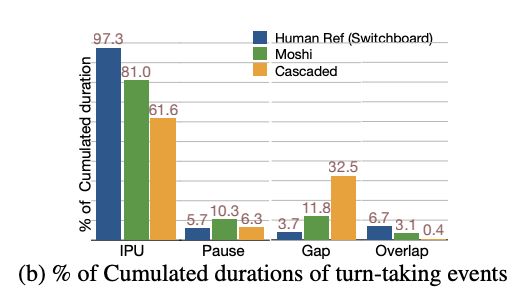
We compare E2E (Moshi us.moshi.chat) & cascaded (github.com/huggingface/...) dialogue systems through user study with global corpus level statistics!
Moshi: small gaps, some overlap—but less than natural dialogue
Cascaded: higher latency, minimal overlap.
(4/9)
Moshi: small gaps, some overlap—but less than natural dialogue
Cascaded: higher latency, minimal overlap.
(4/9)
March 5, 2025 at 4:03 PM
We compare E2E (Moshi us.moshi.chat) & cascaded (github.com/huggingface/...) dialogue systems through user study with global corpus level statistics!
Moshi: small gaps, some overlap—but less than natural dialogue
Cascaded: higher latency, minimal overlap.
(4/9)
Moshi: small gaps, some overlap—but less than natural dialogue
Cascaded: higher latency, minimal overlap.
(4/9)
Silence ≠ turn-switching cue! 🚫 Pauses are often longer than gaps in real conversations. 🤦♂️
Recent audio FMs claim to have conversational abilities but limited efforts to evaluate these models on their turn taking capabilities.
(3/9)
Recent audio FMs claim to have conversational abilities but limited efforts to evaluate these models on their turn taking capabilities.
(3/9)
March 5, 2025 at 4:03 PM
Silence ≠ turn-switching cue! 🚫 Pauses are often longer than gaps in real conversations. 🤦♂️
Recent audio FMs claim to have conversational abilities but limited efforts to evaluate these models on their turn taking capabilities.
(3/9)
Recent audio FMs claim to have conversational abilities but limited efforts to evaluate these models on their turn taking capabilities.
(3/9)
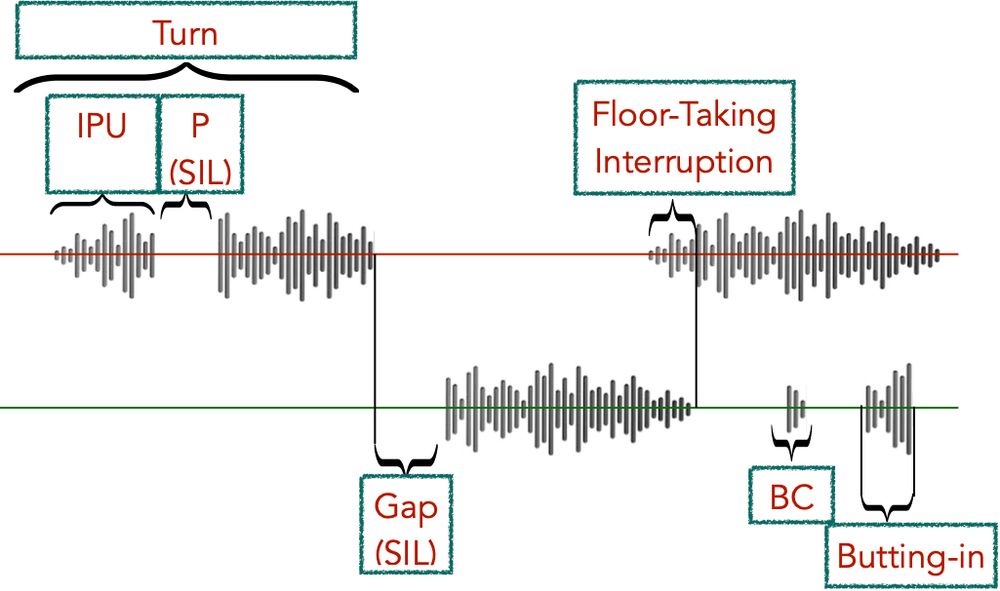
💡 Why does turn-taking matter?
In human dialogue, we listen, speak, and backchannel in real-time.
Similarly the AI should know when to listen, speak, backchannel, interrupt, convey to the user when it wants to keep the conversation floor and address user interruptions
(2/9)
In human dialogue, we listen, speak, and backchannel in real-time.
Similarly the AI should know when to listen, speak, backchannel, interrupt, convey to the user when it wants to keep the conversation floor and address user interruptions
(2/9)
March 5, 2025 at 4:03 PM
💡 Why does turn-taking matter?
In human dialogue, we listen, speak, and backchannel in real-time.
Similarly the AI should know when to listen, speak, backchannel, interrupt, convey to the user when it wants to keep the conversation floor and address user interruptions
(2/9)
In human dialogue, we listen, speak, and backchannel in real-time.
Similarly the AI should know when to listen, speak, backchannel, interrupt, convey to the user when it wants to keep the conversation floor and address user interruptions
(2/9)