




Salvatore Lattanzio
@salvatorelattanzio.bsky.social
Economist at the Bank of Italy | PhD University of Cambridge | Research on labour, inequality and gender | Personal views only
Finally, PL take-up among fathers is associated with better labor market outcomes among their female partners: they work and earn more.🟢
Male partners are instead almost unaffected by PL take-up of mothers.🟡
10/N
Male partners are instead almost unaffected by PL take-up of mothers.🟡
10/N

April 10, 2025 at 11:48 PM
Finally, PL take-up among fathers is associated with better labor market outcomes among their female partners: they work and earn more.🟢
Male partners are instead almost unaffected by PL take-up of mothers.🟡
10/N
Male partners are instead almost unaffected by PL take-up of mothers.🟡
10/N
When exploring mechanisms, we find that PL take-up is associated with *no career costs* for peer fathers, which may push their coworkers to follow their example and take PL themselves
9/N
9/N

April 10, 2025 at 11:48 PM
When exploring mechanisms, we find that PL take-up is associated with *no career costs* for peer fathers, which may push their coworkers to follow their example and take PL themselves
9/N
9/N
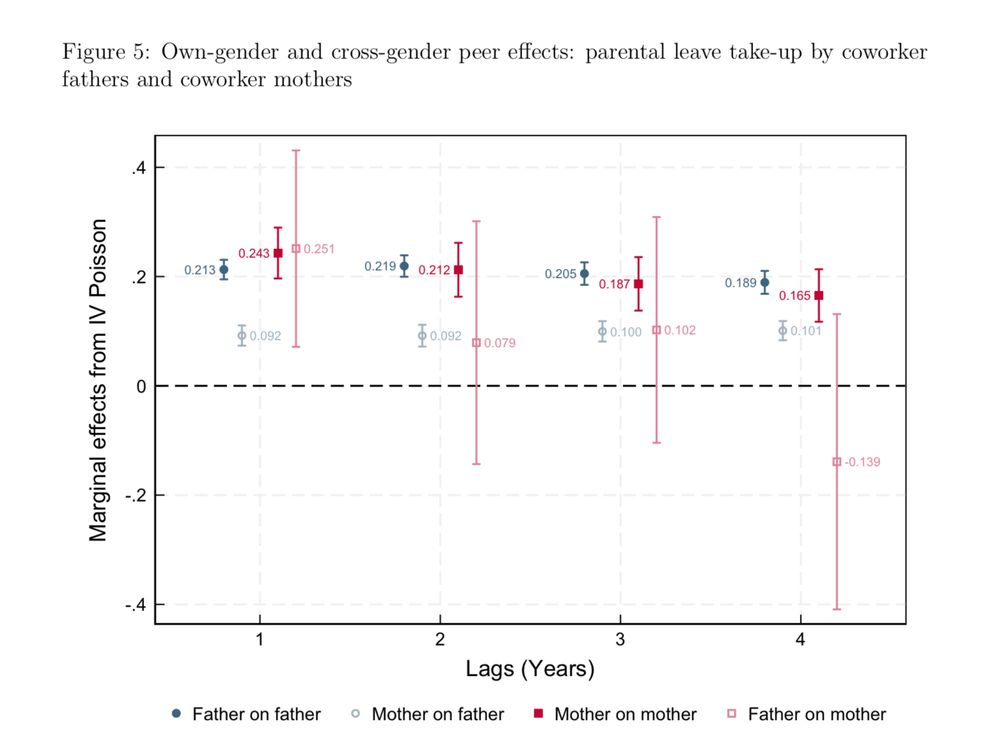
Peer effects are present among mothers, too. 👩💻
However own-gender effects are stronger than cross-gender ones, indicating that peers more than the general firm environment influence our results.
7/N
However own-gender effects are stronger than cross-gender ones, indicating that peers more than the general firm environment influence our results.
7/N
April 10, 2025 at 11:48 PM
Peer effects are present among mothers, too. 👩💻
However own-gender effects are stronger than cross-gender ones, indicating that peers more than the general firm environment influence our results.
7/N
However own-gender effects are stronger than cross-gender ones, indicating that peers more than the general firm environment influence our results.
7/N
We find that 1-year after the share of coworker fathers taking PL increases by 2.4% in response to a 10% increase in the share of peer fathers taking PL because of the reform. Effect persists up to 4 years.⬆️
6/N
6/N

April 10, 2025 at 11:48 PM
We find that 1-year after the share of coworker fathers taking PL increases by 2.4% in response to a 10% increase in the share of peer fathers taking PL because of the reform. Effect persists up to 4 years.⬆️
6/N
6/N
📈First stage result - The policy increased individual take-up of both fathers and mothers of 3-5 y.o. children relative to the pre-reform period and to parents of 0-2 y.o. children
3/N
3/N

April 10, 2025 at 11:48 PM
📈First stage result - The policy increased individual take-up of both fathers and mothers of 3-5 y.o. children relative to the pre-reform period and to parents of 0-2 y.o. children
3/N
3/N
Do coworkers taking parental leave influence your own decision to take it?
In a @cesifo.org new working paper with A. Casarico, @edoardodiporto.bsky.social & J. Kopinska, we find: yes, they do.
Thread below 🧵👇
#econsky
1/N
In a @cesifo.org new working paper with A. Casarico, @edoardodiporto.bsky.social & J. Kopinska, we find: yes, they do.
Thread below 🧵👇
#econsky
1/N


April 10, 2025 at 11:48 PM
Do coworkers taking parental leave influence your own decision to take it?
In a @cesifo.org new working paper with A. Casarico, @edoardodiporto.bsky.social & J. Kopinska, we find: yes, they do.
Thread below 🧵👇
#econsky
1/N
In a @cesifo.org new working paper with A. Casarico, @edoardodiporto.bsky.social & J. Kopinska, we find: yes, they do.
Thread below 🧵👇
#econsky
1/N
“Exploring Gender Inequality: Firm Contribution and Policy Effects”
w/ A. Casarico
is now out at LSE PPR
The paper reviews the literature on firms’ contribution to the gender pay gap & on firm and coworker responses to family policies
ppr.lse.ac.uk/articles/117...
#EconSky
w/ A. Casarico
is now out at LSE PPR
The paper reviews the literature on firms’ contribution to the gender pay gap & on firm and coworker responses to family policies
ppr.lse.ac.uk/articles/117...
#EconSky


March 14, 2025 at 12:29 PM
“Exploring Gender Inequality: Firm Contribution and Policy Effects”
w/ A. Casarico
is now out at LSE PPR
The paper reviews the literature on firms’ contribution to the gender pay gap & on firm and coworker responses to family policies
ppr.lse.ac.uk/articles/117...
#EconSky
w/ A. Casarico
is now out at LSE PPR
The paper reviews the literature on firms’ contribution to the gender pay gap & on firm and coworker responses to family policies
ppr.lse.ac.uk/articles/117...
#EconSky
The major update in the paper is showing with microdata for 🇮🇹 that firms with more workforce aging are those that witness the largest reductions in the gender pay gap, stemming from deteriorated opportunities for younger men, at least until the mid-1990s, when convergence stopped.
[4/5]
[4/5]


January 15, 2025 at 10:35 AM
The major update in the paper is showing with microdata for 🇮🇹 that firms with more workforce aging are those that witness the largest reductions in the gender pay gap, stemming from deteriorated opportunities for younger men, at least until the mid-1990s, when convergence stopped.
[4/5]
[4/5]
In the paper we show that cohort dynamics are crucial to explain gender pay convergence in the labor mkt.
Convergence happened as
1️⃣ newer worker cohorts w/ lower-than-avg pay gaps replaced older ones w/ higher-than-avg gaps
2️⃣ younger men fared progressively worse at lab mkt entry
[2/5]
Convergence happened as
1️⃣ newer worker cohorts w/ lower-than-avg pay gaps replaced older ones w/ higher-than-avg gaps
2️⃣ younger men fared progressively worse at lab mkt entry
[2/5]


January 15, 2025 at 10:35 AM
In the paper we show that cohort dynamics are crucial to explain gender pay convergence in the labor mkt.
Convergence happened as
1️⃣ newer worker cohorts w/ lower-than-avg pay gaps replaced older ones w/ higher-than-avg gaps
2️⃣ younger men fared progressively worse at lab mkt entry
[2/5]
Convergence happened as
1️⃣ newer worker cohorts w/ lower-than-avg pay gaps replaced older ones w/ higher-than-avg gaps
2️⃣ younger men fared progressively worse at lab mkt entry
[2/5]
We have a new update on our paper
"One Cohort at a Time: A New Perspective on the Declining Gender Pay Gap"
w/ @jarellanobover.com, N. Bianchi and M. Paradisi
Short thread🧵👇
[1/5]
"One Cohort at a Time: A New Perspective on the Declining Gender Pay Gap"
w/ @jarellanobover.com, N. Bianchi and M. Paradisi
Short thread🧵👇
[1/5]


January 15, 2025 at 10:35 AM
We have a new update on our paper
"One Cohort at a Time: A New Perspective on the Declining Gender Pay Gap"
w/ @jarellanobover.com, N. Bianchi and M. Paradisi
Short thread🧵👇
[1/5]
"One Cohort at a Time: A New Perspective on the Declining Gender Pay Gap"
w/ @jarellanobover.com, N. Bianchi and M. Paradisi
Short thread🧵👇
[1/5]
Culture over-consumption (British Museum)

December 27, 2024 at 10:59 AM
Culture over-consumption (British Museum)
9/ Our analysis suggests austerity strengthens radical-right support through resource competition rather than anti-establishment sentiment. Anti-immigration rhetoric becomes a powerful tool in times of perceived scarcity.

November 23, 2024 at 2:11 PM
9/ Our analysis suggests austerity strengthens radical-right support through resource competition rather than anti-establishment sentiment. Anti-immigration rhetoric becomes a powerful tool in times of perceived scarcity.
8/ Interestingly, we found no significant increase in anti-establishment sentiments, as measured by the anti-elite score. Radical-right gains weren’t driven by generalized anti-incumbent backlash.

November 23, 2024 at 2:11 PM
8/ Interestingly, we found no significant increase in anti-establishment sentiments, as measured by the anti-elite score. Radical-right gains weren’t driven by generalized anti-incumbent backlash.
7/ Turnout also rose by ~3.7 percentage points in affected areas, suggesting fiscal rules mobilized voters. Austerity’s visibility likely increased political engagement.

November 23, 2024 at 2:11 PM
7/ Turnout also rose by ~3.7 percentage points in affected areas, suggesting fiscal rules mobilized voters. Austerity’s visibility likely increased political engagement.
6/ The political impact was strongest in municipalities where fiscal rules were binding. When actual budget adjustments were necessary, the radical-right vote share jumped.

November 23, 2024 at 2:11 PM
6/ The political impact was strongest in municipalities where fiscal rules were binding. When actual budget adjustments were necessary, the radical-right vote share jumped.
5/ Fiscal rules led to cuts in visible local services like road maintenance and waste collection, increasing perceived competition for resources. This fueled support for anti-immigration parties.

November 23, 2024 at 2:11 PM
5/ Fiscal rules led to cuts in visible local services like road maintenance and waste collection, increasing perceived competition for resources. This fueled support for anti-immigration parties.
4/ Why did this happen? Radical-right parties benefited from an anti-immigration narrative amplified by austerity. M5S, with (at the time) weaker anti-immigration rhetoric, lost support.

November 23, 2024 at 2:11 PM
4/ Why did this happen? Radical-right parties benefited from an anti-immigration narrative amplified by austerity. M5S, with (at the time) weaker anti-immigration rhetoric, lost support.
3/ Main finding: Fiscal rules led to a ~1 percentage point increase in radical-right vote share (~9.3% relative increase). Effects were stronger where fiscal rules required actual budget adjustments.

November 23, 2024 at 2:11 PM
3/ Main finding: Fiscal rules led to a ~1 percentage point increase in radical-right vote share (~9.3% relative increase). Effects were stronger where fiscal rules required actual budget adjustments.
2/ In 2013, Italy imposed deficit targets on municipalities under 5,000 residents. This created a natural experiment to study how austerity affects political behavior.

November 23, 2024 at 2:11 PM
2/ In 2013, Italy imposed deficit targets on municipalities under 5,000 residents. This created a natural experiment to study how austerity affects political behavior.
1/ 🚨 Time to “tweet” about a paper I’ve been working on for a while w/ Alex Savu (University of Cambridge)
How does austerity shape political preferences? We analyze Italy’s 2013 local fiscal rule reform to uncover its effect on support for radical-right parties.
Here’s what we found. 🧵
How does austerity shape political preferences? We analyze Italy’s 2013 local fiscal rule reform to uncover its effect on support for radical-right parties.
Here’s what we found. 🧵

November 23, 2024 at 2:11 PM
1/ 🚨 Time to “tweet” about a paper I’ve been working on for a while w/ Alex Savu (University of Cambridge)
How does austerity shape political preferences? We analyze Italy’s 2013 local fiscal rule reform to uncover its effect on support for radical-right parties.
Here’s what we found. 🧵
How does austerity shape political preferences? We analyze Italy’s 2013 local fiscal rule reform to uncover its effect on support for radical-right parties.
Here’s what we found. 🧵