




Richard W. Petersen 🌈🇺🇸🫘
@rp351.bsky.social
San Diego, CA. Self Employed, Gig Worker, Chef, Caterer, Handyman, Musician 🎹, Traveler, Politics Nerd and all around Nice Guy!
Check out my music writings in the link ⬇️
https://on.soundcloud.com/GcnfXwEZEJcENAwY6
Check out my music writings in the link ⬇️
https://on.soundcloud.com/GcnfXwEZEJcENAwY6
Asked Grok an opinion on Musk’s attack on Social Security as a Ponzi Scheme x.com/i/grok/share...

Elon Musk thinks Social Security is a Ponzi scheme. Write an opposing opinion to him.
Elon Musk has claimed that Social Security is a Ponzi scheme, but this characterization is a misrepresentation of a vital government program that has supported millions of Americans for nearly a century. While it’s true that both Social Security and Ponzi schemes involve current contributors funding payouts to earlier participants, the similarities end there. Social Security is a legitimate, transparent social insurance program—not a fraudulent scam—and it differs from a Ponzi scheme in purpose, structure, and sustainability. ### Social Security Is Not Fraudulent A Ponzi scheme is a deceptive investment fraud that promises high returns with no real underlying business, paying early investors with money from new ones until the scheme collapses. Social Security, established in 1935, is a government-run program designed to provide retirement, disability, and survivor benefits. It’s funded through payroll taxes collected openly from workers and employers, with its operations fully disclosed to the public. Unlike a Ponzi scheme, where the orchestrator profits by exploiting investors, Social Security exists to ensure financial stability for society’s most vulnerable—no one is getting rich off it. ### A Sustainable System, Not a Collapsing Scheme Ponzi schemes rely on an ever-growing pool of new investors and collapse when recruitment slows. Social Security, however, operates as a pay-as-you-go system, where current workers’ taxes fund current beneficiaries. This intergenerational transfer is intentional, not a flaw. The program also has the Social Security Trust Fund, built from past surpluses, to help cover future obligations—a safeguard no Ponzi scheme possesses. While an aging population and declining birth rates pose funding challenges, these are not fatal. Experts, including the Social Security Trustees in their 2023 report, suggest that modest reforms—like raising the retirement age, tweaking benefits, or increasing payroll taxes—can keep it solvent for decades. ### A Safety Net, Not an Investment Scam Unlike Ponzi schemes, which lure victims with promises of quick wealth, Social Security isn’t an investment vehicle. It’s a social insurance program meant to mitigate risks like poverty in old age or disability. Benefits are modest, based on an individual’s earnings history and contributions, and designed to supplement other savings—not replace them. This focus on stability over profit sets it apart from the zero-sum nature of Ponzi schemes, where early participants may gain but later ones lose everything. Social Security ensures nearly all contributors receive benefits proportional to what they paid in. ### Backed by Government, Not Empty Promises Critics like Musk might highlight Social Security’s unfunded liabilities, but this overlooks its unique status as a government program. Unlike private pensions, it isn’t required to pre-fund all future obligations. Backed by the full faith and credit of the U.S. government—which has never defaulted—Social Security has paid benefits without fail for almost 90 years. Policy adjustments can address long-term funding gaps, making it far more resilient than a Ponzi scheme, which has no such adaptability. ### Conclusion Labeling Social Security a Ponzi scheme oversimplifies and mischaracterizes a program that has lifted millions out of poverty since its inception. It’s not a scam designed to enrich a few, but a cornerstone of economic security for Americans. Rather than dismissing it, we should focus on practical solutions to ensure its future. Social Security is a social contract, not a fraud—and it deserves recognition for the stability it provides, not baseless comparisons to a criminal enterprise.
x.com
March 14, 2025 at 6:22 AM
Asked Grok an opinion on Musk’s attack on Social Security as a Ponzi Scheme x.com/i/grok/share...
I’m selling some beautiful mid century modern Norwegian sling chairs. Anybody looking for some really handsome chairs.
www.ebay.com/itm/25684757...
www.ebay.com/itm/25684757...

Leather "Falcon" Sling Chairs by Sigurd Ressell for Vatne Møbler, 1070's | eBay
Elevate your living space with the Leather "Falcon" Sling Chair, a stunning piece by Sigurd Ressell for Vatne Møbler, dating back to the 1970s. Crafted in Norway, this chair set includes a comfortable...
www.ebay.com
March 7, 2025 at 11:10 PM
I’m selling some beautiful mid century modern Norwegian sling chairs. Anybody looking for some really handsome chairs.
www.ebay.com/itm/25684757...
www.ebay.com/itm/25684757...
I just made rice krispy treats at 2:30 am and am currently very sticky and happy.

December 10, 2024 at 10:43 AM
I just made rice krispy treats at 2:30 am and am currently very sticky and happy.
And throwing it out to all you content creators, YouTubers IG, FB. I have 20 hrs of self created sound bites, slides, drifts, follies. Hit me up if you need a quick sound bite for your project. Happy to help.
December 5, 2024 at 9:20 AM
And throwing it out to all you content creators, YouTubers IG, FB. I have 20 hrs of self created sound bites, slides, drifts, follies. Hit me up if you need a quick sound bite for your project. Happy to help.
The cats agree. Write music and live large. That’s my studio in the background.

December 5, 2024 at 9:00 AM
The cats agree. Write music and live large. That’s my studio in the background.
I bought a new Mac Mini as my old computer and music programs became obsolete in doing my writing. I was excited to take on new writings. I now realize I need to finish the 200+ projects I never finished rather than start anything new. I have 3 external HDs full of unfinished work. Oh reality. 😁🎹
November 30, 2024 at 9:40 PM
I bought a new Mac Mini as my old computer and music programs became obsolete in doing my writing. I was excited to take on new writings. I now realize I need to finish the 200+ projects I never finished rather than start anything new. I have 3 external HDs full of unfinished work. Oh reality. 😁🎹
I got myself a new Mac Mini M4. Why’s this good? My old Mac couldn’t run my “making music program” and now I can make new music. Follow me and my SoundCloud acct on my profile as I upload new tunes.
November 26, 2024 at 8:52 AM
I got myself a new Mac Mini M4. Why’s this good? My old Mac couldn’t run my “making music program” and now I can make new music. Follow me and my SoundCloud acct on my profile as I upload new tunes.
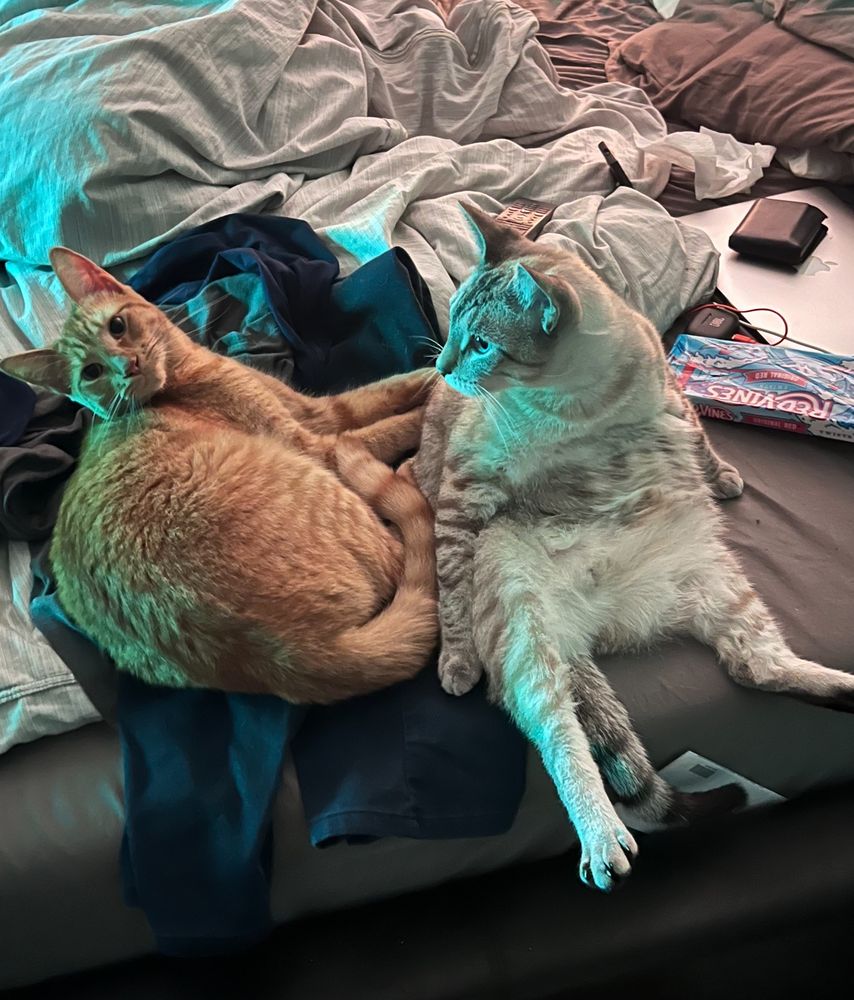
Happy Caturday. My boys Jack and Colby!
November 23, 2024 at 10:48 PM
Happy Caturday. My boys Jack and Colby!
Howard Jones. Last Supper Lyrics. Read than find the song. 😘😘

November 23, 2024 at 8:46 AM
Howard Jones. Last Supper Lyrics. Read than find the song. 😘😘
@auggieh.bsky.social what’s up homiesexuals Richard from SD
November 20, 2024 at 9:32 AM
@auggieh.bsky.social what’s up homiesexuals Richard from SD
Playing around with a boatload of new sounds and decided to go back to 1984 and get my groove on. Thoughts?
on.soundcloud.com/kDb6XGqTw4HS...
on.soundcloud.com/kDb6XGqTw4HS...

Hello 1984
A throwback using only synth sounds from Rolands catalog of amazing synthesizers over the decades. Juno 60, Juno 106, Jupiter 8, etc
on.soundcloud.com
November 19, 2024 at 6:42 AM
Playing around with a boatload of new sounds and decided to go back to 1984 and get my groove on. Thoughts?
on.soundcloud.com/kDb6XGqTw4HS...
on.soundcloud.com/kDb6XGqTw4HS...
Finished uploading new material to SoundCloud
This one “I didn’t want too” interprets 3 clashing sounds that come together into a embracing harmony. My musical interpretation of 3 opposing sides coming together. 😘
on.soundcloud.com/fBLgUQ1uUfdD...
This one “I didn’t want too” interprets 3 clashing sounds that come together into a embracing harmony. My musical interpretation of 3 opposing sides coming together. 😘
on.soundcloud.com/fBLgUQ1uUfdD...

I Didn't Want To
The idea behind this song is allowing different opinions to come together and make something beautiful. The 3 different leads in the song come together to harmonize a nice vibe and feeling.
on.soundcloud.com
November 19, 2024 at 6:37 AM
Finished uploading new material to SoundCloud
This one “I didn’t want too” interprets 3 clashing sounds that come together into a embracing harmony. My musical interpretation of 3 opposing sides coming together. 😘
on.soundcloud.com/fBLgUQ1uUfdD...
This one “I didn’t want too” interprets 3 clashing sounds that come together into a embracing harmony. My musical interpretation of 3 opposing sides coming together. 😘
on.soundcloud.com/fBLgUQ1uUfdD...
@michaelqtodd.bsky.social I need to learn how to not be broke driving for Lyft and Uber. I need a mentor!
I also own the website BeanDover.com with hopes of opening a pour over coffee shop. Pick your beans and we make you coffee. Any assist you can offer? 😘😘😘
I also own the website BeanDover.com with hopes of opening a pour over coffee shop. Pick your beans and we make you coffee. Any assist you can offer? 😘😘😘

Bean Dover
Launching Soon
BeanDover.com
November 13, 2024 at 10:22 PM
@michaelqtodd.bsky.social I need to learn how to not be broke driving for Lyft and Uber. I need a mentor!
I also own the website BeanDover.com with hopes of opening a pour over coffee shop. Pick your beans and we make you coffee. Any assist you can offer? 😘😘😘
I also own the website BeanDover.com with hopes of opening a pour over coffee shop. Pick your beans and we make you coffee. Any assist you can offer? 😘😘😘

Give Me Strength (2020 Remaster) by Howard Jones on Apple Music
Song · 1984 · Duration 5:01
music.apple.com
November 13, 2024 at 9:01 AM
Is he gonna bring a toilet to his next job at the WH?

November 13, 2024 at 7:01 AM
Is he gonna bring a toilet to his next job at the WH?
The first time DJT won I was sad and wrote this song. It’s time to play it again
on.soundcloud.com/znMxK76ftus8...
on.soundcloud.com/znMxK76ftus8...

No DT Final
Got 10,000 new sounds to play with, so this is my first of new tracks to come.
on.soundcloud.com
November 13, 2024 at 5:53 AM
The first time DJT won I was sad and wrote this song. It’s time to play it again
on.soundcloud.com/znMxK76ftus8...
on.soundcloud.com/znMxK76ftus8...
Reposted by Richard W. Petersen 🌈🇺🇸🫘

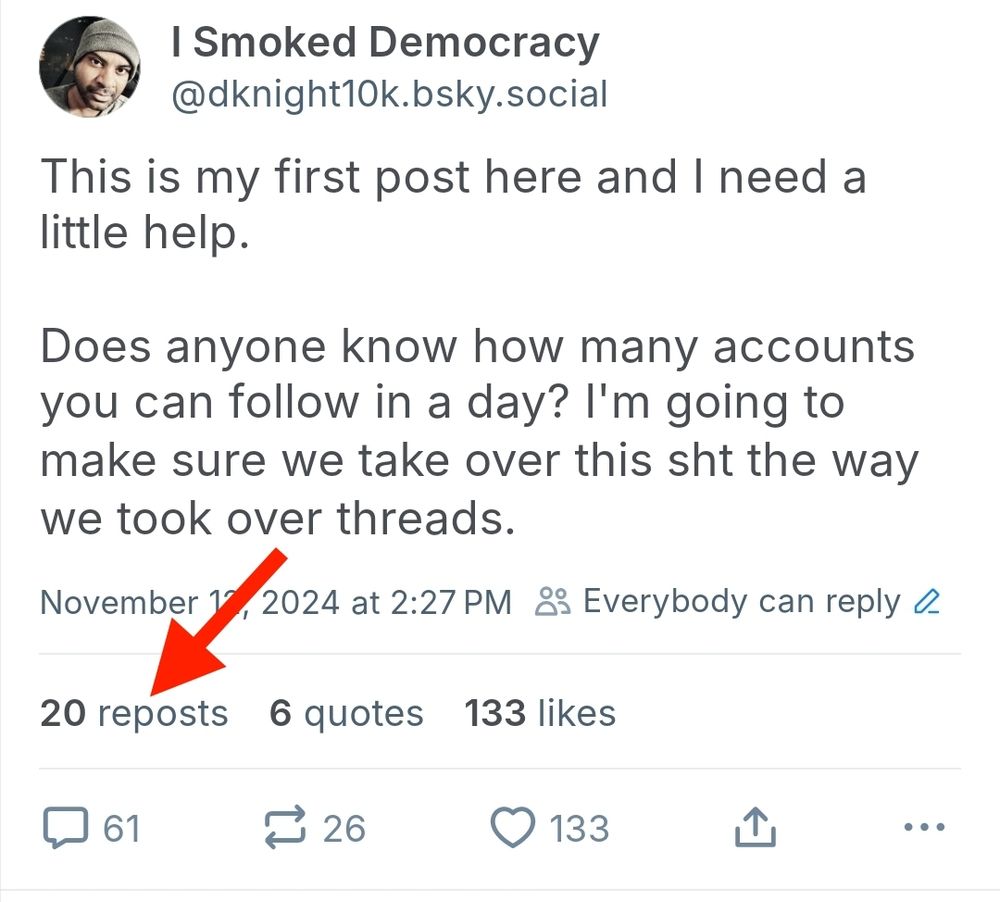
We're going to take over this place the same way we took over threads: by building up all of you
First, hit the like button, reply with #NoDemUnder1k, and most importantly, hit the REPOST button.
Then follow each other back. The easiest way to do so is to follow everyone who reposts.
Here's how:
First, hit the like button, reply with #NoDemUnder1k, and most importantly, hit the REPOST button.
Then follow each other back. The easiest way to do so is to follow everyone who reposts.
Here's how:
November 12, 2024 at 9:13 PM
We're going to take over this place the same way we took over threads: by building up all of you
First, hit the like button, reply with #NoDemUnder1k, and most importantly, hit the REPOST button.
Then follow each other back. The easiest way to do so is to follow everyone who reposts.
Here's how:
First, hit the like button, reply with #NoDemUnder1k, and most importantly, hit the REPOST button.
Then follow each other back. The easiest way to do so is to follow everyone who reposts.
Here's how:
@missjuliebrown.bsky.social found ya. Hi my friend!
November 12, 2024 at 9:09 AM
@missjuliebrown.bsky.social found ya. Hi my friend!
Made the move to Bluesky. Same handle as Twitter. Hi everyone!
November 11, 2024 at 6:22 AM
Made the move to Bluesky. Same handle as Twitter. Hi everyone!