




Roman Barth
@romanbarth.bsky.social
Postdoc in the lab of David Baker | University of Washington | Building new molecular motors | Schmidt Science Fellow 2024 | PhD with Cees Dekker @ TUD
I'm excited to share that I've been selected as one of the 10 recipients of the prestigious Weintraub Award from @fredhutch.bsky.social this year! 🏆
I owe a massive debt of gratitude to the remarkable colleagues and mentors who have shaped my path, especially @ceesdekker.bsky.social !!
I owe a massive debt of gratitude to the remarkable colleagues and mentors who have shaped my path, especially @ceesdekker.bsky.social !!

March 5, 2025 at 2:01 AM
I'm excited to share that I've been selected as one of the 10 recipients of the prestigious Weintraub Award from @fredhutch.bsky.social this year! 🏆
I owe a massive debt of gratitude to the remarkable colleagues and mentors who have shaped my path, especially @ceesdekker.bsky.social !!
I owe a massive debt of gratitude to the remarkable colleagues and mentors who have shaped my path, especially @ceesdekker.bsky.social !!
Check out this cool article by @newscientistnl.bsky.social on our latest work about direction-switching molecular motors racing along DNA: www.newscientist.nl/nieuws/eiwit...

February 4, 2025 at 6:59 AM
Check out this cool article by @newscientistnl.bsky.social on our latest work about direction-switching molecular motors racing along DNA: www.newscientist.nl/nieuws/eiwit...

KTYQR is distinct from YxF: it reduces cohesin's LE activity overall, but doesn't impact cohesin's directionality.
Together, the two motifs account pretty much for the impact of the full NTR!! We hypothesize that connecting the two on one protein chain and some adjacent sequences modulate further.
Together, the two motifs account pretty much for the impact of the full NTR!! We hypothesize that connecting the two on one protein chain and some adjacent sequences modulate further.

January 27, 2025 at 5:34 PM
KTYQR is distinct from YxF: it reduces cohesin's LE activity overall, but doesn't impact cohesin's directionality.
Together, the two motifs account pretty much for the impact of the full NTR!! We hypothesize that connecting the two on one protein chain and some adjacent sequences modulate further.
Together, the two motifs account pretty much for the impact of the full NTR!! We hypothesize that connecting the two on one protein chain and some adjacent sequences modulate further.
A computational AlphaFold screen suggested the KTYQR motif, located N-terminally of the YxF, that appears to also bind STAG1.

January 27, 2025 at 5:34 PM
A computational AlphaFold screen suggested the KTYQR motif, located N-terminally of the YxF, that appears to also bind STAG1.
And indeed, FCS experiments showed that STAG1's DNA affinity increases upon addition of the YxF motif.

January 27, 2025 at 5:34 PM
And indeed, FCS experiments showed that STAG1's DNA affinity increases upon addition of the YxF motif.
We started with the known YxF motif. In brief, the YxF motif:
- reduces cohesin's ATPase rate
- reduces LE initiation
- reduces the fraction of complete LE steps (in Magnetic Tweezers)
So these few amino acids alone already tinker quite a lot with cohesin!
- reduces cohesin's ATPase rate
- reduces LE initiation
- reduces the fraction of complete LE steps (in Magnetic Tweezers)
So these few amino acids alone already tinker quite a lot with cohesin!

January 27, 2025 at 5:34 PM
We started with the known YxF motif. In brief, the YxF motif:
- reduces cohesin's ATPase rate
- reduces LE initiation
- reduces the fraction of complete LE steps (in Magnetic Tweezers)
So these few amino acids alone already tinker quite a lot with cohesin!
- reduces cohesin's ATPase rate
- reduces LE initiation
- reduces the fraction of complete LE steps (in Magnetic Tweezers)
So these few amino acids alone already tinker quite a lot with cohesin!
Observing LE by Magnetic Tweezers provides a much more detailed view, however. We can see individual steps made by cohesin. Previously, we already observed a plethora of phenomena: cohesin often makes full LE steps, as seen by a height decrease of the magnetic bead. But these are also often reversed

January 27, 2025 at 5:34 PM
Observing LE by Magnetic Tweezers provides a much more detailed view, however. We can see individual steps made by cohesin. Previously, we already observed a plethora of phenomena: cohesin often makes full LE steps, as seen by a height decrease of the magnetic bead. But these are also often reversed
We took the CTCF N-terminal region that is already well-known to interact with cohesin and cut it up into smaller pieces. Then, we exposed cohesin to these various fragments in buffer (no DNA binding domain here!) and observed how cohesin handles that.

January 27, 2025 at 5:34 PM
We took the CTCF N-terminal region that is already well-known to interact with cohesin and cut it up into smaller pieces. Then, we exposed cohesin to these various fragments in buffer (no DNA binding domain here!) and observed how cohesin handles that.
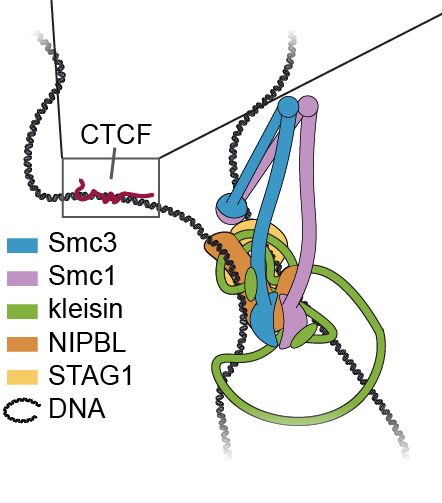
CTCF stall DNA 🧬 loop ➰ extrusion by cohesin -
but exactly how it pulls this off is a 'mechanistic mystery' (to cite @andersshansen.bsky.social, Nucleus, 2020).
We just preprinted 📜 a new study @biorxivpreprint.bsky.social that provides some answers to this enigma: www.biorxiv.org/content/10.1...
but exactly how it pulls this off is a 'mechanistic mystery' (to cite @andersshansen.bsky.social, Nucleus, 2020).
We just preprinted 📜 a new study @biorxivpreprint.bsky.social that provides some answers to this enigma: www.biorxiv.org/content/10.1...
January 27, 2025 at 5:34 PM
CTCF stall DNA 🧬 loop ➰ extrusion by cohesin -
but exactly how it pulls this off is a 'mechanistic mystery' (to cite @andersshansen.bsky.social, Nucleus, 2020).
We just preprinted 📜 a new study @biorxivpreprint.bsky.social that provides some answers to this enigma: www.biorxiv.org/content/10.1...
but exactly how it pulls this off is a 'mechanistic mystery' (to cite @andersshansen.bsky.social, Nucleus, 2020).
We just preprinted 📜 a new study @biorxivpreprint.bsky.social that provides some answers to this enigma: www.biorxiv.org/content/10.1...
And here's a fabulous rendering of this mysterious molecular "machine" by the great Scixel

January 16, 2025 at 4:27 PM
And here's a fabulous rendering of this mysterious molecular "machine" by the great Scixel
Finally, we provide our view on how direction exchanges may happen within the SMC

January 16, 2025 at 4:24 PM
Finally, we provide our view on how direction exchanges may happen within the SMC
Excitingly, we found that an exchange of NIPBL provides a window of opportunity for cohesin to change directions! NIPBL thus functions as a molecular gearbox shifting between extrusion towards one direction or the other

January 16, 2025 at 4:24 PM
Excitingly, we found that an exchange of NIPBL provides a window of opportunity for cohesin to change directions! NIPBL thus functions as a molecular gearbox shifting between extrusion towards one direction or the other
We then had a look at the directionality: which side of the DNA is being incorporated in the loop? Strikingly, we found that during individual LE phases, only one side of the unlooped DNA becomes shorter!

January 16, 2025 at 4:24 PM
We then had a look at the directionality: which side of the DNA is being incorporated in the loop? Strikingly, we found that during individual LE phases, only one side of the unlooped DNA becomes shorter!
Using single molecule visualization of the loop extrusion (LE) process, we analyzed the sequence of events during a typical LE trace. We found that SMCs not only extrude DNA progressively. Sometimes, they can also diffuse along DNA or lose some of the already-extruded loop

January 16, 2025 at 4:24 PM
Using single molecule visualization of the loop extrusion (LE) process, we analyzed the sequence of events during a typical LE trace. We found that SMCs not only extrude DNA progressively. Sometimes, they can also diffuse along DNA or lose some of the already-extruded loop
Exciting news 📃🧬🔬
Today we report on the dynamics of a fascinating class of molecular motors, so-called SMC proteins in @cp-cell.bsky.social
doi.org/10.1016/j.ce...
Today we report on the dynamics of a fascinating class of molecular motors, so-called SMC proteins in @cp-cell.bsky.social
doi.org/10.1016/j.ce...

January 16, 2025 at 4:24 PM
Exciting news 📃🧬🔬
Today we report on the dynamics of a fascinating class of molecular motors, so-called SMC proteins in @cp-cell.bsky.social
doi.org/10.1016/j.ce...
Today we report on the dynamics of a fascinating class of molecular motors, so-called SMC proteins in @cp-cell.bsky.social
doi.org/10.1016/j.ce...
So, how does it work? While this is not 100% clear to us at this stage, we have ideas. There are a bunch of example images and simulations out there where the arms of various SMCs seem to be intertwined. This could roughly add up to the observed -0.6 twist/step

December 16, 2024 at 10:52 PM
So, how does it work? While this is not 100% clear to us at this stage, we have ideas. There are a bunch of example images and simulations out there where the arms of various SMCs seem to be intertwined. This could roughly add up to the observed -0.6 twist/step
We can quantitatively measure this on a per-step-basis. The quantity: -0.6 twists per step.
Excitingly, this quantity appears to be conserved among cohesin, condensin, and SMC5/6, the 3 major SMCs in Eukaryotes
Excitingly, this quantity appears to be conserved among cohesin, condensin, and SMC5/6, the 3 major SMCs in Eukaryotes

December 16, 2024 at 10:52 PM
We can quantitatively measure this on a per-step-basis. The quantity: -0.6 twists per step.
Excitingly, this quantity appears to be conserved among cohesin, condensin, and SMC5/6, the 3 major SMCs in Eukaryotes
Excitingly, this quantity appears to be conserved among cohesin, condensin, and SMC5/6, the 3 major SMCs in Eukaryotes
Magnetic tweezers are a powerful tool to study DNA loop extrusion of SMCs. We can even see individual steps that are being taken, around tens of nanometers, or a few hundred bp in size. Here, using torsionally constrained DNA, we observed that SMCs also add twist to DNA while extruding

December 16, 2024 at 10:52 PM
Magnetic tweezers are a powerful tool to study DNA loop extrusion of SMCs. We can even see individual steps that are being taken, around tens of nanometers, or a few hundred bp in size. Here, using torsionally constrained DNA, we observed that SMCs also add twist to DNA while extruding
My first post! Hi science community 👋🧬
We have been trying to figure out the mechanistic mysteries about SMC motor proteins. They extrude our genome constantly into loops. We know that that's important. But how it works, is a matter of intense debate! Today, we report a piece of the puzzle:
We have been trying to figure out the mechanistic mysteries about SMC motor proteins. They extrude our genome constantly into loops. We know that that's important. But how it works, is a matter of intense debate! Today, we report a piece of the puzzle:

December 16, 2024 at 10:52 PM
My first post! Hi science community 👋🧬
We have been trying to figure out the mechanistic mysteries about SMC motor proteins. They extrude our genome constantly into loops. We know that that's important. But how it works, is a matter of intense debate! Today, we report a piece of the puzzle:
We have been trying to figure out the mechanistic mysteries about SMC motor proteins. They extrude our genome constantly into loops. We know that that's important. But how it works, is a matter of intense debate! Today, we report a piece of the puzzle: