



Rachel C Thayer
@rcthayer.bsky.social
Evolution of structural color in butterflies🦋🌈 Reproductive functional evolution 🧬 Postdoc | UC Davis
🌐 sites.google.com/view/rachelcthayer/welcome
🌐 sites.google.com/view/rachelcthayer/welcome
Instead, mated-state female transcriptomes in the reproductive tract and head— two organ systems with 100s of mating responsive genes, which directly contact semen and mediate the behavioral post-mating response— are indifferent to population differences in their mates. 5/n

September 23, 2025 at 9:55 PM
Instead, mated-state female transcriptomes in the reproductive tract and head— two organ systems with 100s of mating responsive genes, which directly contact semen and mediate the behavioral post-mating response— are indifferent to population differences in their mates. 5/n
We crossed flies between populations to test how a foreign male affects female post-mating responses, given that the foreign males differentially express 27% of all genes in the semen-producing organ, including 38% of all seminal fluid proteins (plus protein sequence variation!) 3/n

September 23, 2025 at 9:55 PM
We crossed flies between populations to test how a foreign male affects female post-mating responses, given that the foreign males differentially express 27% of all genes in the semen-producing organ, including 38% of all seminal fluid proteins (plus protein sequence variation!) 3/n

My neighbor's dog, who keeps eating questionable things, is glum that he now has to wear a head meet net on walks. Fortunately he is in good company among this year's runway models


July 13, 2025 at 8:55 PM
My neighbor's dog, who keeps eating questionable things, is glum that he now has to wear a head meet net on walks. Fortunately he is in good company among this year's runway models
My new favorite image for explaining refraction

June 30, 2025 at 4:56 AM
My new favorite image for explaining refraction
Started Earth Day the right way this morning: with 70 kids on @skypeascientist.bsky.social and two live polyphemus moths I've been raising since last May. It's always fun to share the wild world of insects

April 22, 2025 at 11:42 PM
Started Earth Day the right way this morning: with 70 kids on @skypeascientist.bsky.social and two live polyphemus moths I've been raising since last May. It's always fun to share the wild world of insects
My canvassing partner in a swing state was a registered Republican white man in, probably, his 70s, who also traveled from out of state to knock doors for Harris all weekend. Between us, we could relate to just about everyone who spoke with us!

October 26, 2024 at 6:46 AM
My canvassing partner in a swing state was a registered Republican white man in, probably, his 70s, who also traveled from out of state to knock doors for Harris all weekend. Between us, we could relate to just about everyone who spoke with us!
The sexual conflict model to explain rapid seminal fluid protein sequence #evolution expects that the proteins are male-limited and only experience selection in males. The model doesn’t work for proteins expressed by both sexes’ reproductive tracts. Indeed, female-expressed ‘SFPs’ evolve slower 8/n

October 25, 2024 at 7:54 PM
The sexual conflict model to explain rapid seminal fluid protein sequence #evolution expects that the proteins are male-limited and only experience selection in males. The model doesn’t work for proteins expressed by both sexes’ reproductive tracts. Indeed, female-expressed ‘SFPs’ evolve slower 8/n
Most surprisingly, we find female flies express many of the “seminal fluid proteins” themselves, especially within their sperm storage organs. Any way we look at it— gene diversity (>40% of SFPs), volume (>30% of total RNAs in certain female cell types), specificity (SFPs mark female cell types) 6/n


October 25, 2024 at 7:38 PM
Most surprisingly, we find female flies express many of the “seminal fluid proteins” themselves, especially within their sperm storage organs. Any way we look at it— gene diversity (>40% of SFPs), volume (>30% of total RNAs in certain female cell types), specificity (SFPs mark female cell types) 6/n
A lot of the female reproductive epithelia is polyploid (not only the glandular cells, which were already known to be polyploid.) Our FAC-sorted nuclei showed at least three different ploidy levels, and that roughly half of all the cells in this tissue are polyploid. 5/n

October 25, 2024 at 7:28 PM
A lot of the female reproductive epithelia is polyploid (not only the glandular cells, which were already known to be polyploid.) Our FAC-sorted nuclei showed at least three different ploidy levels, and that roughly half of all the cells in this tissue are polyploid. 5/n
We found previously imperceptible anatomy in the uterus— distinct cell types in the anterior, middle, and posterior uterus with different secretory and hormone signaling-related gene expression activity. There are also specialized cell types surrounding the sperm storage organ entrances 4/n


October 25, 2024 at 7:23 PM
We found previously imperceptible anatomy in the uterus— distinct cell types in the anterior, middle, and posterior uterus with different secretory and hormone signaling-related gene expression activity. There are also specialized cell types surrounding the sperm storage organ entrances 4/n
These multi-tasking organs are fascinating from many perspectives— inter-cellular, inter-organ, and inter-individual / sexual signaling; evolutionary and reproductive fitness; immunity; wound-healing—but, as in much of the biomedical literature, female organs and biology are under-studied 2/n

October 25, 2024 at 7:14 PM
These multi-tasking organs are fascinating from many perspectives— inter-cellular, inter-organ, and inter-individual / sexual signaling; evolutionary and reproductive fitness; immunity; wound-healing—but, as in much of the biomedical literature, female organs and biology are under-studied 2/n
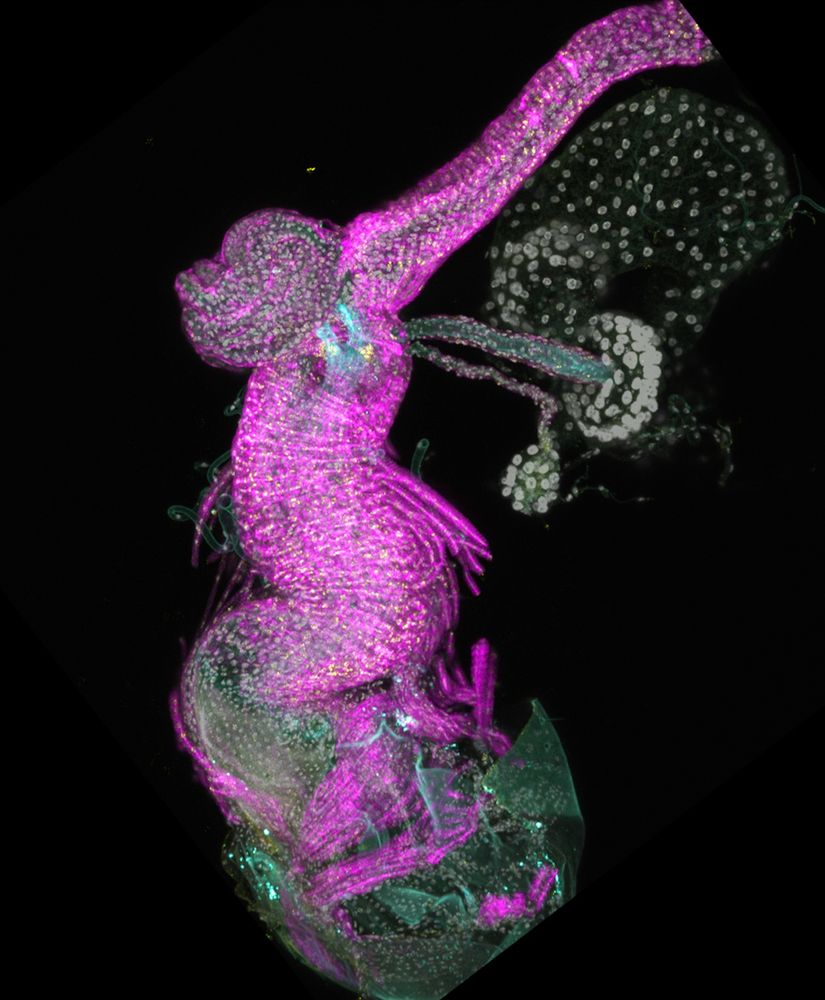
Our paper, identifying all the cell types in the Drosophila melanogaster female reproductive tract (uterus, female-limited glands, sperm storage organs) is out today! We used single-nuclei RNA sequencing and a lot of in situ cross-validation www.pnas.org/doi/10.1073/pnas.2409850121 🪰 🧬🧪 1/n
October 25, 2024 at 7:06 PM
Our paper, identifying all the cell types in the Drosophila melanogaster female reproductive tract (uterus, female-limited glands, sperm storage organs) is out today! We used single-nuclei RNA sequencing and a lot of in situ cross-validation www.pnas.org/doi/10.1073/pnas.2409850121 🪰 🧬🧪 1/n
I thought it was kinda cool to be in the first 16% of users till everybody else shared their 1%er "certified elder" stats

September 17, 2024 at 3:42 AM
I thought it was kinda cool to be in the first 16% of users till everybody else shared their 1%er "certified elder" stats
This AAAS federal science funding dashboard is new to me and so helpful: www.aaas.org/news/fy-2024...

March 5, 2024 at 6:42 AM
This AAAS federal science funding dashboard is new to me and so helpful: www.aaas.org/news/fy-2024...
Maybe prank-adjacent... There was a ledge in the stairwell in the Berkeley bio building with a dead millipede that never got cleaned away. Then one day this memorial scene appeared around it, and kept getting more elaborate, then with other dead research arthropods added

January 18, 2024 at 2:30 AM
Maybe prank-adjacent... There was a ledge in the stairwell in the Berkeley bio building with a dead millipede that never got cleaned away. Then one day this memorial scene appeared around it, and kept getting more elaborate, then with other dead research arthropods added
The dataset has extra info not presented in the paper, e.g. whether structures were in cover vs ground scales, any co-occurring pigments, refs to original studies, notes on all putative structures uncovered by our lit review with incomplete data but maybe worth further investigation, and more 10/11

November 9, 2023 at 8:10 PM
The dataset has extra info not presented in the paper, e.g. whether structures were in cover vs ground scales, any co-occurring pigments, refs to original studies, notes on all putative structures uncovered by our lit review with incomplete data but maybe worth further investigation, and more 10/11
This is a hybrid meta-analysis and literature review. We review how butterflies produce photonic nanostructures– this includes their development, genetic control, and evolution. You may be interested if you are using biomimetic engineering applications to manipulate light. 7/11

November 9, 2023 at 8:08 PM
This is a hybrid meta-analysis and literature review. We review how butterflies produce photonic nanostructures– this includes their development, genetic control, and evolution. You may be interested if you are using biomimetic engineering applications to manipulate light. 7/11
All the data on a phylogeny! Patterns that stand out to me: blue is also the most common phylogenetically, and most of the oddball structures occur in understudied butterfly families. The least-studied groups we highlight may be the best place to look for novel photonic nanostructures. 6/11

November 9, 2023 at 8:07 PM
All the data on a phylogeny! Patterns that stand out to me: blue is also the most common phylogenetically, and most of the oddball structures occur in understudied butterfly families. The least-studied groups we highlight may be the best place to look for novel photonic nanostructures. 6/11
Nanostructure types make different colors. Thin films, the simplest structure, are the only type that makes all the colors but are least bright. Overall, blue is common and made by every major structure type. Long-wavelength colors are super rare and often poor quality 5/11

November 9, 2023 at 8:06 PM
Nanostructure types make different colors. Thin films, the simplest structure, are the only type that makes all the colors but are least bright. Overall, blue is common and made by every major structure type. Long-wavelength colors are super rare and often poor quality 5/11
Consistent with previous reviews, I found 7 major morphological categories of optical nanostructures in butterflies, plus a few uncommon / weird structures. Here, a summary of how the nanostructures compare to a basic butterfly scale: 4/11


November 9, 2023 at 8:05 PM
Consistent with previous reviews, I found 7 major morphological categories of optical nanostructures in butterflies, plus a few uncommon / weird structures. Here, a summary of how the nanostructures compare to a basic butterfly scale: 4/11
Structural color–in which iridescent colors are produced by optical nanostructures rather than by color from chemical pigments–is common in butterfly wings. 2/11

November 9, 2023 at 8:03 PM
Structural color–in which iridescent colors are produced by optical nanostructures rather than by color from chemical pigments–is common in butterfly wings. 2/11