


@quantum-nuclear.bsky.social
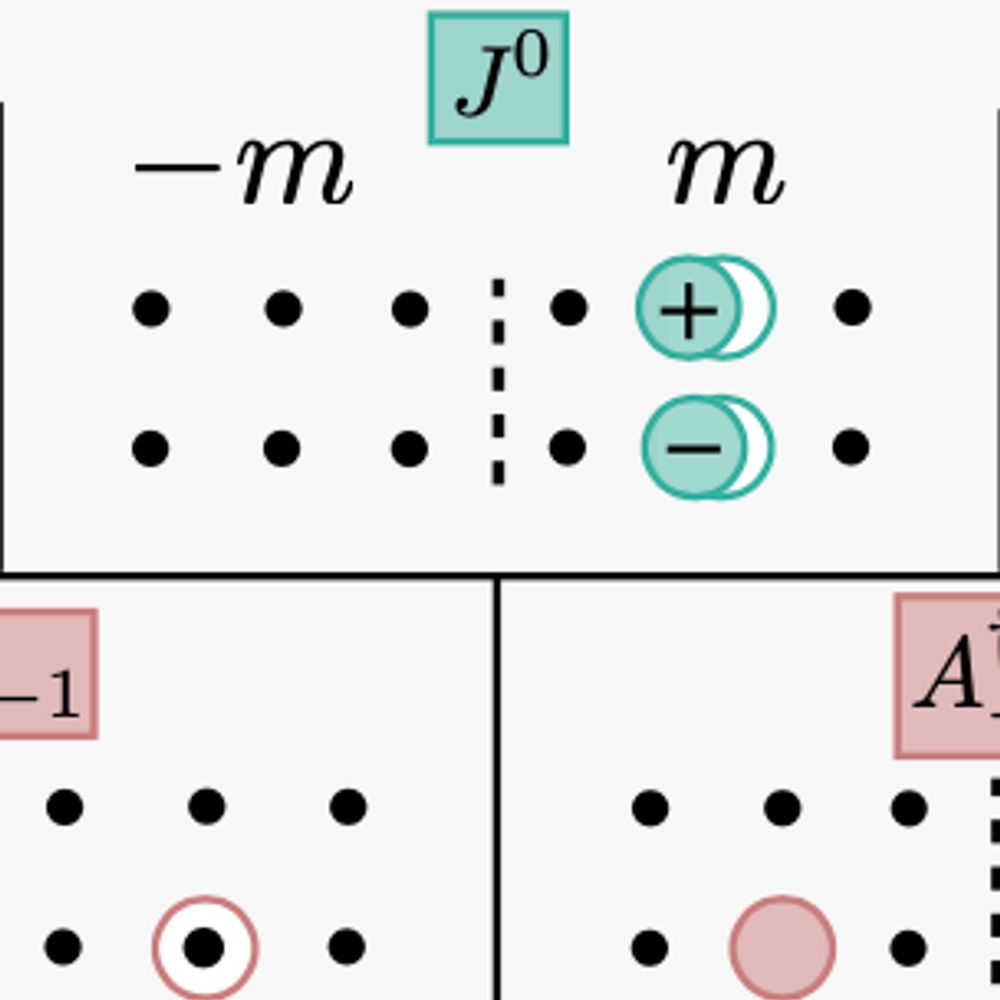
A new paper in Physics Letters B on a quasiparticle encoding method to prepare nuclear physics problems for quantum annealing doi.org/10.1016/j.ph... #openaccess
Redirecting
doi.org
December 3, 2025 at 7:58 AM
A new paper in Physics Letters B on a quasiparticle encoding method to prepare nuclear physics problems for quantum annealing doi.org/10.1016/j.ph... #openaccess
A nuclear <-> qubit mapping scheme for shell model calculations on NISQ-era hardware (Sarma & Stevenson, U. Surrey) arxiv.org/abs/2510.02124

Quantum simulation of nuclear shell model: bridging theory and hardware limitations
In this work, we introduce a new qubit mapping strategy for the Variational Quantum Eigensolver (VQE) applied to nuclear shell model calculations, where each Slater determinant (SD) is mapped to a qub...
arxiv.org
October 3, 2025 at 8:46 AM
A nuclear <-> qubit mapping scheme for shell model calculations on NISQ-era hardware (Sarma & Stevenson, U. Surrey) arxiv.org/abs/2510.02124
A quantum annealing protocol to solve the nucelar shell model scipost.org/SciPostPhys....
SciPost: SciPost Phys. 19, 062 (2025) - A quantum annealing protocol to solve the nuclear shell model
SciPost Journals Publication Detail SciPost Phys. 19, 062 (2025) A quantum annealing protocol to solve the nuclear shell model
scipost.org
September 11, 2025 at 9:55 AM
A quantum annealing protocol to solve the nucelar shell model scipost.org/SciPostPhys....
Reaction Dynamics on a Quantum Computer doi.org/10.1103/vs78...
Solving reaction dynamics with quantum computing algorithms
The description of quantum many-body dynamics is extremely challenging on classical computers, as it can involve many degrees of freedom. However, the time evolution of quantum states is a natural app...
doi.org
August 20, 2025 at 7:37 AM
Reaction Dynamics on a Quantum Computer doi.org/10.1103/vs78...
New preprint from Barcelona group, comparing UCC and ADAPT-VQE in nuclear shell model calcualtions arxiv.org/abs/2507.13819

Comparison of variational quantum eigensolvers in light nuclei
Quantum computing is one of the most promising technologies of the near future, and the simulation of quantum many-body systems is a natural application. In this work, we present classical simulations...
arxiv.org
July 21, 2025 at 10:51 AM
New preprint from Barcelona group, comparing UCC and ADAPT-VQE in nuclear shell model calcualtions arxiv.org/abs/2507.13819
Quantum Simulation of Nuclear Linear Response: Nifeeya Singh et al. ieeexplore.ieee.org/document/108...

Quantum Simulation of Nuclear Linear Response
It presents a quantum algorithm for efficiently computing the response of an atomic nucleus to a small external electromagnetic perturbation. Specifically, the system's Hamiltonian is modeled as a har...
ieeexplore.ieee.org
July 17, 2025 at 10:09 AM
Quantum Simulation of Nuclear Linear Response: Nifeeya Singh et al. ieeexplore.ieee.org/document/108...
Two hadron scattering simulations on real hardware (one IBM, one IonQ) in one day: arxiv.org/abs/2505.20408 & arxiv.org/abs/2505.20387
May 28, 2025 at 6:50 AM
Two hadron scattering simulations on real hardware (one IBM, one IonQ) in one day: arxiv.org/abs/2505.20408 & arxiv.org/abs/2505.20387
New preprint on a method for excited states in the shell model, with a meaningless "ab initio" stuck on the front of the title for good measure arxiv.org/abs/2505.19906
Ab initio many-fermion structure calculations on a quantum computer
To overcome the limitations of existing algorithms for solving self-bound quantum many-body problems -- such as those encountered in nuclear and particle physics -- that access only a restricted subse...
arxiv.org
May 27, 2025 at 6:23 AM
New preprint on a method for excited states in the shell model, with a meaningless "ab initio" stuck on the front of the title for good measure arxiv.org/abs/2505.19906
Two new preprints from IIT Roorkee: Quantum simulation of nuclear resonances & noise-resilient protocols in the nuclear shell model: arxiv.org/abs/2504.11689, arxiv.org/abs/2504.11685
April 17, 2025 at 7:52 AM
Two new preprints from IIT Roorkee: Quantum simulation of nuclear resonances & noise-resilient protocols in the nuclear shell model: arxiv.org/abs/2504.11689, arxiv.org/abs/2504.11685
A postdoc in quantum computing for nuclear physics: academicjobsonline.org/ajo/jobs/299...
University of Arizona, Physics
Job #AJO29906, Postdoctoral Research Position in Theoretical Nuclear Physics and Quantum Information Science, Physics, University of Arizona, Tucson, Arizona, US
academicjobsonline.org
April 11, 2025 at 7:07 PM
A postdoc in quantum computing for nuclear physics: academicjobsonline.org/ajo/jobs/299...
Quantum information studies can give inspiration for simplifications in classical methods - such as in this "weak entanglement approximation for nuclear structure" by Johnson and Gorton arxiv.org/abs/2504.00273
A weak entanglement approximation for nuclear structure: a progress report
We report on a recently proposed approach, inspired by quantum informationtheory, for calculating low-energy nuclear structure in the framework of the configuration-interaction shell-model. Empirical ...
arxiv.org
April 2, 2025 at 6:43 AM
Quantum information studies can give inspiration for simplifications in classical methods - such as in this "weak entanglement approximation for nuclear structure" by Johnson and Gorton arxiv.org/abs/2504.00273
BBC News story on Microsoft's Nature paper claiming realisation of a topological qubit, ft quote from @pdstevenson.bsky.social www.bbc.co.uk/news/article...

Powerful quantum computers in years not decades, says Microsoft
It says a new chip it has created could end up being as important a breakthrough as the semiconductor.
www.bbc.co.uk
February 19, 2025 at 8:57 PM
BBC News story on Microsoft's Nature paper claiming realisation of a topological qubit, ft quote from @pdstevenson.bsky.social www.bbc.co.uk/news/article...
Reposted

PhD opportunity in the interface between quantum computing and nuclear physics with me at Surrey: www.surrey.ac.uk/fees-and-fun...
Fault-tolerant quantum computing for nuclear physics | University of Surrey
www.surrey.ac.uk
February 13, 2025 at 2:44 PM
PhD opportunity in the interface between quantum computing and nuclear physics with me at Surrey: www.surrey.ac.uk/fees-and-fun...
Quantum Computing for Extracting Nuclear Resonances, Zhang, Bai and Ren, Phys. Lett. B 860, 139187 (2025) doi.org/10.1016/j.ph...
Redirecting
doi.org
January 31, 2025 at 4:18 PM
Quantum Computing for Extracting Nuclear Resonances, Zhang, Bai and Ren, Phys. Lett. B 860, 139187 (2025) doi.org/10.1016/j.ph...
"Exploiting symmetries in nuclear Hamiltonians for ground state preparation" Quantum Mach. Intell. 7, 14 (2025) <--- published today & open access.
Can problem-inspired ansatzes help with VQE-like algorithms in finding ground states? Yes! And here are some nuclear physics examples.
Can problem-inspired ansatzes help with VQE-like algorithms in finding ground states? Yes! And here are some nuclear physics examples.
January 30, 2025 at 2:27 PM
"Exploiting symmetries in nuclear Hamiltonians for ground state preparation" Quantum Mach. Intell. 7, 14 (2025) <--- published today & open access.
Can problem-inspired ansatzes help with VQE-like algorithms in finding ground states? Yes! And here are some nuclear physics examples.
Can problem-inspired ansatzes help with VQE-like algorithms in finding ground states? Yes! And here are some nuclear physics examples.
A new preprint from UW Madison simulating the nuclear Lipkin-Meshkov-Glick model on a neutral atom quantum computer, comparing direct and efficient encoding and modelling up to 15 spins arxiv.org/abs/2501.06097
January 21, 2025 at 2:13 PM
A new preprint from UW Madison simulating the nuclear Lipkin-Meshkov-Glick model on a neutral atom quantum computer, comparing direct and efficient encoding and modelling up to 15 spins arxiv.org/abs/2501.06097
Reposted

Hi #quantum folks, does anyone have any favorite examples of non-demolition measurements and links to papers where these have been implemented in practice?
December 30, 2024 at 8:57 PM
Hi #quantum folks, does anyone have any favorite examples of non-demolition measurements and links to papers where these have been implemented in practice?
Hi all! This account has been set up to highlight recent results in the area where nuclear physics and quantun computing overlap, broadly speaking.
Here's a first paper to share: A new quantum algorithm for projecting angular moment, applied to deformed HF states: journals.aps.org/prc/abstract...
Here's a first paper to share: A new quantum algorithm for projecting angular moment, applied to deformed HF states: journals.aps.org/prc/abstract...
Simplified projection on total spin zero for state preparation on quantum computers
We introduce a simple algorithm for projecting on $J=0$ states of a many-body system by performing a series of rotations to remove states with angular momentum projections greater than zero. Existing ...
journals.aps.org
December 24, 2024 at 6:13 PM
Hi all! This account has been set up to highlight recent results in the area where nuclear physics and quantun computing overlap, broadly speaking.
Here's a first paper to share: A new quantum algorithm for projecting angular moment, applied to deformed HF states: journals.aps.org/prc/abstract...
Here's a first paper to share: A new quantum algorithm for projecting angular moment, applied to deformed HF states: journals.aps.org/prc/abstract...