




The PRIMORDIAL group
@primordial-grp.bsky.social
Studying primordial galaxies and black holes at cosmic dawn
The paper can be read in full here: www.nature.com/articles/s41...
With a nice summary here: www.nature.com/articles/d41...
And the @esa.int / Webb PR here: esawebb.org/news/weic2505/
With a nice summary here: www.nature.com/articles/d41...
And the @esa.int / Webb PR here: esawebb.org/news/weic2505/
Witnessing the onset of reionization through Lyman-α emission at redshift 13 - Nature
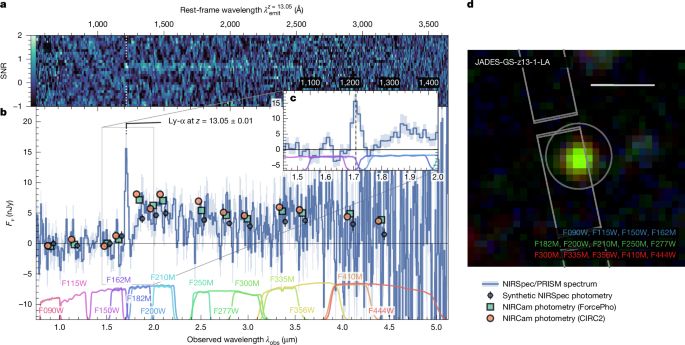
Spectroscopy from the JWST Advanced Deep Extragalactic Survey of a galaxy at redshift 13 shows a singular, bright emission line identified as Lyman-α, suggesting the onset of reionization only 330 Myr...
www.nature.com
March 26, 2025 at 7:30 PM
The paper can be read in full here: www.nature.com/articles/s41...
With a nice summary here: www.nature.com/articles/d41...
And the @esa.int / Webb PR here: esawebb.org/news/weic2505/
With a nice summary here: www.nature.com/articles/d41...
And the @esa.int / Webb PR here: esawebb.org/news/weic2505/
This likely means that UV photons from the first stars can produce extended UV bubbles around galaxies earlier and much more rapidly than previously thought, allowing Lyman-alpha and ionizing photons to escape 🌫️〰️

March 26, 2025 at 7:28 PM
This likely means that UV photons from the first stars can produce extended UV bubbles around galaxies earlier and much more rapidly than previously thought, allowing Lyman-alpha and ionizing photons to escape 🌫️〰️
First, there were evidence for a prominent DLA revealing dense HI gas in and around the galaxy, which now seem common at these redshifts. More exciting, was the simultanous detection of Lyman-alpha emission! This was very unexpected, and changes the reionization history of the Universe 🤯

March 26, 2025 at 7:23 PM
First, there were evidence for a prominent DLA revealing dense HI gas in and around the galaxy, which now seem common at these redshifts. More exciting, was the simultanous detection of Lyman-alpha emission! This was very unexpected, and changes the reionization history of the Universe 🤯
This galaxy, called JADES-GS-z13-1, was identified and spectroscopically observed as part of the JADES survey and showed some exciting and unexpected features!

March 26, 2025 at 7:16 PM
This galaxy, called JADES-GS-z13-1, was identified and spectroscopically observed as part of the JADES survey and showed some exciting and unexpected features!
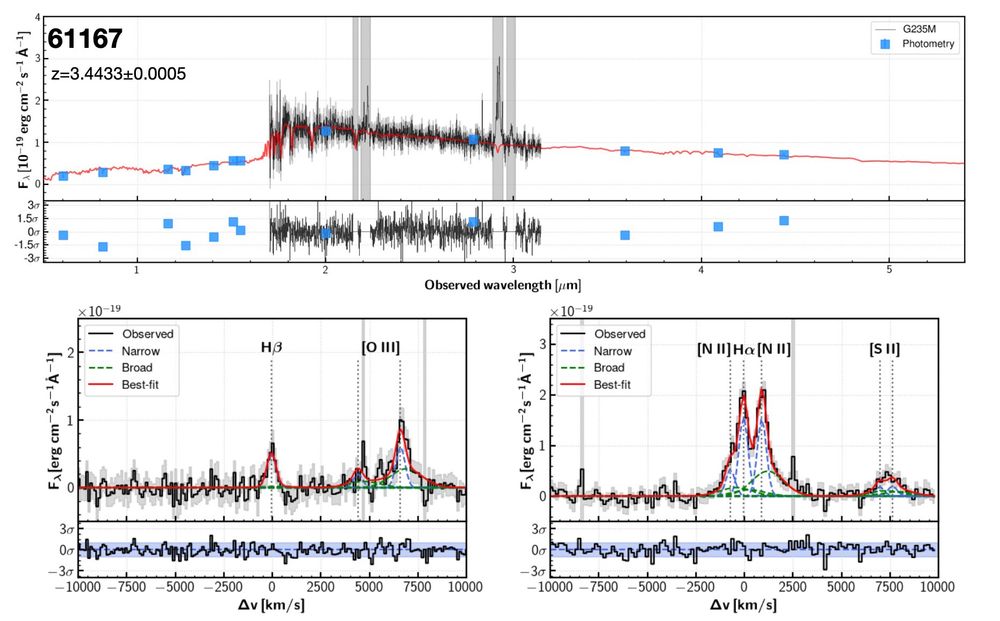
The pairs are puzzling, because almost all models predict that such massive quiescent galaxies should only be found in pairs with number densities 10-80 times lower than observed!

March 5, 2025 at 8:29 AM
The pairs are puzzling, because almost all models predict that such massive quiescent galaxies should only be found in pairs with number densities 10-80 times lower than observed!
The two galaxies are confirmed to spectroscopic redshifts of z~3.44 with recent JWST observations and are likely massive, M*~10^11 Msun, with surpressed star formation.
March 5, 2025 at 8:27 AM
The two galaxies are confirmed to spectroscopic redshifts of z~3.44 with recent JWST observations and are likely massive, M*~10^11 Msun, with surpressed star formation.
Next, we have a paper led by Kei Ito, analyzing a merging pair of massive quiescent galaxies at z=3.44 in the cosmic wine galaxy overdensity: arxiv.org/abs/2503.01953

A merging pair of massive quiescent galaxies at $z=3.44$ in the Cosmic Vine
We report the spectroscopic confirmation of a merging pair of massive quiescent galaxies at $z=3.44$. Using JWST observations, we confirm that the two galaxies lie at a projected separation of 4.5 kpc...
arxiv.org
March 5, 2025 at 8:24 AM
Next, we have a paper led by Kei Ito, analyzing a merging pair of massive quiescent galaxies at z=3.44 in the cosmic wine galaxy overdensity: arxiv.org/abs/2503.01953
Both these galaxies show substantial mass loading factors in the outflows, likely driven by supernovae feedback or perhaps an additional AGN contribution. These results hints at a rich variety of galaxy quenching pathways at high-z 💥

March 5, 2025 at 8:22 AM
Both these galaxies show substantial mass loading factors in the outflows, likely driven by supernovae feedback or perhaps an additional AGN contribution. These results hints at a rich variety of galaxy quenching pathways at high-z 💥
But perhaps more excitingly, there is robust evidence for a significant blueshift of typical neutral ISM absorption lines in both cases, implying substantial outflows.

March 5, 2025 at 8:18 AM
But perhaps more excitingly, there is robust evidence for a significant blueshift of typical neutral ISM absorption lines in both cases, implying substantial outflows.
These recently-quenched galaxies show a wealth of stellar absorption features and are likely massive, M*>10^10 Msun.

March 5, 2025 at 8:17 AM
These recently-quenched galaxies show a wealth of stellar absorption features and are likely massive, M*>10^10 Msun.
All this evidence point towards a scenario where GS-z14 is deeply embedded in pristine, neutral gas, fuelling its intense star formation 🤯 but is in fact consistent with many other early galaxies we’re seeing at this epoch with Webb.
February 11, 2025 at 10:22 AM
All this evidence point towards a scenario where GS-z14 is deeply embedded in pristine, neutral gas, fuelling its intense star formation 🤯 but is in fact consistent with many other early galaxies we’re seeing at this epoch with Webb.
We proposed a scenario where most of this gas originates outside the central, star-forming region, such that any estimates on the gas content of the galaxy based on the central-component only, would be severely biased against the full gas content (verified through 3 different approachs)

February 11, 2025 at 10:19 AM
We proposed a scenario where most of this gas originates outside the central, star-forming region, such that any estimates on the gas content of the galaxy based on the central-component only, would be severely biased against the full gas content (verified through 3 different approachs)
Carrying out our own independent analysis, together with Clara Pollock, @joriswitstok.bsky.social, and @chamillaterp.bsky.social here at DAWN/NBI @ucph.bsky.social, we confirmed the dense, massive foreground HI gas, completely enshrouding this remarkably bright nascent galaxy

February 11, 2025 at 10:18 AM
Carrying out our own independent analysis, together with Clara Pollock, @joriswitstok.bsky.social, and @chamillaterp.bsky.social here at DAWN/NBI @ucph.bsky.social, we confirmed the dense, massive foreground HI gas, completely enshrouding this remarkably bright nascent galaxy
Follow-up work by Schouws+24 and Carniani+24 used ALMA to accurately pin-point the redshift of the galaxy and found it to be somewhat lower, at z=14.179. This was consistent with a massive DLA, from dense HI gas in the line of sight! But puzzling in the context of no [CII] emission (Schouws+25)

February 11, 2025 at 10:14 AM
Follow-up work by Schouws+24 and Carniani+24 used ALMA to accurately pin-point the redshift of the galaxy and found it to be somewhat lower, at z=14.179. This was consistent with a massive DLA, from dense HI gas in the line of sight! But puzzling in the context of no [CII] emission (Schouws+25)
The source, JADES-GS-z14-0, was originally found by Stefano Carniani and the JADES team, and spectroscopically determined to be at z~14.32 based on the Lyman-alpha break, potentially within the first ~280 Myr after the Big Bang!

February 11, 2025 at 10:10 AM
The source, JADES-GS-z14-0, was originally found by Stefano Carniani and the JADES team, and spectroscopically determined to be at z~14.32 based on the Lyman-alpha break, potentially within the first ~280 Myr after the Big Bang!
Very cool find! It resembles a bit our detection of very strong DLAs in and around a massive overdensity of galaxies at z~5.4 here: ui.adsabs.harvard.edu/abs/2024arXi...
Would you in principle be able to map the HI column density distribution from the optical depth? Or perhaps too uncertain z_abs?
Would you in principle be able to map the HI column density distribution from the optical depth? Or perhaps too uncertain z_abs?
A massive, neutral gas reservoir permeating a galaxy proto-cluster after the reionization era
Galaxy clusters are the most massive, gravitationally-bound structures in the Universe, emerging through hierarchical structure formation of large-scale dark matter and baryon overdensities. Early gal...
ui.adsabs.harvard.edu
February 3, 2025 at 3:35 PM
Very cool find! It resembles a bit our detection of very strong DLAs in and around a massive overdensity of galaxies at z~5.4 here: ui.adsabs.harvard.edu/abs/2024arXi...
Would you in principle be able to map the HI column density distribution from the optical depth? Or perhaps too uncertain z_abs?
Would you in principle be able to map the HI column density distribution from the optical depth? Or perhaps too uncertain z_abs?
Lots of more cool science and results to come from the JWST-PRIMAL very soon!
February 2, 2025 at 4:42 PM
Lots of more cool science and results to come from the JWST-PRIMAL very soon!
We found that, at all redshifts z=5-14, there appeared to be a substantial fraction (+50%) of galaxies with strong DLAs. Further, evidence for prominent Lyman-alpha emission first started to appear at z<8, tracing the timeline of reionization.

February 2, 2025 at 4:42 PM
We found that, at all redshifts z=5-14, there appeared to be a substantial fraction (+50%) of galaxies with strong DLAs. Further, evidence for prominent Lyman-alpha emission first started to appear at z<8, tracing the timeline of reionization.
Here, we specifically wanted to constrain the physical properties of 600 (!) galaxies at z>5, and provide a simple diagnostic to figure out if they were 1) Lyman-a emitters, or 2) had damped absorption profiles consistent with IGM or local dense HI gas.

February 2, 2025 at 4:21 PM
Here, we specifically wanted to constrain the physical properties of 600 (!) galaxies at z>5, and provide a simple diagnostic to figure out if they were 1) Lyman-a emitters, or 2) had damped absorption profiles consistent with IGM or local dense HI gas.
This paper compiles and interprets all the spectroscopic JWST data (for galaxies at z>5) from the DAWN JWST Archive (DJA): dawn-cph.github.io/dja/

DJA The DAWN JWST Archive
dawn-cph.github.io
February 2, 2025 at 1:15 PM
This paper compiles and interprets all the spectroscopic JWST data (for galaxies at z>5) from the DAWN JWST Archive (DJA): dawn-cph.github.io/dja/