




FOSS4G Observatory
@oss4geo.mastodon.social.ap.brid.gy
The FOSS4G Observatory (ex-OSS4gEO), is a 2- year activity funded by ESA through the permanently open call Future EO-1: EO Science for Society and carried out […]
[bridged from https://mastodon.social/@OSS4gEO on the fediverse by https://fed.brid.gy/ ]
[bridged from https://mastodon.social/@OSS4gEO on the fediverse by https://fed.brid.gy/ ]
In 2024, @gdal launched the first user survey and the feedback mattered! 🗣️ GDAL did a massive CLI modernisation that users are already enjoying from 3.11 release! 💻✨By 31st of December, you have the opportunity to share your feedback through the 2025 GDAL […]
[Original post on mastodon.social]
[Original post on mastodon.social]

December 9, 2025 at 1:16 PM
In 2024, @gdal launched the first user survey and the feedback mattered! 🗣️ GDAL did a massive CLI modernisation that users are already enjoying from 3.11 release! 💻✨By 31st of December, you have the opportunity to share your feedback through the 2025 GDAL […]
[Original post on mastodon.social]
[Original post on mastodon.social]
📚✨ Welcome to the FOSS4G Observatory Courses!
#education is key to sustaining and improving any initiative! So within the FOSS4G Observatory we now offer a set of open educational materials designed to support the understanding and adoption of #opensource #geospatial technologies.
Five topics […]
#education is key to sustaining and improving any initiative! So within the FOSS4G Observatory we now offer a set of open educational materials designed to support the understanding and adoption of #opensource #geospatial technologies.
Five topics […]
Original post on mastodon.social
mastodon.social
December 5, 2025 at 6:21 AM
📚✨ Welcome to the FOSS4G Observatory Courses!
#education is key to sustaining and improving any initiative! So within the FOSS4G Observatory we now offer a set of open educational materials designed to support the understanding and adoption of #opensource #geospatial technologies.
Five topics […]
#education is key to sustaining and improving any initiative! So within the FOSS4G Observatory we now offer a set of open educational materials designed to support the understanding and adoption of #opensource #geospatial technologies.
Five topics […]
Reposted by FOSS4G Observatory

🌾 GRASS 8.4.2 is out! 🎉
This update brings enhanced stability and performance improvements to our powerful open-source software 🙌
The changes span core tools, GUI, Python support, packaging, and build infrastructure — making GRASS more stable, reliable, and polished for day-to-day use 🚀
👉 […]
This update brings enhanced stability and performance improvements to our powerful open-source software 🙌
The changes span core tools, GUI, Python support, packaging, and build infrastructure — making GRASS more stable, reliable, and polished for day-to-day use 🚀
👉 […]
Original post on fosstodon.org
fosstodon.org
December 2, 2025 at 2:16 PM
🌾 GRASS 8.4.2 is out! 🎉
This update brings enhanced stability and performance improvements to our powerful open-source software 🙌
The changes span core tools, GUI, Python support, packaging, and build infrastructure — making GRASS more stable, reliable, and polished for day-to-day use 🚀
👉 […]
This update brings enhanced stability and performance improvements to our powerful open-source software 🙌
The changes span core tools, GUI, Python support, packaging, and build infrastructure — making GRASS more stable, reliable, and polished for day-to-day use 🚀
👉 […]
🎤👩🏼🏫 Today we presented FOSS4G Observatory at #geoearth Conference, which marked 125 years of geography education at University of Bucharest (Romania) 🌍🎓 .
Our poster highlighted the platform’s role as a digital infrastructure for open-source geospatial […]
[Original post on mastodon.social]
Our poster highlighted the platform’s role as a digital infrastructure for open-source geospatial […]
[Original post on mastodon.social]

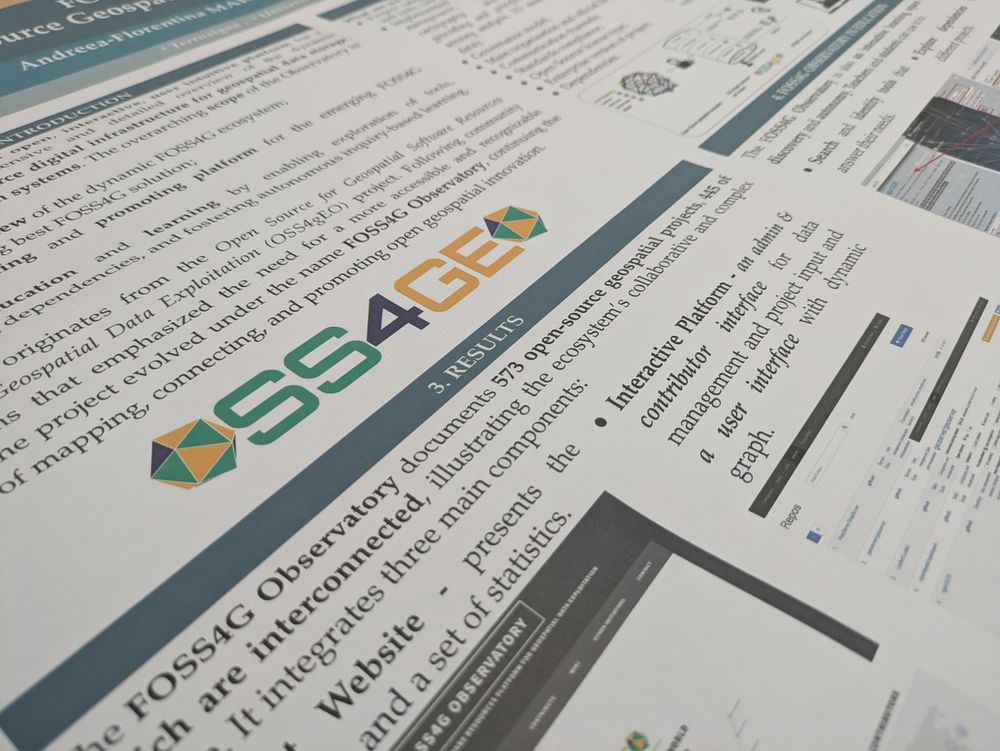
November 7, 2025 at 6:32 PM
🎤👩🏼🏫 Today we presented FOSS4G Observatory at #geoearth Conference, which marked 125 years of geography education at University of Bucharest (Romania) 🌍🎓 .
Our poster highlighted the platform’s role as a digital infrastructure for open-source geospatial […]
[Original post on mastodon.social]
Our poster highlighted the platform’s role as a digital infrastructure for open-source geospatial […]
[Original post on mastodon.social]
🔧 The open source geospatial ecosystem drives innovation and remains a key topic of the @geospatialorg seminars.
📊 “State and Prospects of the Open Source Geospatial Software Ecosystem: October 2025” covers 2024–2025 updates (GeoServer, STAC, MapStore) and […]
[Original post on mastodon.social]
📊 “State and Prospects of the Open Source Geospatial Software Ecosystem: October 2025” covers 2024–2025 updates (GeoServer, STAC, MapStore) and […]
[Original post on mastodon.social]

October 30, 2025 at 7:51 AM
🔧 The open source geospatial ecosystem drives innovation and remains a key topic of the @geospatialorg seminars.
📊 “State and Prospects of the Open Source Geospatial Software Ecosystem: October 2025” covers 2024–2025 updates (GeoServer, STAC, MapStore) and […]
[Original post on mastodon.social]
📊 “State and Prospects of the Open Source Geospatial Software Ecosystem: October 2025” covers 2024–2025 updates (GeoServer, STAC, MapStore) and […]
[Original post on mastodon.social]
Reposted by FOSS4G Observatory

#jupyter based #gis tool compatible with @qgis
#python #gischat #qgis #jupytergis #geodata
https://eo4society.esa.int/2025/10/16/jupytergis-breaks-through-to-the-next-level/
#python #gischat #qgis #jupytergis #geodata
https://eo4society.esa.int/2025/10/16/jupytergis-breaks-through-to-the-next-level/

JupyterGIS breaks through to the next level
Launched in June 2024, JupyterGIS was introduced as a collaborative, web-based GIS environment built on the JupyterLab framework. Its objective is to bring QGIS-inspired workflows into the browser, enabling real-time collaborative editing, seamless integration with notebooks, and support for core geospatial data formats.
When it was first announced earlier this year, JupyterGIS already delivered:
* Real-time collaborative editing (Google Docs-style)
* Visualisation of raster & vector data
* Symbology editing and spatio-temporal animations
* Programmatic map control via a Python API.
Thanks to contributions from the community and support from partner organizations, JupyterGIS has advanced significantly and now offers an expanded range of features for analysis, visualization, and collaboration.
**Enhanced vector tile capabilities**
Support for vector tiles has been strengthened, including full compatibility with the _pmtiles_ format.
Other key updates include:
* An _identify tool_ that inspects vector tiles to display features and associated properties.
* A _symbology panel_ that applies graduated, categorized, and canonical symbology to vector tile layers.
These improvements enhance the interpretability and styling of geospatial datasets directly in the browser.
The identify tool in action with a pmtiles vector dataset.
The symbology panel in action, allowing for different notations.
**A new processing toolbox**
One of the most significant updates is a new browser-based processing toolbox powered by a WebAssembly (WASM) build of the Geospatial Data Abstraction Library (GDAL).
Available tools include:
* _Buffer_ : computes a buffer around geometries of a vector dataset.
* _Convex Hull_ : calculates the convex hull for each feature of an input layer.
* _Dissolve_ : combines features of vector layers into new features
* _Bounding Boxes_ : calculates the bounding box for each feature in an input layer.
* _Centroid_ : creates a new layer with the centroids of the geometries of an input layer.
* _Concave Hull_ : computes the concave hull for each feature of an input point layer.
This toolbox has been designed for extensibility, with a JSON schema that allows additional GDAL operations to be integrated in a straightforward manner.
Using the processing tool to compute the convex hulls of geometries.
**Symbology enhancements**
Visualization of geospatial data has become more flexible and expressive through several enhancements:
* _Viridis_ is now the default colormap, providing perceptually uniform visualization.
* _Multiband symbology_ is now available for GeoTIFFs.
* _Canonical symbology_ defined in GeoJSON files can be applied automatically.
* _Colormaps_ can now be _reversed_ , allowing greater flexibility for data interpretation and visualization.
* In the case of _point layers_ , color and marker size can be styled independently, and bound to different data.
Setting color and radius based on data.
**Integration with SpatioTemporal Asset Catalogs (STAC)**
A SpatioTemporal Asset Catalog (STAC) browser is now embedded into JupyterGIS, streamlining access to different data collections. Users can select specific platforms and sensors, choose data products and processing levels, and set temporal and spatial constraints.
It is now possible to search across multiple datasets simultaneously. Users can click on any result to add it directly as a layer to their JupyterGIS project. This creates a seamless workflow from data discovery to visualization, making it easier for researchers and analysts to find and integrate relevant satellite imagery and geospatial datasets into their Jupyter notebooks.
Currently, the STAC Browser only supports the Geodes STAC API but support for all STAC catalogs is under way.
Browsing a STAC access catalog from JupyterGIS.
**Support for more data types**
The range of supported geospatial data formats is now broadened with _GeoParquet_ and _PMTiles_**,** enabling efficient columnar storage and fast analytical queries for GeoParquet, and highly compact, streaming-friendly vector tile delivery for PMTiles.
**User experience and interface improvements**
The interface has been refined for a smoother workflow:
* _Integrated control panels_ (layer list, filters, layer properties, etc.), reducing back and forth between the JupyterLab side-panels and the JupyterGIS UI. It also improves the “single document” scenario, allowing it to interact with JupyterGIS controls when opening a GIS document from the classic Jupyter Notebook UI.
* An improved _toolbar design_ , with cleaner icons and better usability.
* A new feature to center the map on your _current location_.
* _Map annotations_ now link to the map: clicking an annotation automatically re-centers and zooms to the location.
* _Full-screen_ mode support.
**Legends for vector layers**
JupyterGIS now automatically generates legends for vector layers, ensuring consistent interpretation:
* Legends are dynamically updated to reflect current symbology.
* Customizations such as reversed colormaps are preserved.
Displaying legends in the layers panel.
**JupyterGIS tiler extension**
An extension for JupyterGIS enables the creation of JupyterGIS layers from _xarray variables_ in Jupyter kernels, with support for lazy evaluation, bridging geospatial workflows with powerful array-based computation.
The package, called JupyterGIS-tiler, is available in GitHub here and can be installed from PyPI with _pip install jupytergis-tiler_.
**Looking ahead**
Development will continue to expand JupyterGIS in several directions:
* Extension of the GDAL-based processing toolbox.
* Deeper integration with QGIS and a richer Python API for automation.
* A Story Maps Editor and Viewer to enable interactive communication of geospatial information through text, imagery, and maps.
In the meantime, feel free to try JupyterGIS directly in your browser with JupyterLite, no installation required.
Opportunities for engagement also include:
* Checking out documentation for tutorials and the Python API.
* Discussions via the GeoJupyter Zulip channel or the bi-weekly GeoJupyter hackathon.
* Contributions to the development repository.
The JupyterGIS community continues to grow, and active participation from researchers, developers, and educators worldwide is encouraged.
eo4society.esa.int
October 24, 2025 at 6:41 PM
Reposted by FOSS4G Observatory

Greetings from the #osgeo Community Sprint 2025 in Riga. https://www.osgeo.org/events/join-osgeo-community-sprint-2025-at-bids-25-riga-latvia/
If you are around, you are welcome to join us at 19:00 for our social event at Ala Pagrabs.
And if you have time to […]
[Original post on fosstodon.org]
If you are around, you are welcome to join us at 19:00 for our social event at Ala Pagrabs.
And if you have time to […]
[Original post on fosstodon.org]

September 30, 2025 at 3:28 PM
Greetings from the #osgeo Community Sprint 2025 in Riga. https://www.osgeo.org/events/join-osgeo-community-sprint-2025-at-bids-25-riga-latvia/
If you are around, you are welcome to join us at 19:00 for our social event at Ala Pagrabs.
And if you have time to […]
[Original post on fosstodon.org]
If you are around, you are welcome to join us at 19:00 for our social event at Ala Pagrabs.
And if you have time to […]
[Original post on fosstodon.org]
🍁🌍 Open source & GIS updates at the start of autumn:
📦 New releases:
#saga 9.9.2
https://sourceforge.net/p/saga-gis/news/2025/09/saga-992-released/
#proj 9.7.0
https://proj.org/en/9.7/news.html
#geoserver
https://geoserver.org/announcements/2025/09/01/geoserver-2-26-4-released.html
#pgadmin4 […]
📦 New releases:
#saga 9.9.2
https://sourceforge.net/p/saga-gis/news/2025/09/saga-992-released/
#proj 9.7.0
https://proj.org/en/9.7/news.html
#geoserver
https://geoserver.org/announcements/2025/09/01/geoserver-2-26-4-released.html
#pgadmin4 […]
Original post on mastodon.social
mastodon.social
September 18, 2025 at 6:51 AM
🍁🌍 Open source & GIS updates at the start of autumn:
📦 New releases:
#saga 9.9.2
https://sourceforge.net/p/saga-gis/news/2025/09/saga-992-released/
#proj 9.7.0
https://proj.org/en/9.7/news.html
#geoserver
https://geoserver.org/announcements/2025/09/01/geoserver-2-26-4-released.html
#pgadmin4 […]
📦 New releases:
#saga 9.9.2
https://sourceforge.net/p/saga-gis/news/2025/09/saga-992-released/
#proj 9.7.0
https://proj.org/en/9.7/news.html
#geoserver
https://geoserver.org/announcements/2025/09/01/geoserver-2-26-4-released.html
#pgadmin4 […]
🗺️ Curious about where contributors of the open source geospatial tools coming from?
The FOSS4G Observatory (@OSS4gEO) maps the global distribution of contributors to open geospatial projects like @qgis, @geoserver, @grassgis, and many more.
Explore the map […]
[Original post on mastodon.social]
The FOSS4G Observatory (@OSS4gEO) maps the global distribution of contributors to open geospatial projects like @qgis, @geoserver, @grassgis, and many more.
Explore the map […]
[Original post on mastodon.social]

September 8, 2025 at 10:36 AM
🗺️ Curious about where contributors of the open source geospatial tools coming from?
The FOSS4G Observatory (@OSS4gEO) maps the global distribution of contributors to open geospatial projects like @qgis, @geoserver, @grassgis, and many more.
Explore the map […]
[Original post on mastodon.social]
The FOSS4G Observatory (@OSS4gEO) maps the global distribution of contributors to open geospatial projects like @qgis, @geoserver, @grassgis, and many more.
Explore the map […]
[Original post on mastodon.social]
📢 Our statistics dashboard got a major upgrade! ✨
👉 Filter by Category, License, Functionality, Organization or just search by name of repo;
👉 Pick 2 projects and compare them to explore activity of the projects: contributors, lines of code and commits.
Check it out → […]
👉 Filter by Category, License, Functionality, Organization or just search by name of repo;
👉 Pick 2 projects and compare them to explore activity of the projects: contributors, lines of code and commits.
Check it out → […]
Original post on mastodon.social
mastodon.social
July 3, 2025 at 10:12 AM
📢 Our statistics dashboard got a major upgrade! ✨
👉 Filter by Category, License, Functionality, Organization or just search by name of repo;
👉 Pick 2 projects and compare them to explore activity of the projects: contributors, lines of code and commits.
Check it out → […]
👉 Filter by Category, License, Functionality, Organization or just search by name of repo;
👉 Pick 2 projects and compare them to explore activity of the projects: contributors, lines of code and commits.
Check it out → […]
🎙️ Our talk — “FOSS4G Observatory: an open initiative to support the long-term sustainability of open-source geospatial projects” — was presented today at #lps25 🌍 🛰️
We’ll be ( @codrina , @vcraciunescu ) here, all week, in Vienna 🇦🇹 to:
💻 Sharing
📝 Learning
🤝 Connecting
✨ and Enjoying the […]
We’ll be ( @codrina , @vcraciunescu ) here, all week, in Vienna 🇦🇹 to:
💻 Sharing
📝 Learning
🤝 Connecting
✨ and Enjoying the […]
Original post on mastodon.social
mastodon.social
June 23, 2025 at 4:52 PM
🎙️ Our talk — “FOSS4G Observatory: an open initiative to support the long-term sustainability of open-source geospatial projects” — was presented today at #lps25 🌍 🛰️
We’ll be ( @codrina , @vcraciunescu ) here, all week, in Vienna 🇦🇹 to:
💻 Sharing
📝 Learning
🤝 Connecting
✨ and Enjoying the […]
We’ll be ( @codrina , @vcraciunescu ) here, all week, in Vienna 🇦🇹 to:
💻 Sharing
📝 Learning
🤝 Connecting
✨ and Enjoying the […]
📢 Open source just got a boost. 🇫🇷 The French Government steps up for open tech—becoming the first to endorse UN Open Source Principle👏🌐. Who’s next?
https://camptocamp.com/en/news-events/france-becomes-first-government-to-endorse-un-open-source-principles%2C-now-what-
#opensource […]
https://camptocamp.com/en/news-events/france-becomes-first-government-to-endorse-un-open-source-principles%2C-now-what-
#opensource […]
Original post on mastodon.social
mastodon.social
June 8, 2025 at 4:07 PM
📢 Open source just got a boost. 🇫🇷 The French Government steps up for open tech—becoming the first to endorse UN Open Source Principle👏🌐. Who’s next?
https://camptocamp.com/en/news-events/france-becomes-first-government-to-endorse-un-open-source-principles%2C-now-what-
#opensource […]
https://camptocamp.com/en/news-events/france-becomes-first-government-to-endorse-un-open-source-principles%2C-now-what-
#opensource […]
Some new releases in the #opensource #geospatial world:
🗺️ PostGIS 3.6.0alpha 1 https://postgis.net/news/
📐 Proj4js 2.17.0
github.com/proj4js/proj4js/releases
🧭 pgRouting 3.6.3
github.com/pgRouting/pgrouting/releases
🌍 GDAL 3.11
gdal.org/download.html
🔧 GeoTools 33.0 […]
🗺️ PostGIS 3.6.0alpha 1 https://postgis.net/news/
📐 Proj4js 2.17.0
github.com/proj4js/proj4js/releases
🧭 pgRouting 3.6.3
github.com/pgRouting/pgrouting/releases
🌍 GDAL 3.11
gdal.org/download.html
🔧 GeoTools 33.0 […]
Original post on mastodon.social
mastodon.social
May 20, 2025 at 12:31 PM
Some new releases in the #opensource #geospatial world:
🗺️ PostGIS 3.6.0alpha 1 https://postgis.net/news/
📐 Proj4js 2.17.0
github.com/proj4js/proj4js/releases
🧭 pgRouting 3.6.3
github.com/pgRouting/pgrouting/releases
🌍 GDAL 3.11
gdal.org/download.html
🔧 GeoTools 33.0 […]
🗺️ PostGIS 3.6.0alpha 1 https://postgis.net/news/
📐 Proj4js 2.17.0
github.com/proj4js/proj4js/releases
🧭 pgRouting 3.6.3
github.com/pgRouting/pgrouting/releases
🌍 GDAL 3.11
gdal.org/download.html
🔧 GeoTools 33.0 […]
🧐 Is Free and Open Source Software (FOSS) Sustainable?
In his article, @jospoortvliet reminds us that #free and #opensource software isn't just a code or development model, it's a philosophy build on principles of #freedom , #collaboration and #community 🌐 🤝 💻 .
Read the full article here 👉 […]
In his article, @jospoortvliet reminds us that #free and #opensource software isn't just a code or development model, it's a philosophy build on principles of #freedom , #collaboration and #community 🌐 🤝 💻 .
Read the full article here 👉 […]
Original post on mastodon.social
mastodon.social
May 6, 2025 at 6:58 PM
🧐 Is Free and Open Source Software (FOSS) Sustainable?
In his article, @jospoortvliet reminds us that #free and #opensource software isn't just a code or development model, it's a philosophy build on principles of #freedom , #collaboration and #community 🌐 🤝 💻 .
Read the full article here 👉 […]
In his article, @jospoortvliet reminds us that #free and #opensource software isn't just a code or development model, it's a philosophy build on principles of #freedom , #collaboration and #community 🌐 🤝 💻 .
Read the full article here 👉 […]
🌍 #foss4gobservatory - By the Numbers 📊
We're growing stronger every day! Here’s a snapshot of our open source ecosystem:
• 📁 551 documented repositories
• 🔗 420 graph connections
• 👥 17 active contributors
📊 Explore our interactive stats visualization: https://project.oss4geo.org/
🔍 Explore […]
We're growing stronger every day! Here’s a snapshot of our open source ecosystem:
• 📁 551 documented repositories
• 🔗 420 graph connections
• 👥 17 active contributors
📊 Explore our interactive stats visualization: https://project.oss4geo.org/
🔍 Explore […]
Original post on mastodon.social
mastodon.social
April 22, 2025 at 8:34 AM
🌍 #foss4gobservatory - By the Numbers 📊
We're growing stronger every day! Here’s a snapshot of our open source ecosystem:
• 📁 551 documented repositories
• 🔗 420 graph connections
• 👥 17 active contributors
📊 Explore our interactive stats visualization: https://project.oss4geo.org/
🔍 Explore […]
We're growing stronger every day! Here’s a snapshot of our open source ecosystem:
• 📁 551 documented repositories
• 🔗 420 graph connections
• 👥 17 active contributors
📊 Explore our interactive stats visualization: https://project.oss4geo.org/
🔍 Explore […]
🎉Celebrating Git's 20th Anniversary!🎂
Today, we’re marking a major milestone in the world of #opensource and #geospatial software.
From FOSS4G Observatory ( @OSS4gEO ) we're raising a toast to 20 years of #git! 🚀 It has been a game-changer for the #foss4g community, making it easier for […]
Today, we’re marking a major milestone in the world of #opensource and #geospatial software.
From FOSS4G Observatory ( @OSS4gEO ) we're raising a toast to 20 years of #git! 🚀 It has been a game-changer for the #foss4g community, making it easier for […]
Original post on mastodon.social
mastodon.social
April 7, 2025 at 7:36 PM
🎉Celebrating Git's 20th Anniversary!🎂
Today, we’re marking a major milestone in the world of #opensource and #geospatial software.
From FOSS4G Observatory ( @OSS4gEO ) we're raising a toast to 20 years of #git! 🚀 It has been a game-changer for the #foss4g community, making it easier for […]
Today, we’re marking a major milestone in the world of #opensource and #geospatial software.
From FOSS4G Observatory ( @OSS4gEO ) we're raising a toast to 20 years of #git! 🚀 It has been a game-changer for the #foss4g community, making it easier for […]
🎤🗓️ Our team had the privilege of presenting the #foss4gobservatory at the geo-spatial.org seminars in Chișinău, Moldova 🇲🇩. It was a fantastic opportunity to share the latest developments of our project, to highlight how open-source geospatial […]
[Original post on mastodon.social]
[Original post on mastodon.social]


February 28, 2025 at 9:32 AM
🎤🗓️ Our team had the privilege of presenting the #foss4gobservatory at the geo-spatial.org seminars in Chișinău, Moldova 🇲🇩. It was a fantastic opportunity to share the latest developments of our project, to highlight how open-source geospatial […]
[Original post on mastodon.social]
[Original post on mastodon.social]
"Space: The final frontier." 🌌
📢 💠 The HD digital scan (600dpi 48bit) of the framed front page of the @grassgis manual '87 edition, signed by William Shatner aka Captain Kirk, is now preserved in the Zenodo.org open access repository […]
[Original post on mastodon.social]
📢 💠 The HD digital scan (600dpi 48bit) of the framed front page of the @grassgis manual '87 edition, signed by William Shatner aka Captain Kirk, is now preserved in the Zenodo.org open access repository […]
[Original post on mastodon.social]
February 11, 2025 at 1:36 PM
"Space: The final frontier." 🌌
📢 💠 The HD digital scan (600dpi 48bit) of the framed front page of the @grassgis manual '87 edition, signed by William Shatner aka Captain Kirk, is now preserved in the Zenodo.org open access repository […]
[Original post on mastodon.social]
📢 💠 The HD digital scan (600dpi 48bit) of the framed front page of the @grassgis manual '87 edition, signed by William Shatner aka Captain Kirk, is now preserved in the Zenodo.org open access repository […]
[Original post on mastodon.social]
Reposted by FOSS4G Observatory

QGIS recognized as Digital Public Good
We are thrilled to announce that QGIS has been officially recognized as a Digital Public Good (DPG) by the Digital Public Goods Alliance (DPGA)! This recognition underscores our commitment to open-source geospatial solutions that contribute to the […]
We are thrilled to announce that QGIS has been officially recognized as a Digital Public Good (DPG) by the Digital Public Goods Alliance (DPGA)! This recognition underscores our commitment to open-source geospatial solutions that contribute to the […]
Original post on fosstodon.org
fosstodon.org
February 8, 2025 at 12:07 PM
QGIS recognized as Digital Public Good
We are thrilled to announce that QGIS has been officially recognized as a Digital Public Good (DPG) by the Digital Public Goods Alliance (DPGA)! This recognition underscores our commitment to open-source geospatial solutions that contribute to the […]
We are thrilled to announce that QGIS has been officially recognized as a Digital Public Good (DPG) by the Digital Public Goods Alliance (DPGA)! This recognition underscores our commitment to open-source geospatial solutions that contribute to the […]
🎉🎉 Happy 19th Birthday, @osgeo ! 🎉🎉
A big 👏 to the OSGeo community for 19 incredible years of promoting open source geospatial technologies, fostering innovation and collaboration!🤝🌐🗺️🛰️ 💻
https://www.osgeo.org/foundation-news/happy-19th-birthday-osgeo/
#osgeo #opensource […]
A big 👏 to the OSGeo community for 19 incredible years of promoting open source geospatial technologies, fostering innovation and collaboration!🤝🌐🗺️🛰️ 💻
https://www.osgeo.org/foundation-news/happy-19th-birthday-osgeo/
#osgeo #opensource […]
Original post on mastodon.social
mastodon.social
February 4, 2025 at 8:45 PM
🎉🎉 Happy 19th Birthday, @osgeo ! 🎉🎉
A big 👏 to the OSGeo community for 19 incredible years of promoting open source geospatial technologies, fostering innovation and collaboration!🤝🌐🗺️🛰️ 💻
https://www.osgeo.org/foundation-news/happy-19th-birthday-osgeo/
#osgeo #opensource […]
A big 👏 to the OSGeo community for 19 incredible years of promoting open source geospatial technologies, fostering innovation and collaboration!🤝🌐🗺️🛰️ 💻
https://www.osgeo.org/foundation-news/happy-19th-birthday-osgeo/
#osgeo #opensource […]
✨🗄️ 🔍 A new repo has been added to our #foss4gobservatory database: OSM2World
#osm2world is an Open Source application that converts OpenStreetMap data to three-dimensional models. Recently OSM2World 0.4.0 was released. Check for new updates ( […]
#osm2world is an Open Source application that converts OpenStreetMap data to three-dimensional models. Recently OSM2World 0.4.0 was released. Check for new updates ( […]
Original post on mastodon.social
mastodon.social
February 4, 2025 at 8:43 AM
✨🗄️ 🔍 A new repo has been added to our #foss4gobservatory database: OSM2World
#osm2world is an Open Source application that converts OpenStreetMap data to three-dimensional models. Recently OSM2World 0.4.0 was released. Check for new updates ( […]
#osm2world is an Open Source application that converts OpenStreetMap data to three-dimensional models. Recently OSM2World 0.4.0 was released. Check for new updates ( […]
Did you know that every last Friday of the month is the QGIS Open Day? 🗓️ 💻 🌎
Whether you're a beginner or an experienced user these open sessions are the perfect opportunity to:
• Explore the latest QGIS features 🔍;
• Learn from experts through live demos and interactive sessions 💬 […]
Whether you're a beginner or an experienced user these open sessions are the perfect opportunity to:
• Explore the latest QGIS features 🔍;
• Learn from experts through live demos and interactive sessions 💬 […]
Original post on mastodon.social
mastodon.social
January 30, 2025 at 6:19 AM
Did you know that every last Friday of the month is the QGIS Open Day? 🗓️ 💻 🌎
Whether you're a beginner or an experienced user these open sessions are the perfect opportunity to:
• Explore the latest QGIS features 🔍;
• Learn from experts through live demos and interactive sessions 💬 […]
Whether you're a beginner or an experienced user these open sessions are the perfect opportunity to:
• Explore the latest QGIS features 🔍;
• Learn from experts through live demos and interactive sessions 💬 […]
👉 FOSS4G Observatory (ex-OSS4gEO) depends on your support! We welcome contributions in every form and shape, either making FOSS4G Observatory's underlying software better, adding new projects to the FOSS4G Observatory database or correcting/completing the […]
[Original post on mastodon.social]
[Original post on mastodon.social]

January 29, 2025 at 8:59 AM
👉 FOSS4G Observatory (ex-OSS4gEO) depends on your support! We welcome contributions in every form and shape, either making FOSS4G Observatory's underlying software better, adding new projects to the FOSS4G Observatory database or correcting/completing the […]
[Original post on mastodon.social]
[Original post on mastodon.social]
📰 News from the #postgis team: PostGIS 3.5.2 was released on January 18, 2025.
https://postgis.net/news/
#postgis #postgresql #proj #opensource #oss4geo #foss4gobservatory
https://postgis.net/news/
#postgis #postgresql #proj #opensource #oss4geo #foss4gobservatory
News
postgis.net
January 28, 2025 at 8:31 AM
📰 News from the #postgis team: PostGIS 3.5.2 was released on January 18, 2025.
https://postgis.net/news/
#postgis #postgresql #proj #opensource #oss4geo #foss4gobservatory
https://postgis.net/news/
#postgis #postgresql #proj #opensource #oss4geo #foss4gobservatory