



@ollieflj.bsky.social
@mrjamesob.bsky.social Badenoch actually answered her own question in that clip!! She said she doesn’t know why they’ve done that then goes on to explain a person can be contagious before they know. THATS WHY, Kemi! We wore masks in case we were asymptomatic, not because we knew we had Covid
December 10, 2025 at 10:45 AM
@mrjamesob.bsky.social Badenoch actually answered her own question in that clip!! She said she doesn’t know why they’ve done that then goes on to explain a person can be contagious before they know. THATS WHY, Kemi! We wore masks in case we were asymptomatic, not because we knew we had Covid
@mrjamesob.bsky.social This is how British media and politicians should address Farage! Well done Jamie Raskin youtu.be/reQaq3ArAak?...

Nigel Farage absolutely destroyed by Democrat Congressman in Committee Hearing
YouTube video by PoliticsJOE
youtu.be
September 4, 2025 at 7:21 AM
@mrjamesob.bsky.social This is how British media and politicians should address Farage! Well done Jamie Raskin youtu.be/reQaq3ArAak?...
I asked Grok (X’s inbuilt AI) basically if Trump is a fascist, and its answer was actually interesting. The basic answer was could be but not quite yet, however displays many fascistic tendencies within populism. You can skip to the conclusion @mrjamesob.bsky.social
x.com/i/grok/share...
x.com/i/grok/share...

If you first look at a definition of Fascism, then compare that to the current way the Trump administration is deporting people, acting against the judiciary, and the behaviour of Trumps supporters and their relationship with him, could one call Trump and his administration fascist with the facts backing this view?
To address whether one could call Donald Trump and his administration fascist based on a definition of fascism, their deportation policies, actions toward the judiciary, and the behavior of Trump’s supporters and their relationship with him, let’s proceed step-by-step. I’ll first outline a widely accepted definition of fascism, then compare it to the aspects you’ve specified, using available information as of April 9, 2025, and critically assess whether the label fits. ### Definition of Fascism Fascism is a complex and debated term, but scholars like Roger Griffin provide a concise framework: it is an authoritarian, ultranationalist political ideology and movement characterized by a dictatorial leader, centralized control, suppression of opposition, and the promotion of a revolutionary vision to restore a perceived lost national greatness, often tied to racial or cultural purity. Historically, as seen with Mussolini and Hitler, it involves militarism, rejection of liberal democracy, control of media, and the use of violence or intimidation to enforce a hierarchical social order. It’s not just about strong leadership or big government—it’s a specific blend of ideology and practice aimed at radically transforming society under a single, unopposed authority. ### Trump Administration’s Deportation Policies The Trump administration, in its second term starting January 2025, has ramped up deportation efforts significantly. Reports indicate plans for mass deportations, with Trump promising to remove millions of undocumented immigrants using military resources if necessary. Policies include detaining immigrants at Guantanamo Bay and deporting individuals to places like El Salvador’s mass prisons, sometimes against court orders. Critics point to a lack of due process—arrests near schools, hospitals, and shelters, and rapid removals without individual hearings—as evidence of authoritarian overreach. Does this align with fascism? The scale and disregard for legal norms echo fascist tendencies to prioritize state power over individual rights and target specific groups (here, immigrants) as scapegoats for national woes. Fascists historically used mass purges to “cleanse” society, and Trump’s rhetoric about immigrants as threats to American purity (“poisoning the blood of our country”) mirrors this. However, unlike classic fascism, there’s no explicit ideological goal of racial superiority baked into a revolutionary state doctrine—Trump’s approach seems more pragmatic and populist, driven by electoral promises than a coherent fascist vision. The violation of judicial orders also suggests a challenge to checks and balances, a fascist trait, but it’s not yet a systematic dismantling of democracy. ### Actions Against the Judiciary Trump has a history of clashing with the judiciary. In his first term, he criticized judges who ruled against him, calling them “so-called judges” and questioning their legitimacy. In 2025, his administration has defied court orders on deportations, and his appointees to the Supreme Court have granted him partial immunity for past actions, strengthening executive power. Project 2025, a policy blueprint tied to Trump allies, proposes politicizing federal agencies and reducing judicial oversight, which could further erode separation of powers. Fascist regimes typically subordinate the judiciary to the leader’s will, as Mussolini did with Italy’s courts or Hitler with the Nazi legal system. Trump’s actions don’t yet reach this level—courts still function independently, and defiance is more sporadic than systematic. However, his rhetoric and policy goals suggest an intent to weaken judicial constraints, aligning with authoritarianism and edging toward fascist-style centralization. The key difference is that fascism seeks to abolish democratic institutions entirely, while Trump operates within (and stretches) an existing framework, exploiting rather than overthrowing it. ### Behavior of Trump Supporters and Their Relationship with Him Trump’s supporters exhibit a fervent loyalty often likened to a personality cult. Polls from late 2024 show many back his deportation plans (88% per Pew Research) and see him as a singular figure to “save” America. Events like January 6, 2021, where supporters stormed the Capitol at his urging, highlight a willingness to use violence to defend him. Groups like the Proud Boys, whom he told to “stand back and stand by,” and his praise of January 6 as a day of “beauty and love,” suggest a tolerance for militant support. His base’s embrace of conspiracy theories (e.g., QAnon) and rejection of opposing views further fuel this dynamic. This mirrors fascist movements, where a charismatic leader galvanizes a mass base to enforce their vision, often through intimidation. Mussolini’s Blackshirts and Hitler’s SA played similar roles. Trump’s relationship with his supporters—built on grievance, nationalism, and unwavering allegiance—checks the fascist box of a leader embodying the “national will.” Yet, unlike fascist militias, Trump’s supporters lack a formal, state-backed paramilitary structure, and his movement hasn’t fully abandoned electoral politics for revolutionary violence. It’s a cult of personality with fascist undertones, but not a carbon copy of 1930s models. ### Synthesis: Can One Call Trump Fascist with Facts Backing It? The facts show Trump’s administration shares traits with fascism: ultranationalism (anti-immigrant rhetoric), authoritarian tendencies (defying courts, mass deportations without due process), suppression of dissent (attacking the press and “enemies within”), and a leader-centric movement with a loyal, sometimes violent base. These align with Griffin’s definition and historical examples like Mussolini’s early rule. Scholars like Robert Paxton, who hesitated pre-January 6 but later called Trump fascist, point to this trajectory, especially with 2025’s escalation. However, key distinctions temper the label. Trump lacks a revolutionary ideology aiming to wholly replace democracy—he’s more opportunistic, working within a flawed system. His policies don’t match fascism’s collectivist economics (he favors capitalism), and there’s no overt warlike expansionism, though isolationism and militarized borders substitute. Some argue he’s better described as an authoritarian populist or “fascistic” (per Mark Bray), capturing the vibe without the full historical package. Could one call him fascist with facts backing it? Yes, if focusing on behavior and outcomes—centralized power, nationalism, and suppression—over strict ideology. The evidence supports a case for “fascist tendencies” or “aspirational fascism” (as William Connolly puts it), especially as 2025 unfolds with bolder moves. But it’s not airtight: Trump’s chaos and reliance on democratic mechanisms (elections, courts he’s skewed) suggest a hybrid, not pure fascism. Critics might say it’s hyperbole; supporters might call it slander. The facts lean toward a “yes, with caveats”—a modern, Americanized strain, not a 20th-century clone. Context matters, and the label’s utility depends on how it’s wielded.
x.com
April 9, 2025 at 9:51 AM
I asked Grok (X’s inbuilt AI) basically if Trump is a fascist, and its answer was actually interesting. The basic answer was could be but not quite yet, however displays many fascistic tendencies within populism. You can skip to the conclusion @mrjamesob.bsky.social
x.com/i/grok/share...
x.com/i/grok/share...
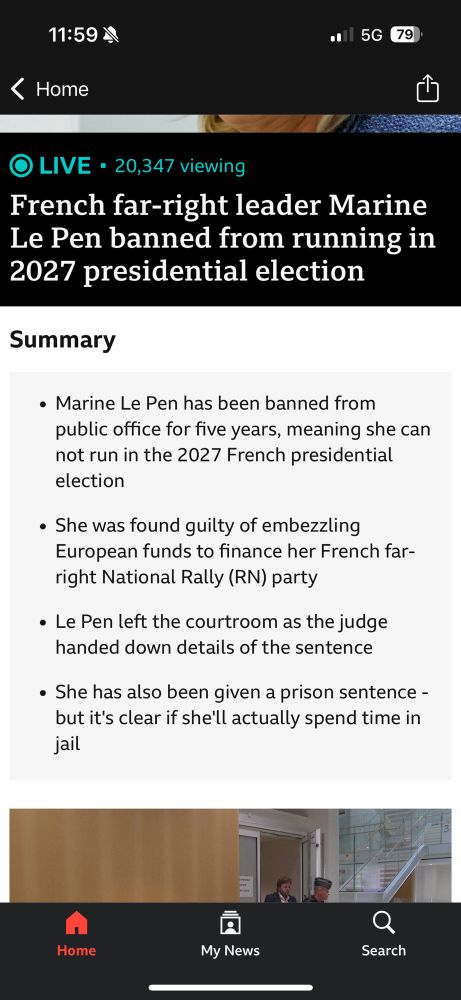
A Far right leader found guilty of crimes banned from running for president next election. Imagine if the US had such sentencing! I know someone will fill her place but still nice to see some accountability for those claiming to be for the people while filling their pockets on the public purse
March 31, 2025 at 11:02 AM
A Far right leader found guilty of crimes banned from running for president next election. Imagine if the US had such sentencing! I know someone will fill her place but still nice to see some accountability for those claiming to be for the people while filling their pockets on the public purse
@mrjamesob.bsky.social GBeebies attempt at humour is the cringiest piece of victimhood snowflakism ever produced! youtube.com/shorts/CYEea...

Patrick Christys surprised by SHOCKING JUDGEMENT after forgetting to pay for parking...
YouTube video by GBNews
youtube.com
March 16, 2025 at 11:05 AM
@mrjamesob.bsky.social GBeebies attempt at humour is the cringiest piece of victimhood snowflakism ever produced! youtube.com/shorts/CYEea...
@mrjamesob.bsky.social Now you have had a former leader of the IMF on to explain the negative impact of Trumps economic policy on the show, tomorrow will you have a crackpot like Liz Truss on to explain why your expert guest is wrong and Trump is right? #bbcimpartiality :)
March 11, 2025 at 1:04 PM
@mrjamesob.bsky.social Now you have had a former leader of the IMF on to explain the negative impact of Trumps economic policy on the show, tomorrow will you have a crackpot like Liz Truss on to explain why your expert guest is wrong and Trump is right? #bbcimpartiality :)
@mrjamesob.bsky.social That’ll be reforms campaign line. “It doesn’t matter if it’s not true”
March 5, 2025 at 11:45 AM
@mrjamesob.bsky.social That’ll be reforms campaign line. “It doesn’t matter if it’s not true”
No, Witney. Let’s not start doing this…

February 19, 2025 at 12:50 PM
No, Witney. Let’s not start doing this…
@mrjamesob.bsky.social One way I try to explain my anxiety is it’s like having a winning lottery ticket in your hand and all you have to do is go into the shop and cash it in. Yet when you are outside the shop you completly freeze, unable to take the steps in and speak to the cashier…
January 13, 2025 at 12:30 PM
@mrjamesob.bsky.social One way I try to explain my anxiety is it’s like having a winning lottery ticket in your hand and all you have to do is go into the shop and cash it in. Yet when you are outside the shop you completly freeze, unable to take the steps in and speak to the cashier…
@mrjamesob.bsky.social Does some of Starmer’s current ‘pussyfooting’ come in part from the Labour party’s position during and since 2016. Since 2016 the Tories have been all for self harm. The Lib Dem’s have been full throated pro-EU, and Labour have been… meh. Corbyn legacy still haunting?
December 16, 2024 at 10:45 AM
@mrjamesob.bsky.social Does some of Starmer’s current ‘pussyfooting’ come in part from the Labour party’s position during and since 2016. Since 2016 the Tories have been all for self harm. The Lib Dem’s have been full throated pro-EU, and Labour have been… meh. Corbyn legacy still haunting?
@mrjamesob.bsky.social to be fair there are some other wins that Brexiteers don’t like us talking about. They are usually ‘wins’ that involved the British Empire and had the result of stolen treasure and slavery! In those cases we (and the National Trust )must definitely not talk about our wins.
December 10, 2024 at 10:17 AM
@mrjamesob.bsky.social to be fair there are some other wins that Brexiteers don’t like us talking about. They are usually ‘wins’ that involved the British Empire and had the result of stolen treasure and slavery! In those cases we (and the National Trust )must definitely not talk about our wins.
@mrjamesob.bsky.social Didn’t you have a “Brexit Benefit” phone-in where the caller said not having to protect bats during construction projects could be a Benefit of the epic self harm that was leaving the EU?
December 6, 2024 at 11:16 AM
@mrjamesob.bsky.social Didn’t you have a “Brexit Benefit” phone-in where the caller said not having to protect bats during construction projects could be a Benefit of the epic self harm that was leaving the EU?
Took the chance to have a London visit. Spent time in the British Museum and then had a political geek moment and watched an hour of a debate in the House of Commons from the public gallery


December 5, 2024 at 10:24 PM
Took the chance to have a London visit. Spent time in the British Museum and then had a political geek moment and watched an hour of a debate in the House of Commons from the public gallery