



Fran Oficialdegui
@oficialdegui.bsky.social
Biological invasions, freshwater ecology, crayfish-lover and keen on cycling
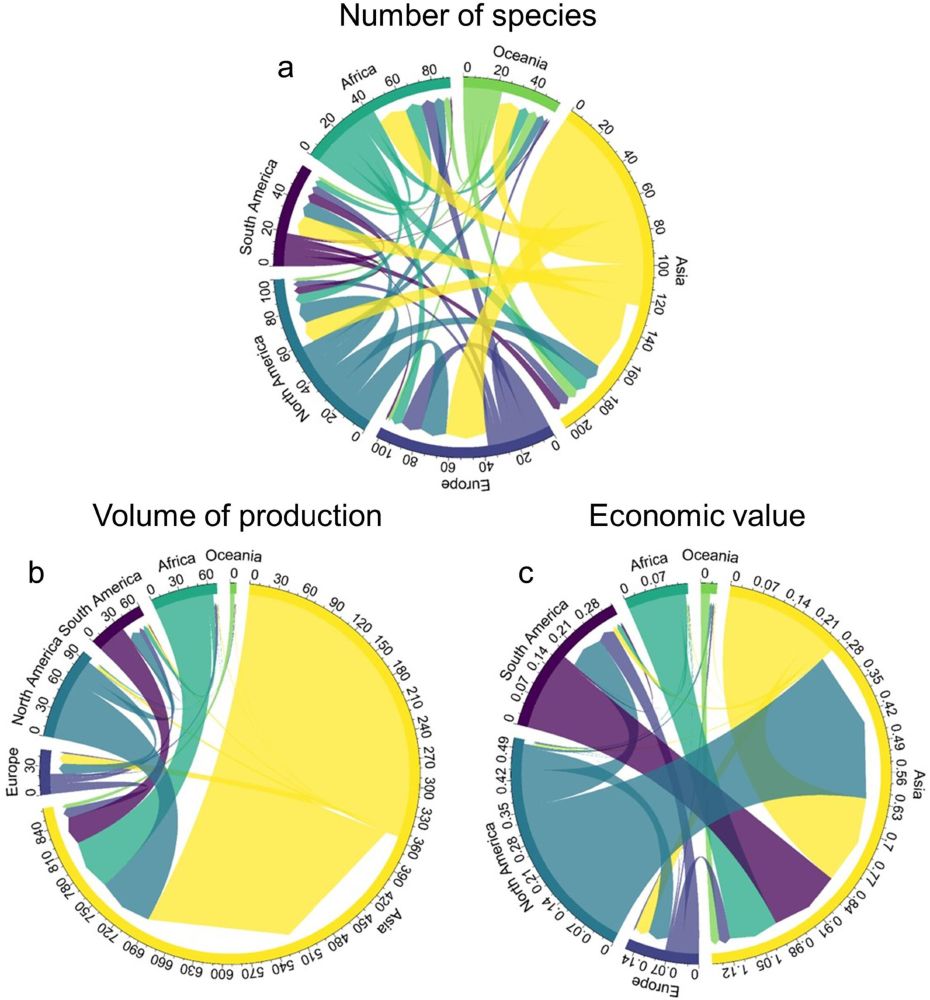
According to the proportion of species donated and received, Asia and North America were the primary donors of non-native species, while Europe and South America receive a large number of species. Asian species have been extensively translocated both inter- and intra-continentally for aquaculture
June 17, 2025 at 9:20 AM
According to the proportion of species donated and received, Asia and North America were the primary donors of non-native species, while Europe and South America receive a large number of species. Asian species have been extensively translocated both inter- and intra-continentally for aquaculture
This total production is largely driven by a handful of commonly farmed species (see Table 2 in the paper), many of which are farmed outside their native ranges and are recognised as high-risk invaders once established in non-native areas with monetary costs

June 17, 2025 at 9:20 AM
This total production is largely driven by a handful of commonly farmed species (see Table 2 in the paper), many of which are farmed outside their native ranges and are recognised as high-risk invaders once established in non-native areas with monetary costs
Over the past decades, production volumes have risen rapidly, with native production being several orders of magnitude higher than its non-native counterpart, but the annual growth rate for non-native species' production (and economic value) is currently surpassed that of native one.

June 17, 2025 at 9:20 AM
Over the past decades, production volumes have risen rapidly, with native production being several orders of magnitude higher than its non-native counterpart, but the annual growth rate for non-native species' production (and economic value) is currently surpassed that of native one.
While the production of native fish and molluscs remains higher than that of non-native ones, algae—and especially crustaceans—are predominantly produced outside their native ranges. The latter with a rate of change exceeding 11,000% since 2000 compared to the previous two decades


June 17, 2025 at 9:20 AM
While the production of native fish and molluscs remains higher than that of non-native ones, algae—and especially crustaceans—are predominantly produced outside their native ranges. The latter with a rate of change exceeding 11,000% since 2000 compared to the previous two decades
📝Non-Native Species in Aquaculture: Burgeoning Production and Environmental Sustainability Risks doi.org/10.1111/raq.... Finally out! 🥳@rosscuthbert.bsky.social @mkour.bsky.social

June 17, 2025 at 9:20 AM
📝Non-Native Species in Aquaculture: Burgeoning Production and Environmental Sustainability Risks doi.org/10.1111/raq.... Finally out! 🥳@rosscuthbert.bsky.social @mkour.bsky.social
No dejes pasar la oportunidad!! Dar visibilidad a los datos no publicados de EEI en España @guardias.bsky.social @bgallardo.bsky.social

May 29, 2025 at 10:24 AM
No dejes pasar la oportunidad!! Dar visibilidad a los datos no publicados de EEI en España @guardias.bsky.social @bgallardo.bsky.social
La idea de su introducción, no es ni de largo nueva... ya desde finales del siglo pasado y principios de este se viene barajando justificada por las diferencias genéticas y fragmentación de la distribución del complejo. Ver por ejemplo Grandjean et al. 2002. www.kmae-journal.org/articles/kma...

March 12, 2025 at 2:54 PM
La idea de su introducción, no es ni de largo nueva... ya desde finales del siglo pasado y principios de este se viene barajando justificada por las diferencias genéticas y fragmentación de la distribución del complejo. Ver por ejemplo Grandjean et al. 2002. www.kmae-journal.org/articles/kma...
Como bien dice Ester, quien nombró la especie es italiano (Alessadro Ninni) pero donde describe la especie es en Italia (copio foto). Si fuera A. pallipes, entonces el autor sería francés (Dominique Lereboullet), lo que corresponde con la distribución de A. pallipes actual.

March 12, 2025 at 12:42 PM
Como bien dice Ester, quien nombró la especie es italiano (Alessadro Ninni) pero donde describe la especie es en Italia (copio foto). Si fuera A. pallipes, entonces el autor sería francés (Dominique Lereboullet), lo que corresponde con la distribución de A. pallipes actual.
Por alusiones, no, no se nos ha pasado el 'detalle'. Austropotamobius es un género con una taxonomía que ha variado muchísimo incluso dentro de la misma especie A. pallipes. El uso de A. fulcisianus viene del más reciente artículo publicado al respecto (doi.org/10.1093/jcbi...).

March 12, 2025 at 12:42 PM
Por alusiones, no, no se nos ha pasado el 'detalle'. Austropotamobius es un género con una taxonomía que ha variado muchísimo incluso dentro de la misma especie A. pallipes. El uso de A. fulcisianus viene del más reciente artículo publicado al respecto (doi.org/10.1093/jcbi...).
2) Lower haplotype diversity in pet shops than feral populations
3) Haplotypes shared between Asian pet trade and European trade and open waters in Hungary
4) Hungary hosts a high haplotype variability
3) Haplotypes shared between Asian pet trade and European trade and open waters in Hungary
4) Hungary hosts a high haplotype variability

February 17, 2025 at 1:55 PM
2) Lower haplotype diversity in pet shops than feral populations
3) Haplotypes shared between Asian pet trade and European trade and open waters in Hungary
4) Hungary hosts a high haplotype variability
3) Haplotypes shared between Asian pet trade and European trade and open waters in Hungary
4) Hungary hosts a high haplotype variability
Highlights:
1) Different colour morphs of P. clarkii associated with aquarium trade
1) Different colour morphs of P. clarkii associated with aquarium trade

February 17, 2025 at 1:55 PM
Highlights:
1) Different colour morphs of P. clarkii associated with aquarium trade
1) Different colour morphs of P. clarkii associated with aquarium trade