



@ndjconrad.bsky.social
Reposted

Detection of dynamic communities in temporal networks with sparse data. Publication (co)authored by Zuse Institute members. In: Applied Network Science, doi.org/10.1007/s411...

Detection of dynamic communities in temporal networks with sparse data - Applied Network Science
Temporal networks are a powerful tool for studying the dynamic nature of a wide range of real-world complex systems, including social, biological and physical systems. In particular, detection of dyna...
doi.org
July 30, 2025 at 3:28 PM
Detection of dynamic communities in temporal networks with sparse data. Publication (co)authored by Zuse Institute members. In: Applied Network Science, doi.org/10.1007/s411...
Reposted
Clustering Time-Evolving Networks Using the Spatiotemporal Graph Laplacian. Publication (co)authored by Zuse Institute members. In: Chaos: An Interdisciplinary Journal of Nonlinear Science, doi.org/10.1063/5.02...
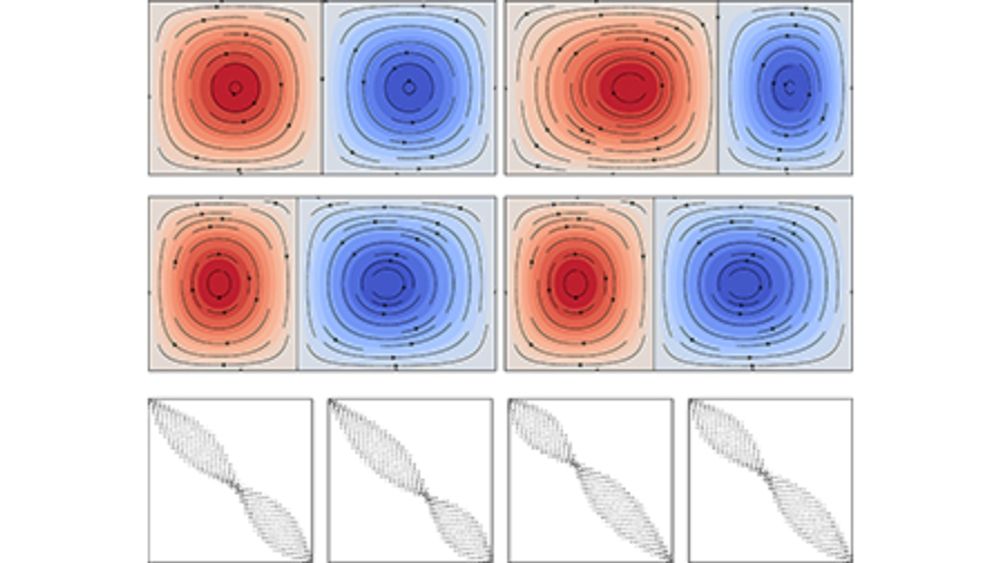
Clustering time-evolving networks using the spatiotemporal graph Laplacian
Time-evolving graphs arise frequently when modeling complex dynamical systems such as social networks, traffic flow, and biological processes. Developing techni
doi.org
July 30, 2025 at 3:36 PM
Clustering Time-Evolving Networks Using the Spatiotemporal Graph Laplacian. Publication (co)authored by Zuse Institute members. In: Chaos: An Interdisciplinary Journal of Nonlinear Science, doi.org/10.1063/5.02...
Reposted
On reduced inertial PDE models for Cucker-Smale flocking dynamics. Publication (co)authored by Zuse Institute members. In: Proceedings of the Royal Society A, doi.org/10.1098/rspa...

On reduced inertial PDE models for Cucker–Smale flocking dynamics | Proceedings of the Royal Society A: Mathematical, Physical and Engineering Sciences
In particle systems, flocking refers to the phenomenon where particles’ individual
velocities eventually align. The Cucker–Smale (CS) model is a well-known mathematical
framework that describes this b...
doi.org
July 30, 2025 at 3:40 PM
On reduced inertial PDE models for Cucker-Smale flocking dynamics. Publication (co)authored by Zuse Institute members. In: Proceedings of the Royal Society A, doi.org/10.1098/rspa...
Reposted
Congratulations to MATH+ on the positive result in the 2nd round of the DFG Excellence Strategy! Proud to be part of the MATH+ team!
@mathplusberlin.bsky.social @weierstrassinst.bsky.social @humboldtuni.bsky.social @freieuniversitaet.bsky.social @tuberlin.bsky.social @zuseinstitute.bsky.social
@mathplusberlin.bsky.social @weierstrassinst.bsky.social @humboldtuni.bsky.social @freieuniversitaet.bsky.social @tuberlin.bsky.social @zuseinstitute.bsky.social

May 22, 2025 at 3:07 PM
Congratulations to MATH+ on the positive result in the 2nd round of the DFG Excellence Strategy! Proud to be part of the MATH+ team!
@mathplusberlin.bsky.social @weierstrassinst.bsky.social @humboldtuni.bsky.social @freieuniversitaet.bsky.social @tuberlin.bsky.social @zuseinstitute.bsky.social
@mathplusberlin.bsky.social @weierstrassinst.bsky.social @humboldtuni.bsky.social @freieuniversitaet.bsky.social @tuberlin.bsky.social @zuseinstitute.bsky.social