



@ncfa.bsky.social
Reposted
A really nice Astrobites article about our recent discovery of two really interesting black hole binaries observed with @ligo.org and @egovirgo.bsky.social!

From Neev Shah @neevshah101.bsky.social : Do black holes have a family tree? Read more in today’s bite! ⚛️🔭☄🧪
astrobites.org/2025/11/21/g...
astrobites.org/2025/11/21/g...

Spinning into the merging binary black hole family tree
Do black holes have a family tree? Read more in today's bite!
astrobites.org
November 24, 2025 at 12:27 AM
A really nice Astrobites article about our recent discovery of two really interesting black hole binaries observed with @ligo.org and @egovirgo.bsky.social!
Reposted

A universal mystery 🪐 Recently published research co-authored by UNLV astrophysicist Carl-Johan Haster gives insight into black holes and fundamental physics.
#UniversityResearch #Science #Physics #Astrophysics
www.unlv.edu/news/release...
#UniversityResearch #Science #Physics #Astrophysics
www.unlv.edu/news/release...

Study: Pair of Distinct Black Hole Mergers Reveals Clues on How They Form and Evolve
The mergers, measured one month apart in 2024 by LIGO-Virgo-KAGRA collaboration, advance scientific understanding of the nature of black hole formation and fundamental physics; offer evidence of "seco...
www.unlv.edu
November 7, 2025 at 3:26 PM
A universal mystery 🪐 Recently published research co-authored by UNLV astrophysicist Carl-Johan Haster gives insight into black holes and fundamental physics.
#UniversityResearch #Science #Physics #Astrophysics
www.unlv.edu/news/release...
#UniversityResearch #Science #Physics #Astrophysics
www.unlv.edu/news/release...
New paper from @ligo.org, @egovirgo.bsky.social and KAGRA announcing the observation of a pair of Binary Black Holes, with big implications for their formation history as well as big impact on our understanding of fundamental physics in our Universe.
Contributions from NCfA member Cael Haster.
Contributions from NCfA member Cael Haster.
I'm incredibly happy to share the amazing results we in the @ligo.org, @egovirgo.bsky.social, KAGRA collaborations have made public today.
iopscience.iop.org/article/10.3...
We are today announcing the observation of two new Binary Black Holes, GW241011 and GW241110.
iopscience.iop.org/article/10.3...
We are today announcing the observation of two new Binary Black Holes, GW241011 and GW241110.
Radware Bot Manager Captcha
To ensure we keep this website safe, please can you confirm you are a human by ticking the box below.
iopscience.iop.org
October 28, 2025 at 4:14 PM
New paper from @ligo.org, @egovirgo.bsky.social and KAGRA announcing the observation of a pair of Binary Black Holes, with big implications for their formation history as well as big impact on our understanding of fundamental physics in our Universe.
Contributions from NCfA member Cael Haster.
Contributions from NCfA member Cael Haster.
Reposted

Exciting new steps towards more multimessenger astrophysical observations!
Congratulations to NCfA members Carl-Johan Haster and Leo Tsukada!
@unlv.edu
Congratulations to NCfA members Carl-Johan Haster and Leo Tsukada!
@unlv.edu
Victoria Niu (grad student @pennstateuniv.bsky.social) and the rest of the gstlal team have designed a cool search targeting binary neutron star mergers, and then found one in the recently released O4a data from @ligo.org! I helped with the astrophysical inference 🙂
@unlv.edu @ncfa.bsky.social 🧪🔭
@unlv.edu @ncfa.bsky.social 🧪🔭
September 15, 2025 at 8:19 AM
Exciting new steps towards more multimessenger astrophysical observations!
Congratulations to NCfA members Carl-Johan Haster and Leo Tsukada!
@unlv.edu
Congratulations to NCfA members Carl-Johan Haster and Leo Tsukada!
@unlv.edu
A new paper led by NCfA grad student Jiaming Zhuge providing a new constraint of the Hubble constant using only observations of well-localized Fast Radio bursts.
arxiv.org/abs/2508.05161
arxiv.org/abs/2508.05161

Hubble constant constraint using 117 FRBs with a more accurate probability density function for ${\rm DM}_{\rm diff}$
Fast radio bursts (FRBs) are among the most mysterious astronomical transients. Due to their short durations and cosmological distances, their dispersion measure (DM) - redshift ($z$) relation is usef...
arxiv.org
August 19, 2025 at 6:13 PM
A new paper led by NCfA grad student Jiaming Zhuge providing a new constraint of the Hubble constant using only observations of well-localized Fast Radio bursts.
arxiv.org/abs/2508.05161
arxiv.org/abs/2508.05161
On the second day of the @apsphysics.bsky.social #APSSummit25, @ncfa.bsky.social postdoc Marios Kalomenopoulos ( @unlv.edu ) presents results on measuring global correlations in the observed population of binary black hole systems.

March 18, 2025 at 6:40 PM
On the second day of the @apsphysics.bsky.social #APSSummit25, @ncfa.bsky.social postdoc Marios Kalomenopoulos ( @unlv.edu ) presents results on measuring global correlations in the observed population of binary black hole systems.
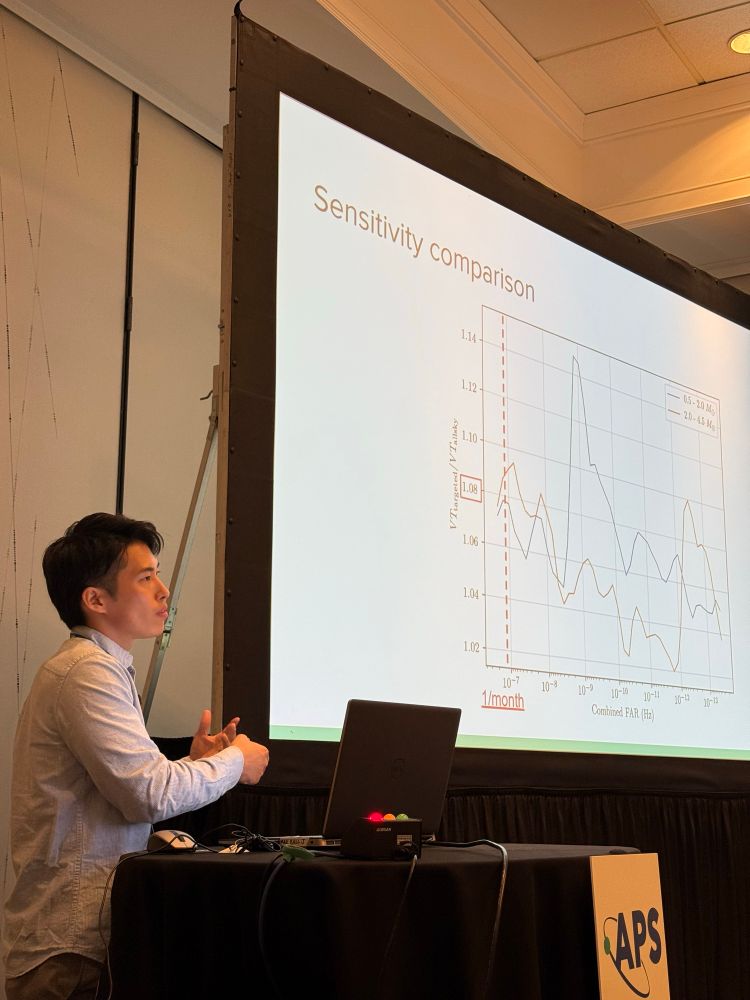
At this year's #APSSummit25 by @apsphysics.bsky.social in Anaheim, Leo Tsukada (@ncfa.bsky.social Fellow @unlv.edu ) presents a method for doing a targeted GW search using the gstlal pipeline.
March 17, 2025 at 6:14 PM
At this year's #APSSummit25 by @apsphysics.bsky.social in Anaheim, Leo Tsukada (@ncfa.bsky.social Fellow @unlv.edu ) presents a method for doing a targeted GW search using the gstlal pipeline.
Back from lunch on the second day of the NCfA symposium, Shri Kulkarni ( @caltech.edu ) tells the story of the Zwicky Transient Facility: A Discovery Engine

February 27, 2025 at 10:22 PM
Back from lunch on the second day of the NCfA symposium, Shri Kulkarni ( @caltech.edu ) tells the story of the Zwicky Transient Facility: A Discovery Engine
Starting our second symposium day is Michael Coughlin (University of Minnesota) discussing what is new in GW searches, and how is that important for MMA science.

February 27, 2025 at 5:09 PM
Starting our second symposium day is Michael Coughlin (University of Minnesota) discussing what is new in GW searches, and how is that important for MMA science.
Conference banquet with the proper NCfA touch!

February 27, 2025 at 5:03 AM
Conference banquet with the proper NCfA touch!
The first talk in the Monday afternoon session of the NCfA MMA symposium is given by Kohta Murase ( @pennstateuniv.bsky.social) about multimessenger emission from the primary sources of high-energy cosmic neutrinos.

February 26, 2025 at 10:39 PM
The first talk in the Monday afternoon session of the NCfA MMA symposium is given by Kohta Murase ( @pennstateuniv.bsky.social) about multimessenger emission from the primary sources of high-energy cosmic neutrinos.
The first talk at the 2025 NCfA Multimessenger Symposium is by Marcos Santander about an overview of current neutrino astrophysics

February 26, 2025 at 5:11 PM
The first talk at the 2025 NCfA Multimessenger Symposium is by Marcos Santander about an overview of current neutrino astrophysics