


Nao Okabe
@nao-neuro.bsky.social
Neuroscientist
@UCLA, brain repair, motor learning, 2 photon microscope, EEG
@UCLA, brain repair, motor learning, 2 photon microscope, EEG
Thank you! Happy to hear that!
March 25, 2025 at 12:45 AM
Thank you! Happy to hear that!
(6/6)
A huge thank you to my co-authors, especially my PI, Tom Carmichael, for his incredible support.
Proud to represent
@UCLANeurology
in this work! Thanks to all the lab members, friends, and family who made this possible.
A huge thank you to my co-authors, especially my PI, Tom Carmichael, for his incredible support.
Proud to represent
@UCLANeurology
in this work! Thanks to all the lab members, friends, and family who made this possible.
March 18, 2025 at 8:58 PM
(6/6)
A huge thank you to my co-authors, especially my PI, Tom Carmichael, for his incredible support.
Proud to represent
@UCLANeurology
in this work! Thanks to all the lab members, friends, and family who made this possible.
A huge thank you to my co-authors, especially my PI, Tom Carmichael, for his incredible support.
Proud to represent
@UCLANeurology
in this work! Thanks to all the lab members, friends, and family who made this possible.
(5/6)
This study reveals the complex and heterogeneous circuit changes underlying stroke recovery. It also highlights the therapeutic potential of interneuron circuits as a target for recovery interventions.
This study reveals the complex and heterogeneous circuit changes underlying stroke recovery. It also highlights the therapeutic potential of interneuron circuits as a target for recovery interventions.
March 18, 2025 at 8:58 PM
(5/6)
This study reveals the complex and heterogeneous circuit changes underlying stroke recovery. It also highlights the therapeutic potential of interneuron circuits as a target for recovery interventions.
This study reveals the complex and heterogeneous circuit changes underlying stroke recovery. It also highlights the therapeutic potential of interneuron circuits as a target for recovery interventions.
(4/6)
Rehabilitative training recovers PV synapses, functional connectivity, and gamma power.
Using chemogenetics, we found that activating PV interneurons is essential for recovery. Remarkably, pharmacological PV activation mimics rehab benefits.
Rehabilitative training recovers PV synapses, functional connectivity, and gamma power.
Using chemogenetics, we found that activating PV interneurons is essential for recovery. Remarkably, pharmacological PV activation mimics rehab benefits.
March 18, 2025 at 8:58 PM
(4/6)
Rehabilitative training recovers PV synapses, functional connectivity, and gamma power.
Using chemogenetics, we found that activating PV interneurons is essential for recovery. Remarkably, pharmacological PV activation mimics rehab benefits.
Rehabilitative training recovers PV synapses, functional connectivity, and gamma power.
Using chemogenetics, we found that activating PV interneurons is essential for recovery. Remarkably, pharmacological PV activation mimics rehab benefits.
(3/6)
We identified neurons projecting to the stroke site (Stroke-projecting neurons) lose key synaptic inputs, including those from PV interneurons.
This loss disrupts functional connectivity, leading to decreased gamma power and impaired motor function.
We identified neurons projecting to the stroke site (Stroke-projecting neurons) lose key synaptic inputs, including those from PV interneurons.
This loss disrupts functional connectivity, leading to decreased gamma power and impaired motor function.
March 18, 2025 at 8:58 PM
(3/6)
We identified neurons projecting to the stroke site (Stroke-projecting neurons) lose key synaptic inputs, including those from PV interneurons.
This loss disrupts functional connectivity, leading to decreased gamma power and impaired motor function.
We identified neurons projecting to the stroke site (Stroke-projecting neurons) lose key synaptic inputs, including those from PV interneurons.
This loss disrupts functional connectivity, leading to decreased gamma power and impaired motor function.
(2/6)
Stroke recovery depends on plasticity.
Rehabilitation harnesses experience-dependent plasticity, but how specific neuronal circuits drive recovery has remained unclear—until now.
We identified key inhibitory circuits shaping rehabilitation-induced recovery.
Stroke recovery depends on plasticity.
Rehabilitation harnesses experience-dependent plasticity, but how specific neuronal circuits drive recovery has remained unclear—until now.
We identified key inhibitory circuits shaping rehabilitation-induced recovery.
March 18, 2025 at 8:58 PM
(2/6)
Stroke recovery depends on plasticity.
Rehabilitation harnesses experience-dependent plasticity, but how specific neuronal circuits drive recovery has remained unclear—until now.
We identified key inhibitory circuits shaping rehabilitation-induced recovery.
Stroke recovery depends on plasticity.
Rehabilitation harnesses experience-dependent plasticity, but how specific neuronal circuits drive recovery has remained unclear—until now.
We identified key inhibitory circuits shaping rehabilitation-induced recovery.
Reposted by Nao Okabe

🔥 Inflammation and neuron protection
In aging brains, genes associated with inflammation became more active, while those related to neuronal structure and function decreased.
Read the publication 📜 nature.com/articles/s41...
In aging brains, genes associated with inflammation became more active, while those related to neuronal structure and function decreased.
Read the publication 📜 nature.com/articles/s41...
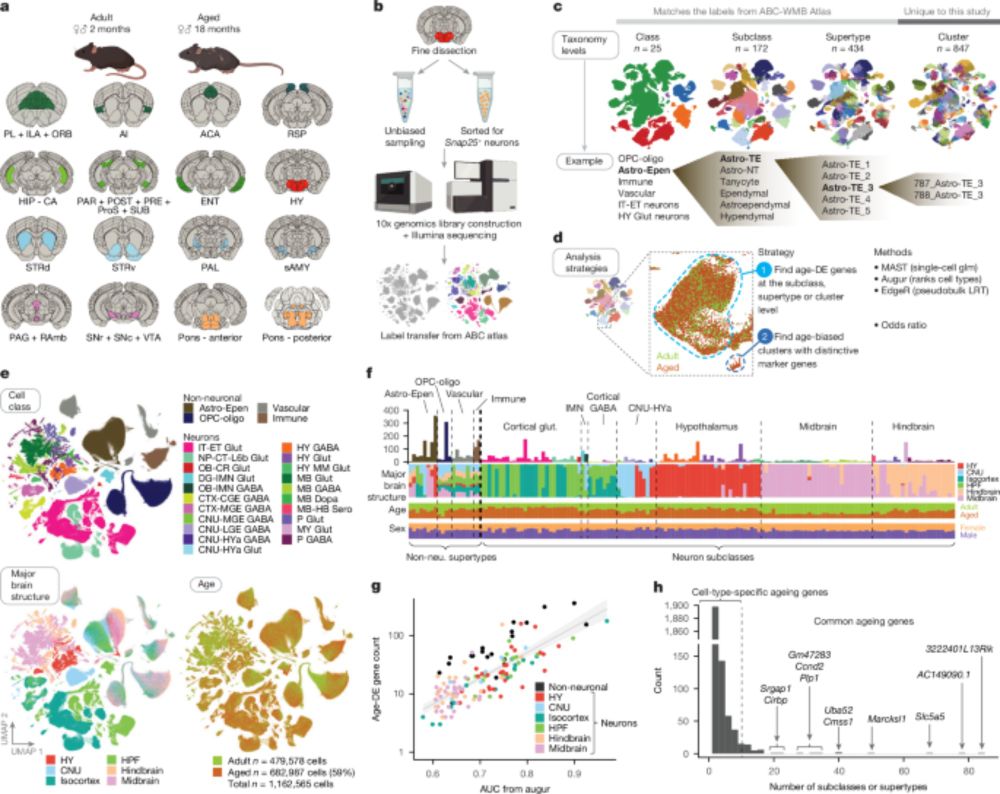
Brain-wide cell-type-specific transcriptomic signatures of healthy ageing in mice - Nature
A comprehensive single-cell RNA sequencing study delineates cell-type-specific transcriptomic changes in the brain associated with normal ageing that will inform the investigation into functional chan...
nature.com
January 1, 2025 at 5:08 PM
🔥 Inflammation and neuron protection
In aging brains, genes associated with inflammation became more active, while those related to neuronal structure and function decreased.
Read the publication 📜 nature.com/articles/s41...
In aging brains, genes associated with inflammation became more active, while those related to neuronal structure and function decreased.
Read the publication 📜 nature.com/articles/s41...