


Scott Haulton 🦇🐦🌳
@myotissodalis.bsky.social
Disturbance ecology, forests, wildlife, especially 🦇&🐦, dabbling in🦎🐝🦋. Central Hardwoods (most recently). https://heeforeststudy.org. Personal account, views are my own.
Proud native New Yorker (Upstate edition). Team McLaren 🏎️🧡🇬🇧
Proud native New Yorker (Upstate edition). Team McLaren 🏎️🧡🇬🇧
In spring, this is one of my favorite sites at Yellowwood State Forest. Each year, for nearly 20 years, my colleagues have monitored state endangered cerulean warbler territories along this hillside. Had an overstory thinning with 1-5 acre patch cuts in 2009. Here in south-central IN, nesting… 1/2 🌎
May 18, 2025 at 4:12 PM
In spring, this is one of my favorite sites at Yellowwood State Forest. Each year, for nearly 20 years, my colleagues have monitored state endangered cerulean warbler territories along this hillside. Had an overstory thinning with 1-5 acre patch cuts in 2009. Here in south-central IN, nesting… 1/2 🌎
In spring, this is one of my favorite sites at Yellowwood State Forest. Each year, for nearly 20 years, my colleagues have monitored cerulean warbler territories along this hillside. Had an overstory thinning with 1-5 acre patch cuts in 2009. Here in south-central IN, nesting ceruleans have… 1/2 🪶🍁
May 18, 2025 at 12:56 AM
In spring, this is one of my favorite sites at Yellowwood State Forest. Each year, for nearly 20 years, my colleagues have monitored cerulean warbler territories along this hillside. Had an overstory thinning with 1-5 acre patch cuts in 2009. Here in south-central IN, nesting ceruleans have… 1/2 🪶🍁

Oh, hey there, little buddy.
April 28, 2025 at 9:51 PM
Oh, hey there, little buddy.
As expected, silver-haired bats our most frequent visitor so far this spring, across 21 forested monitoring sites in so.-central Indiana. Here’s a call from a site that’s received a few prescribed burns over the last decade. Good quality call according to KPro, 100% match ratio and 0.49 margin. 🔈 1/

April 26, 2025 at 2:27 PM
As expected, silver-haired bats our most frequent visitor so far this spring, across 21 forested monitoring sites in so.-central Indiana. Here’s a call from a site that’s received a few prescribed burns over the last decade. Good quality call according to KPro, 100% match ratio and 0.49 margin. 🔈 1/
Me, picking up the fifth data card of the day loaded with >2 weeks of bat calls:
“🎶 It’s the most won-der-ful tiiiiime of the year! 🎶” 🔈
“🎶 It’s the most won-der-ful tiiiiime of the year! 🎶” 🔈
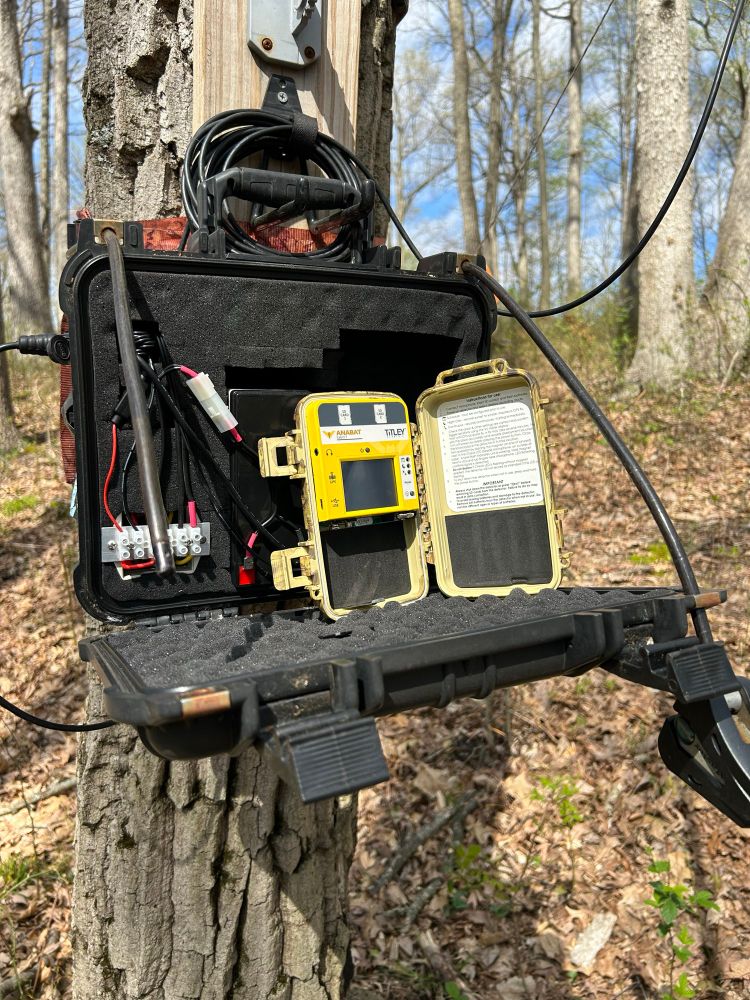
April 24, 2025 at 3:22 PM
Me, picking up the fifth data card of the day loaded with >2 weeks of bat calls:
“🎶 It’s the most won-der-ful tiiiiime of the year! 🎶” 🔈
“🎶 It’s the most won-der-ful tiiiiime of the year! 🎶” 🔈
A beautiful spring morning in the woods! Redbud and dogwood blooming, spring ephemerals up, and the chorus of spring migrants. Hooded warblers arrived in force this week in south central IN. Bat detectors reporting our annual spring flood of silver-haired bats are moving through, too. 🔈

April 22, 2025 at 2:17 PM
A beautiful spring morning in the woods! Redbud and dogwood blooming, spring ephemerals up, and the chorus of spring migrants. Hooded warblers arrived in force this week in south central IN. Bat detectors reporting our annual spring flood of silver-haired bats are moving through, too. 🔈
Always exciting to get that first bat detector up of the year! This one will monitor activity over a 5-acre patch cut that’s part of the Hardwood Ecosystem Experiment at Yellowwood State Forest in south-central Indiana. Continuous recording into October - lots of great ‘bat chat’! 🔈 #bioacoustics

March 25, 2025 at 12:59 PM
Always exciting to get that first bat detector up of the year! This one will monitor activity over a 5-acre patch cut that’s part of the Hardwood Ecosystem Experiment at Yellowwood State Forest in south-central Indiana. Continuous recording into October - lots of great ‘bat chat’! 🔈 #bioacoustics
Ok, last post bump to #mammals feed. Recorded this nice tricolored bat call earlier this fall at Yellowwood state forest. Slowed down 1/16 speed so us non-bats can hear it. Before white-nose syndrome decimated populations here, we’d get several calls a night, now lucky to get even a few in a week. ☹️
November 28, 2024 at 12:35 AM
Ok, last post bump to #mammals feed. Recorded this nice tricolored bat call earlier this fall at Yellowwood state forest. Slowed down 1/16 speed so us non-bats can hear it. Before white-nose syndrome decimated populations here, we’d get several calls a night, now lucky to get even a few in a week. ☹️
2/3 The maternity roosts in this colony were located in 2013 by Ball State U. researchers. Radio-transmitters were glued to the back (NOT permanent!) and bats tracked to roosts. One roosting NLEB was tucked into the top of the vertical cavity in a small beech tree (photo courtesy of Holly Badin). 🦊


November 27, 2024 at 4:22 PM
2/3 The maternity roosts in this colony were located in 2013 by Ball State U. researchers. Radio-transmitters were glued to the back (NOT permanent!) and bats tracked to roosts. One roosting NLEB was tucked into the top of the vertical cavity in a small beech tree (photo courtesy of Holly Badin). 🦊
Recorded this beautiful northern long-eared bat call at an historic maternity colony site at Yellowwood state forest. Tall, steep pulses indicative of a bat capable of foraging among “cluttered” forest understory. Good to see since NLEB pop’ns have PLUMMETED here due to white-nose syndrome. 1/3 🦊
November 27, 2024 at 4:22 PM
Recorded this beautiful northern long-eared bat call at an historic maternity colony site at Yellowwood state forest. Tall, steep pulses indicative of a bat capable of foraging among “cluttered” forest understory. Good to see since NLEB pop’ns have PLUMMETED here due to white-nose syndrome. 1/3 🦊

The maternity roosts in this colony were located in 2013 by Ball State U. researchers. Radio-transmitters were glued to the back (not permanent!) and bats tracked to roosts. One roosting NLEB was tucked into the top of the vertical cavity in a small beech tree (photo courtesy of Holly Badin). 2/2 🔈🦊
November 26, 2024 at 2:49 PM
The maternity roosts in this colony were located in 2013 by Ball State U. researchers. Radio-transmitters were glued to the back (not permanent!) and bats tracked to roosts. One roosting NLEB was tucked into the top of the vertical cavity in a small beech tree (photo courtesy of Holly Badin). 2/2 🔈🦊
Recorded this beautiful northern long-eared bat call at an historic maternity colony site at Yellowwood state forest. Tall, steep pulses indicative of a bat capable of foraging among “cluttered” forest understory. Good to see since NLEB pop’ns have PLUMMETED here due to white-nose syndrome. 1/2 🔈🦊
November 26, 2024 at 2:49 PM
Recorded this beautiful northern long-eared bat call at an historic maternity colony site at Yellowwood state forest. Tall, steep pulses indicative of a bat capable of foraging among “cluttered” forest understory. Good to see since NLEB pop’ns have PLUMMETED here due to white-nose syndrome. 1/2 🔈🦊

Recorded this nice tricolored bat call earlier this fall at Yellowwood state forest. Slowed it down 1/16 speed so us non-bats can hear it. Before white-nose syndrome decimated populations here, we’d get several calls a night, now we’re lucky to see even a few in a week. 🔈🦊
November 24, 2024 at 11:01 PM
Recorded this nice tricolored bat call earlier this fall at Yellowwood state forest. Slowed it down 1/16 speed so us non-bats can hear it. Before white-nose syndrome decimated populations here, we’d get several calls a night, now we’re lucky to see even a few in a week. 🔈🦊
The maternity roosts in this area were all located by Ball State U. researchers in 2013. Photo on the left shows them gluing on the radio transmitter(not permanent!). On the right, a radio-tagged NLEB tucked into the top of the vertical cavity in a small beech tree. SO glad they’re still here! 2/2
November 23, 2024 at 7:13 PM
The maternity roosts in this area were all located by Ball State U. researchers in 2013. Photo on the left shows them gluing on the radio transmitter(not permanent!). On the right, a radio-tagged NLEB tucked into the top of the vertical cavity in a small beech tree. SO glad they’re still here! 2/2
Recorded this beautiful northern long-eared bat call at an historic maternity colony site in Yellowwood state forest. Tall, steep pulses indicative of a species capable of foraging among “cluttered” forest understory. Great to see since NLEB pop’ns have plummeted due to white-nose syndrome. 1/2 🔈 🌎

November 23, 2024 at 6:45 PM
Recorded this beautiful northern long-eared bat call at an historic maternity colony site in Yellowwood state forest. Tall, steep pulses indicative of a species capable of foraging among “cluttered” forest understory. Great to see since NLEB pop’ns have plummeted due to white-nose syndrome. 1/2 🔈 🌎
I have an ARU station not far from this site, so maybe I’ll be hearing from them again? 🪶 🔈

November 22, 2024 at 11:41 PM
I have an ARU station not far from this site, so maybe I’ll be hearing from them again? 🪶 🔈
🪶 Cute break! These whippoorwill chicks were in a young forest patch created by an EF4 tornado in southern Indiana 12 years earlier. Only knew the “nest” was there when the hen flushed off it as I approached. Revisited the area a couple of weeks later and the chicks were already flying (barely)!

November 22, 2024 at 11:32 PM
🪶 Cute break! These whippoorwill chicks were in a young forest patch created by an EF4 tornado in southern Indiana 12 years earlier. Only knew the “nest” was there when the hen flushed off it as I approached. Revisited the area a couple of weeks later and the chicks were already flying (barely)!
Now, NLEB is federally endangered and you can’t even see its activity on the chart, below. Tricolored is a candidate for federal listing and infrequently detected. Red bats, unaffected by WNS are now the top-bat. Great for them, but how does this major community change affect our forests? 🌎 4/4

November 21, 2024 at 11:24 PM
Now, NLEB is federally endangered and you can’t even see its activity on the chart, below. Tricolored is a candidate for federal listing and infrequently detected. Red bats, unaffected by WNS are now the top-bat. Great for them, but how does this major community change affect our forests? 🌎 4/4
Red bat is the dominant bat in our forests but it hasn’t always been that way. White-nose syndrome has dramatically changed our bat community since it first appeared here in the winter of 2011. Before WNS, our two most frequently recorded species were tricolored bat and northern long-eared bat. 3/4

November 21, 2024 at 11:24 PM
Red bat is the dominant bat in our forests but it hasn’t always been that way. White-nose syndrome has dramatically changed our bat community since it first appeared here in the winter of 2011. Before WNS, our two most frequently recorded species were tricolored bat and northern long-eared bat. 3/4
Red bats have highly variable call structure, that can change dramatically with the habitat condition. On the left is a call recorded above the trees of a 15 year old patch cut, so basically flying in open space. Right, steeper pulses in a call within closed-canopy mature forest with “clutter”. 2/4


November 21, 2024 at 11:24 PM
Red bats have highly variable call structure, that can change dramatically with the habitat condition. On the left is a call recorded above the trees of a 15 year old patch cut, so basically flying in open space. Right, steeper pulses in a call within closed-canopy mature forest with “clutter”. 2/4
2/2 🔈 Haven’t analyzed data yet, but am willing to bet I’ll be hearing from A LOT of these guys…

November 18, 2024 at 3:12 PM
2/2 🔈 Haven’t analyzed data yet, but am willing to bet I’ll be hearing from A LOT of these guys…