


Maxim Faroux
@molecularmax.bsky.social
PhD candidate
Kiel University
Stukenbrock Lab - @envgenlab.bsky.social
Plant molecular biology 🌱🧬
Plant/pathogens interactions 🌾🍄
Kiel University
Stukenbrock Lab - @envgenlab.bsky.social
Plant molecular biology 🌱🧬
Plant/pathogens interactions 🌾🍄
The IMPRS for Evolutionary Biology is offering up to ten new doctoral positions for the 2026 cohort, all will be located at the MPI-Plön.
Applications can be submitted now, the closing date for the submissions is 11th January. The program starts in September 2026.
Applications can be submitted now, the closing date for the submissions is 11th January. The program starts in September 2026.

December 11, 2025 at 9:10 AM
The IMPRS for Evolutionary Biology is offering up to ten new doctoral positions for the 2026 cohort, all will be located at the MPI-Plön.
Applications can be submitted now, the closing date for the submissions is 11th January. The program starts in September 2026.
Applications can be submitted now, the closing date for the submissions is 11th January. The program starts in September 2026.
Happy to present my research at the Kiel Plant Center Mini Symposium yesterday.
Thanks @lizflorez.bsky.social for chairing, @estukenbrock.bsky.social for the invitation 😃
Thanks @lizflorez.bsky.social for chairing, @estukenbrock.bsky.social for the invitation 😃

November 12, 2025 at 3:53 PM
Happy to present my research at the Kiel Plant Center Mini Symposium yesterday.
Thanks @lizflorez.bsky.social for chairing, @estukenbrock.bsky.social for the invitation 😃
Thanks @lizflorez.bsky.social for chairing, @estukenbrock.bsky.social for the invitation 😃
Reposted by Maxim Faroux

Looking forward to the KPC Mini-Symposium tomorrow — a great event for all plant scientists in the Kiel area! Speakers are: Hanin Alzubaidy, @lies-nerd.bsky.social and @molecularmax.bsky.social . Don’t miss these exciting talks and discussions!
November 10, 2025 at 12:56 PM
Looking forward to the KPC Mini-Symposium tomorrow — a great event for all plant scientists in the Kiel area! Speakers are: Hanin Alzubaidy, @lies-nerd.bsky.social and @molecularmax.bsky.social . Don’t miss these exciting talks and discussions!
Reposted by Maxim Faroux
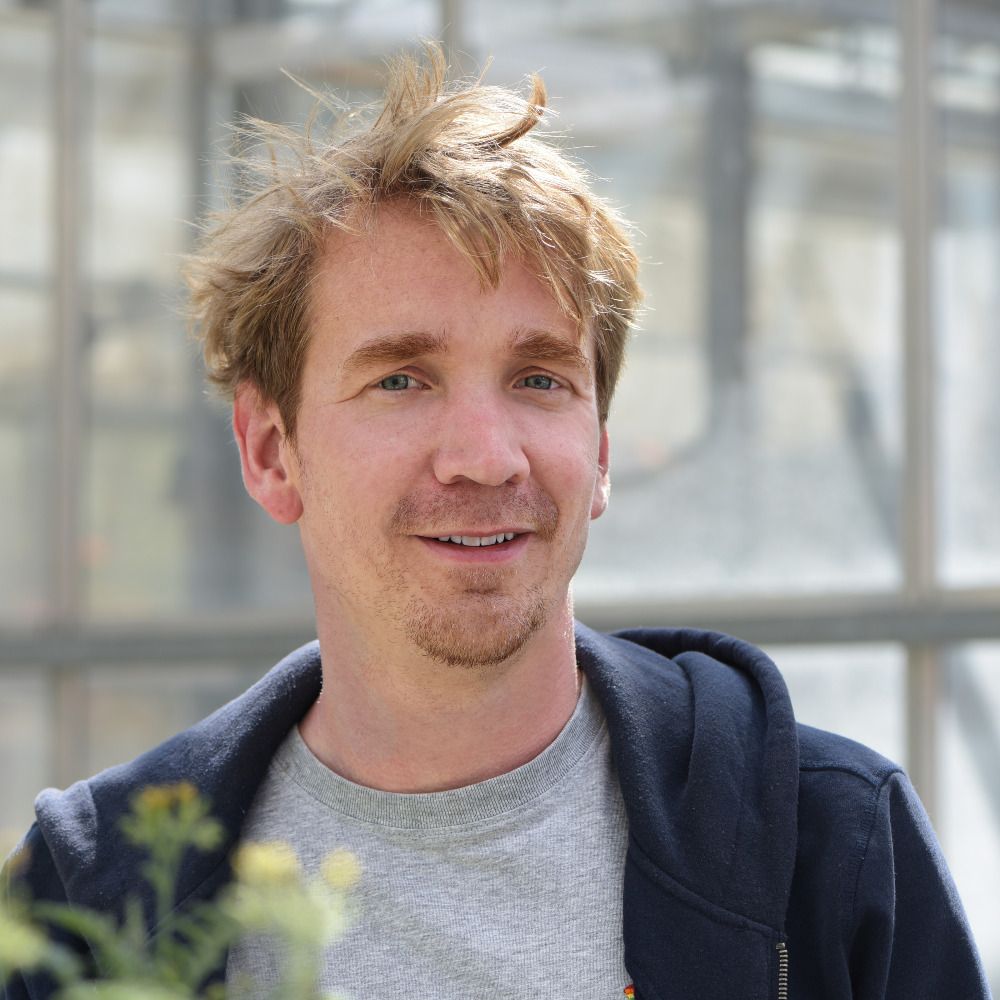
I had a couple of great days at our first @plantscochallenge.bsky.social annual meeting. Inspiring to discuss diverse aspects of multiple stress responses with colleagues from other parts of the plant sciences
www.uni-kiel.de/en/details/n...
Big thanks to @estukenbrock.bsky.social for organising.
www.uni-kiel.de/en/details/n...
Big thanks to @estukenbrock.bsky.social for organising.
www.uni-kiel.de
October 2, 2025 at 5:19 PM
I had a couple of great days at our first @plantscochallenge.bsky.social annual meeting. Inspiring to discuss diverse aspects of multiple stress responses with colleagues from other parts of the plant sciences
www.uni-kiel.de/en/details/n...
Big thanks to @estukenbrock.bsky.social for organising.
www.uni-kiel.de/en/details/n...
Big thanks to @estukenbrock.bsky.social for organising.
Reposted by Maxim Faroux
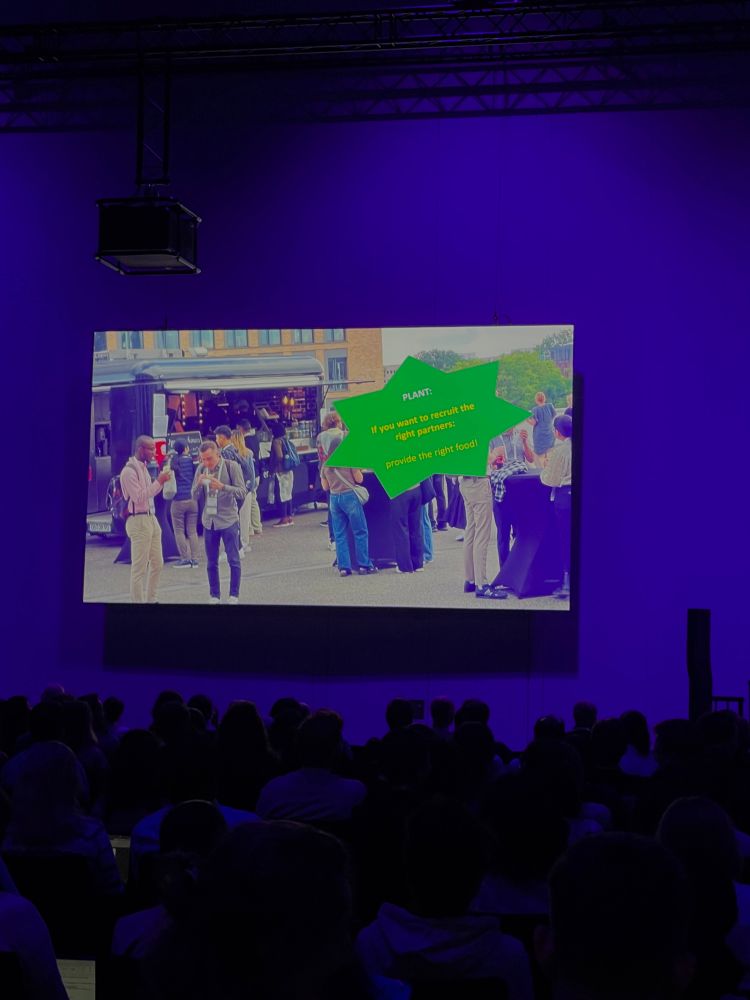
Corné M.J. Pieterse speaking for all of us! #2025ISMPMI
July 17, 2025 at 4:11 PM
Corné M.J. Pieterse speaking for all of us! #2025ISMPMI
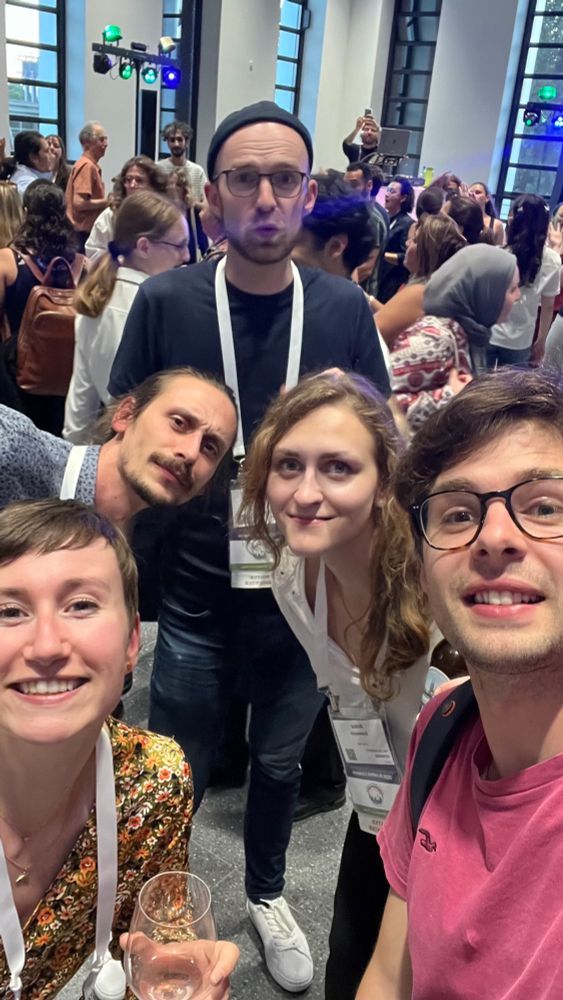
Celebrating 5 days of science at #ISMPMI2025 with my colleagues from @envgenlab.bsky.social @anmaylin96.bsky.social @ruhansen.bsky.social @Leonhard and @Eva 🎉🌾🍄
July 17, 2025 at 7:18 PM
Celebrating 5 days of science at #ISMPMI2025 with my colleagues from @envgenlab.bsky.social @anmaylin96.bsky.social @ruhansen.bsky.social @Leonhard and @Eva 🎉🌾🍄
Reposted by Maxim Faroux
To wrap up…!
Why keep an effector the plant can recognize?
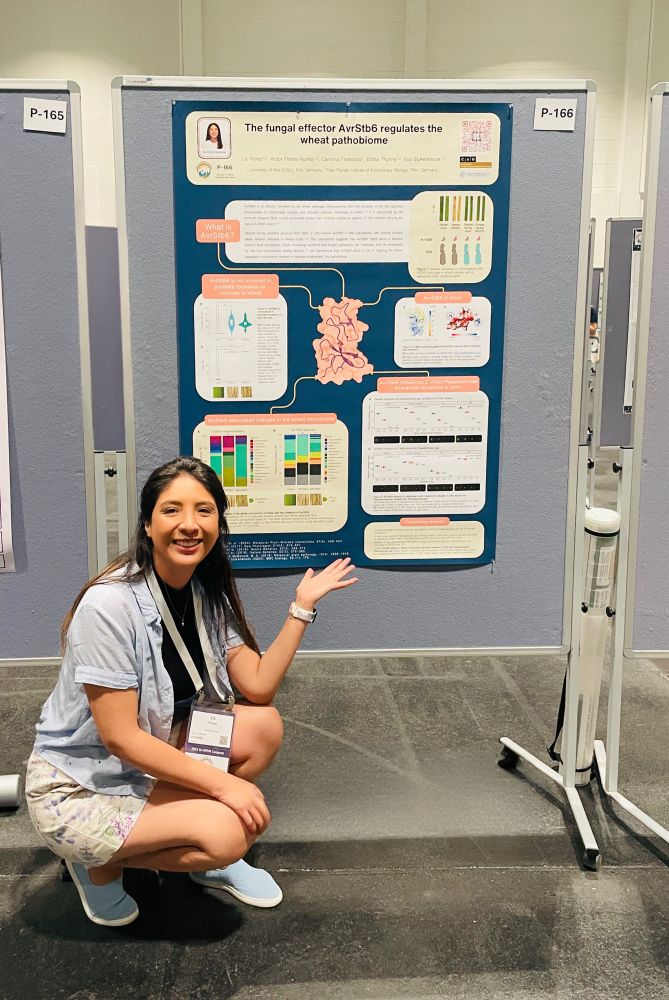
Our postdoc Liz Florez shows Z. tritici’s effector AvrStb6 shapes the wheat microbiome, esp. Pseudomonas spp., in susceptible cultivars. A hidden microbial modulation role beyond host recognition?
🗓️ Poster P-166
🔗 doi.org/10.5281/zeno...
Why keep an effector the plant can recognize?
Our postdoc Liz Florez shows Z. tritici’s effector AvrStb6 shapes the wheat microbiome, esp. Pseudomonas spp., in susceptible cultivars. A hidden microbial modulation role beyond host recognition?
🗓️ Poster P-166
🔗 doi.org/10.5281/zeno...
July 17, 2025 at 10:17 AM
To wrap up…!
Why keep an effector the plant can recognize?
Our postdoc Liz Florez shows Z. tritici’s effector AvrStb6 shapes the wheat microbiome, esp. Pseudomonas spp., in susceptible cultivars. A hidden microbial modulation role beyond host recognition?
🗓️ Poster P-166
🔗 doi.org/10.5281/zeno...
Why keep an effector the plant can recognize?
Our postdoc Liz Florez shows Z. tritici’s effector AvrStb6 shapes the wheat microbiome, esp. Pseudomonas spp., in susceptible cultivars. A hidden microbial modulation role beyond host recognition?
🗓️ Poster P-166
🔗 doi.org/10.5281/zeno...
Reposted by Maxim Faroux
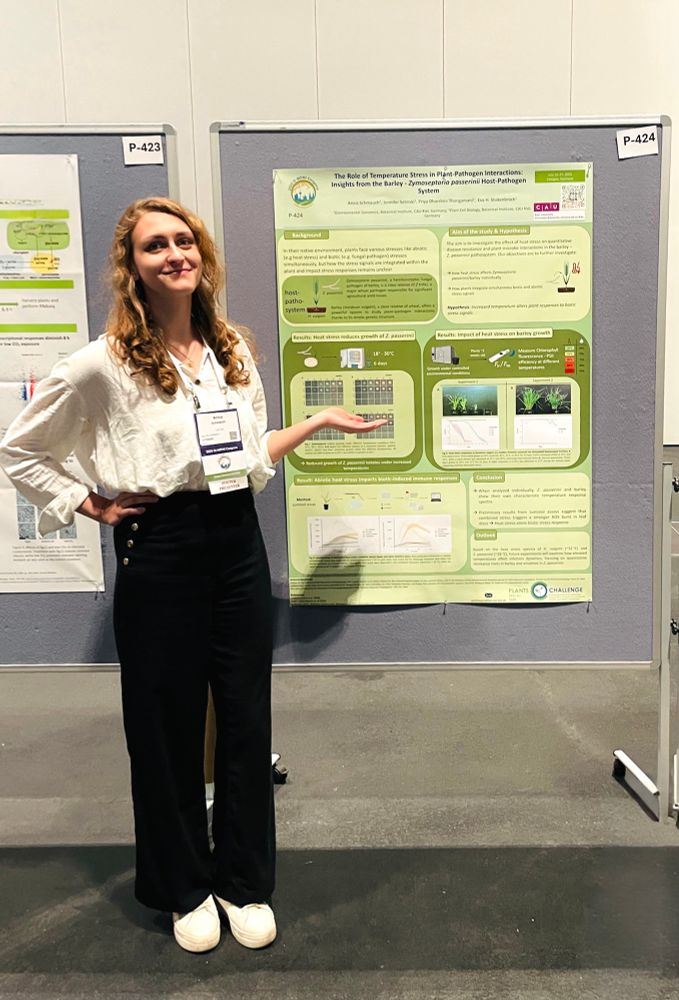
How does heat reshape plant immune responses?
Our PhD student Anica Schmauch shows higher temperatures boost ROS bursts in barley and potentially affect Z. passerinii growth, revealing abiotic-biotic cross-talk in disease resistance.
🗓️ Poster P-424
#2025ISMPMI
Our PhD student Anica Schmauch shows higher temperatures boost ROS bursts in barley and potentially affect Z. passerinii growth, revealing abiotic-biotic cross-talk in disease resistance.
🗓️ Poster P-424
#2025ISMPMI
July 17, 2025 at 8:36 AM
How does heat reshape plant immune responses?
Our PhD student Anica Schmauch shows higher temperatures boost ROS bursts in barley and potentially affect Z. passerinii growth, revealing abiotic-biotic cross-talk in disease resistance.
🗓️ Poster P-424
#2025ISMPMI
Our PhD student Anica Schmauch shows higher temperatures boost ROS bursts in barley and potentially affect Z. passerinii growth, revealing abiotic-biotic cross-talk in disease resistance.
🗓️ Poster P-424
#2025ISMPMI
Reposted by Maxim Faroux
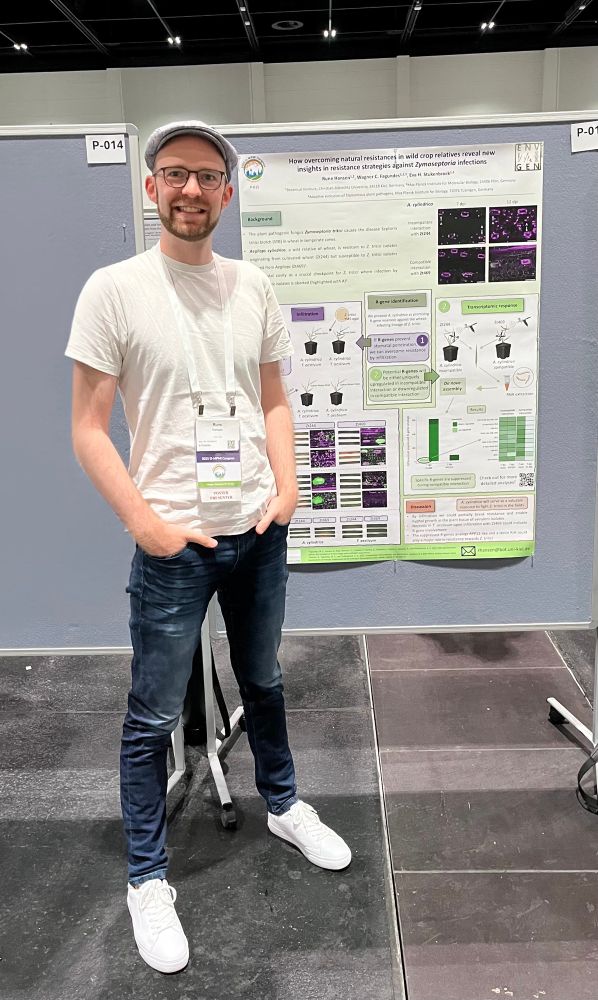
What makes wild wheat resistant to domestic Zymoseptoria?
Our PhD student Rune Hansen found wild wheat relatives that stop infection by domestic Zymoseptoria at the stomata, with a pool of candidate genes that could potentially boost resistance in domestic wheat.
🗓️ Poster P-015
#2025ISMPMI
Our PhD student Rune Hansen found wild wheat relatives that stop infection by domestic Zymoseptoria at the stomata, with a pool of candidate genes that could potentially boost resistance in domestic wheat.
🗓️ Poster P-015
#2025ISMPMI
July 16, 2025 at 8:42 AM
What makes wild wheat resistant to domestic Zymoseptoria?
Our PhD student Rune Hansen found wild wheat relatives that stop infection by domestic Zymoseptoria at the stomata, with a pool of candidate genes that could potentially boost resistance in domestic wheat.
🗓️ Poster P-015
#2025ISMPMI
Our PhD student Rune Hansen found wild wheat relatives that stop infection by domestic Zymoseptoria at the stomata, with a pool of candidate genes that could potentially boost resistance in domestic wheat.
🗓️ Poster P-015
#2025ISMPMI
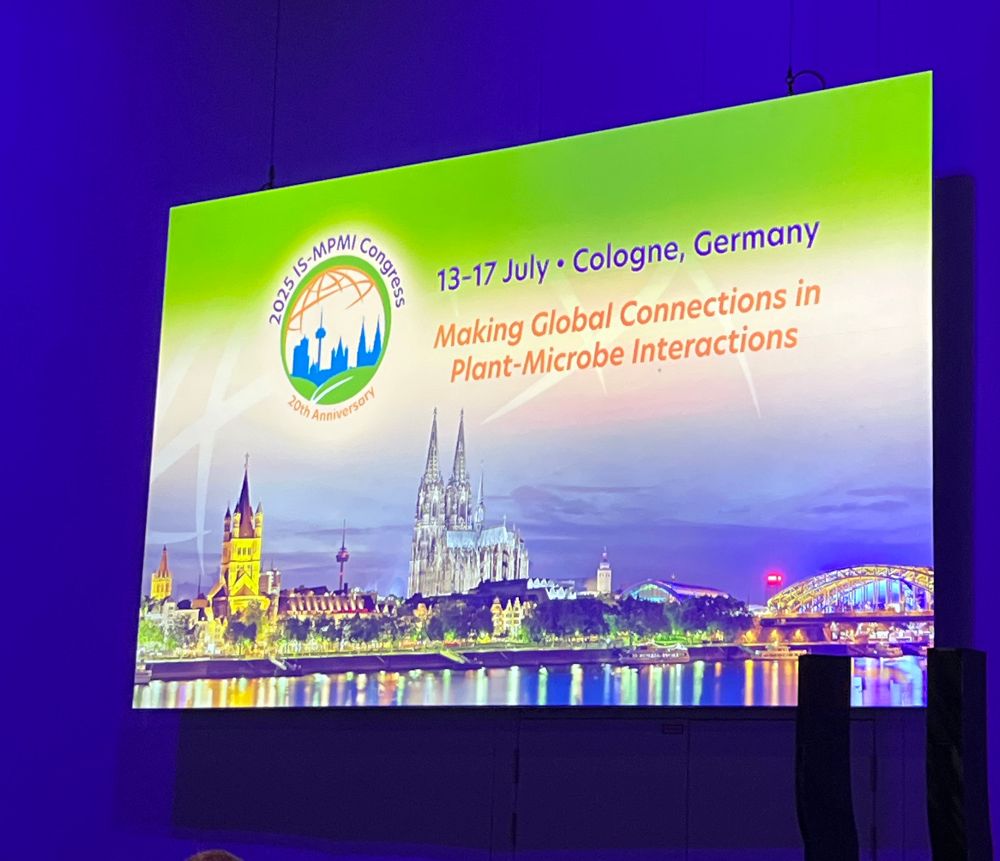
3rd day of #ISMPMI2025, means poster présentation day 😌
July 15, 2025 at 6:14 AM
3rd day of #ISMPMI2025, means poster présentation day 😌
Reposted by Maxim Faroux
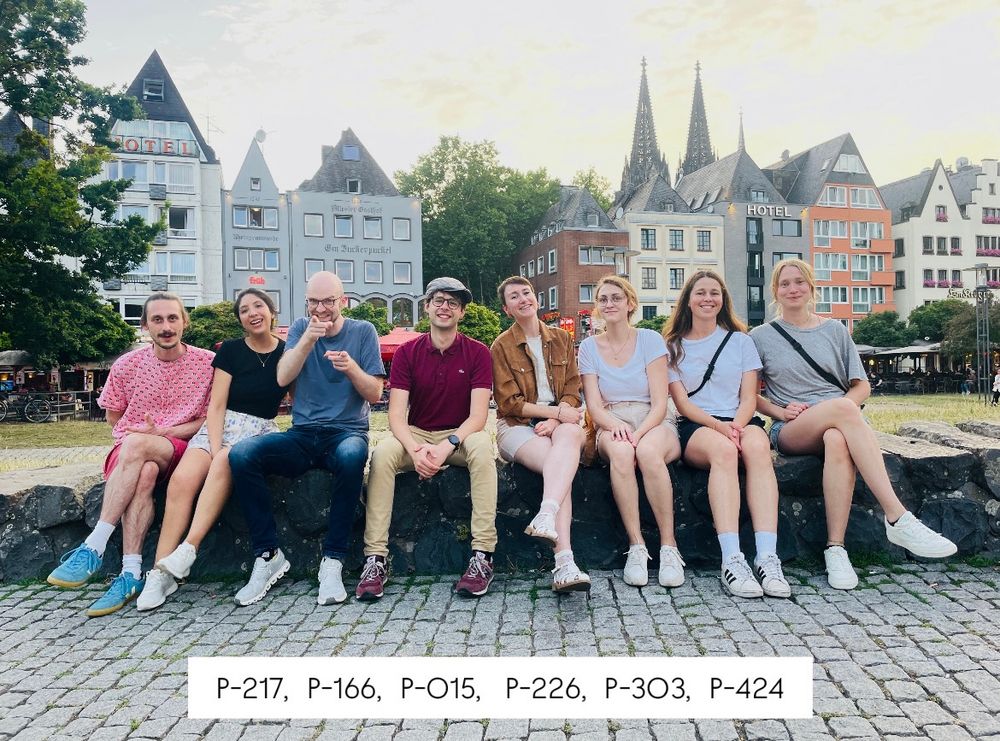
🌿 Curious about microbiomes, effectors, resistance genes, and temperature stress?
Come meet our team at #2025ISMPMI
We’ll be presenting posters all week on Zymoseptoria–plant interactions, wild relatives, and immune manipulation!
🧵 Thread with posters & schedule ⬇️
Come meet our team at #2025ISMPMI
We’ll be presenting posters all week on Zymoseptoria–plant interactions, wild relatives, and immune manipulation!
🧵 Thread with posters & schedule ⬇️
July 14, 2025 at 8:44 AM
🌿 Curious about microbiomes, effectors, resistance genes, and temperature stress?
Come meet our team at #2025ISMPMI
We’ll be presenting posters all week on Zymoseptoria–plant interactions, wild relatives, and immune manipulation!
🧵 Thread with posters & schedule ⬇️
Come meet our team at #2025ISMPMI
We’ll be presenting posters all week on Zymoseptoria–plant interactions, wild relatives, and immune manipulation!
🧵 Thread with posters & schedule ⬇️
Reposted by Maxim Faroux
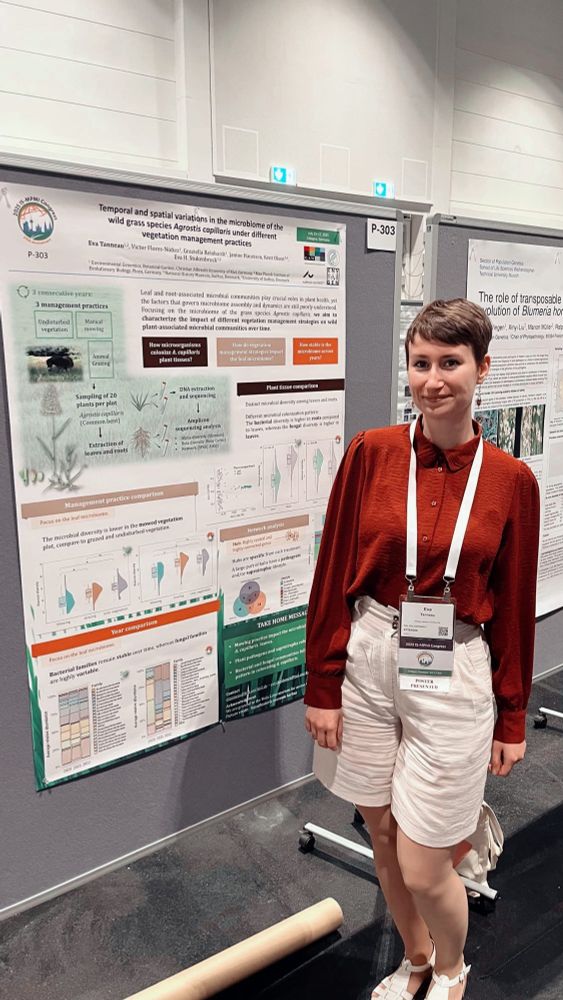
How does mowing and grazing shape the leaf and root microbiome of a wild grass?
Our PhD student Eva Tanneau tracked 3 years of Agrostis capillaris microbiomes and found striking shifts under different management regimes, including pathogen emergence in leaf networks.
🗓️ Poster P-303
#2025ISMPMI
Our PhD student Eva Tanneau tracked 3 years of Agrostis capillaris microbiomes and found striking shifts under different management regimes, including pathogen emergence in leaf networks.
🗓️ Poster P-303
#2025ISMPMI
July 14, 2025 at 8:44 AM
How does mowing and grazing shape the leaf and root microbiome of a wild grass?
Our PhD student Eva Tanneau tracked 3 years of Agrostis capillaris microbiomes and found striking shifts under different management regimes, including pathogen emergence in leaf networks.
🗓️ Poster P-303
#2025ISMPMI
Our PhD student Eva Tanneau tracked 3 years of Agrostis capillaris microbiomes and found striking shifts under different management regimes, including pathogen emergence in leaf networks.
🗓️ Poster P-303
#2025ISMPMI
Reposted by Maxim Faroux
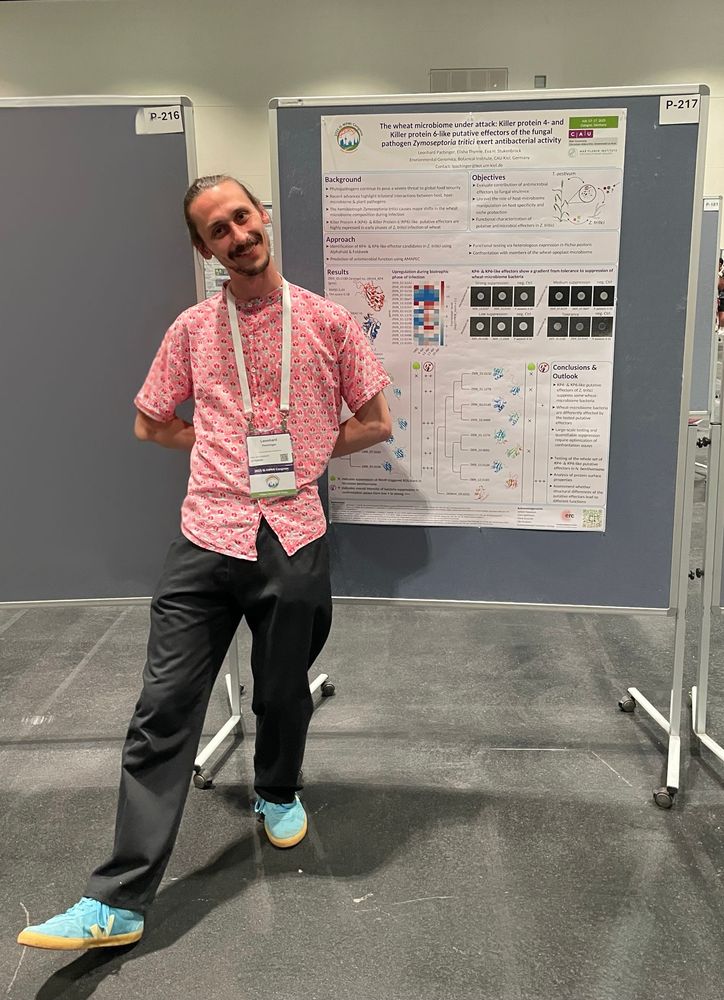
Can fungal pathogens manipulate the plant microbiome to aid infection?
PhD student Leonhard Pachinger shows Z. tritici expression of killer-like protein effectors KP-4 & KP-6 that inhibit apoplastic bacteria, suggesting a microbiome-targeting strategy during infection.
🗓️ Poster P-217
#2025ISMPMI
PhD student Leonhard Pachinger shows Z. tritici expression of killer-like protein effectors KP-4 & KP-6 that inhibit apoplastic bacteria, suggesting a microbiome-targeting strategy during infection.
🗓️ Poster P-217
#2025ISMPMI
July 14, 2025 at 8:44 AM
Can fungal pathogens manipulate the plant microbiome to aid infection?
PhD student Leonhard Pachinger shows Z. tritici expression of killer-like protein effectors KP-4 & KP-6 that inhibit apoplastic bacteria, suggesting a microbiome-targeting strategy during infection.
🗓️ Poster P-217
#2025ISMPMI
PhD student Leonhard Pachinger shows Z. tritici expression of killer-like protein effectors KP-4 & KP-6 that inhibit apoplastic bacteria, suggesting a microbiome-targeting strategy during infection.
🗓️ Poster P-217
#2025ISMPMI
Reposted by Maxim Faroux
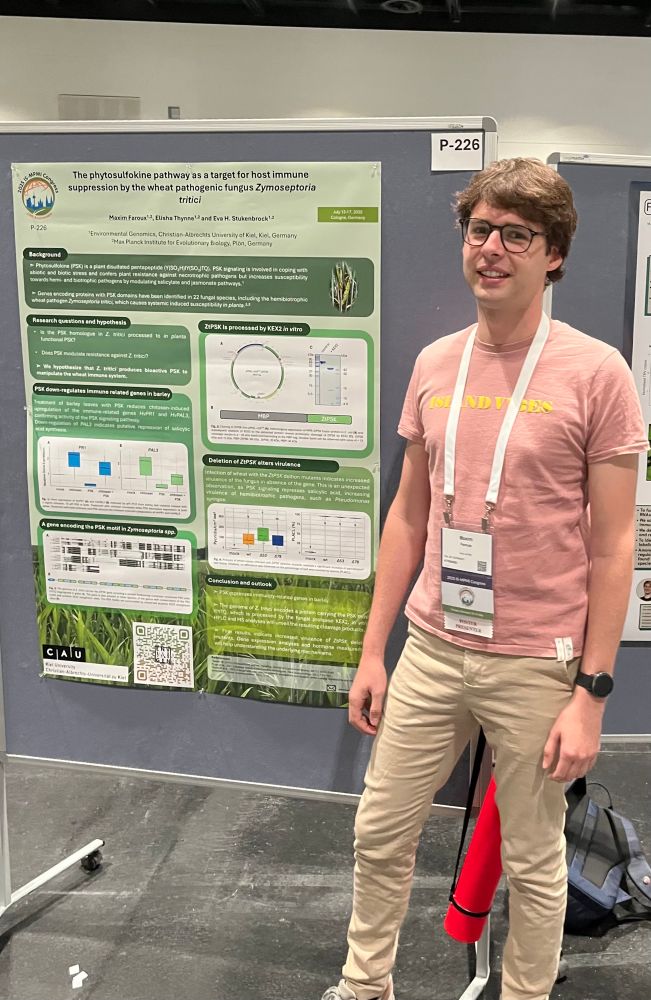
Can fungal pathogens hijack host signaling peptides?
Our PhD student Maxim Faroux @molecularmax.bsky.social uncovers a Zymoseptoria KEX2-processed effector putatively mimicking the plant hormone peptide phytosulfokine (PSK) known to lower immunity against hemibiotrophs.
🗓️ Poster P-226
#2025ISMPMI
Our PhD student Maxim Faroux @molecularmax.bsky.social uncovers a Zymoseptoria KEX2-processed effector putatively mimicking the plant hormone peptide phytosulfokine (PSK) known to lower immunity against hemibiotrophs.
🗓️ Poster P-226
#2025ISMPMI
July 14, 2025 at 9:49 AM
Can fungal pathogens hijack host signaling peptides?
Our PhD student Maxim Faroux @molecularmax.bsky.social uncovers a Zymoseptoria KEX2-processed effector putatively mimicking the plant hormone peptide phytosulfokine (PSK) known to lower immunity against hemibiotrophs.
🗓️ Poster P-226
#2025ISMPMI
Our PhD student Maxim Faroux @molecularmax.bsky.social uncovers a Zymoseptoria KEX2-processed effector putatively mimicking the plant hormone peptide phytosulfokine (PSK) known to lower immunity against hemibiotrophs.
🗓️ Poster P-226
#2025ISMPMI
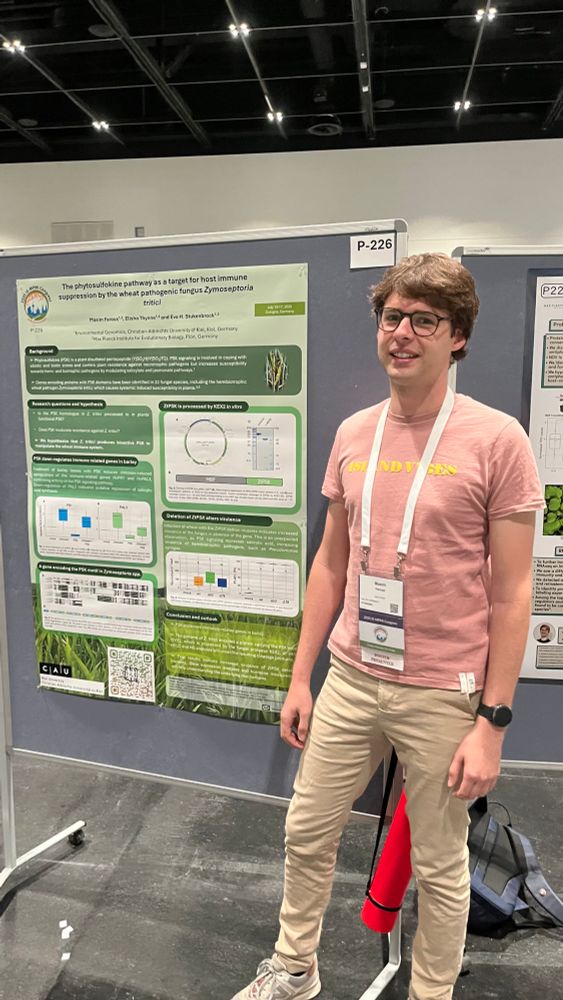
Excited to present my poster (P-226) tomorrow at #ISMPMI2025. Looking forward to nice scientific discussions!
July 14, 2025 at 8:29 AM
Excited to present my poster (P-226) tomorrow at #ISMPMI2025. Looking forward to nice scientific discussions!
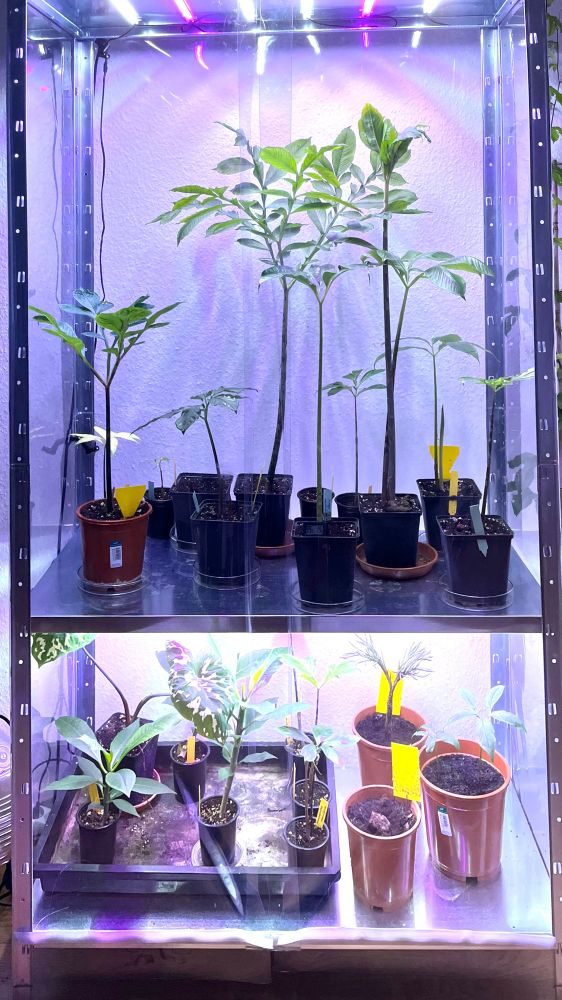
Being a plant biologist also means loving plants. Since phytochambers are not affordable for private use, nothing better than a DIY greenhouse full of #amorphophallus
November 16, 2024 at 7:45 PM
Being a plant biologist also means loving plants. Since phytochambers are not affordable for private use, nothing better than a DIY greenhouse full of #amorphophallus
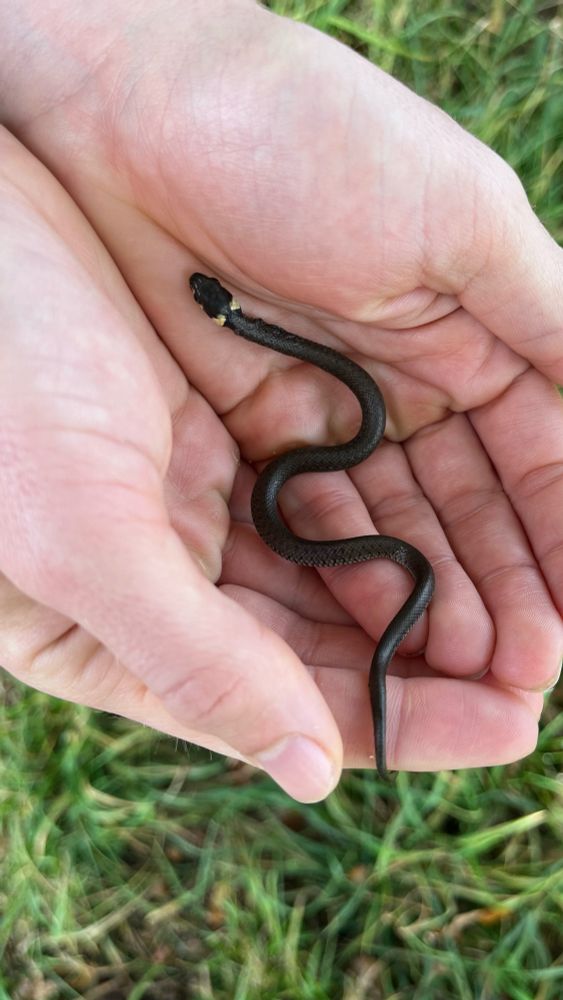
Found a small grass (or ringed) snake (natrix natrix) 🐍
October 20, 2024 at 2:45 PM
Found a small grass (or ringed) snake (natrix natrix) 🐍
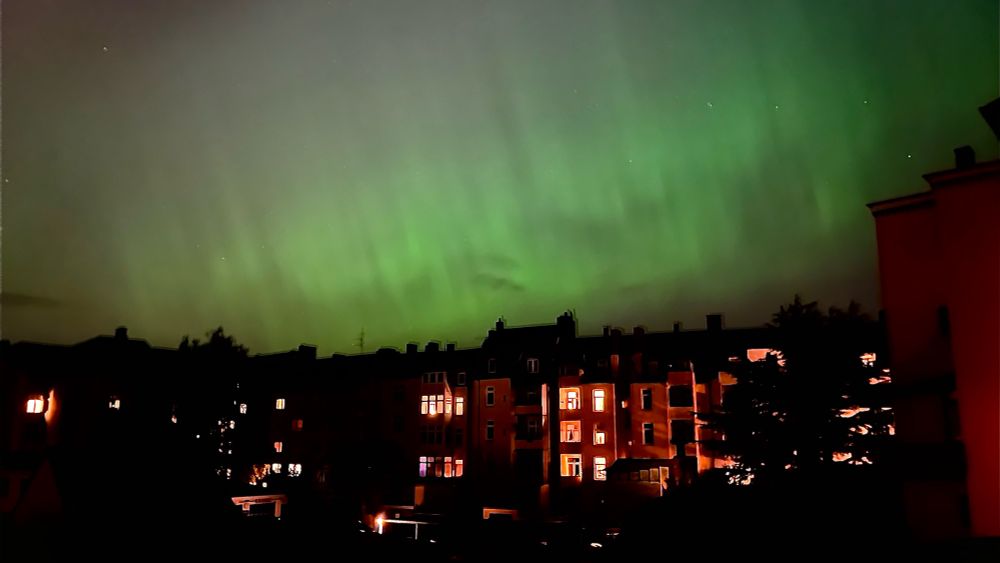
Northern Lights in Kiel on October 10th. Nature is amazing 🌃
October 20, 2024 at 2:02 PM
Northern Lights in Kiel on October 10th. Nature is amazing 🌃