


Mohamed Wafik
@mo-wafik.bsky.social
🧬 Clinical Geneticist in London | Paediatric focus | Innovating patient care through genomics 🇬🇧 🇪🇬🔬
#ESHG2025 day 3
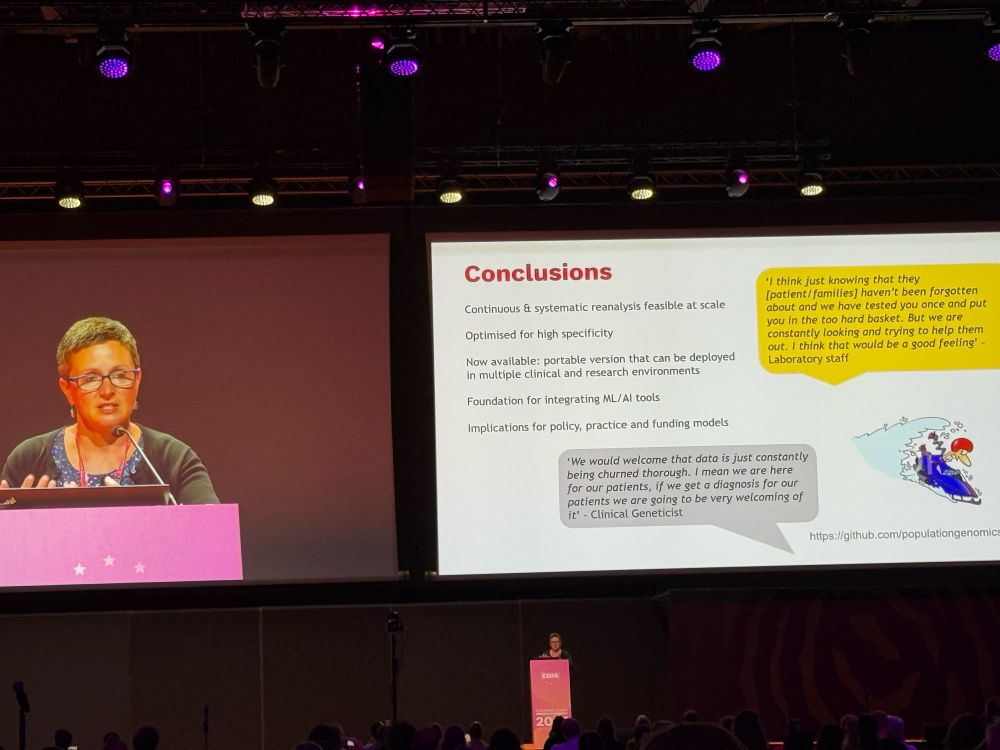
Prof Zornitza Stark presenting interesting data using Talos, an open source automated tool, in large scale genomic data reanalysis:
• 86% of known in scope diagnoses
• >250 new diagnoses from a cohort of 4,735 undiagnosed cases
• ~ 30% from new gene-disease relationships
Prof Zornitza Stark presenting interesting data using Talos, an open source automated tool, in large scale genomic data reanalysis:
• 86% of known in scope diagnoses
• >250 new diagnoses from a cohort of 4,735 undiagnosed cases
• ~ 30% from new gene-disease relationships
May 26, 2025 at 3:48 PM
#ESHG2025 day 3
Prof Zornitza Stark presenting interesting data using Talos, an open source automated tool, in large scale genomic data reanalysis:
• 86% of known in scope diagnoses
• >250 new diagnoses from a cohort of 4,735 undiagnosed cases
• ~ 30% from new gene-disease relationships
Prof Zornitza Stark presenting interesting data using Talos, an open source automated tool, in large scale genomic data reanalysis:
• 86% of known in scope diagnoses
• >250 new diagnoses from a cohort of 4,735 undiagnosed cases
• ~ 30% from new gene-disease relationships
#ESHG2025 Sequencing square
@jamesfasham.bsky.social @aleenamolbio.bsky.social (virtually) running a workshop on the use of Social Media in Science; asking the question:
"Has social media broken scientific knowledge sharing?"
Join to find out more!
#Socialmedia #Science #Genomics
@jamesfasham.bsky.social @aleenamolbio.bsky.social (virtually) running a workshop on the use of Social Media in Science; asking the question:
"Has social media broken scientific knowledge sharing?"
Join to find out more!
#Socialmedia #Science #Genomics

May 26, 2025 at 12:30 PM
#ESHG2025 Sequencing square
@jamesfasham.bsky.social @aleenamolbio.bsky.social (virtually) running a workshop on the use of Social Media in Science; asking the question:
"Has social media broken scientific knowledge sharing?"
Join to find out more!
#Socialmedia #Science #Genomics
@jamesfasham.bsky.social @aleenamolbio.bsky.social (virtually) running a workshop on the use of Social Media in Science; asking the question:
"Has social media broken scientific knowledge sharing?"
Join to find out more!
#Socialmedia #Science #Genomics
#ESH2025
What a wonderful educational session by Dr Bart Van der Sanden (Radbound UMC) on long read sequencing:
Technical interpretation of variants from LRS data with case examples including different disease mechanisms.
I've learned something new today!
What a wonderful educational session by Dr Bart Van der Sanden (Radbound UMC) on long read sequencing:
Technical interpretation of variants from LRS data with case examples including different disease mechanisms.
I've learned something new today!

May 25, 2025 at 1:44 PM
#ESH2025
What a wonderful educational session by Dr Bart Van der Sanden (Radbound UMC) on long read sequencing:
Technical interpretation of variants from LRS data with case examples including different disease mechanisms.
I've learned something new today!
What a wonderful educational session by Dr Bart Van der Sanden (Radbound UMC) on long read sequencing:
Technical interpretation of variants from LRS data with case examples including different disease mechanisms.
I've learned something new today!
"Navigating variant interpretation in a sea of guidelines"
A wonderful educational session by Dr Julia Baptista on how to balance the evidence, context, and uncertainty in Genomics; using ACMG/ACGS general criteria as well as ClinGen and disease-specific criteria
#ESHG2025 #VariantInterpretation
A wonderful educational session by Dr Julia Baptista on how to balance the evidence, context, and uncertainty in Genomics; using ACMG/ACGS general criteria as well as ClinGen and disease-specific criteria
#ESHG2025 #VariantInterpretation

May 25, 2025 at 1:00 PM
"Navigating variant interpretation in a sea of guidelines"
A wonderful educational session by Dr Julia Baptista on how to balance the evidence, context, and uncertainty in Genomics; using ACMG/ACGS general criteria as well as ClinGen and disease-specific criteria
#ESHG2025 #VariantInterpretation
A wonderful educational session by Dr Julia Baptista on how to balance the evidence, context, and uncertainty in Genomics; using ACMG/ACGS general criteria as well as ClinGen and disease-specific criteria
#ESHG2025 #VariantInterpretation
#ESHG2025
Lovely talk from Dr. Susan Treves exploring how we identify and assess RYR1 variants, and use experimental tools to resolve variants of uncertain significance (VUS) in RYR1-related muscle disorders.
#Neuromuscular #Genetics #RYR1
Lovely talk from Dr. Susan Treves exploring how we identify and assess RYR1 variants, and use experimental tools to resolve variants of uncertain significance (VUS) in RYR1-related muscle disorders.
#Neuromuscular #Genetics #RYR1

May 25, 2025 at 12:42 PM
#ESHG2025
Lovely talk from Dr. Susan Treves exploring how we identify and assess RYR1 variants, and use experimental tools to resolve variants of uncertain significance (VUS) in RYR1-related muscle disorders.
#Neuromuscular #Genetics #RYR1
Lovely talk from Dr. Susan Treves exploring how we identify and assess RYR1 variants, and use experimental tools to resolve variants of uncertain significance (VUS) in RYR1-related muscle disorders.
#Neuromuscular #Genetics #RYR1
#ESHG2025 Day 2
An inspiring workshop exploring the power of European Reference Networks (ERNs) in Rare Disease, from MDT discussions in ERNs,
ERDERA erdera.org & EU rare disease projects, to CPMS 2.0 cpms2.ern-net.eu/screen/public, registry updates and patient tutorials.
#Rarediseasenetworks
An inspiring workshop exploring the power of European Reference Networks (ERNs) in Rare Disease, from MDT discussions in ERNs,
ERDERA erdera.org & EU rare disease projects, to CPMS 2.0 cpms2.ern-net.eu/screen/public, registry updates and patient tutorials.
#Rarediseasenetworks


May 25, 2025 at 11:04 AM
#ESHG2025 Day 2
An inspiring workshop exploring the power of European Reference Networks (ERNs) in Rare Disease, from MDT discussions in ERNs,
ERDERA erdera.org & EU rare disease projects, to CPMS 2.0 cpms2.ern-net.eu/screen/public, registry updates and patient tutorials.
#Rarediseasenetworks
An inspiring workshop exploring the power of European Reference Networks (ERNs) in Rare Disease, from MDT discussions in ERNs,
ERDERA erdera.org & EU rare disease projects, to CPMS 2.0 cpms2.ern-net.eu/screen/public, registry updates and patient tutorials.
#Rarediseasenetworks
#ESHG2025 Day 2!
Unlocking the hidden genome in neurodegeneration
Dr Jensen sharing Stanford's data
Using long read sequencing and multi omics in 551 deeply phenotyped individuals with neurodegenerative disease to identify >200K structural variants (SVs), most invisible to short reads.
#LRS
Unlocking the hidden genome in neurodegeneration
Dr Jensen sharing Stanford's data
Using long read sequencing and multi omics in 551 deeply phenotyped individuals with neurodegenerative disease to identify >200K structural variants (SVs), most invisible to short reads.
#LRS

May 25, 2025 at 10:03 AM

Live from #ESHG2025
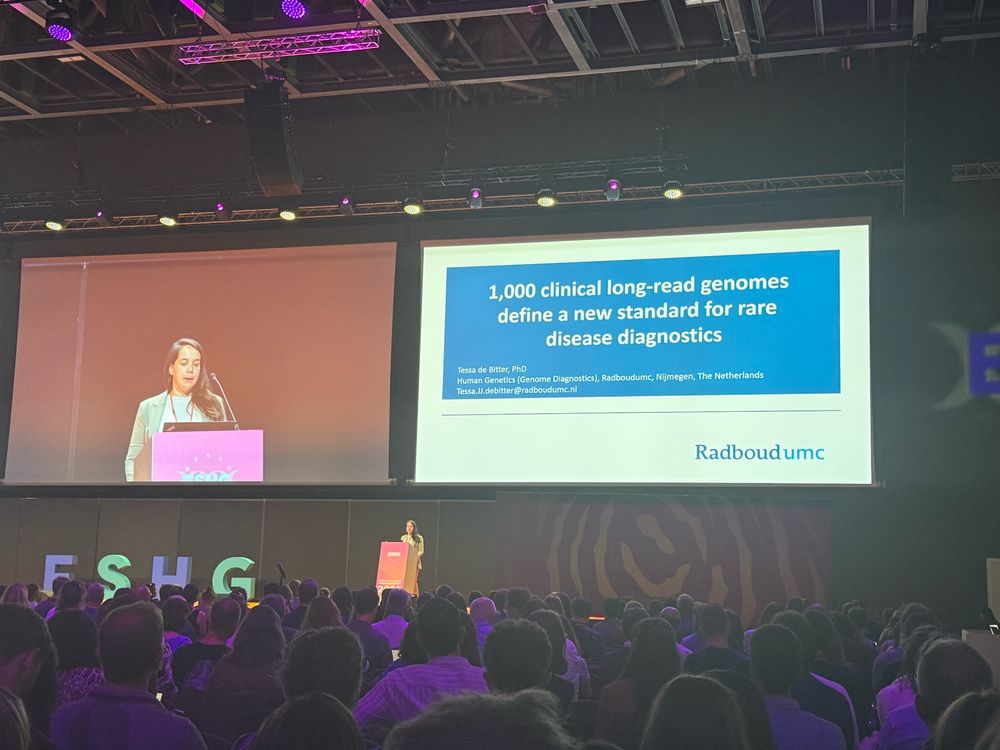
The role of long-read sequencing in transforming germline diagnostics (Radboud UMC 1,000 clinical samples study):
94.6% concordance with standard of care
4.5% additional diagnose mainly in recessive disease via haplotyping & novel variant detection
#LRS #RareDisease
The role of long-read sequencing in transforming germline diagnostics (Radboud UMC 1,000 clinical samples study):
94.6% concordance with standard of care
4.5% additional diagnose mainly in recessive disease via haplotyping & novel variant detection
#LRS #RareDisease
May 24, 2025 at 3:30 PM
Live from #ESHG2025
The role of long-read sequencing in transforming germline diagnostics (Radboud UMC 1,000 clinical samples study):
94.6% concordance with standard of care
4.5% additional diagnose mainly in recessive disease via haplotyping & novel variant detection
#LRS #RareDisease
The role of long-read sequencing in transforming germline diagnostics (Radboud UMC 1,000 clinical samples study):
94.6% concordance with standard of care
4.5% additional diagnose mainly in recessive disease via haplotyping & novel variant detection
#LRS #RareDisease
Happening now #ESHG2025
"Genetic Sounds Podcast: The Diary of a Journal Editor: Voices, Values, and Vocabulary of Science"
Great episode showing what it really means to be journal editor in today's scientific landscape, and the evolving vocabulary used in patient communication
"Genetic Sounds Podcast: The Diary of a Journal Editor: Voices, Values, and Vocabulary of Science"
Great episode showing what it really means to be journal editor in today's scientific landscape, and the evolving vocabulary used in patient communication

May 24, 2025 at 10:47 AM
Happening now #ESHG2025
"Genetic Sounds Podcast: The Diary of a Journal Editor: Voices, Values, and Vocabulary of Science"
Great episode showing what it really means to be journal editor in today's scientific landscape, and the evolving vocabulary used in patient communication
"Genetic Sounds Podcast: The Diary of a Journal Editor: Voices, Values, and Vocabulary of Science"
Great episode showing what it really means to be journal editor in today's scientific landscape, and the evolving vocabulary used in patient communication
#ESHG2025
C04.06.
Interesting data from Aalborg University (Dr Peter Moller) applying context-dependant Polygenic Risk Score to assess sex-related disparities in stratification for Coronary Artery Disease.
Personalized genomics making healthcare more inclusive!
C04.06.
Interesting data from Aalborg University (Dr Peter Moller) applying context-dependant Polygenic Risk Score to assess sex-related disparities in stratification for Coronary Artery Disease.
Personalized genomics making healthcare more inclusive!

May 24, 2025 at 10:24 AM
#ESHG2025
C04.06.
Interesting data from Aalborg University (Dr Peter Moller) applying context-dependant Polygenic Risk Score to assess sex-related disparities in stratification for Coronary Artery Disease.
Personalized genomics making healthcare more inclusive!
C04.06.
Interesting data from Aalborg University (Dr Peter Moller) applying context-dependant Polygenic Risk Score to assess sex-related disparities in stratification for Coronary Artery Disease.
Personalized genomics making healthcare more inclusive!
#ESHG2025
C04.01 Dr Gandin explores how rare, likely pathogenic variants in genes not traditionally associated with hypertrophic cardiomyopathy may still significantly elevate the risk for major cardiac events; using large-scale data from the UK Biobank.
Insightful talk!
C04.01 Dr Gandin explores how rare, likely pathogenic variants in genes not traditionally associated with hypertrophic cardiomyopathy may still significantly elevate the risk for major cardiac events; using large-scale data from the UK Biobank.
Insightful talk!

May 24, 2025 at 9:40 AM
#ESHG2025
C04.01 Dr Gandin explores how rare, likely pathogenic variants in genes not traditionally associated with hypertrophic cardiomyopathy may still significantly elevate the risk for major cardiac events; using large-scale data from the UK Biobank.
Insightful talk!
C04.01 Dr Gandin explores how rare, likely pathogenic variants in genes not traditionally associated with hypertrophic cardiomyopathy may still significantly elevate the risk for major cardiac events; using large-scale data from the UK Biobank.
Insightful talk!