



Jesus Miro-Bueno
@mirobueno.bsky.social
Researcher in https://biocomputationlab.com/ at CNB-CSIC
Co-founder of NEWTON Biotwins
Synthetic & Systems Biology | Digital Twins | Bio & Quantum Computing | Data Analysis | Modeling
#synbio #sysbio #digitaltwins #computing #quantum
Co-founder of NEWTON Biotwins
Synthetic & Systems Biology | Digital Twins | Bio & Quantum Computing | Data Analysis | Modeling
#synbio #sysbio #digitaltwins #computing #quantum
Reposted by Jesus Miro-Bueno
Our #ALIFE2025 paper is out! 🎉 We show that even when two circuits produce the same output, their evolutionary potential can differ greatly. #Evolution at the smallest scale.
“Parameter Evolvability in Gene Expression Models Drives Phenotypic Adaptation”
🔗 direct.mit.edu/isal/proceed...
“Parameter Evolvability in Gene Expression Models Drives Phenotypic Adaptation”
🔗 direct.mit.edu/isal/proceed...

December 1, 2025 at 7:56 AM
Our #ALIFE2025 paper is out! 🎉 We show that even when two circuits produce the same output, their evolutionary potential can differ greatly. #Evolution at the smallest scale.
“Parameter Evolvability in Gene Expression Models Drives Phenotypic Adaptation”
🔗 direct.mit.edu/isal/proceed...
“Parameter Evolvability in Gene Expression Models Drives Phenotypic Adaptation”
🔗 direct.mit.edu/isal/proceed...
Reposted by Jesus Miro-Bueno
If you are at the Emerging Applications of Microbes conference in Leuven, go to poster #24: Engineering growth control to modulate circuit host dependencies, by @angeles-hg.bsky.social. This is a brilliant story about growth rates vs. genetic circuit function. And, of course, noise! #synbio
November 7, 2025 at 6:57 AM
If you are at the Emerging Applications of Microbes conference in Leuven, go to poster #24: Engineering growth control to modulate circuit host dependencies, by @angeles-hg.bsky.social. This is a brilliant story about growth rates vs. genetic circuit function. And, of course, noise! #synbio
Reposted by Jesus Miro-Bueno
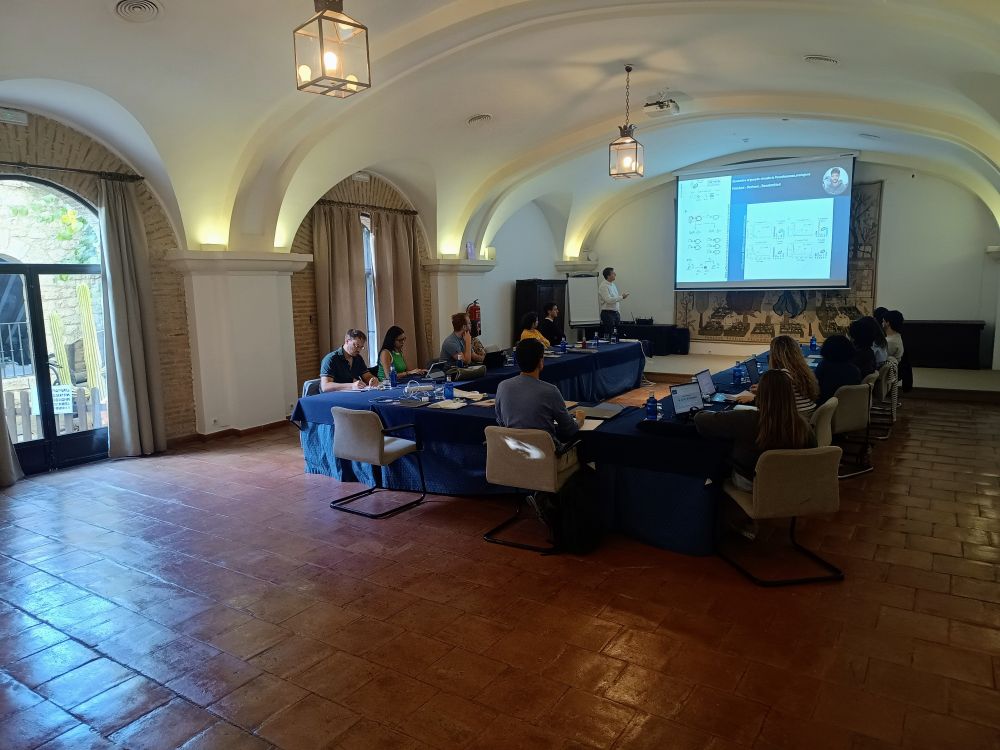
The 2025 Retreat of the Biocomputation Lab (in wonderful Chinchón, Madrid) comes to an end. Three days of fantastic discussions, with new (and revisited) goals ahead. What a brilliant team!



October 29, 2025 at 2:12 PM
The 2025 Retreat of the Biocomputation Lab (in wonderful Chinchón, Madrid) comes to an end. Three days of fantastic discussions, with new (and revisited) goals ahead. What a brilliant team!
Reposted by Jesus Miro-Bueno

Good news everyone! Our new paper in OUP SynBio is out: Construction of a syntrophic Pseudomonas putida consortium with reciprocal substrate processing url: academic.oup.com/synbio/artic...
Many thanks to Barbora and our collaborators @mirobueno.bsky.social and @angelgm.bsky.social
Many thanks to Barbora and our collaborators @mirobueno.bsky.social and @angelgm.bsky.social
academic.oup.com
August 11, 2025 at 1:41 PM
Good news everyone! Our new paper in OUP SynBio is out: Construction of a syntrophic Pseudomonas putida consortium with reciprocal substrate processing url: academic.oup.com/synbio/artic...
Many thanks to Barbora and our collaborators @mirobueno.bsky.social and @angelgm.bsky.social
Many thanks to Barbora and our collaborators @mirobueno.bsky.social and @angelgm.bsky.social
Very happy to see the final version published of our collaboration with Pavel Dvorak's lab! 🦠🧬
doi.org/10.1093/synb...
doi.org/10.1093/synb...

Construction of a syntrophic Pseudomonas putida consortium with reciprocal substrate processing
Abstract. Synthetic microbial consortia can leverage their expanded enzymatic reach to tackle biotechnological challenges too complex for single strains, s
doi.org
August 11, 2025 at 8:39 AM
Very happy to see the final version published of our collaboration with Pavel Dvorak's lab! 🦠🧬
doi.org/10.1093/synb...
doi.org/10.1093/synb...
Reposted by Jesus Miro-Bueno
Brilliant news here! Our manuscript on evolvability was accepted for presentation at @alife2025.bsky.social. So there is a new item in the Lab's conference agenda: #ALIFE Kyoto! More on this coming soon...
August 4, 2025 at 3:36 PM
Brilliant news here! Our manuscript on evolvability was accepted for presentation at @alife2025.bsky.social. So there is a new item in the Lab's conference agenda: #ALIFE Kyoto! More on this coming soon...
Reposted by Jesus Miro-Bueno

El grupo de Angel Goñi lidera un proyecto "Proof of Concept" @erc.europa.eu para desarrollar gemelos digitales pioneros y analizar en profundidad el comportamiento de células vivas
Más info: www.cnb.csic.es/proyecto-de-...
@angelgm.bsky.social
@csic.es
@sommalliance.bsky.social
Más info: www.cnb.csic.es/proyecto-de-...
@angelgm.bsky.social
@csic.es
@sommalliance.bsky.social

July 14, 2025 at 1:45 PM
El grupo de Angel Goñi lidera un proyecto "Proof of Concept" @erc.europa.eu para desarrollar gemelos digitales pioneros y analizar en profundidad el comportamiento de células vivas
Más info: www.cnb.csic.es/proyecto-de-...
@angelgm.bsky.social
@csic.es
@sommalliance.bsky.social
Más info: www.cnb.csic.es/proyecto-de-...
@angelgm.bsky.social
@csic.es
@sommalliance.bsky.social
Reposted by Jesus Miro-Bueno

💡El #CSIC lidera dos proyectos de innovación europeos para prevenir la sismicidad y analizar en profundidad células vivas
👩💻Las iniciativas buscan gestionar los riesgos sísmicos de la actividad geoenergética y desarrollar gemelos digitales pioneros
➡️ https://tinyurl.com/d2m5ffzk
👩💻Las iniciativas buscan gestionar los riesgos sísmicos de la actividad geoenergética y desarrollar gemelos digitales pioneros
➡️ https://tinyurl.com/d2m5ffzk

July 14, 2025 at 10:02 AM
💡El #CSIC lidera dos proyectos de innovación europeos para prevenir la sismicidad y analizar en profundidad células vivas
👩💻Las iniciativas buscan gestionar los riesgos sísmicos de la actividad geoenergética y desarrollar gemelos digitales pioneros
➡️ https://tinyurl.com/d2m5ffzk
👩💻Las iniciativas buscan gestionar los riesgos sísmicos de la actividad geoenergética y desarrollar gemelos digitales pioneros
➡️ https://tinyurl.com/d2m5ffzk
Reposted by Jesus Miro-Bueno
The NEWTON project got funded, let's go! #DigitalTwins on their way...

📣 Out now! First results of the 2025 ERC Proof of Concept call.
150 grants – each worth €150,000 – will help ERC grantees to bridge the gap between the discoveries stemming from their frontier research and their practical application.
Recipients, projects, locations👉 buff.ly/pPccOPc
#ERCPoC
150 grants – each worth €150,000 – will help ERC grantees to bridge the gap between the discoveries stemming from their frontier research and their practical application.
Recipients, projects, locations👉 buff.ly/pPccOPc
#ERCPoC

July 14, 2025 at 11:33 AM
The NEWTON project got funded, let's go! #DigitalTwins on their way...
Reposted by Jesus Miro-Bueno
Just out! Want to use quorum sensing (QS) for cell–cell communication? Check this out — you might find it useful! Kudos to Paula Múgica 👏
Standardized Quorum Sensing Tools for Gram-Negative Bacteria | @pubs.acs.org @acs.org #SyntheticBiology @sevaplasmids.bsky.social pubs.acs.org/doi/10.1021/...
Standardized Quorum Sensing Tools for Gram-Negative Bacteria | @pubs.acs.org @acs.org #SyntheticBiology @sevaplasmids.bsky.social pubs.acs.org/doi/10.1021/...

Standardized Quorum Sensing Tools for Gram-Negative Bacteria
Engineering synthetic consortia to perform distributed functions requires robust quorum sensing (QS) systems to facilitate communication between cells. However, the current QS toolbox lacks standardized implementations, which are particularly valuable for use in bacteria beyond the model species Escherichia coli. We developed a set of three QS systems encompassing both sender and receiver modules, constructed using backbones from the SEVA (Standard European Vector Architecture) plasmid collection. This increases versatility, allowing plasmid features like the origin of replication or antibiotic marker to be easily swapped. The systems were characterized using the synthetic biology chassis Pseudomonas putida. We first tested individual modules, then combined sender and receiver modules in the same host, and finally assessed the performance across separate cells to evaluate consortia dynamics. Alongside the QS set, we provide mathematical models and rate parameters to support the design efforts. Together, these tools advance the engineering of robust and predictable multicellular functions.
pubs.acs.org
June 6, 2025 at 2:43 PM
Just out! Want to use quorum sensing (QS) for cell–cell communication? Check this out — you might find it useful! Kudos to Paula Múgica 👏
Standardized Quorum Sensing Tools for Gram-Negative Bacteria | @pubs.acs.org @acs.org #SyntheticBiology @sevaplasmids.bsky.social pubs.acs.org/doi/10.1021/...
Standardized Quorum Sensing Tools for Gram-Negative Bacteria | @pubs.acs.org @acs.org #SyntheticBiology @sevaplasmids.bsky.social pubs.acs.org/doi/10.1021/...
Reposted by Jesus Miro-Bueno
Digital logic doesn't always fit living matter. Here, two suggestions for handling biological information:
1) Random Pulse Computing (von Neumann's old idea)—check the output robustness (left pic)
2) Probabilistic bits, enabling invertible logic (right pic)
🔗 doi.org/10.1103/Phys...
1) Random Pulse Computing (von Neumann's old idea)—check the output robustness (left pic)
2) Probabilistic bits, enabling invertible logic (right pic)
🔗 doi.org/10.1103/Phys...


May 30, 2025 at 5:56 AM
Digital logic doesn't always fit living matter. Here, two suggestions for handling biological information:
1) Random Pulse Computing (von Neumann's old idea)—check the output robustness (left pic)
2) Probabilistic bits, enabling invertible logic (right pic)
🔗 doi.org/10.1103/Phys...
1) Random Pulse Computing (von Neumann's old idea)—check the output robustness (left pic)
2) Probabilistic bits, enabling invertible logic (right pic)
🔗 doi.org/10.1103/Phys...
Just published!: "Genetic designs for stochastic and probabilistic biocomputing".
We explore moving beyond binary logic in #SynBio and #Biocomputation using random pulses and p-bits—embracing biological noise to design robust, invertible genetic circuits in cells.
journals.aps.org/pre/abstract...
We explore moving beyond binary logic in #SynBio and #Biocomputation using random pulses and p-bits—embracing biological noise to design robust, invertible genetic circuits in cells.
journals.aps.org/pre/abstract...
Genetic designs for stochastic and probabilistic biocomputing
The programming of computations in living cells is achieved by manipulating information flows within genetic networks. Typically, gene expression is discretized into high and low levels, representing ...
journals.aps.org
May 23, 2025 at 5:29 AM
Just published!: "Genetic designs for stochastic and probabilistic biocomputing".
We explore moving beyond binary logic in #SynBio and #Biocomputation using random pulses and p-bits—embracing biological noise to design robust, invertible genetic circuits in cells.
journals.aps.org/pre/abstract...
We explore moving beyond binary logic in #SynBio and #Biocomputation using random pulses and p-bits—embracing biological noise to design robust, invertible genetic circuits in cells.
journals.aps.org/pre/abstract...
Reposted by Jesus Miro-Bueno
Why cellular computations challenge our design principles.
We write about computational theory, information, living cells, complexity, computers, evolution... I really enjoyed writing this piece on #biocomputation. Kudos to Lewis & Bruno. www.sciencedirect.com/science/arti...
We write about computational theory, information, living cells, complexity, computers, evolution... I really enjoyed writing this piece on #biocomputation. Kudos to Lewis & Bruno. www.sciencedirect.com/science/arti...

May 2, 2025 at 7:53 AM
Why cellular computations challenge our design principles.
We write about computational theory, information, living cells, complexity, computers, evolution... I really enjoyed writing this piece on #biocomputation. Kudos to Lewis & Bruno. www.sciencedirect.com/science/arti...
We write about computational theory, information, living cells, complexity, computers, evolution... I really enjoyed writing this piece on #biocomputation. Kudos to Lewis & Bruno. www.sciencedirect.com/science/arti...
Reposted by Jesus Miro-Bueno

⚛️💻El ordenador cuántico del BSC @quantumspain.bsky.social estará a disposición de la comunidad investigadora, empresas y organismos públicos
✨Conoced➕sobre el 1r ordenador cuántico de España desarrollado con tecnología 100% europea
🔘 Interactivo: bsc.es/interactivo_...
🔘 PDF: bsc.es/cuantico_pdf
✨Conoced➕sobre el 1r ordenador cuántico de España desarrollado con tecnología 100% europea
🔘 Interactivo: bsc.es/interactivo_...
🔘 PDF: bsc.es/cuantico_pdf

March 27, 2025 at 10:36 AM
⚛️💻El ordenador cuántico del BSC @quantumspain.bsky.social estará a disposición de la comunidad investigadora, empresas y organismos públicos
✨Conoced➕sobre el 1r ordenador cuántico de España desarrollado con tecnología 100% europea
🔘 Interactivo: bsc.es/interactivo_...
🔘 PDF: bsc.es/cuantico_pdf
✨Conoced➕sobre el 1r ordenador cuántico de España desarrollado con tecnología 100% europea
🔘 Interactivo: bsc.es/interactivo_...
🔘 PDF: bsc.es/cuantico_pdf
Reposted by Jesus Miro-Bueno
Next on the Lab's conference agenda: The Gordon Conference #GRC on Quantum Biology. Jesús Miró-Bueno @mirobueno.bsky.social will present our work on probabilistic biocomputation. www.grc.org/quantum-biol...
2025 Quantum Biology Conference GRC
The 2025 Gordon Research Conference on Quantum Biology will be held in Lucca (Barga), Lucca Italy. Apply today to reserve your spot.
www.grc.org
February 25, 2025 at 8:34 AM
Next on the Lab's conference agenda: The Gordon Conference #GRC on Quantum Biology. Jesús Miró-Bueno @mirobueno.bsky.social will present our work on probabilistic biocomputation. www.grc.org/quantum-biol...
Reposted by Jesus Miro-Bueno
On 14 February, we’re hosting the Artificial Intelligence in Biology Workshop at #CNB_CSIC with an exceptional line-up of speakers.
The opening talk will be given by @hsalis.bsky.social (Biological Engineering, Penn State University).
@angelgm.bsky.social
Sign up & more info👇
bit.ly/AIinBiology
The opening talk will be given by @hsalis.bsky.social (Biological Engineering, Penn State University).
@angelgm.bsky.social
Sign up & more info👇
bit.ly/AIinBiology

January 31, 2025 at 10:50 AM
On 14 February, we’re hosting the Artificial Intelligence in Biology Workshop at #CNB_CSIC with an exceptional line-up of speakers.
The opening talk will be given by @hsalis.bsky.social (Biological Engineering, Penn State University).
@angelgm.bsky.social
Sign up & more info👇
bit.ly/AIinBiology
The opening talk will be given by @hsalis.bsky.social (Biological Engineering, Penn State University).
@angelgm.bsky.social
Sign up & more info👇
bit.ly/AIinBiology
Reposted by Jesus Miro-Bueno
Looking forward to this timely workshop on #AI in #Biology at @cnb-csic.bsky.social (Feb 14)! Excited to hear from experts like @hsalis.bsky.social , @alfonsovalencia.bsky.social , @noeliaferruz.bsky.social , @pablocarb.bsky.social , and others. (Note: Won’t be streamed.) 🧬🤖 #Science #synbio

January 28, 2025 at 12:38 PM
Looking forward to this timely workshop on #AI in #Biology at @cnb-csic.bsky.social (Feb 14)! Excited to hear from experts like @hsalis.bsky.social , @alfonsovalencia.bsky.social , @noeliaferruz.bsky.social , @pablocarb.bsky.social , and others. (Note: Won’t be streamed.) 🧬🤖 #Science #synbio
Reposted by Jesus Miro-Bueno
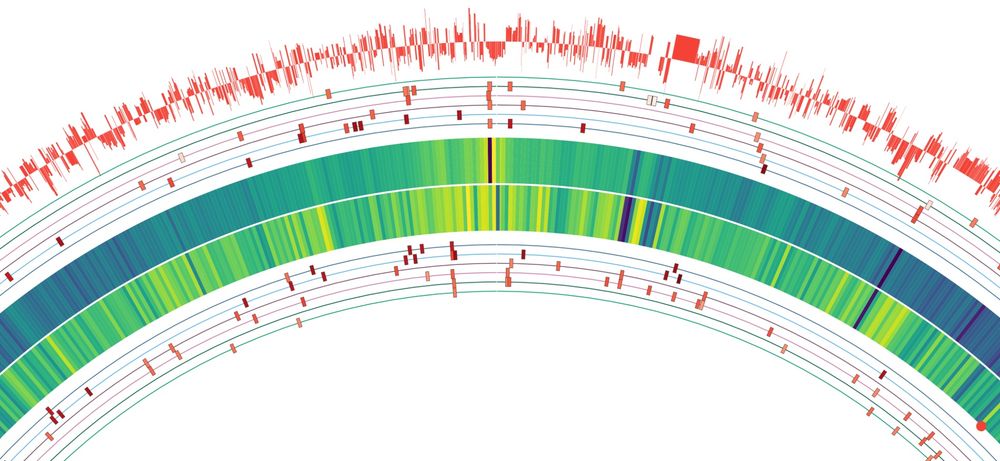
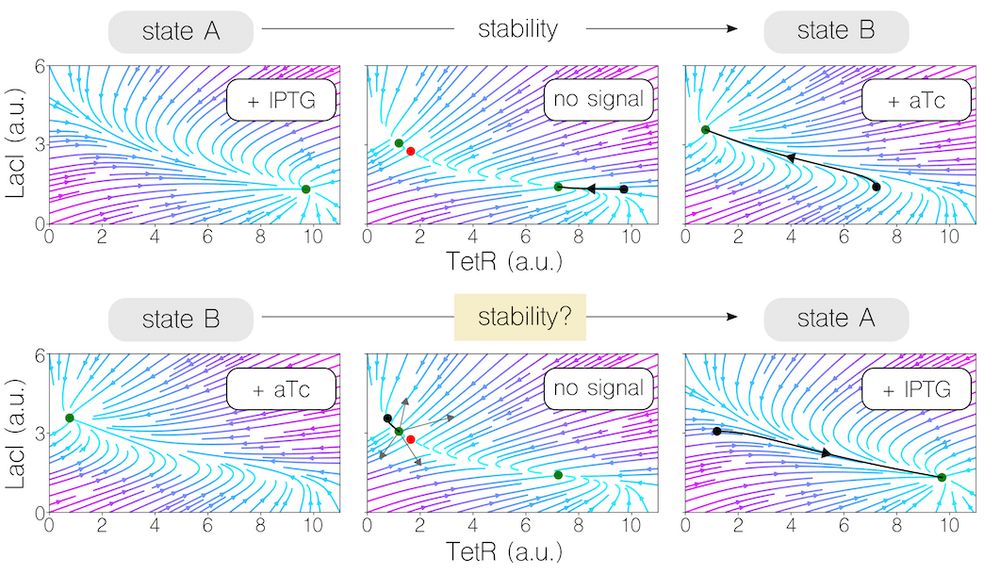
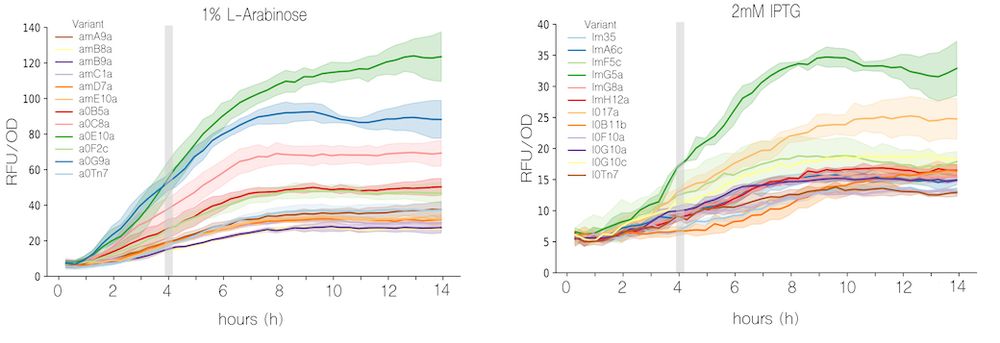
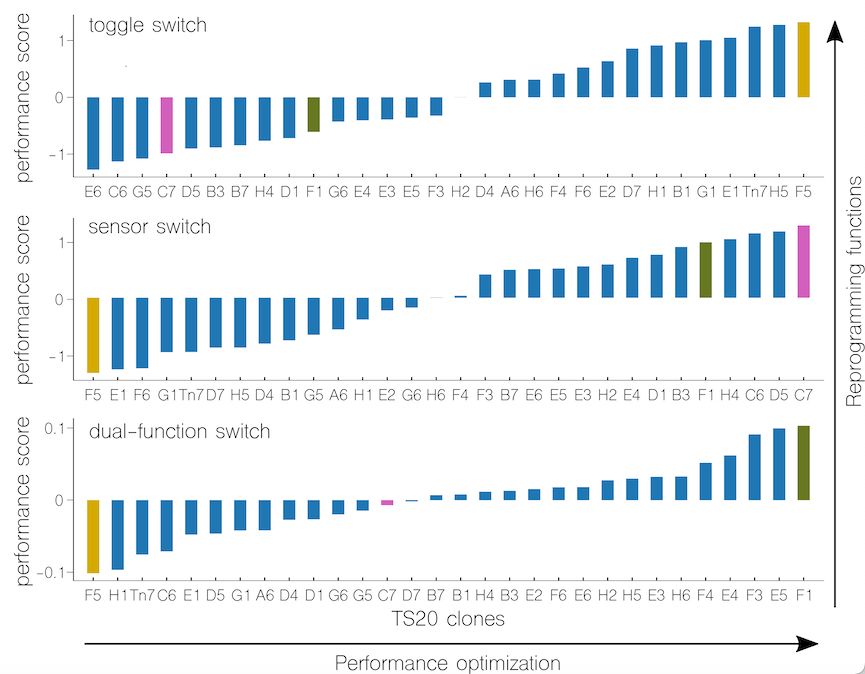
Massive upgrade to our preprint "Reprogramming genetic circuits using space": mathematical modeling, time-based experiments, new functions, more supplementary material... We're thrilled about this work and hope you enjoy it! www.biorxiv.org/content/10.1...
January 15, 2025 at 12:56 PM
Massive upgrade to our preprint "Reprogramming genetic circuits using space": mathematical modeling, time-based experiments, new functions, more supplementary material... We're thrilled about this work and hope you enjoy it! www.biorxiv.org/content/10.1...
Reposted by Jesus Miro-Bueno
A SynBio-enabled (metabolic) love story 😍 Nothing is better for a lasting and efficent relationship than making partners depend on each other 👇
Great work by Pavel Dvorak's team, with our collaboration. Engineer stability in microbial consortia via reciprocal substrate processing. www.biorxiv.org/content/10.1...

Building a syntrophic Pseudomonas putida consortium with reciprocal substrate processing of lignocellulosic disaccharides
Synthetic microbial consortia can leverage their expanded enzymatic reach to tackle biotechnological challenges too complex for single strains, such as lignocellulose valorisation. The benefit of meta...
www.biorxiv.org
November 20, 2024 at 12:02 PM
A SynBio-enabled (metabolic) love story 😍 Nothing is better for a lasting and efficent relationship than making partners depend on each other 👇
Reposted by Jesus Miro-Bueno
Great work by Pavel Dvorak's team, with our collaboration. Engineer stability in microbial consortia via reciprocal substrate processing. www.biorxiv.org/content/10.1...
Building a syntrophic Pseudomonas putida consortium with reciprocal substrate processing of lignocellulosic disaccharides
Synthetic microbial consortia can leverage their expanded enzymatic reach to tackle biotechnological challenges too complex for single strains, such as lignocellulose valorisation. The benefit of meta...
www.biorxiv.org
November 20, 2024 at 10:17 AM
Great work by Pavel Dvorak's team, with our collaboration. Engineer stability in microbial consortia via reciprocal substrate processing. www.biorxiv.org/content/10.1...
