




Michał Filipiak
@michalfilipiak.bsky.social
Ecologist @tum.de & @ioes-ju.bsky.social. Ecosystem ecology, biogeochemistry, nutrient cycling, ecological #stoichiometry.
3-minute videos:
K:Na ratio in bee ecology - https://youtu.be/U35eFpxrSfQ
How to help wild bees - https://youtu.be/OsNImYspsPo
3-minute videos:
K:Na ratio in bee ecology - https://youtu.be/U35eFpxrSfQ
How to help wild bees - https://youtu.be/OsNImYspsPo
Mike, I'm very sorry. I wasn't aware of that. I have taken care of it now, though.
August 1, 2025 at 1:59 PM
Mike, I'm very sorry. I wasn't aware of that. I have taken care of it now, though.
Reposted by Michał Filipiak

🧵2/10
🪰 Did you know flies are pollinators too? And it’s not just insects — birds, bats, even lizards can pollinate plants. The world of pollination is wildly diverse and utterly fascinating. 🦋🦇🐦🐭
🌺 Let’s explore the pollinator diversity with expert insights from @jeffollerton.bsky.social 👇
🪰 Did you know flies are pollinators too? And it’s not just insects — birds, bats, even lizards can pollinate plants. The world of pollination is wildly diverse and utterly fascinating. 🦋🦇🐦🐭
🌺 Let’s explore the pollinator diversity with expert insights from @jeffollerton.bsky.social 👇
June 21, 2025 at 9:55 AM
🧵2/10
🪰 Did you know flies are pollinators too? And it’s not just insects — birds, bats, even lizards can pollinate plants. The world of pollination is wildly diverse and utterly fascinating. 🦋🦇🐦🐭
🌺 Let’s explore the pollinator diversity with expert insights from @jeffollerton.bsky.social 👇
🪰 Did you know flies are pollinators too? And it’s not just insects — birds, bats, even lizards can pollinate plants. The world of pollination is wildly diverse and utterly fascinating. 🦋🦇🐦🐭
🌺 Let’s explore the pollinator diversity with expert insights from @jeffollerton.bsky.social 👇
Reposted by Michał Filipiak
🧵5/7
🌾 And did you know?
🐝Some #bees feed on pollen from wind-pollinated plants — trees, grasses — not just flowers.
🌳Even in small amounts, that pollen provides vital nutrients for bee larvae!
📖 https://f.mtr.cool/djnskqmpbu
#BiodiversityMatters #PollinatorWeek #pollinators
🌾 And did you know?
🐝Some #bees feed on pollen from wind-pollinated plants — trees, grasses — not just flowers.
🌳Even in small amounts, that pollen provides vital nutrients for bee larvae!
📖 https://f.mtr.cool/djnskqmpbu
#BiodiversityMatters #PollinatorWeek #pollinators
Redirecting
f.mtr.cool
June 20, 2025 at 4:30 AM
🧵5/7
🌾 And did you know?
🐝Some #bees feed on pollen from wind-pollinated plants — trees, grasses — not just flowers.
🌳Even in small amounts, that pollen provides vital nutrients for bee larvae!
📖 https://f.mtr.cool/djnskqmpbu
#BiodiversityMatters #PollinatorWeek #pollinators
🌾 And did you know?
🐝Some #bees feed on pollen from wind-pollinated plants — trees, grasses — not just flowers.
🌳Even in small amounts, that pollen provides vital nutrients for bee larvae!
📖 https://f.mtr.cool/djnskqmpbu
#BiodiversityMatters #PollinatorWeek #pollinators
Reposted by Michał Filipiak
🧵4/7
🌍 #Pollinators are part of global ecological processes.
Enter the Nutrient Dilution Hypothesis.
Rising CO₂ helps plants grow—but dilutes the nutrients inside them. 📉
That includes pollen.
So bee larvae may be growing up on less nutritious food.😟
📄
🌍 #Pollinators are part of global ecological processes.
Enter the Nutrient Dilution Hypothesis.
Rising CO₂ helps plants grow—but dilutes the nutrients inside them. 📉
That includes pollen.
So bee larvae may be growing up on less nutritious food.😟
📄
Elevated atmospheric CO2 alters the multi-element stoichiometry of pollen-bearing oak flowers, with possible negative effects on bees - Oecologia
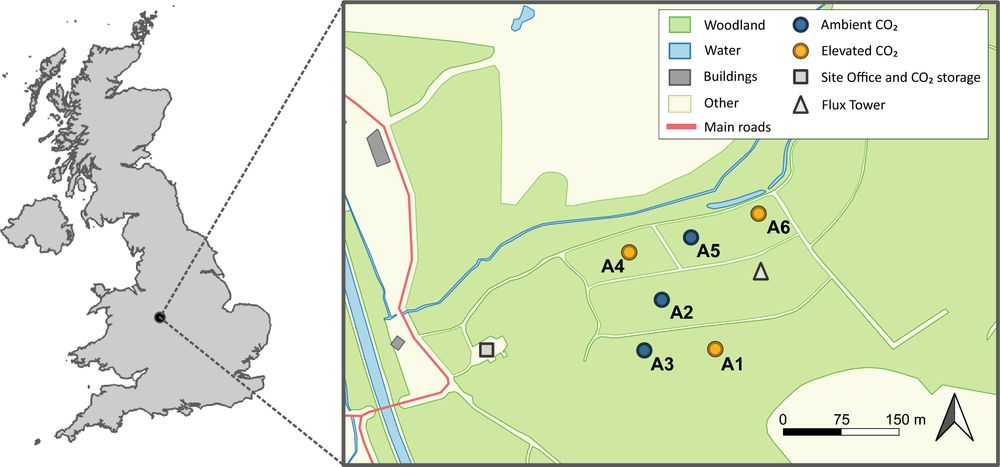
Increasing atmospheric CO2 levels change the elemental composition in plants, altering their nutritional quality and affecting consumers and ecosystems. Ecological stoichiometry provides a framework for investigating how CO2-driven nutrient dilution in pollen affects bees by linking changes in pollen chemical element proportions to the nutritional needs of bees. We investigated the consequences of five years of Free Air CO2 Enrichment (FACE) in a mature oak-dominated temperate forest on the elemental composition of English oak (Quercus robur) pollen. We measured the concentrations and proportions of 12 elements (C, N, P, S, K, Na, Ca, Mg, Cu, Zn, Fe, and Mn) in Q. robur pollen-bearing flowers collected from the Birmingham Institute for Forest Research (BIFoR) FACE facility. An elevated CO2 (eCO2) level of 150 ppm above ambient significantly reduced the S, K, and Fe levels and altered the multi-element ratio, with different elements behaving differently. This shift in pollen multi-element composition may have subsequent cascading effects on higher trophic levels. To assess the impact on bees, we calculated the stoichiometric mismatch (a measure of the discrepancy between consumer needs and food quality) for two bee species, Osmia bicornis (red mason bee) and Apis mellifera (honey bee), that consume oak pollen in nature. We observed stoichiometric mismatches for P and S, in pollen under eCO2, which could negatively affect bees. We highlight the need for a comprehensive understanding of the changes in pollen multi-element stoichiometry under eCO2, which leads to nutrient limitations under climate change with consequences for bees.
f.mtr.cool
June 20, 2025 at 4:30 AM
🧵4/7
🌍 #Pollinators are part of global ecological processes.
Enter the Nutrient Dilution Hypothesis.
Rising CO₂ helps plants grow—but dilutes the nutrients inside them. 📉
That includes pollen.
So bee larvae may be growing up on less nutritious food.😟
📄
🌍 #Pollinators are part of global ecological processes.
Enter the Nutrient Dilution Hypothesis.
Rising CO₂ helps plants grow—but dilutes the nutrients inside them. 📉
That includes pollen.
So bee larvae may be growing up on less nutritious food.😟
📄