



Mike Henderson
@mhender.bsky.social
Retired Applied Mathematician. Computational Dynamical Systems.
Still trying to understand how things work.
https://multifario.sourceforge.io/henderson/
I might be wrong.
Still trying to understand how things work.
https://multifario.sourceforge.io/henderson/
I might be wrong.
These are out-takes from
www.worldscientific.com/doi/10.1142/...
A very weird surface. Points on it satisfy 3d ODE with bcs and four parameters. It can be embedded in 4d, but projected into 3d it crosses itself.
The colors have to do with a classification of the solutions - # loops and twists.
www.worldscientific.com/doi/10.1142/...
A very weird surface. Points on it satisfy 3d ODE with bcs and four parameters. It can be embedded in 4d, but projected into 3d it crosses itself.
The colors have to do with a classification of the solutions - # loops and twists.


October 30, 2025 at 5:22 PM
These are out-takes from
www.worldscientific.com/doi/10.1142/...
A very weird surface. Points on it satisfy 3d ODE with bcs and four parameters. It can be embedded in 4d, but projected into 3d it crosses itself.
The colors have to do with a classification of the solutions - # loops and twists.
www.worldscientific.com/doi/10.1142/...
A very weird surface. Points on it satisfy 3d ODE with bcs and four parameters. It can be embedded in 4d, but projected into 3d it crosses itself.
The colors have to do with a classification of the solutions - # loops and twists.
This is the same algorithm (and code) as for the torus. The continuation is limited to the inside of a box, so you only see the yellow spheres until they cross that. The polyhedra around the spheres are more visible. They're used to find the boundary of the union of spherical balls.
October 27, 2025 at 1:42 PM
This is the same algorithm (and code) as for the torus. The continuation is limited to the inside of a box, so you only see the yellow spheres until they cross that. The polyhedra around the spheres are more visible. They're used to find the boundary of the union of spherical balls.
This is an animation of an algorithm for covering a torus with the projection of disks tangent to the surface. Red is the boundary, and the yellow contribute to the boundary. Blue ones are interior.
Each step picks a point on the boundary for a new disk. The boundary is a simple list.
Each step picks a point on the boundary for a new disk. The boundary is a simple list.
October 26, 2025 at 7:17 PM
This is an animation of an algorithm for covering a torus with the projection of disks tangent to the surface. Red is the boundary, and the yellow contribute to the boundary. Blue ones are interior.
Each step picks a point on the boundary for a new disk. The boundary is a simple list.
Each step picks a point on the boundary for a new disk. The boundary is a simple list.
I 'm reading Hermann's "Geometry, Physics, and Systems", 1973. It's got a chapter on Thermo. I love this guy.
He doesn't like the (dU/dP)_V notation or mysticism (his word) about entropy.
But what's with the bibliography? All references are labelled 1? Later there are some 2's.
He doesn't like the (dU/dP)_V notation or mysticism (his word) about entropy.
But what's with the bibliography? All references are labelled 1? Later there are some 2's.


October 1, 2025 at 6:19 PM
I 'm reading Hermann's "Geometry, Physics, and Systems", 1973. It's got a chapter on Thermo. I love this guy.
He doesn't like the (dU/dP)_V notation or mysticism (his word) about entropy.
But what's with the bibliography? All references are labelled 1? Later there are some 2's.
He doesn't like the (dU/dP)_V notation or mysticism (his word) about entropy.
But what's with the bibliography? All references are labelled 1? Later there are some 2's.
Aha. I probably shouldn't be doing this in public.
The phase constraint just is. We're talking about paths on the phase manifold, and not all paths are allowed? And for a path there's work done and a heat flow needed?
BTW This ⬇️isn't helping thank you.
The phase constraint just is. We're talking about paths on the phase manifold, and not all paths are allowed? And for a path there's work done and a heat flow needed?
BTW This ⬇️isn't helping thank you.

September 16, 2025 at 4:44 PM
Aha. I probably shouldn't be doing this in public.
The phase constraint just is. We're talking about paths on the phase manifold, and not all paths are allowed? And for a path there's work done and a heat flow needed?
BTW This ⬇️isn't helping thank you.
The phase constraint just is. We're talking about paths on the phase manifold, and not all paths are allowed? And for a path there's work done and a heat flow needed?
BTW This ⬇️isn't helping thank you.
I'm used to conservation laws. Navier Stokes and so on. So div f=0 in spatial vars. Thermo eqs seem to instead be "Irrotational", or path independent, so curl f=0. And not in space, but in pairs of the phase variables? Related to the second partials being the same (d^2U/dSdV=d^2U/dV/dS).
Head hurts
Head hurts


September 15, 2025 at 5:50 PM
I'm used to conservation laws. Navier Stokes and so on. So div f=0 in spatial vars. Thermo eqs seem to instead be "Irrotational", or path independent, so curl f=0. And not in space, but in pairs of the phase variables? Related to the second partials being the same (d^2U/dSdV=d^2U/dV/dS).
Head hurts
Head hurts
Did it again. Gotta watch out for black text on a transparent background.

September 14, 2025 at 3:59 PM
Did it again. Gotta watch out for black text on a transparent background.
Always wondered why they wrote thermodynamics equations as differentials. Of course Navier Stokes writes a temperature equation as a PDE, but ..
Am reading www.fys.ku.dk/~andresen/BA... and trying to get my head around work and heat flow being differential forms on the manifold of state (???!)
Am reading www.fys.ku.dk/~andresen/BA... and trying to get my head around work and heat flow being differential forms on the manifold of state (???!)

September 14, 2025 at 3:52 PM
Always wondered why they wrote thermodynamics equations as differentials. Of course Navier Stokes writes a temperature equation as a PDE, but ..
Am reading www.fys.ku.dk/~andresen/BA... and trying to get my head around work and heat flow being differential forms on the manifold of state (???!)
Am reading www.fys.ku.dk/~andresen/BA... and trying to get my head around work and heat flow being differential forms on the manifold of state (???!)
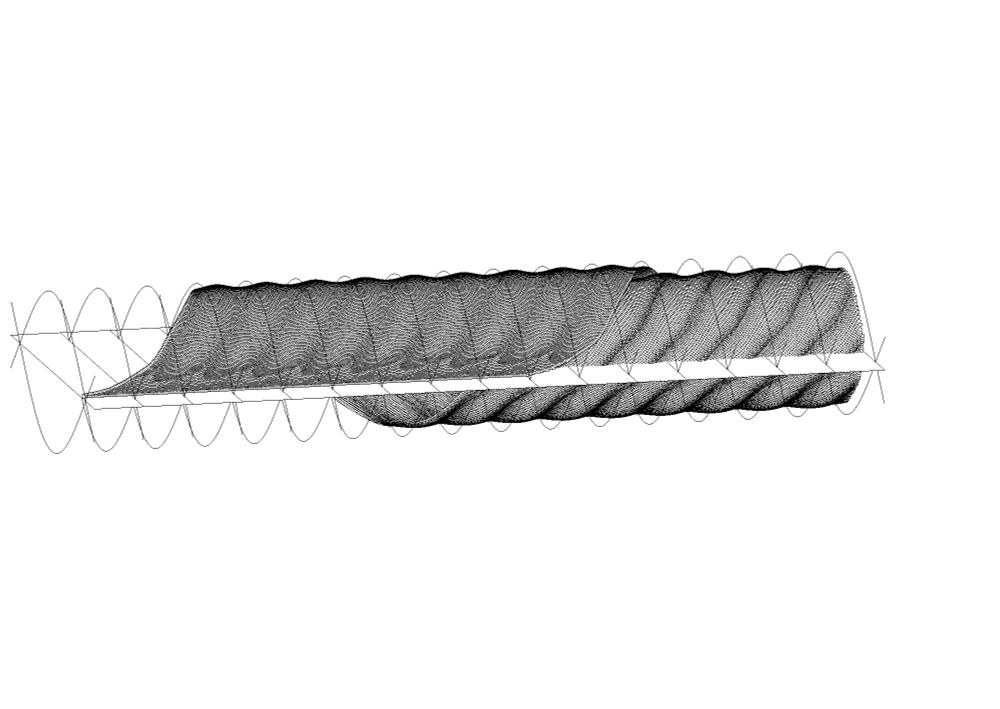
These are from the periodically forced damped pendulum, showing how points near the unstable fixed point (up) evolve. W/o forcing they'd spiral to the stable fixed point (down).
The surface is rendered as white with black polygons. Hidden line removal but still black and white.
The surface is rendered as white with black polygons. Hidden line removal but still black and white.


August 31, 2025 at 5:47 PM
These are from the periodically forced damped pendulum, showing how points near the unstable fixed point (up) evolve. W/o forcing they'd spiral to the stable fixed point (down).
The surface is rendered as white with black polygons. Hidden line removal but still black and white.
The surface is rendered as white with black polygons. Hidden line removal but still black and white.
These are three very old (1987) figures showing the cusp, swallowtail and butterfly catastrophes and the complex sheets associated with them. These were done in CATIA. Yep. Not many choices back then.


August 31, 2025 at 5:25 PM
These are three very old (1987) figures showing the cusp, swallowtail and butterfly catastrophes and the complex sheets associated with them. These were done in CATIA. Yep. Not many choices back then.

August 30, 2025 at 4:43 PM
And of course there's always the "famous" multifario demo:
multifario.sourceforge.io/henderson/mu...
multifario.sourceforge.io/henderson/mu...

August 27, 2025 at 2:40 AM
And of course there's always the "famous" multifario demo:
multifario.sourceforge.io/henderson/mu...
multifario.sourceforge.io/henderson/mu...
I used my admittedly limited JavaScript skills to make a vector field editor:
multifario.sourceforge.io/henderson/ve...
Changing each vector independently isn't the best, but it is what I set out to do. Uses a tensor product Bezier approx.
Next to find and mark the fixed points.
multifario.sourceforge.io/henderson/ve...
Changing each vector independently isn't the best, but it is what I set out to do. Uses a tensor product Bezier approx.
Next to find and mark the fixed points.

August 27, 2025 at 2:35 AM
I used my admittedly limited JavaScript skills to make a vector field editor:
multifario.sourceforge.io/henderson/ve...
Changing each vector independently isn't the best, but it is what I set out to do. Uses a tensor product Bezier approx.
Next to find and mark the fixed points.
multifario.sourceforge.io/henderson/ve...
Changing each vector independently isn't the best, but it is what I set out to do. Uses a tensor product Bezier approx.
Next to find and mark the fixed points.
I never really understood this picture -- it's part of the configurations of a axially clamped twisted rod. So like a garden hose held in two hands. The horizontal is how hard you have to pull, and the vertical plane is the torque you have to apply. The curves are various special configurations.

August 23, 2025 at 3:12 AM
I never really understood this picture -- it's part of the configurations of a axially clamped twisted rod. So like a garden hose held in two hands. The horizontal is how hard you have to pull, and the vertical plane is the torque you have to apply. The curves are various special configurations.
Computing a stable invariant circle in a map. I write a system for a point on a circle, and it's 9 iterates under the map. Long vector. The solution is a curve in the large space. Plotting pairs of coordinates gives the ellipses. The black zig zag line is one solution of the large system.


August 18, 2025 at 6:37 PM
Computing a stable invariant circle in a map. I write a system for a point on a circle, and it's 9 iterates under the map. Long vector. The solution is a curve in the large space. Plotting pairs of coordinates gives the ellipses. The black zig zag line is one solution of the large system.
We always used to call these locusts. I know they're cicadas and not grasshoppers, but that's what we called them.

August 17, 2025 at 9:44 PM
We always used to call these locusts. I know they're cicadas and not grasshoppers, but that's what we called them.
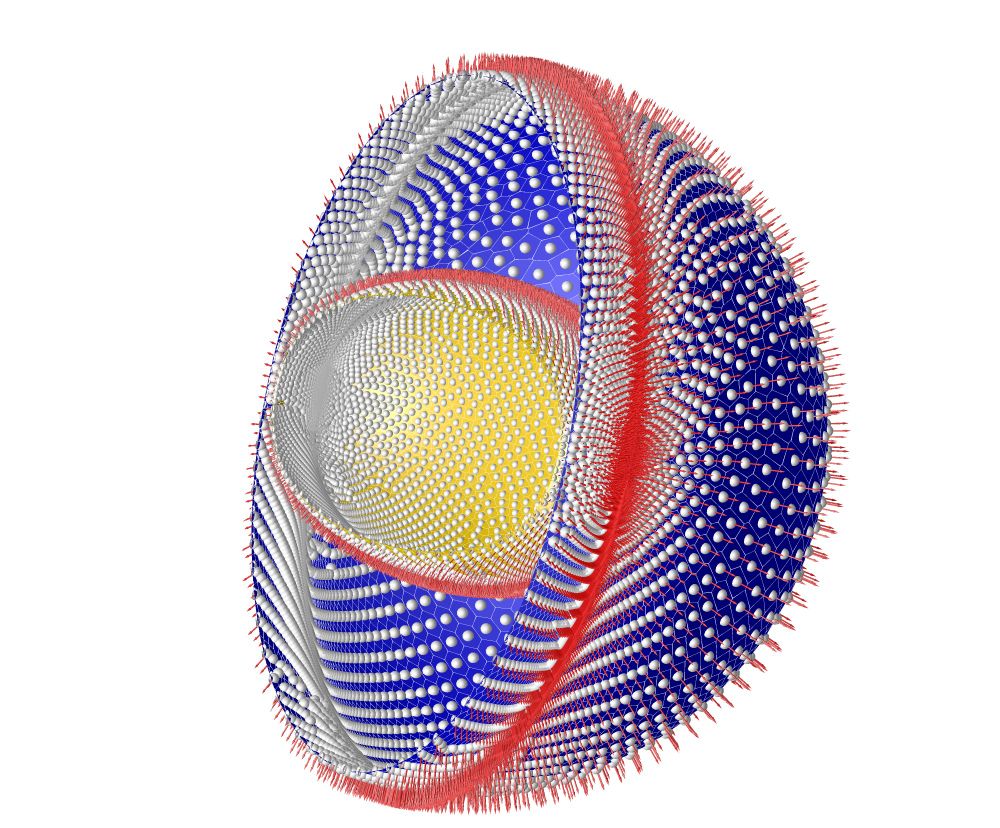
My first thought was "Wow". My second was "I really messed that up". But hey.
August 3, 2025 at 5:23 PM
My first thought was "Wow". My second was "I really messed that up". But hey.
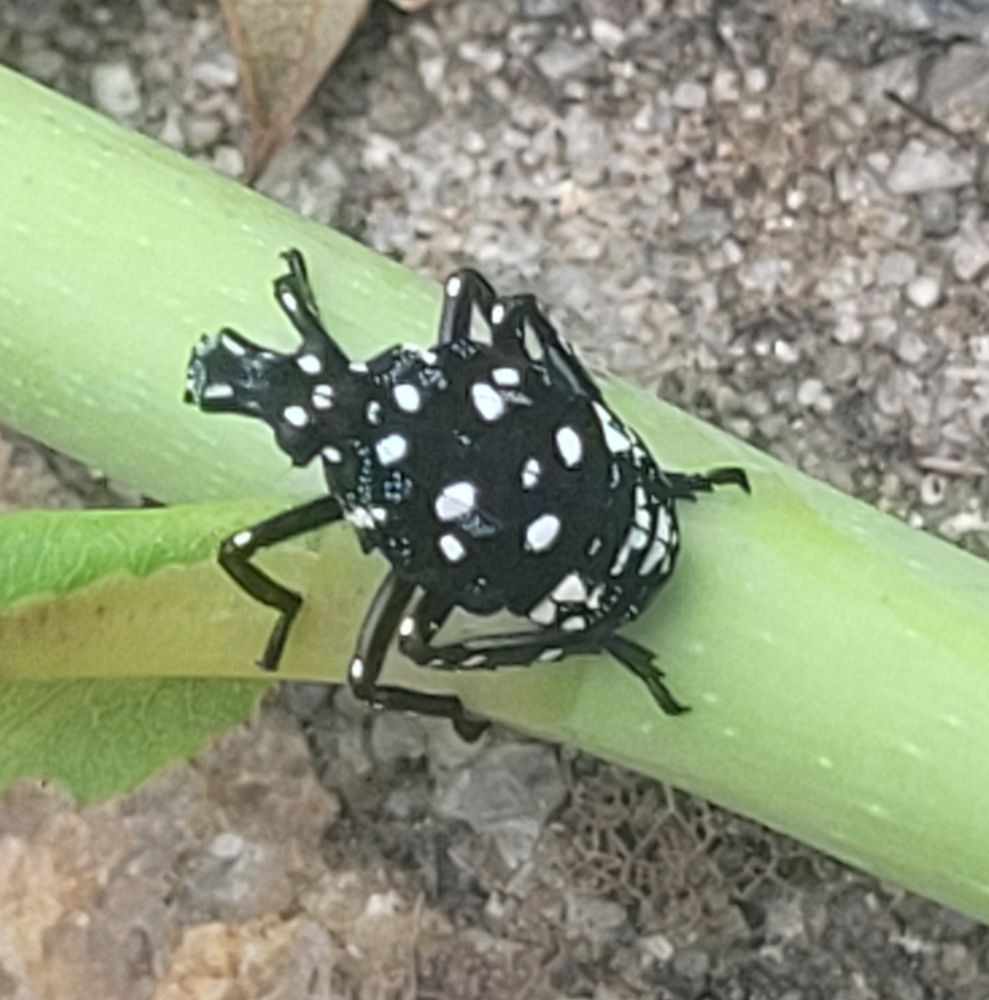
Hello? What exactly are you?
July 10, 2025 at 8:57 PM
Hello? What exactly are you?
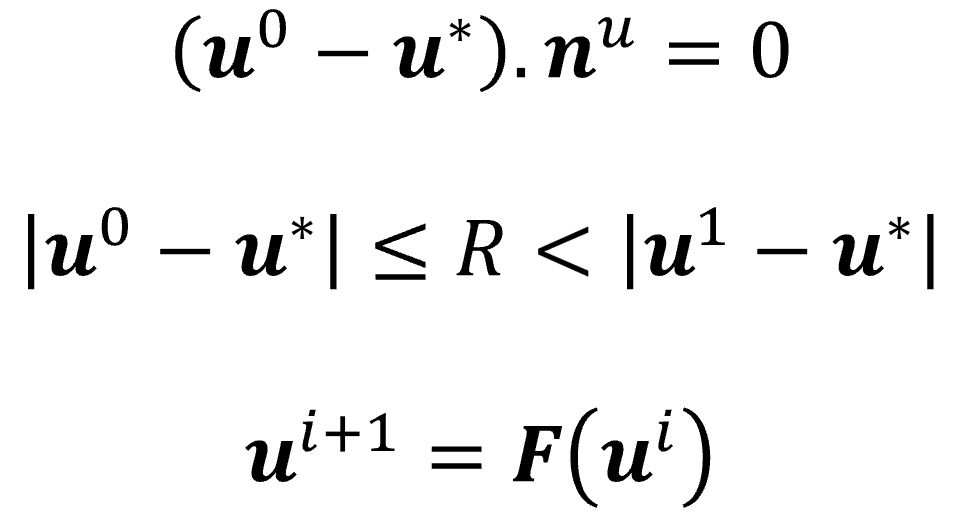
I forgot to add the equations.
July 8, 2025 at 1:11 PM
I forgot to add the equations.
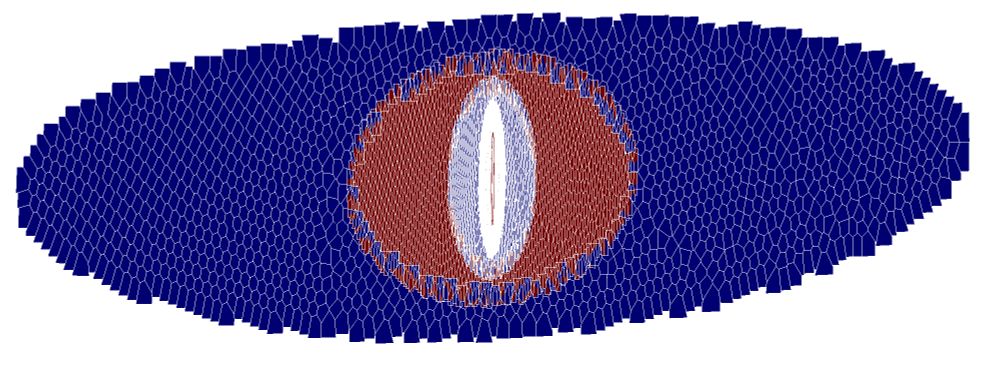
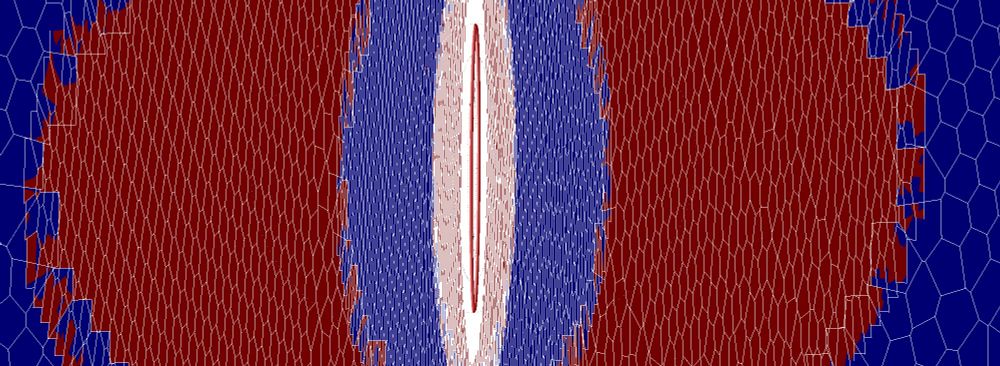
These are my first steps at computing invariant manifolds of maps. This is the stable manifold of the origin in discrete Lorenz. A "point" is five three-d pts, each the image of the other under the map, with the first in the stable eigenspace. The first pair straddles the small, thin red ellipse.
July 8, 2025 at 12:52 PM
These are my first steps at computing invariant manifolds of maps. This is the stable manifold of the origin in discrete Lorenz. A "point" is five three-d pts, each the image of the other under the map, with the first in the stable eigenspace. The first pair straddles the small, thin red ellipse.
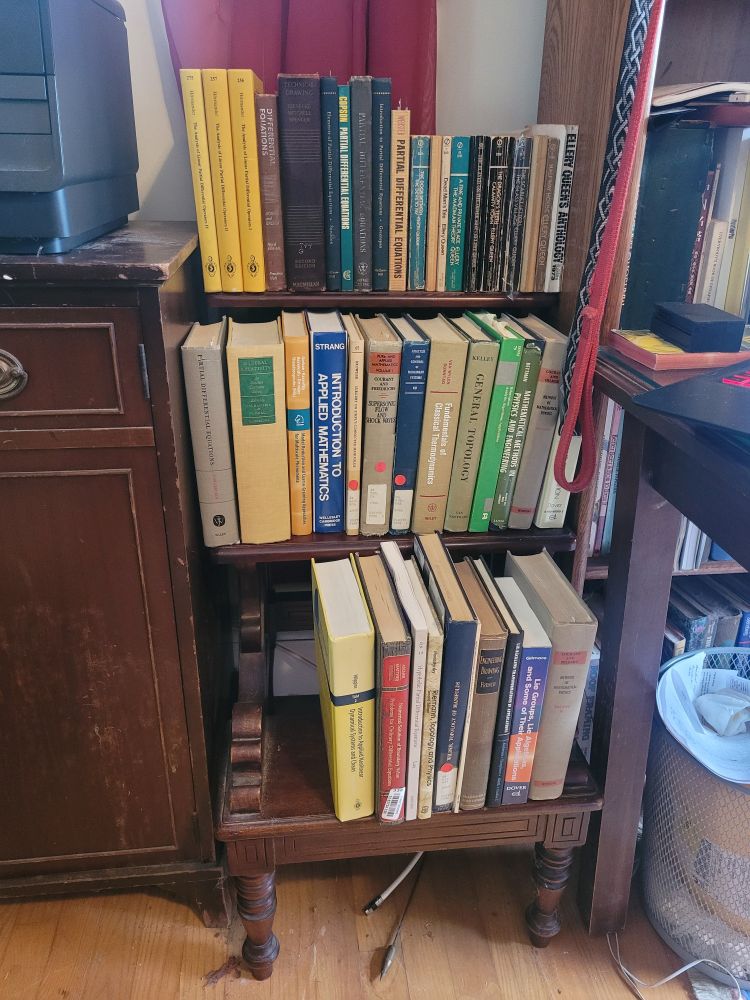
If I'm using my library steps as extra bookshelf space, do I have a problem?
July 7, 2025 at 3:34 PM
If I'm using my library steps as extra bookshelf space, do I have a problem?
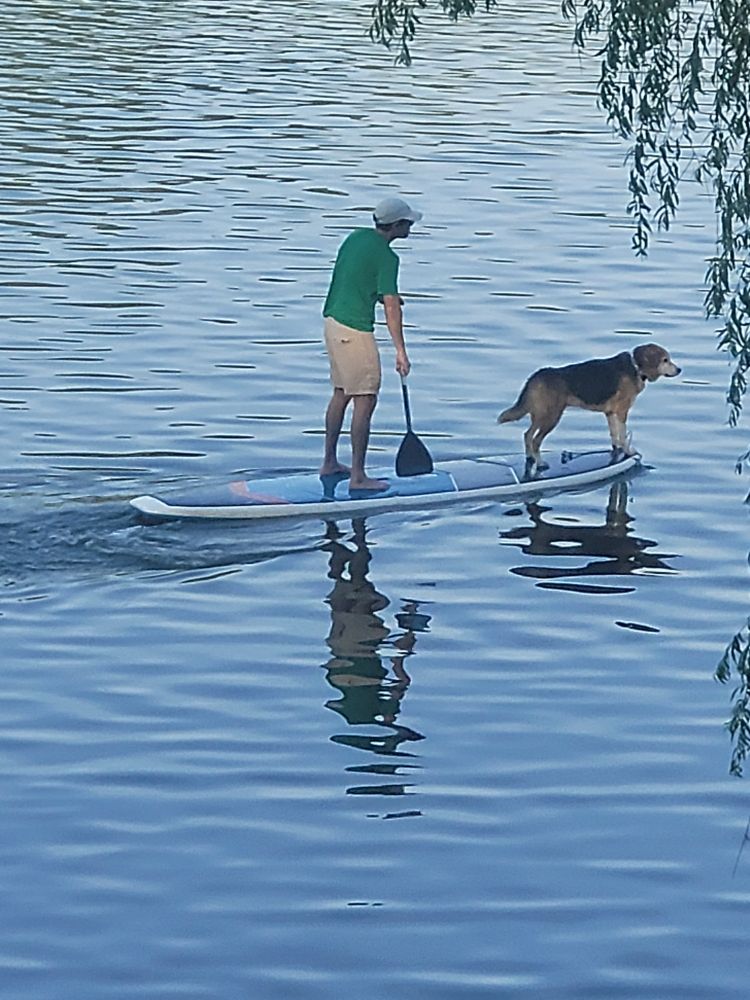
I'm guessing that this takes way more coordination than I possess. The dog trots back and forth on the board. Looks slippery.
Ooo. Cool the way the reflections show on the waves.
Ooo. Cool the way the reflections show on the waves.
July 5, 2025 at 10:24 PM
I'm guessing that this takes way more coordination than I possess. The dog trots back and forth on the board. Looks slippery.
Ooo. Cool the way the reflections show on the waves.
Ooo. Cool the way the reflections show on the waves.
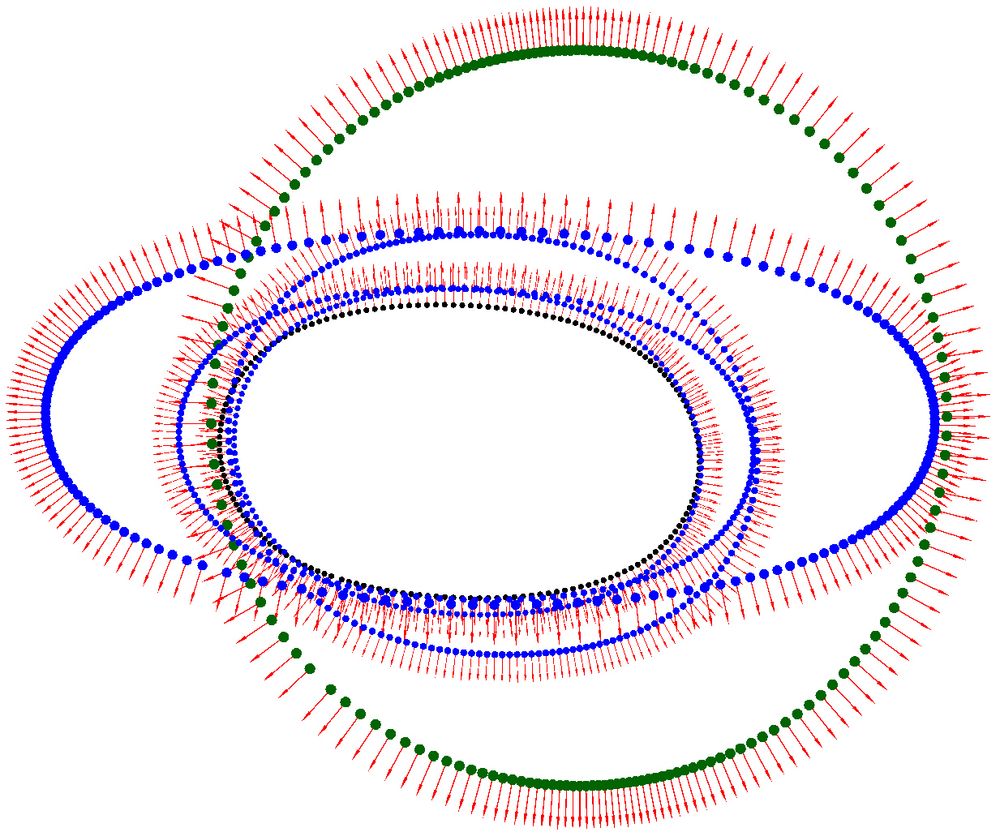
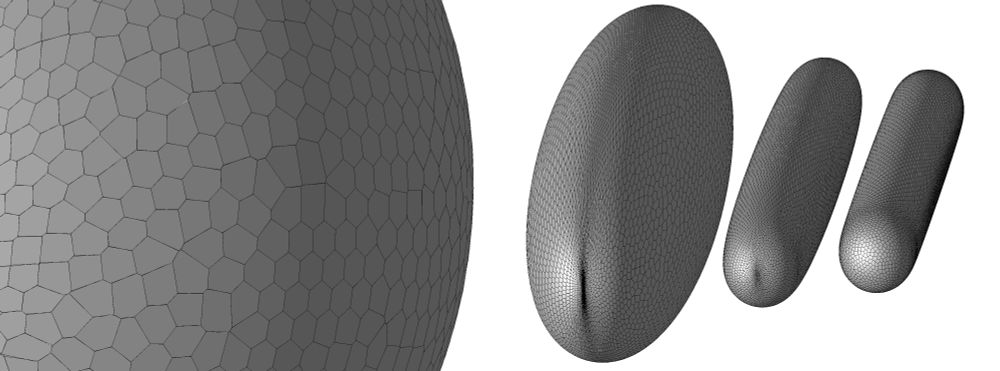
I'm not going to try to explain these, but the gods of computation decided that they'd let my code work.
The curves/surfaces are points on all trajectories of a mapping (2d->2d and 3d->3d) starting on a manifold of initial conditions (a circle/sphere here).
The curves/surfaces are points on all trajectories of a mapping (2d->2d and 3d->3d) starting on a manifold of initial conditions (a circle/sphere here).
July 1, 2025 at 8:18 PM
I'm not going to try to explain these, but the gods of computation decided that they'd let my code work.
The curves/surfaces are points on all trajectories of a mapping (2d->2d and 3d->3d) starting on a manifold of initial conditions (a circle/sphere here).
The curves/surfaces are points on all trajectories of a mapping (2d->2d and 3d->3d) starting on a manifold of initial conditions (a circle/sphere here).
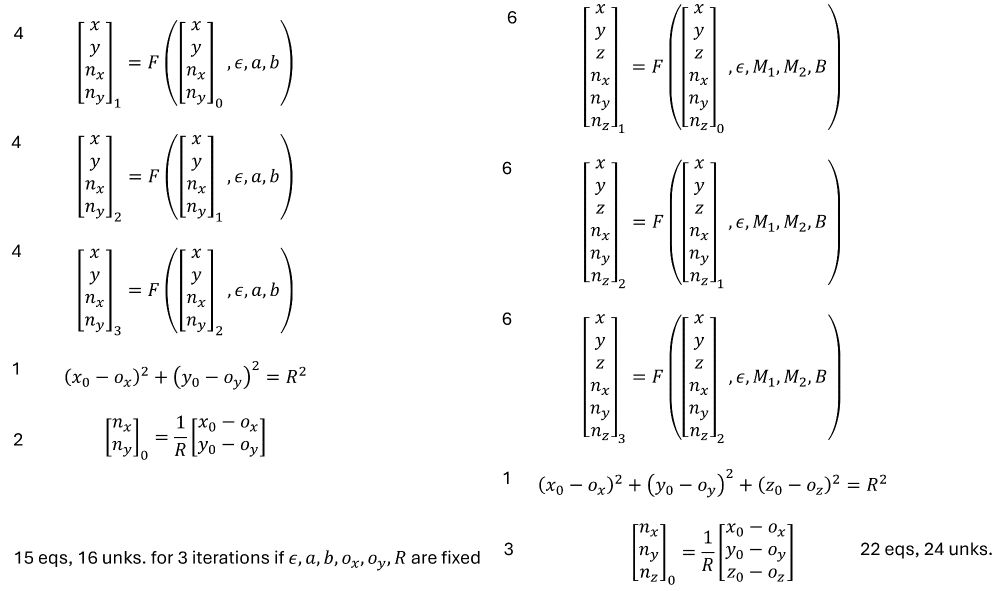
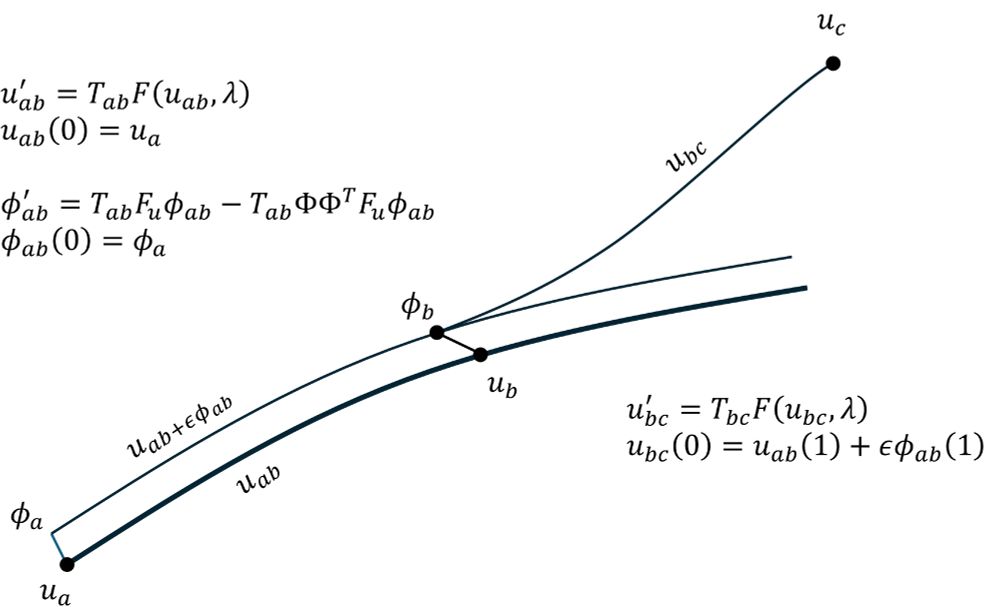
Argh. I messed up the equations on the figure, and somehow managed to mess the alt text. I thought I'd got it set not to let me do that. Hmmm.
June 25, 2025 at 6:32 PM
Argh. I messed up the equations on the figure, and somehow managed to mess the alt text. I thought I'd got it set not to let me do that. Hmmm.
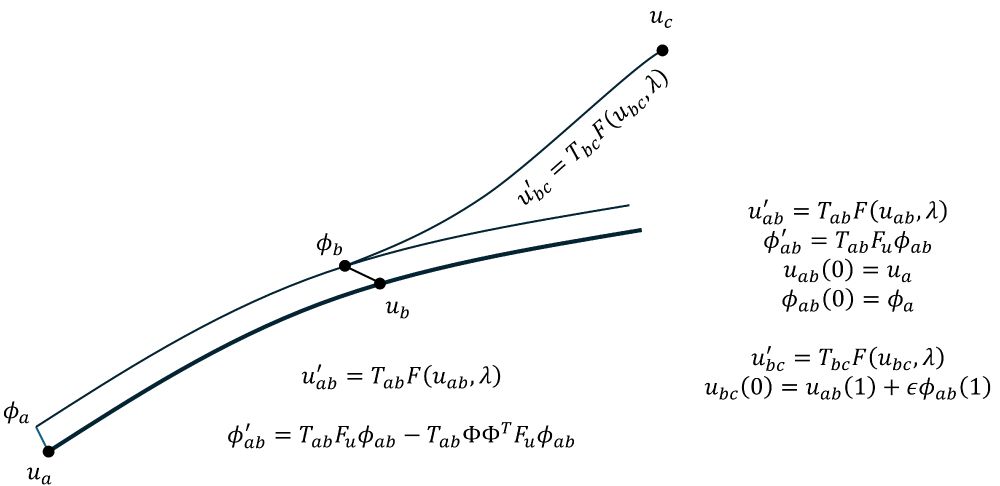
Here's what I'm thinking about.
Invariant manifolds defined by smooth transverse sections are "easy". Those associated with a trajectory (like a periodic orbit) are collections of trajectories that approach or diverge from a curve tangent to the flow.
Invariant manifolds defined by smooth transverse sections are "easy". Those associated with a trajectory (like a periodic orbit) are collections of trajectories that approach or diverge from a curve tangent to the flow.
June 25, 2025 at 6:08 PM
Here's what I'm thinking about.
Invariant manifolds defined by smooth transverse sections are "easy". Those associated with a trajectory (like a periodic orbit) are collections of trajectories that approach or diverge from a curve tangent to the flow.
Invariant manifolds defined by smooth transverse sections are "easy". Those associated with a trajectory (like a periodic orbit) are collections of trajectories that approach or diverge from a curve tangent to the flow.