




Morten H. Christiansen
@mh-christiansen.bsky.social
Cognitive scientist interested in the processing, acquisition and evolution of language; statistical learning; computational modeling.
Lab website: https://csl-lab.psych.cornell.edu
Lab website: https://csl-lab.psych.cornell.edu
Inspired by the Scottish Enlightenment philosopher Adam Ferguson, we explore how cultural and social organization arises from human action, but not human design: from myopic, moment-by-moment modifications to the rules by which we live—modifications intelligently chosen to solve current problems
2/8
2/8

November 28, 2025 at 3:36 PM
Inspired by the Scottish Enlightenment philosopher Adam Ferguson, we explore how cultural and social organization arises from human action, but not human design: from myopic, moment-by-moment modifications to the rules by which we live—modifications intelligently chosen to solve current problems
2/8
2/8
Ross D. Kristensen-McLachlan, Pablo Contreras Kallens and I suggest that the introduction of Reinforcement Learning with Human Feedback provides much need socially informed feedback and that this makes their linguistic behavior more human-like (including human errors) 2/2
Curious? The article is OA
Curious? The article is OA

October 12, 2025 at 1:31 AM
Ross D. Kristensen-McLachlan, Pablo Contreras Kallens and I suggest that the introduction of Reinforcement Learning with Human Feedback provides much need socially informed feedback and that this makes their linguistic behavior more human-like (including human errors) 2/2
Curious? The article is OA
Curious? The article is OA
Papers (cont):
Brown & Walasek
Trujillo, Zhang, Zhi-Xuan, Tenenbaum & Levine
Contreras Kallens & Christiansen
Chater
3/3
Brown & Walasek
Trujillo, Zhang, Zhi-Xuan, Tenenbaum & Levine
Contreras Kallens & Christiansen
Chater
3/3

July 28, 2025 at 5:35 PM
Papers (cont):
Brown & Walasek
Trujillo, Zhang, Zhi-Xuan, Tenenbaum & Levine
Contreras Kallens & Christiansen
Chater
3/3
Brown & Walasek
Trujillo, Zhang, Zhi-Xuan, Tenenbaum & Levine
Contreras Kallens & Christiansen
Chater
3/3
Just in time for the @cogscisociety.bsky.social conference and the Rumelhart 25th Anniversary Event, the 2023 Rumelhart Prize Issue Honoring Nick Chater is out in TopiCS in Cognitive Science, edited by Mike Oaksford and me:
onlinelibrary.wiley.com/toc/17568765...
🧵 1/3
onlinelibrary.wiley.com/toc/17568765...
🧵 1/3

July 28, 2025 at 5:35 PM
Just in time for the @cogscisociety.bsky.social conference and the Rumelhart 25th Anniversary Event, the 2023 Rumelhart Prize Issue Honoring Nick Chater is out in TopiCS in Cognitive Science, edited by Mike Oaksford and me:
onlinelibrary.wiley.com/toc/17568765...
🧵 1/3
onlinelibrary.wiley.com/toc/17568765...
🧵 1/3
📣 Save the date 🗓️ to present your exciting statistical learning research at the 6th Interdisciplinary Advances in Statistical Learning Conference June 10-12 2026 in San Sebastián 🇪🇸
Keynotes by
@jennysaffran.bsky.social
@noranewcombe.bsky.social
@pyoudeyer.bsky.social
More info to follow #IASL26
Keynotes by
@jennysaffran.bsky.social
@noranewcombe.bsky.social
@pyoudeyer.bsky.social
More info to follow #IASL26

July 18, 2025 at 3:38 PM
📣 Save the date 🗓️ to present your exciting statistical learning research at the 6th Interdisciplinary Advances in Statistical Learning Conference June 10-12 2026 in San Sebastián 🇪🇸
Keynotes by
@jennysaffran.bsky.social
@noranewcombe.bsky.social
@pyoudeyer.bsky.social
More info to follow #IASL26
Keynotes by
@jennysaffran.bsky.social
@noranewcombe.bsky.social
@pyoudeyer.bsky.social
More info to follow #IASL26
We propose a top-down, memory-based perspective on structural priming in which multiple contextual (including non-syntactic) constraints shape the representation of a sentence. This proposal resolves the anomalous empirical findings and accounts for structural priming in LLMs.
3/4
3/4

June 25, 2025 at 5:46 PM
We propose a top-down, memory-based perspective on structural priming in which multiple contextual (including non-syntactic) constraints shape the representation of a sentence. This proposal resolves the anomalous empirical findings and accounts for structural priming in LLMs.
3/4
3/4
We review recent empirical work from within the structural priming literature itself and from research on LLMs that questions the standard view of what structural priming says about the mental representation of language. Instead we offer an alternative account rooted in basic memory processes.
2/4
2/4

June 25, 2025 at 5:46 PM
We review recent empirical work from within the structural priming literature itself and from research on LLMs that questions the standard view of what structural priming says about the mental representation of language. Instead we offer an alternative account rooted in basic memory processes.
2/4
2/4
I'm excited about this TICS Opinion with @yngwienielsen.bsky.social, challenging the view that structural priming—the tendency to reuse a recent syntactic structure—provides evidence for the psychological reality of grammar-based constituent structure.
authors.elsevier.com/a/1lIFK4sIRv...
🧵1/4
authors.elsevier.com/a/1lIFK4sIRv...
🧵1/4

June 25, 2025 at 5:46 PM
I'm excited about this TICS Opinion with @yngwienielsen.bsky.social, challenging the view that structural priming—the tendency to reuse a recent syntactic structure—provides evidence for the psychological reality of grammar-based constituent structure.
authors.elsevier.com/a/1lIFK4sIRv...
🧵1/4
authors.elsevier.com/a/1lIFK4sIRv...
🧵1/4
And a final bonus meme: Laura Bridgman was the first person with no sight and hearing who learned how to communicate via finger spelling. She later taught Anne Sullivan who introduced Helen Keller to finger spelling. Yet, sadly, most are unaware of Laura Bridgman's pioneering role today.
5/5
5/5

April 29, 2025 at 5:48 PM
And a final bonus meme: Laura Bridgman was the first person with no sight and hearing who learned how to communicate via finger spelling. She later taught Anne Sullivan who introduced Helen Keller to finger spelling. Yet, sadly, most are unaware of Laura Bridgman's pioneering role today.
5/5
5/5
The second third-place meme was about Harry Harlow's Pitt of Despair, which was used to illustrate one of the many reasons for why "the forbidden experiment" (involving bringing up children in isolation to see if they develop language) can never be done.
4/5
4/5

April 29, 2025 at 5:48 PM
The second third-place meme was about Harry Harlow's Pitt of Despair, which was used to illustrate one of the many reasons for why "the forbidden experiment" (involving bringing up children in isolation to see if they develop language) can never be done.
4/5
4/5
Two memes ended up in third place. The first one is about the McGurk effect in which an auditory /ba/ combined with the lip movements for "Ga" leads to the perception of a "Da".
3/5
3/5

April 29, 2025 at 5:48 PM
Two memes ended up in third place. The first one is about the McGurk effect in which an auditory /ba/ combined with the lip movements for "Ga" leads to the perception of a "Da".
3/5
3/5
The runner up was about a second topic that elicited several memes: The rapid turn-taking in everyday conversations
2/5
2/5

April 29, 2025 at 5:48 PM
The runner up was about a second topic that elicited several memes: The rapid turn-taking in everyday conversations
2/5
2/5
Every year at the end of the semester, I ask the students in my Psych of Language class to create memes about what they've learned. They then vote for their favorites.
Here's the winner about how the idea of a universal grammar is no longer as compelling as it once seemed.
1/5
Here's the winner about how the idea of a universal grammar is no longer as compelling as it once seemed.
1/5

April 29, 2025 at 5:48 PM
Every year at the end of the semester, I ask the students in my Psych of Language class to create memes about what they've learned. They then vote for their favorites.
Here's the winner about how the idea of a universal grammar is no longer as compelling as it once seemed.
1/5
Here's the winner about how the idea of a universal grammar is no longer as compelling as it once seemed.
1/5
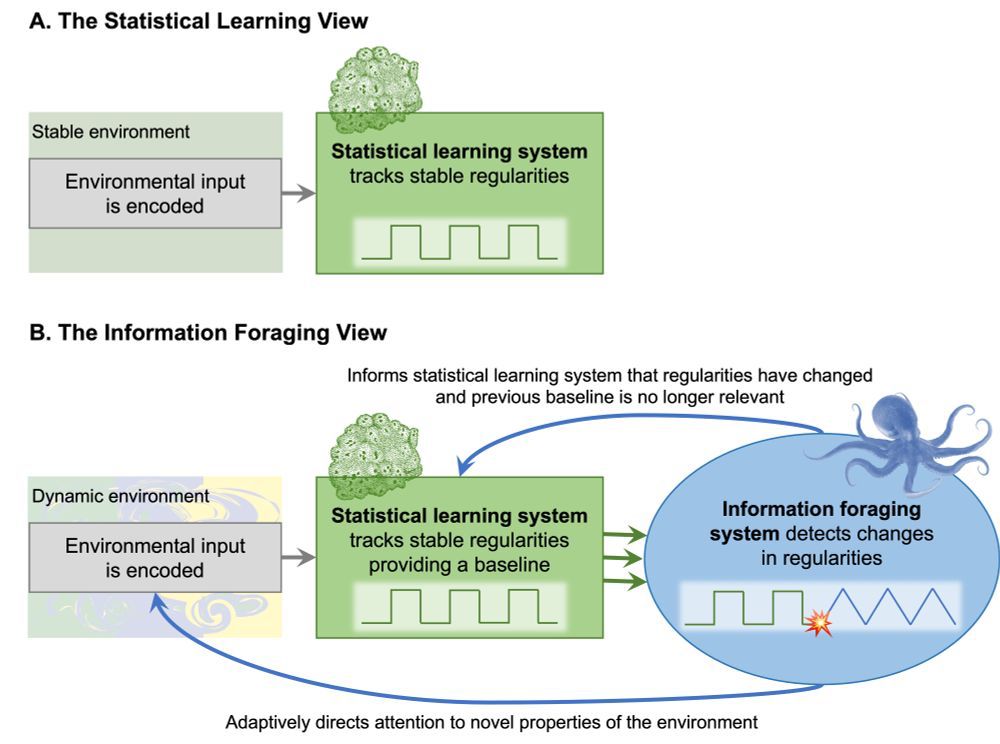
We argue that the environment is constantly in flux and thus that SL therefore cannot be the end goal but rather provides a baseline against which novelty can be detected from random noise. We discuss the implications of this perspective for #CognitiveScience 2/2
doi.org/10.1037/rev0...
doi.org/10.1037/rev0...
February 27, 2025 at 2:07 PM
We argue that the environment is constantly in flux and thus that SL therefore cannot be the end goal but rather provides a baseline against which novelty can be detected from random noise. We discuss the implications of this perspective for #CognitiveScience 2/2
doi.org/10.1037/rev0...
doi.org/10.1037/rev0...
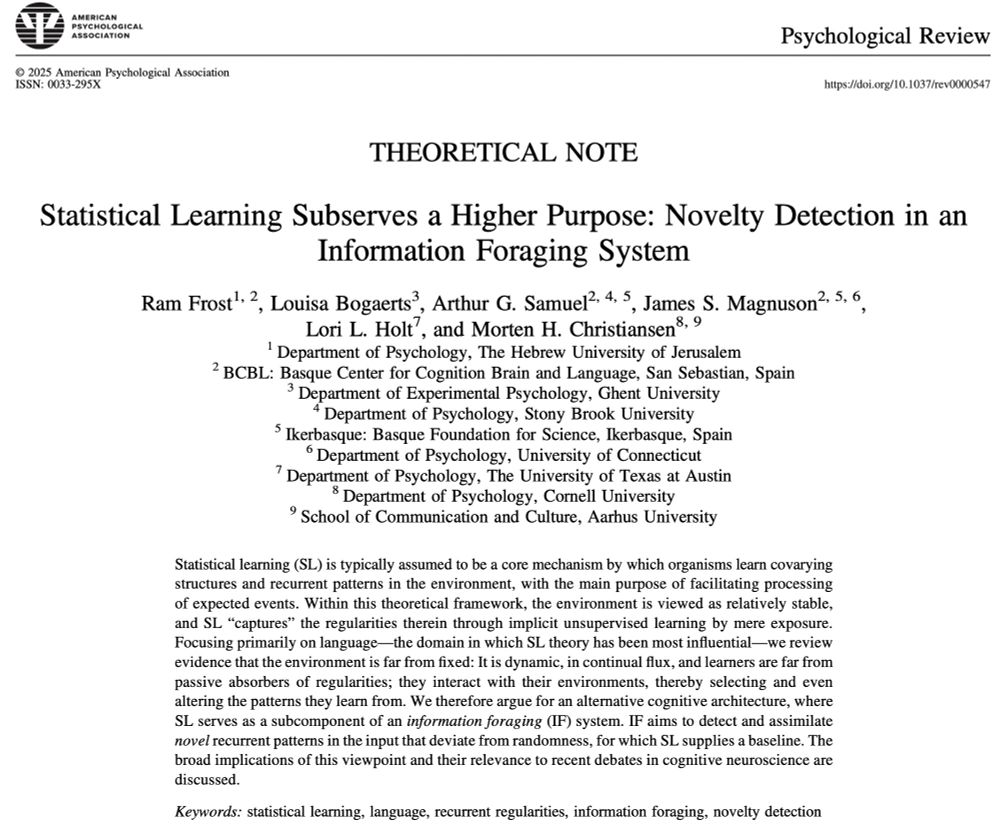
What is human #StatisticalLearning for? The standard assumption is that the goal of SL is to learn the regularities in the environment to guide behavior. In our new Psych Review paper, we argue that SL instead is provides the basis for novelty detection within an information foraging system
1/2
1/2
February 27, 2025 at 2:07 PM
What is human #StatisticalLearning for? The standard assumption is that the goal of SL is to learn the regularities in the environment to guide behavior. In our new Psych Review paper, we argue that SL instead is provides the basis for novelty detection within an information foraging system
1/2
1/2