



Marianne Aubin Le Quéré
@mariannealq.bsky.social
Postdoctoral Fellow @ Princeton CITP. ex-Cornell PhD, future UIUC asst prof (fall 2026).
Looking at AI's impact on information ecosystems and news consumption. social computing, computational social science & journalism
mariannealq.com
Looking at AI's impact on information ecosystems and news consumption. social computing, computational social science & journalism
mariannealq.com
Does your work explore mis/disinformation, scams, hate speech, or other forms of harmful information online?
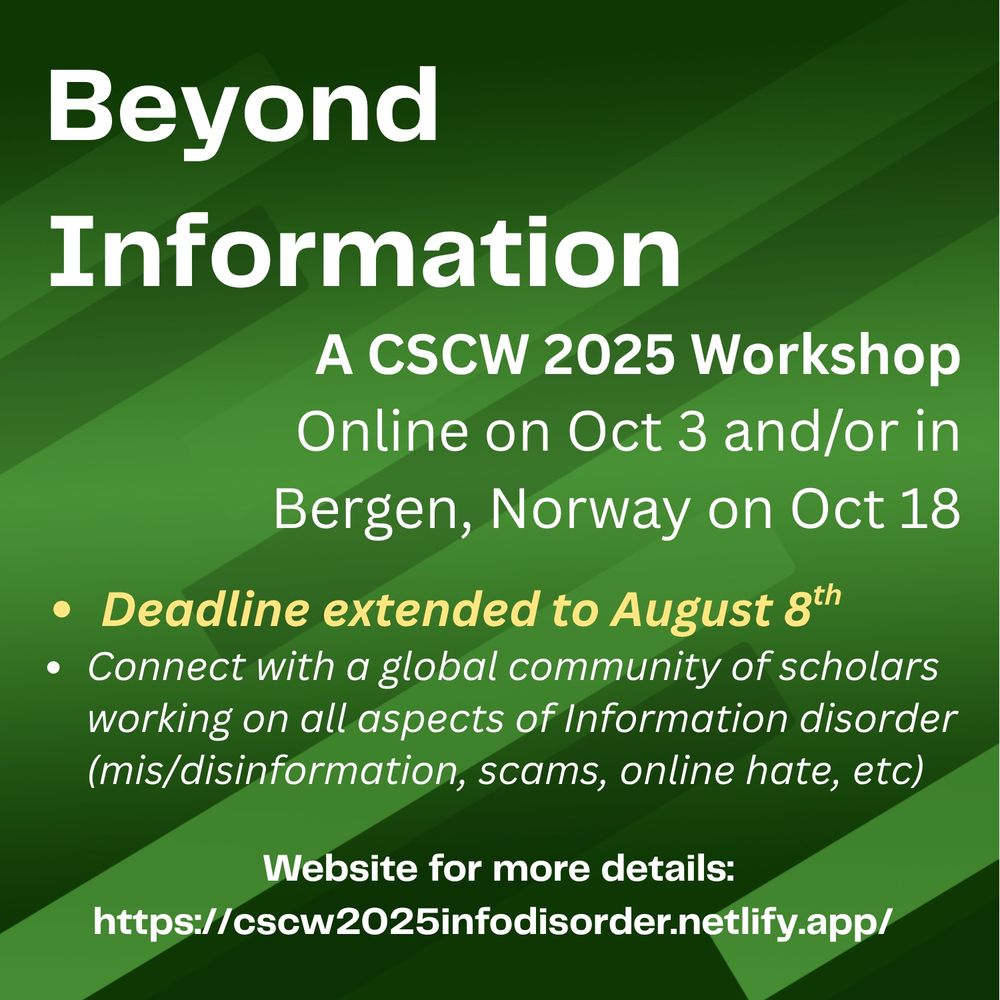
We are convening a CSCW workshop to bring together a global community focused on information disorder. We welcome 2-6 page submissions, due August 8th.
Cscw2025infodisorder.netlify.app
We are convening a CSCW workshop to bring together a global community focused on information disorder. We welcome 2-6 page submissions, due August 8th.
Cscw2025infodisorder.netlify.app
August 2, 2025 at 11:16 PM
Does your work explore mis/disinformation, scams, hate speech, or other forms of harmful information online?
We are convening a CSCW workshop to bring together a global community focused on information disorder. We welcome 2-6 page submissions, due August 8th.
Cscw2025infodisorder.netlify.app
We are convening a CSCW workshop to bring together a global community focused on information disorder. We welcome 2-6 page submissions, due August 8th.
Cscw2025infodisorder.netlify.app
We find strong evidence that those who follow localized social media (LSMs) have higher community attachment and political participation intent.
We find some evidence that those attitudes are stronger for users who followed these subreddits for longer and who participate more.
We find some evidence that those attitudes are stronger for users who followed these subreddits for longer and who participate more.

June 5, 2025 at 2:56 PM
We find strong evidence that those who follow localized social media (LSMs) have higher community attachment and political participation intent.
We find some evidence that those attitudes are stronger for users who followed these subreddits for longer and who participate more.
We find some evidence that those attitudes are stronger for users who followed these subreddits for longer and who participate more.
Out today in Social Media + Society!
In a new paper with @skairam.bsky.social, we conduct a longitudinal survey with Reddit trace data to compare the demographics and behaviors of users who follow local subreddits and those who do not.
Here's what we learned🧵
journals.sagepub.com/doi/10.1177/...
In a new paper with @skairam.bsky.social, we conduct a longitudinal survey with Reddit trace data to compare the demographics and behaviors of users who follow local subreddits and those who do not.
Here's what we learned🧵
journals.sagepub.com/doi/10.1177/...

June 5, 2025 at 2:56 PM
Out today in Social Media + Society!
In a new paper with @skairam.bsky.social, we conduct a longitudinal survey with Reddit trace data to compare the demographics and behaviors of users who follow local subreddits and those who do not.
Here's what we learned🧵
journals.sagepub.com/doi/10.1177/...
In a new paper with @skairam.bsky.social, we conduct a longitudinal survey with Reddit trace data to compare the demographics and behaviors of users who follow local subreddits and those who do not.
Here's what we learned🧵
journals.sagepub.com/doi/10.1177/...
Noodling on the implications of this #CHI2025 paper today:
The estimated max cost of ALL GenAI research submitted to CHI2024 was 12 tons of CO2 emitted vs 7000+ tons of CO2 emitted by attendees traveling to the conference.
dl.acm.org/doi/10.1145/...
The estimated max cost of ALL GenAI research submitted to CHI2024 was 12 tons of CO2 emitted vs 7000+ tons of CO2 emitted by attendees traveling to the conference.
dl.acm.org/doi/10.1145/...


April 30, 2025 at 1:22 AM
Noodling on the implications of this #CHI2025 paper today:
The estimated max cost of ALL GenAI research submitted to CHI2024 was 12 tons of CO2 emitted vs 7000+ tons of CO2 emitted by attendees traveling to the conference.
dl.acm.org/doi/10.1145/...
The estimated max cost of ALL GenAI research submitted to CHI2024 was 12 tons of CO2 emitted vs 7000+ tons of CO2 emitted by attendees traveling to the conference.
dl.acm.org/doi/10.1145/...
And the #CHI2025 News Futures workshop is off to a running start! First up: a panel led by @sachnishal.bsky.social, ft Lydia Chilton, @hheuer.bsky.social , Kazuhiro Kida, and @bronwynjo.bsky.social.

April 26, 2025 at 12:34 AM
And the #CHI2025 News Futures workshop is off to a running start! First up: a panel led by @sachnishal.bsky.social, ft Lydia Chilton, @hheuer.bsky.social , Kazuhiro Kida, and @bronwynjo.bsky.social.
Our CHI workshop report is now published in Interactions Magazine, in their brand new "Waves" format!
In this piece we recap three main takeaways from our workshop on LLMs as Research Tools in HCI. Read on for more...
interactions.acm.org/archive/view...
In this piece we recap three main takeaways from our workshop on LLMs as Research Tools in HCI. Read on for more...
interactions.acm.org/archive/view...

January 13, 2025 at 6:13 PM
Our CHI workshop report is now published in Interactions Magazine, in their brand new "Waves" format!
In this piece we recap three main takeaways from our workshop on LLMs as Research Tools in HCI. Read on for more...
interactions.acm.org/archive/view...
In this piece we recap three main takeaways from our workshop on LLMs as Research Tools in HCI. Read on for more...
interactions.acm.org/archive/view...
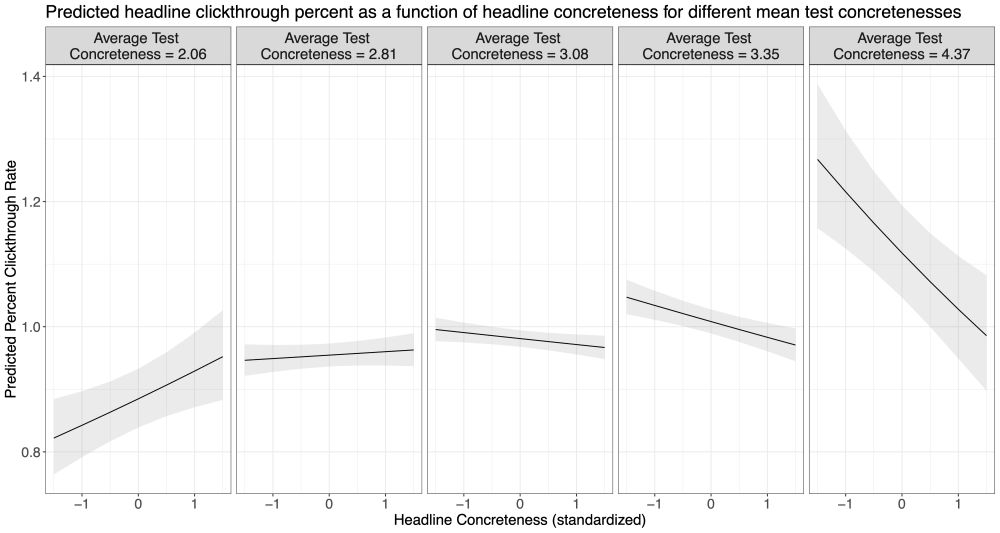
6/ Headlines that strike a balance—revealing just enough to spark curiosity—get the most clicks. This suggests a "Goldilocks effect" where revealing the right amount of information maximizes engagement.
These findings also harmonize prior conflicting findings, and tie back to the information gap.
These findings also harmonize prior conflicting findings, and tie back to the information gap.
January 7, 2025 at 9:27 PM
6/ Headlines that strike a balance—revealing just enough to spark curiosity—get the most clicks. This suggests a "Goldilocks effect" where revealing the right amount of information maximizes engagement.
These findings also harmonize prior conflicting findings, and tie back to the information gap.
These findings also harmonize prior conflicting findings, and tie back to the information gap.
5/ To test this theory in a news context, we tagged nearly 9,000 real headline experiments with a novel automated concreteness measure that labels how much specific information a headline reveals. As it turns out, both vague and overly detailed headlines perform worse.

January 7, 2025 at 9:27 PM
5/ To test this theory in a news context, we tagged nearly 9,000 real headline experiments with a novel automated concreteness measure that labels how much specific information a headline reveals. As it turns out, both vague and overly detailed headlines perform worse.
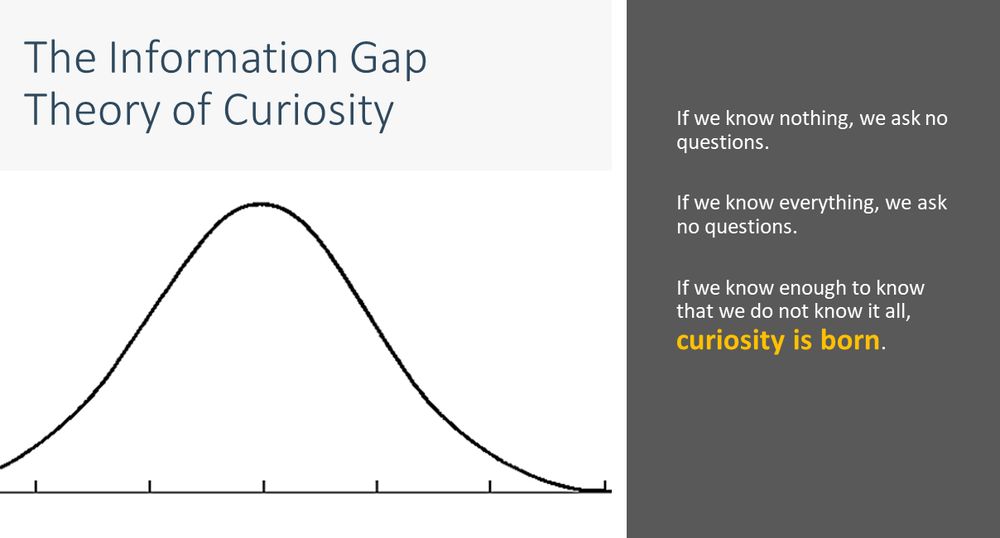
4/ So, we went back to the original concept of the “information gap” from the psychology of curiosity. Information gap theories suggests that people are most curious in medium-information environments: when some information, but not all, is available.
January 7, 2025 at 9:27 PM
4/ So, we went back to the original concept of the “information gap” from the psychology of curiosity. Information gap theories suggests that people are most curious in medium-information environments: when some information, but not all, is available.
1/🚨 New paper alert! 🚨 In what is likely the most fun study of my PhD, I am excited to share new work with @natematias.bsky.social about what makes news headlines most effective at grabbing reader attention. Let’s dive in to the science behind clickbait 🧵👇

January 7, 2025 at 9:27 PM
1/🚨 New paper alert! 🚨 In what is likely the most fun study of my PhD, I am excited to share new work with @natematias.bsky.social about what makes news headlines most effective at grabbing reader attention. Let’s dive in to the science behind clickbait 🧵👇
Giving bluesky a go for CSCW!
I'll present work with @informor.bsky.social where we experimentally compare the impact and perceptions of local online groups vs local media.
TLDR; local online groups are highly followed, but perceived as lower quality than local media dl.acm.org/doi/10.1145/...
I'll present work with @informor.bsky.social where we experimentally compare the impact and perceptions of local online groups vs local media.
TLDR; local online groups are highly followed, but perceived as lower quality than local media dl.acm.org/doi/10.1145/...

November 8, 2024 at 5:57 PM
Giving bluesky a go for CSCW!
I'll present work with @informor.bsky.social where we experimentally compare the impact and perceptions of local online groups vs local media.
TLDR; local online groups are highly followed, but perceived as lower quality than local media dl.acm.org/doi/10.1145/...
I'll present work with @informor.bsky.social where we experimentally compare the impact and perceptions of local online groups vs local media.
TLDR; local online groups are highly followed, but perceived as lower quality than local media dl.acm.org/doi/10.1145/...