




Marcos Gil-Garcia
@marcosgil-garcia.bsky.social
Postdoc at ETH Zurich in the Prof. Paolo Arosio Lab at D-CHAB. Interested in protein aggregation and phase separation.
Reposted by Marcos Gil-Garcia

📣 @xabierjota.bsky.social and I are looking for candidates for a fully funded PhD position at UPV / EHU to study intrinsically disordered proteins using molecular simulations and computational chemistry calculations
👩🔬🧑🔬
📅 Deadline: October 1st
👇 Details below, please RT
👩🔬🧑🔬
📅 Deadline: October 1st
👇 Details below, please RT

September 9, 2025 at 4:42 PM
📣 @xabierjota.bsky.social and I are looking for candidates for a fully funded PhD position at UPV / EHU to study intrinsically disordered proteins using molecular simulations and computational chemistry calculations
👩🔬🧑🔬
📅 Deadline: October 1st
👇 Details below, please RT
👩🔬🧑🔬
📅 Deadline: October 1st
👇 Details below, please RT
Mont-Blanc massif from Le Lac Blanc.
Tour du Mont-Blanc 2025.
Tour du Mont-Blanc 2025.

August 13, 2025 at 5:33 PM
Mont-Blanc massif from Le Lac Blanc.
Tour du Mont-Blanc 2025.
Tour du Mont-Blanc 2025.
Reposted by Marcos Gil-Garcia

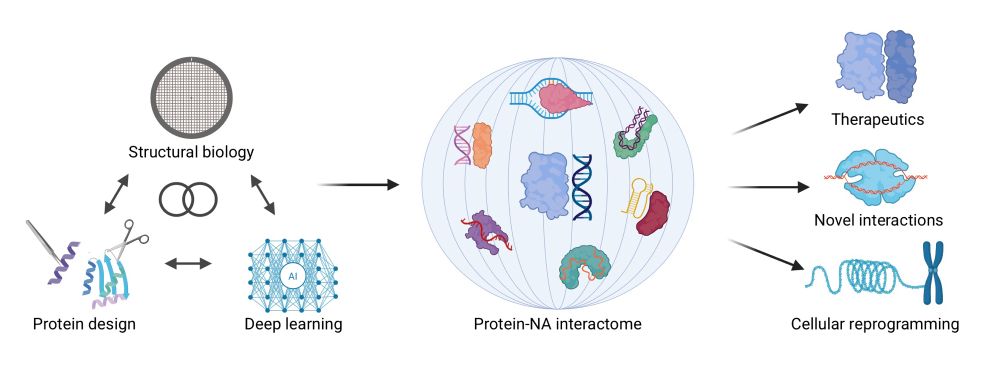
I am super excited to announce that I will be starting my lab at the Department of Pharmacology of the University of Zurich in Switzerland next year!
July 25, 2025 at 7:48 AM
I am super excited to announce that I will be starting my lab at the Department of Pharmacology of the University of Zurich in Switzerland next year!
Reposted by Marcos Gil-Garcia
Check out the updated version of our preprint "Crossover in Aromatic Amino Acid Interaction Strength: Tyrosine vs. Phenylalanine in Biomolecular Condensates", with @xabierjota.bsky.social
@dipcehu.bsky.social
www.biorxiv.org/content/10.1...
@dipcehu.bsky.social
www.biorxiv.org/content/10.1...

Crossover in Aromatic Amino Acid Interaction Strength: Tyrosine vs. Phenylalanine in Biomolecular Condensates
Biomolecular condensates often form through the self-assembly of disordered proteins with low-complexity sequences. In these polypeptides, the aromatic amino acids phenylalanine and tyrosine act as ke...
www.biorxiv.org
July 24, 2025 at 7:22 AM
Check out the updated version of our preprint "Crossover in Aromatic Amino Acid Interaction Strength: Tyrosine vs. Phenylalanine in Biomolecular Condensates", with @xabierjota.bsky.social
@dipcehu.bsky.social
www.biorxiv.org/content/10.1...
@dipcehu.bsky.social
www.biorxiv.org/content/10.1...
Reposted by Marcos Gil-Garcia

🚨Online now!
A Comment from Paolo Arosio & co-workers on biomolecular condensates as regulators of enzymatic reactions, with a look at how classical reaction engineering principles continue to provide insights into key underlying mechanisms. #ChemSky #ChemBio
www.nature.com/articles/s44... ($)
A Comment from Paolo Arosio & co-workers on biomolecular condensates as regulators of enzymatic reactions, with a look at how classical reaction engineering principles continue to provide insights into key underlying mechanisms. #ChemSky #ChemBio
www.nature.com/articles/s44... ($)

Biomolecular condensates as regulators of enzymatic reactions - Nature Chemical Engineering
Open compartments, termed biomolecular condensates, are involved in cellular reactions. This Comment highlights their ability to enhance robustness and control of reactions in space and time, going be...
www.nature.com
July 18, 2025 at 4:20 PM
🚨Online now!
A Comment from Paolo Arosio & co-workers on biomolecular condensates as regulators of enzymatic reactions, with a look at how classical reaction engineering principles continue to provide insights into key underlying mechanisms. #ChemSky #ChemBio
www.nature.com/articles/s44... ($)
A Comment from Paolo Arosio & co-workers on biomolecular condensates as regulators of enzymatic reactions, with a look at how classical reaction engineering principles continue to provide insights into key underlying mechanisms. #ChemSky #ChemBio
www.nature.com/articles/s44... ($)
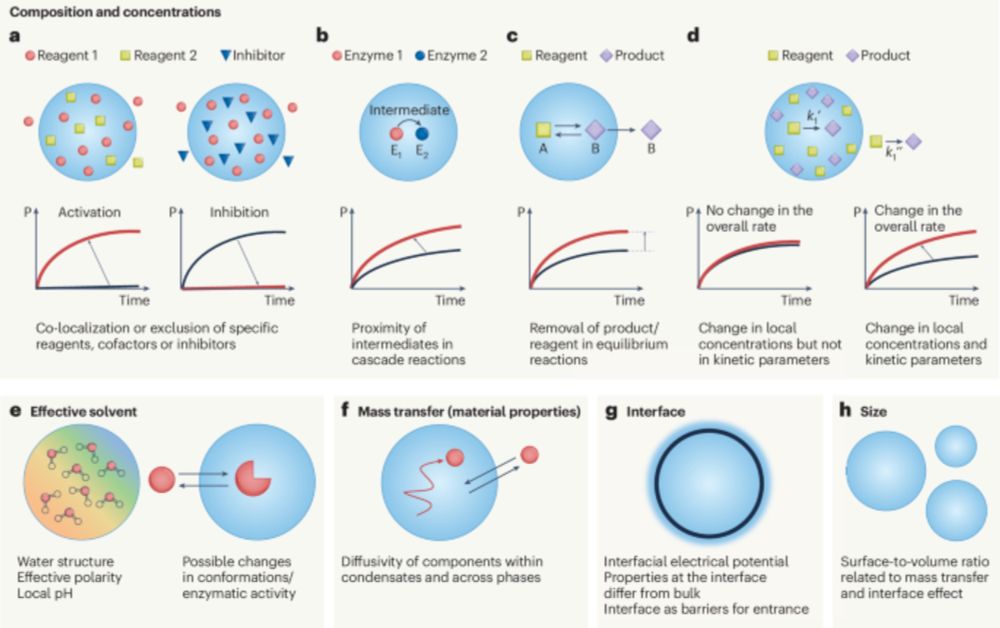
Glad to share our latest comment published in @natchemeng.nature.com
Here, we discuss the role of biomolecular condensates as regulators of enzymatic reactions.
I hope you enjoy it!
www.nature.com/articles/s44...
Here, we discuss the role of biomolecular condensates as regulators of enzymatic reactions.
I hope you enjoy it!
www.nature.com/articles/s44...
Biomolecular condensates as regulators of enzymatic reactions - Nature Chemical Engineering
Open compartments, termed biomolecular condensates, are involved in cellular reactions. This Comment highlights their ability to enhance robustness and control of reactions in space and time, going be...
www.nature.com
July 21, 2025 at 9:54 AM
Glad to share our latest comment published in @natchemeng.nature.com
Here, we discuss the role of biomolecular condensates as regulators of enzymatic reactions.
I hope you enjoy it!
www.nature.com/articles/s44...
Here, we discuss the role of biomolecular condensates as regulators of enzymatic reactions.
I hope you enjoy it!
www.nature.com/articles/s44...
Glad to share our latest publication in @natcomms.nature.com!
Here, we show that pH buffering within the dense phase of condensates expands the pH interval which is optimal for enzymatic activity and enables optimization of one-pot cascade reactions.
www.nature.com/articles/s41...
Here, we show that pH buffering within the dense phase of condensates expands the pH interval which is optimal for enzymatic activity and enables optimization of one-pot cascade reactions.
www.nature.com/articles/s41...

Enhancement of enzymatic activity by biomolecular condensates through pH buffering - Nature Communications
Through local pH buffering, biomolecular condensates can expand the optimal pH interval for enzymatic reactions, increasing robustness to changes in solution pH and enabling network reactions with enz...
www.nature.com
July 16, 2025 at 1:58 PM
Glad to share our latest publication in @natcomms.nature.com!
Here, we show that pH buffering within the dense phase of condensates expands the pH interval which is optimal for enzymatic activity and enables optimization of one-pot cascade reactions.
www.nature.com/articles/s41...
Here, we show that pH buffering within the dense phase of condensates expands the pH interval which is optimal for enzymatic activity and enables optimization of one-pot cascade reactions.
www.nature.com/articles/s41...
Glad to share our latest prepint!
-We developed a computational pipeline (combining CG simulations and ML) for the de novo design of peptides targeting condensate interfaces.
www.biorxiv.org/content/10.1...
-We developed a computational pipeline (combining CG simulations and ML) for the de novo design of peptides targeting condensate interfaces.
www.biorxiv.org/content/10.1...

De novo design of peptides localizing at the interface of biomolecular condensates
The interface of biomolecular condensates has been shown to play an important role in processes such as protein aggregation and biochemical reactions. Targeted modulation of these interfaces could, th...
www.biorxiv.org
May 15, 2025 at 3:04 PM
Glad to share our latest prepint!
-We developed a computational pipeline (combining CG simulations and ML) for the de novo design of peptides targeting condensate interfaces.
www.biorxiv.org/content/10.1...
-We developed a computational pipeline (combining CG simulations and ML) for the de novo design of peptides targeting condensate interfaces.
www.biorxiv.org/content/10.1...
Reposted by Marcos Gil-Garcia

De novo design of peptides localizing at the interface of biomolecular condensates https://www.biorxiv.org/content/10.1101/2025.05.09.653111v1
May 12, 2025 at 2:46 AM
De novo design of peptides localizing at the interface of biomolecular condensates https://www.biorxiv.org/content/10.1101/2025.05.09.653111v1
Happy to share our latest review/opinion on the role of BDEVs in neurodegeneration! We discuss their potential as a promising route for early diagnosis of NDs and the associated challenges and opportunities. Hope you enjoy it!
www.sciencedirect.com/science/arti...
www.sciencedirect.com/science/arti...

Monitoring neurodegeneration through brain-derived extracellular vesicles in biofluids
The identification of neurodegenerative disease (ND) biomarkers in easily accessible body fluids is crucial in the fight against this class of disorde…
www.sciencedirect.com
May 2, 2025 at 9:46 AM
Happy to share our latest review/opinion on the role of BDEVs in neurodegeneration! We discuss their potential as a promising route for early diagnosis of NDs and the associated challenges and opportunities. Hope you enjoy it!
www.sciencedirect.com/science/arti...
www.sciencedirect.com/science/arti...
Reposted by Marcos Gil-Garcia

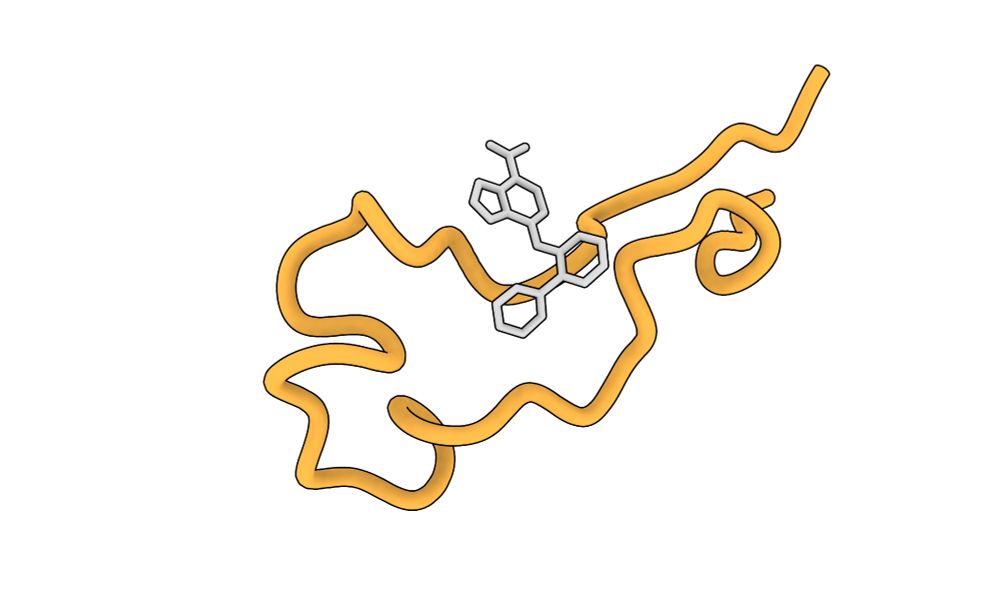
Today @gogs-k.bsky.social, @tlhr.bsky.social, and I are launching @bindresearch.org, a UK-based not-for-profit research startup to deliver publicly–available tools and datasets to make intrinsically disordered proteins druggable. 🍝 💊🧲 💻 🦠
February 11, 2025 at 9:26 AM
Today @gogs-k.bsky.social, @tlhr.bsky.social, and I are launching @bindresearch.org, a UK-based not-for-profit research startup to deliver publicly–available tools and datasets to make intrinsically disordered proteins druggable. 🍝 💊🧲 💻 🦠
Back in time, I had the opportunity to work on studying the redox-controlled folding of small cysteine-rich proteins.
One intriguing example was TRIAP1. This small, disulfide-rich protein targets the IMS and plays a crucial role in phospholipid trafficking between mitochondrial membranes. (1/2)
One intriguing example was TRIAP1. This small, disulfide-rich protein targets the IMS and plays a crucial role in phospholipid trafficking between mitochondrial membranes. (1/2)
February 7, 2025 at 8:14 AM
Back in time, I had the opportunity to work on studying the redox-controlled folding of small cysteine-rich proteins.
One intriguing example was TRIAP1. This small, disulfide-rich protein targets the IMS and plays a crucial role in phospholipid trafficking between mitochondrial membranes. (1/2)
One intriguing example was TRIAP1. This small, disulfide-rich protein targets the IMS and plays a crucial role in phospholipid trafficking between mitochondrial membranes. (1/2)