
Manvi Agarwal
@manviagarwal.bsky.social
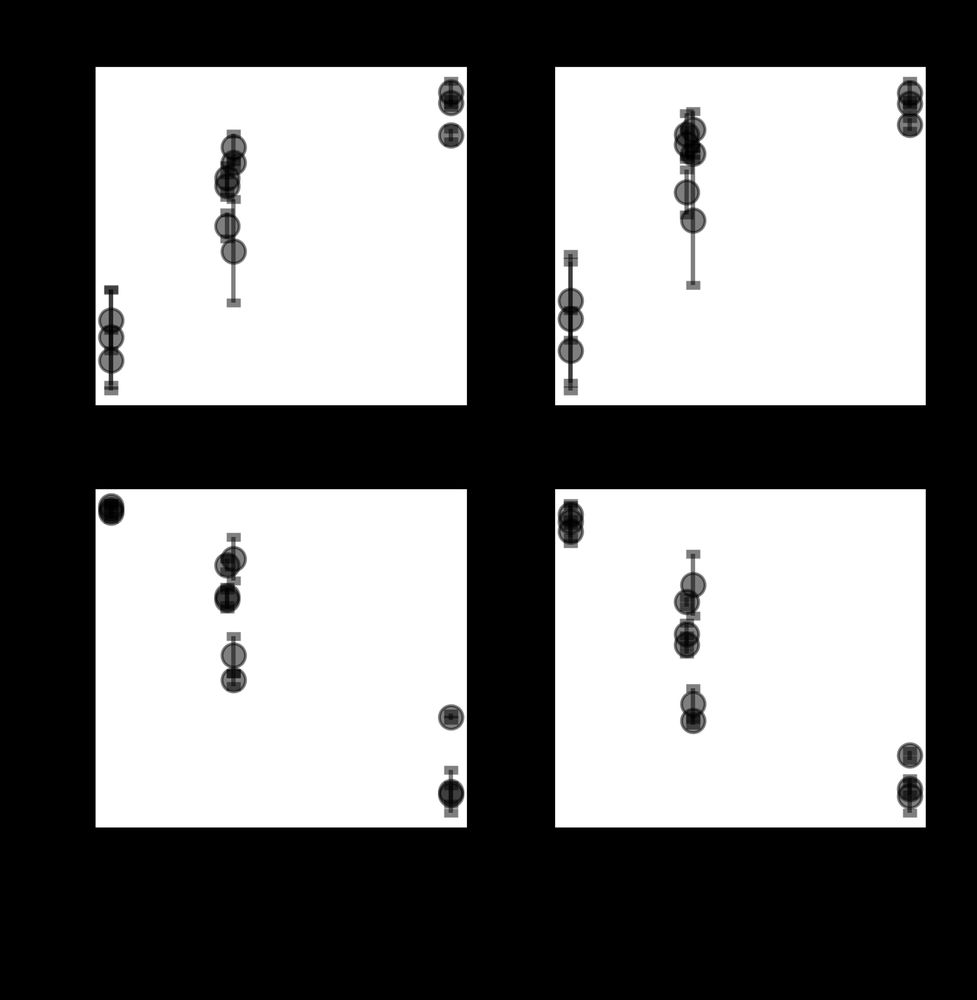
3️⃣ We explain why structural information in PE has proven to be empirically successful.
We go back to 1️⃣ and use the content-context connection to show that the higher is the mutual information between data and its positional representation, the better is task performance.
We go back to 1️⃣ and use the content-context connection to show that the higher is the mutual information between data and its positional representation, the better is task performance.
April 8, 2025 at 4:52 AM
3️⃣ We explain why structural information in PE has proven to be empirically successful.
We go back to 1️⃣ and use the content-context connection to show that the higher is the mutual information between data and its positional representation, the better is task performance.
We go back to 1️⃣ and use the content-context connection to show that the higher is the mutual information between data and its positional representation, the better is task performance.
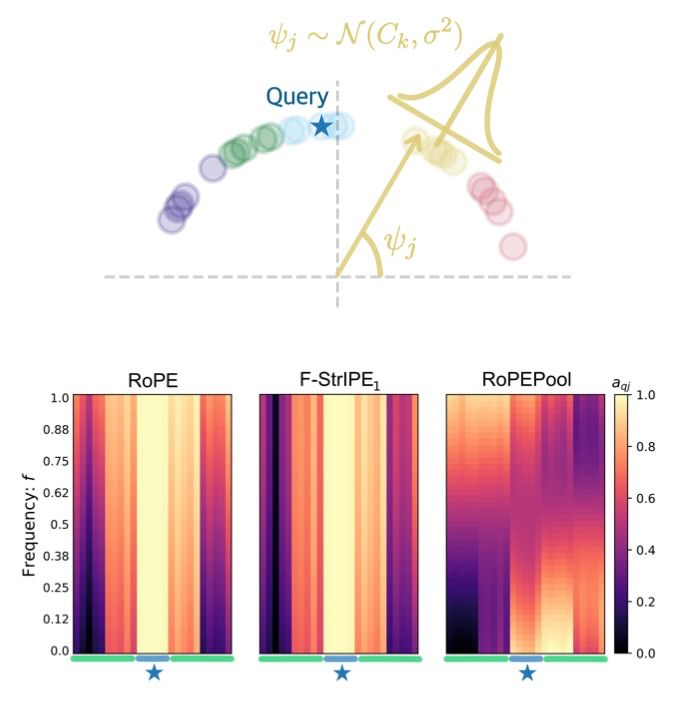
2️⃣ We introduce a new positional encoding method - RoPEPool - that can model causality.
How does RoPEPool compare to RoPE and F-StrIPE? Our analysis with a toy example says: RoPEPool isn’t just different, it’s also richer in terms of expressivity.
How does RoPEPool compare to RoPE and F-StrIPE? Our analysis with a toy example says: RoPEPool isn’t just different, it’s also richer in terms of expressivity.
April 8, 2025 at 4:52 AM
2️⃣ We introduce a new positional encoding method - RoPEPool - that can model causality.
How does RoPEPool compare to RoPE and F-StrIPE? Our analysis with a toy example says: RoPEPool isn’t just different, it’s also richer in terms of expressivity.
How does RoPEPool compare to RoPE and F-StrIPE? Our analysis with a toy example says: RoPEPool isn’t just different, it’s also richer in terms of expressivity.
1️⃣ We show how different families of positional encoding - rotation-based (RoPE) and random fourier features-based (F-StrIPE) - can be compared using kernel methods.
It’s not just vibes - we characterize precisely how queries and keys are affected by positional information.
It’s not just vibes - we characterize precisely how queries and keys are affected by positional information.

April 8, 2025 at 4:52 AM
1️⃣ We show how different families of positional encoding - rotation-based (RoPE) and random fourier features-based (F-StrIPE) - can be compared using kernel methods.
It’s not just vibes - we characterize precisely how queries and keys are affected by positional information.
It’s not just vibes - we characterize precisely how queries and keys are affected by positional information.
With these two interventions, we obtain better performance at lower cost! 🚀
Curious? Check out the companion webpage: bit.ly/faststructurepe
Curious? Check out the companion webpage: bit.ly/faststructurepe
April 7, 2025 at 11:48 AM
With these two interventions, we obtain better performance at lower cost! 🚀
Curious? Check out the companion webpage: bit.ly/faststructurepe
Curious? Check out the companion webpage: bit.ly/faststructurepe
In our paper, we show that stochastic positional encoding is, in fact, a noisy version of a well-known kernel approximation technique: Random Fourier Features. We also show how prior knowledge (e.g. related to musical structure) can be used in such linear-complexity Transformers.
April 7, 2025 at 11:48 AM
In our paper, we show that stochastic positional encoding is, in fact, a noisy version of a well-known kernel approximation technique: Random Fourier Features. We also show how prior knowledge (e.g. related to musical structure) can be used in such linear-complexity Transformers.
However, there was a piece missing: how do you handle relative positional encoding in these linear-complexity transformers? 🤔
Enter Stochastic Positional Encoding! It brings relative positional information back into the picture without going to quadratic cost.
Enter Stochastic Positional Encoding! It brings relative positional information back into the picture without going to quadratic cost.
April 7, 2025 at 11:48 AM
However, there was a piece missing: how do you handle relative positional encoding in these linear-complexity transformers? 🤔
Enter Stochastic Positional Encoding! It brings relative positional information back into the picture without going to quadratic cost.
Enter Stochastic Positional Encoding! It brings relative positional information back into the picture without going to quadratic cost.
Luckily, there's a solution: you can think of attention as a kernel function and use kernel approximation techniques to reduce the cost from quadratic to linear. ⚡
This was the idea used by Performers, for example.
This was the idea used by Performers, for example.
April 7, 2025 at 11:48 AM
Luckily, there's a solution: you can think of attention as a kernel function and use kernel approximation techniques to reduce the cost from quadratic to linear. ⚡
This was the idea used by Performers, for example.
This was the idea used by Performers, for example.
Transformers are powerful, but there's a problem: their cost grows quadratically with sequence length. 📈
This makes it really hard to apply them to lengthy sequences, like music, where long-term connections carry important information.
This makes it really hard to apply them to lengthy sequences, like music, where long-term connections carry important information.
April 7, 2025 at 11:48 AM
Transformers are powerful, but there's a problem: their cost grows quadratically with sequence length. 📈
This makes it really hard to apply them to lengthy sequences, like music, where long-term connections carry important information.
This makes it really hard to apply them to lengthy sequences, like music, where long-term connections carry important information.