




Matthew Costa
@mangrovematt.bsky.social
Postdoctoral Research Associate at Northeastern University, oceanographer, wetland ecologist, biogeochemist, educator, and nature-lover
Visiting the #mangroves in Santa Catalina on the Pacific Coast of Panama in March 2025, I was struck by high levels of localized leaf #herbivory. Does anyone know what organism(s) are responsible?


November 25, 2025 at 4:57 PM
Visiting the #mangroves in Santa Catalina on the Pacific Coast of Panama in March 2025, I was struck by high levels of localized leaf #herbivory. Does anyone know what organism(s) are responsible?
How do you get all the dried biomass from 36 #saltmarsh plant mesocosms home from a field site hundreds of miles away (along with with frozen water samples and sediment)? A lot of drying, sorting into paper bags, packing into duffels and coolers, and schlepping through airports..., but they made it!


October 31, 2025 at 3:00 PM
How do you get all the dried biomass from 36 #saltmarsh plant mesocosms home from a field site hundreds of miles away (along with with frozen water samples and sediment)? A lot of drying, sorting into paper bags, packing into duffels and coolers, and schlepping through airports..., but they made it!
Check out the amazing density of snails on the Spartina alterniflora #saltmarsh plants at North Inlet-Winyah Bay NERR. (I think that they are Littoraria irrorata, but chime in if you have a better id!)

October 29, 2025 at 4:08 PM
Check out the amazing density of snails on the Spartina alterniflora #saltmarsh plants at North Inlet-Winyah Bay NERR. (I think that they are Littoraria irrorata, but chime in if you have a better id!)
In November 2024, after two growing seasons of treatments, you can really see the effect of #nitrogen fertilization in our field plots at North Inlet-Winyah Bay, SC! We are testing the effect of ammonium vs. nitrate inputs on #saltmarsh plant and microbe responses.


October 27, 2025 at 5:24 PM
In November 2024, after two growing seasons of treatments, you can really see the effect of #nitrogen fertilization in our field plots at North Inlet-Winyah Bay, SC! We are testing the effect of ammonium vs. nitrate inputs on #saltmarsh plant and microbe responses.
#Saltmarshes bury a lot of #carbon in place, but also excess, dead Spartina plant matter is carried away by wind and tides and can accumulate elsewhere, episodically loading sites like this marsh-upland edge with marsh wrack (North Inlet-Winyah Bay NERR, September 2024).

October 16, 2025 at 2:00 PM
#Saltmarshes bury a lot of #carbon in place, but also excess, dead Spartina plant matter is carried away by wind and tides and can accumulate elsewhere, episodically loading sites like this marsh-upland edge with marsh wrack (North Inlet-Winyah Bay NERR, September 2024).
Once that biomass was rinsed off, the real work was just beginning! Thanks to an army of volunteers and a core team of committed lab members, that biomass was sorted into living rhizomes, living roots, and dead biomass, which we then dried, weighed, and ground up to analyze its C and N content.


October 15, 2025 at 2:44 AM
Once that biomass was rinsed off, the real work was just beginning! Thanks to an army of volunteers and a core team of committed lab members, that biomass was sorted into living rhizomes, living roots, and dead biomass, which we then dried, weighed, and ground up to analyze its C and N content.
Then we took those sediment samples, held in PVC half-pipes and plastic wrap, and saw them down the middle. One half of the sample we dried and ground up to analyze the sediment itself, but the other half we rinsed the sediment away on a sieve, leaving just the belowground biomass.


October 15, 2025 at 2:44 AM
Then we took those sediment samples, held in PVC half-pipes and plastic wrap, and saw them down the middle. One half of the sample we dried and ground up to analyze the sediment itself, but the other half we rinsed the sediment away on a sieve, leaving just the belowground biomass.
Watch Stephanie Tsui (Ph.D. candidate in the Bowen Lab @bowenlab.bsky.social ) and me carefully remove the sediment from the surface down to 30 cm from a marsh organ pipe in South Carolina. The different pipe elevations represent different marsh elevation/sea-level rise scenarios. It's muddy work!
October 15, 2025 at 2:44 AM
Watch Stephanie Tsui (Ph.D. candidate in the Bowen Lab @bowenlab.bsky.social ) and me carefully remove the sediment from the surface down to 30 cm from a marsh organ pipe in South Carolina. The different pipe elevations represent different marsh elevation/sea-level rise scenarios. It's muddy work!
In summer 2024 we collected the Spartina alterniflora plants and sediment from the marsh organs we used in our field experiment on the effects of different forms of nitrogen fertilization on #saltmarsh #carbon and #nitrogen cycling, @pie-lter.bsky.social and at North Inlet-Winyah Bay NERR.


October 15, 2025 at 2:44 AM
In summer 2024 we collected the Spartina alterniflora plants and sediment from the marsh organs we used in our field experiment on the effects of different forms of nitrogen fertilization on #saltmarsh #carbon and #nitrogen cycling, @pie-lter.bsky.social and at North Inlet-Winyah Bay NERR.
We got a fascinating tour of the oyster-rearing process right in the Rowley River by our neighbors at the Great Marsh Shellfish Co. ( www.thegreatmarshshellfishco.com ) in September 2024 @pie-lter.bsky.social. They were the tastiest things I've ever eaten pulled right out out of a salt marsh!

October 10, 2025 at 3:29 PM
We got a fascinating tour of the oyster-rearing process right in the Rowley River by our neighbors at the Great Marsh Shellfish Co. ( www.thegreatmarshshellfishco.com ) in September 2024 @pie-lter.bsky.social. They were the tastiest things I've ever eaten pulled right out out of a salt marsh!
Check out the incredible density of fiddler crabs in the #saltmarsh at North Inlet-Winyah Bay National Estuarine Reserve, where colleagues and I were measuring nitrogen cycling in June 2024.
October 8, 2025 at 4:23 PM
Check out the incredible density of fiddler crabs in the #saltmarsh at North Inlet-Winyah Bay National Estuarine Reserve, where colleagues and I were measuring nitrogen cycling in June 2024.
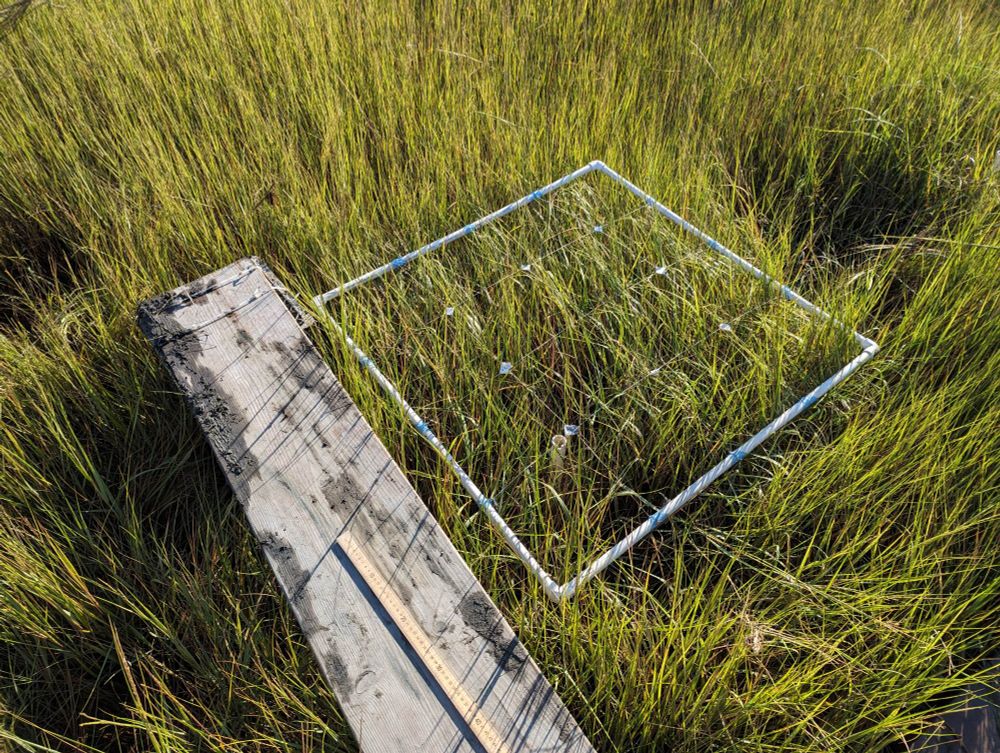
Fallen asleep on the job? Dropped a contact lens? No, in fact estimating aboveground biomass in the #saltmarsh by measuring every shoot in a 25 cm x 25 cm plot means hours with your face in the grass (while perched precariously on a boardwalk plank or milk crate platform) @pie-lter.bsky.social.


October 7, 2025 at 3:58 PM
Fallen asleep on the job? Dropped a contact lens? No, in fact estimating aboveground biomass in the #saltmarsh by measuring every shoot in a 25 cm x 25 cm plot means hours with your face in the grass (while perched precariously on a boardwalk plank or milk crate platform) @pie-lter.bsky.social.
These are our experimental plots in summer 2024, in SC and MA respectively. Some have been given ammonium, some nitrate, and others are controls. Can you see the plants' response to treatment?


October 3, 2025 at 2:51 PM
These are our experimental plots in summer 2024, in SC and MA respectively. Some have been given ammonium, some nitrate, and others are controls. Can you see the plants' response to treatment?
When our measurements in the #saltmarsh @pie-lter.bsky.social involve hanging out on the boardwalk over high tide, we get to see a whole other side of the environment, from the marsh organs being overtopped by the tide to egrets (and the midges...) waiting at the edge of the water to feed.


August 28, 2025 at 4:11 AM
When our measurements in the #saltmarsh @pie-lter.bsky.social involve hanging out on the boardwalk over high tide, we get to see a whole other side of the environment, from the marsh organs being overtopped by the tide to egrets (and the midges...) waiting at the edge of the water to feed.
Then every 45 minutes we pump back up ("pull") a sample of porewater into an airtight tube to be analyzed back at the lab to find out how much of that 15N-nitrate, as well as the nitrate already present, has been converted into N2 gas. Lots of work (with intervals of waiting) in a beautiful place!


August 18, 2025 at 9:23 PM
Then every 45 minutes we pump back up ("pull") a sample of porewater into an airtight tube to be analyzed back at the lab to find out how much of that 15N-nitrate, as well as the nitrate already present, has been converted into N2 gas. Lots of work (with intervals of waiting) in a beautiful place!
and the water and added nitrate is mixed using this fun magnet trick, all without mixing the porewater with the atmosphere, which would affect its dissolved gas content. Then that mixture is then pumped ("pushed") back underground to incubate over the course of high tide.
August 18, 2025 at 9:23 PM
and the water and added nitrate is mixed using this fun magnet trick, all without mixing the porewater with the atmosphere, which would affect its dissolved gas content. Then that mixture is then pumped ("pushed") back underground to incubate over the course of high tide.
We insert one of these metal tubes below the marsh surface and use them to pump porewater (the water down among the roots and sediment beneath the marsh surface) up into one of these graduated cylinders. 15N-isotopically-labelled nitrate is added to the porewater in the cylinder,


August 18, 2025 at 9:23 PM
We insert one of these metal tubes below the marsh surface and use them to pump porewater (the water down among the roots and sediment beneath the marsh surface) up into one of these graduated cylinders. 15N-isotopically-labelled nitrate is added to the porewater in the cylinder,
How do we measure #denitrification in our #saltmarsh ammonium and nitrate treatment plots at @pie-lter.bsky.social? Anne Giblin and Jane Tucker from @mblscience.bsky.social bring the lab into the field for this in situ "push-pull" denitrification measurement.

August 18, 2025 at 9:23 PM
How do we measure #denitrification in our #saltmarsh ammonium and nitrate treatment plots at @pie-lter.bsky.social? Anne Giblin and Jane Tucker from @mblscience.bsky.social bring the lab into the field for this in situ "push-pull" denitrification measurement.
In April 2024, 1 year after planting these Spartina alterniflora in the #saltmarsh organs at North Inlet, they were going strong! We simulated different marsh elevations in three rows of pipes, and randomly assigned each plant a #nitrogen treatment. Stephanie and Karen survey the plants' progress.


August 16, 2025 at 6:42 PM
In April 2024, 1 year after planting these Spartina alterniflora in the #saltmarsh organs at North Inlet, they were going strong! We simulated different marsh elevations in three rows of pipes, and randomly assigned each plant a #nitrogen treatment. Stephanie and Karen survey the plants' progress.
At our #saltmarsh field plots @pie-lter.bsky.social and North-Inlet-Winyah Bay, we are measuring Spartina alterniflora biomass and CO2 uptake/release using clear plastic chambers attached to a CO2 analyzer (and a precariously perched laptop!). Thanks Stephanie, Camille, and Pooja (September 2023)!


May 25, 2025 at 6:49 PM
At our #saltmarsh field plots @pie-lter.bsky.social and North-Inlet-Winyah Bay, we are measuring Spartina alterniflora biomass and CO2 uptake/release using clear plastic chambers attached to a CO2 analyzer (and a precariously perched laptop!). Thanks Stephanie, Camille, and Pooja (September 2023)!
We tend to put #saltmarshes and the #rockyintertidal into very different ecosystem boxes, but here's an example of salt marsh plants (Spartina alterniflora) growing in a patch of shallow peat among sand and gravel on the rocky shore in Essex County, MA (August 2023).


May 23, 2025 at 2:32 AM
We tend to put #saltmarshes and the #rockyintertidal into very different ecosystem boxes, but here's an example of salt marsh plants (Spartina alterniflora) growing in a patch of shallow peat among sand and gravel on the rocky shore in Essex County, MA (August 2023).
This particular spot in the #rockyintertidal environment in Essex County, MA, upon closer inspection, was crawling with springtails! Seashore springtails (Anurida maritima) are known to aggregate by use of a pheromone that helps them find each other. August 2023.


May 17, 2025 at 4:09 PM
This particular spot in the #rockyintertidal environment in Essex County, MA, upon closer inspection, was crawling with springtails! Seashore springtails (Anurida maritima) are known to aggregate by use of a pheromone that helps them find each other. August 2023.
By August 2023 the #Spartina alterniflora plants we had planted in our marsh organs @pie-lter.bsky.social had grown to a healthy size! The different elevations of the marsh organ simulate the effects of varying sea level scenarios. Also, check out all those mud snails (Ilyanassa obsoleta?)!

May 16, 2025 at 5:05 PM
By August 2023 the #Spartina alterniflora plants we had planted in our marsh organs @pie-lter.bsky.social had grown to a healthy size! The different elevations of the marsh organ simulate the effects of varying sea level scenarios. Also, check out all those mud snails (Ilyanassa obsoleta?)!
April in the salt marsh at @pie-lter.bsky.social means that the Spartina alterniflora is sending up new shoots! See the little green new leaves among the brown of the previous year's dead biomass. This #saltmarsh plant's rhizomes overwinter underground but send up new leaves each spring. Apr 2023

April 29, 2025 at 3:18 PM
April in the salt marsh at @pie-lter.bsky.social means that the Spartina alterniflora is sending up new shoots! See the little green new leaves among the brown of the previous year's dead biomass. This #saltmarsh plant's rhizomes overwinter underground but send up new leaves each spring. Apr 2023