




Mak Itambu
@makariusitambu.bsky.social
Archaeologist, University of Dar Es Salaam
Paysage de la région de Singida


October 14, 2025 at 7:52 PM
Paysage de la région de Singida
Reposted by Mak Itambu
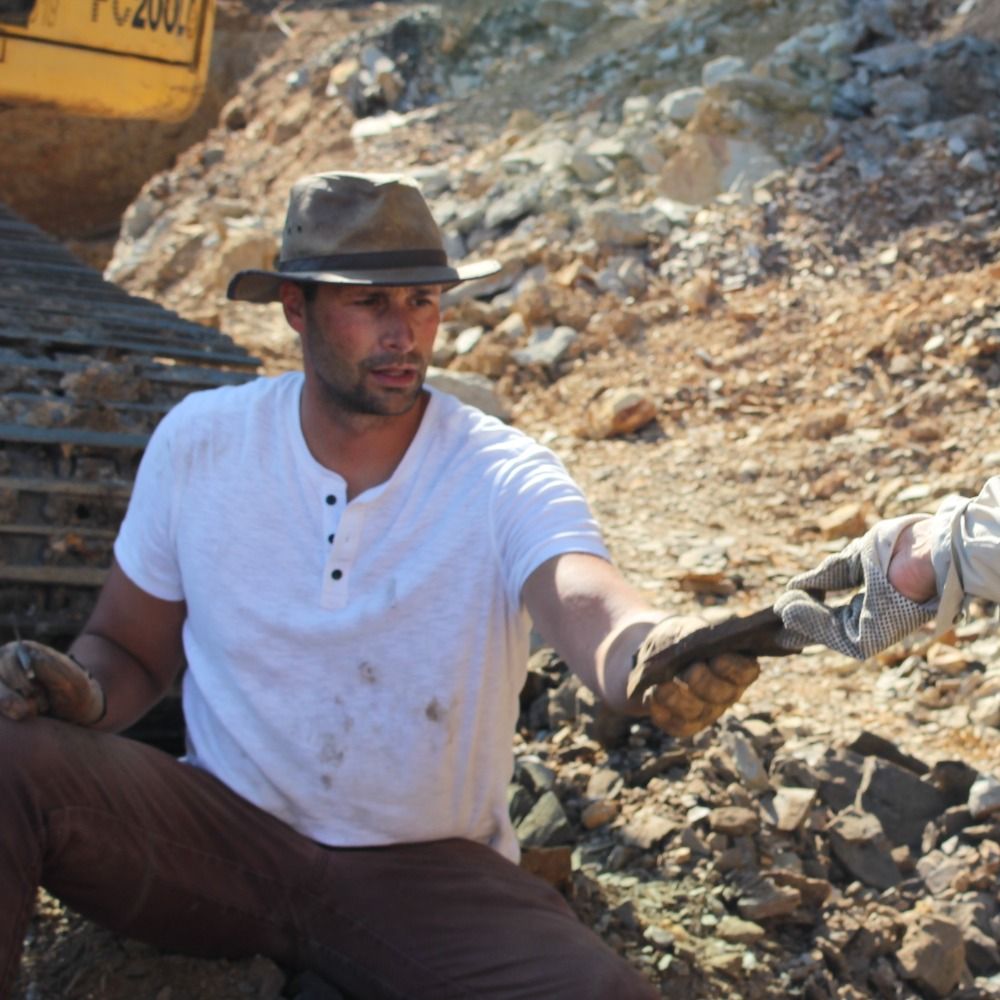
For more on this site and others in central Tanzania, check out our recent paper in African Archaeological Review 🏺
October 3, 2025 at 10:45 AM
For more on this site and others in central Tanzania, check out our recent paper in African Archaeological Review 🏺
Reposted by Mak Itambu

From the archive. An evolutionary anthropologist argues that Paleolithic diets were much more varied than people think based on his research with the Hadza community, contemporary hunter-gatherers in Tanzania. Read more: www.sapiens.org/biology/pale...

Hunting Down the Facts About Paleo Diets
An evolutionary anthropologist argues that Paleolithic diets were more varied than people think based on research with the Hadza of Tanzania.
www.sapiens.org
September 23, 2025 at 7:03 PM
From the archive. An evolutionary anthropologist argues that Paleolithic diets were much more varied than people think based on his research with the Hadza community, contemporary hunter-gatherers in Tanzania. Read more: www.sapiens.org/biology/pale...
Fouilles archéologiques à l'abri sous roche d'Itramuka, mission de terrain 2025 à Singida
-Archaeological excavations at the Itramuka rock shelter, Singida field mission 2025
-Archaeological excavations at the Itramuka rock shelter, Singida field mission 2025


September 16, 2025 at 2:59 PM
Fouilles archéologiques à l'abri sous roche d'Itramuka, mission de terrain 2025 à Singida
-Archaeological excavations at the Itramuka rock shelter, Singida field mission 2025
-Archaeological excavations at the Itramuka rock shelter, Singida field mission 2025
Reposted by Mak Itambu
The SHARP project has been quite active this summer, uncovering what appears to be ESA artifacts in central Tanzania. 🏺
The Singida2025 research expedition into on human origins continues to discover more early Stone Age sites today
-L'expédition de recherche Singida2025 sur les origines de l'homme continue de découvrir d'autres sites de l'âge de pierre
-L'expédition de recherche Singida2025 sur les origines de l'homme continue de découvrir d'autres sites de l'âge de pierre


September 15, 2025 at 7:53 PM
The SHARP project has been quite active this summer, uncovering what appears to be ESA artifacts in central Tanzania. 🏺
The Singida2025 research expedition into on human origins continues to discover more early Stone Age sites today
-L'expédition de recherche Singida2025 sur les origines de l'homme continue de découvrir d'autres sites de l'âge de pierre
-L'expédition de recherche Singida2025 sur les origines de l'homme continue de découvrir d'autres sites de l'âge de pierre
August 22, 2025 at 7:55 AM
The Singida2025 research expedition into on human origins continues to discover more early Stone Age sites today
-L'expédition de recherche Singida2025 sur les origines de l'homme continue de découvrir d'autres sites de l'âge de pierre
-L'expédition de recherche Singida2025 sur les origines de l'homme continue de découvrir d'autres sites de l'âge de pierre
www.tandfonline.com/doi/full/10....
Nouvelle publication : La conservation communautaire du patrimoine est compacte dans la région de Singida
-New publication: Community heritage conservation is compact in the Singida region
Nouvelle publication : La conservation communautaire du patrimoine est compacte dans la région de Singida
-New publication: Community heritage conservation is compact in the Singida region


August 20, 2025 at 5:05 AM
www.tandfonline.com/doi/full/10....
Nouvelle publication : La conservation communautaire du patrimoine est compacte dans la région de Singida
-New publication: Community heritage conservation is compact in the Singida region
Nouvelle publication : La conservation communautaire du patrimoine est compacte dans la région de Singida
-New publication: Community heritage conservation is compact in the Singida region
La région de Singida continue de faire de nouvelles découvertes chaque année, avec des ossements fossiles et des outils datant du début de l'âge de pierre trouvés aujourd'hui... d'autres nouveaux sites sur les origines humaines du Pléistocène tanzanien sont encore à venir....


August 15, 2025 at 10:18 AM
La région de Singida continue de faire de nouvelles découvertes chaque année, avec des ossements fossiles et des outils datant du début de l'âge de pierre trouvés aujourd'hui... d'autres nouveaux sites sur les origines humaines du Pléistocène tanzanien sont encore à venir....
Reposted by Mak Itambu
Late Pleistocene vegetation succession, climate change and hominin adaptation in Sandinggai site, central South China 🏺

Late Pleistocene vegetation succession, climate change and hominin adaptation in Sandinggai site, central South China - Journal of Geographical Sciences
The paleoenvironmental changes and adaptation strategies of hominins during the Late Pleistocene are crucial for understanding the evolution, dispersal, and behavioral shifts of early modern humans. D...
link.springer.com
August 9, 2025 at 11:46 AM
Late Pleistocene vegetation succession, climate change and hominin adaptation in Sandinggai site, central South China 🏺
Reposted by Mak Itambu
Paleoenvironmental reconstruction of human adaptation in the Nihewan Basin of North China during Middle Pleistocene: A case study of Jijiazhuang archaeological site 🏺
Paleoenvironmental reconstruction of human adaptation in the Nihewan Basin of North China during Middle Pleistocene: A case study of Jijiazhuang archaeological site - Journal of Geographical Sciences
Situated in the semi-arid regions of North China, the Nihewan Basin documents the fluvio-lacustrine sequence and Pleistocene archaeological sites, offering an excellent opportunity to investigate huma...
link.springer.com
August 9, 2025 at 11:54 AM
Paleoenvironmental reconstruction of human adaptation in the Nihewan Basin of North China during Middle Pleistocene: A case study of Jijiazhuang archaeological site 🏺
Reposted by Mak Itambu
Don’t insult Australopithecines like that


August 11, 2025 at 5:05 PM
Don’t insult Australopithecines like that
Expéditions géophysiques et géochronologiques en cours dans la région de Singida, 2025
-Geophysical and geochronological expeditions underway in the Singida region
-Geophysical and geochronological expeditions underway in the Singida region


August 13, 2025 at 11:46 AM
Expéditions géophysiques et géochronologiques en cours dans la région de Singida, 2025
-Geophysical and geochronological expeditions underway in the Singida region
-Geophysical and geochronological expeditions underway in the Singida region
Reposted by Mak Itambu

Have you heard of our @exoceanlab.bsky.social lab? It's a new facility for experimental oceanography -- We culture, measure, and dissolve carbonates there. Register to the account to get fresh updates from what we are doing there!
July 24, 2025 at 2:32 PM
Have you heard of our @exoceanlab.bsky.social lab? It's a new facility for experimental oceanography -- We culture, measure, and dissolve carbonates there. Register to the account to get fresh updates from what we are doing there!
Reposted by Mak Itambu
I didn’t know Wenner Gren lost their funding from the Mellon Foundation and Ford Foundation, in addition to the major cuts and restrictions to the Fulbright program, National Science Foundation, and National Endowment for the Humanities
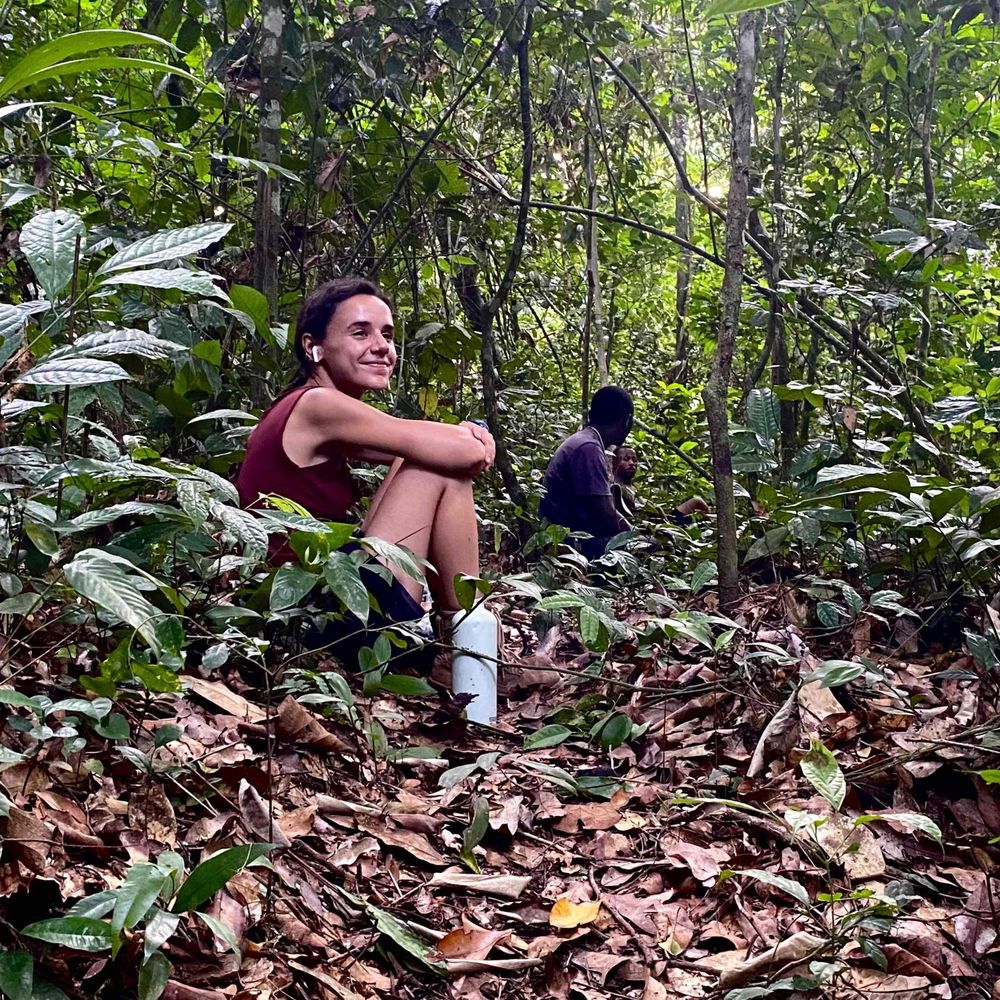
This is really sad news. Sapiens was a fantastic medium to share, promote and diversify anthropology and the platform where many people (like me) learnt and developed skills in science communication. Times are tough, but Sapiens’ niche is now left empty ☹️ wennergren.org/article/sapi...

SAPIENS to Cease Publication
wennergren.org
July 24, 2025 at 4:16 PM
I didn’t know Wenner Gren lost their funding from the Mellon Foundation and Ford Foundation, in addition to the major cuts and restrictions to the Fulbright program, National Science Foundation, and National Endowment for the Humanities
Reposted by Mak Itambu
Thrilled to return to Tanzania's Usambara Mountains in 2026! With support from the NSF International Research Experiences for Students program, we're launching the next phase of U·M·A·P·P, the Ecological Resilience of Afromontane Forests project. Check out more on the project below 👇

U·M·A·P·P
Usambara Mountains Archaeology and Palaeoecology Project
arcg.is
July 24, 2025 at 12:58 PM
Thrilled to return to Tanzania's Usambara Mountains in 2026! With support from the NSF International Research Experiences for Students program, we're launching the next phase of U·M·A·P·P, the Ecological Resilience of Afromontane Forests project. Check out more on the project below 👇
Reposted by Mak Itambu

How do you look back at a science a hundred years ago and grapple with the frauds and failures promoted above their grade, and the myopia of legendary researchers who criticized enduring discoveries while promoting eugenics. Well, that’s history isn’t it?
open.substack.com/pub/johnhawk...
open.substack.com/pub/johnhawk...

Human origins science in 1925: the good, the bad, and the fake
As I look back at a sometimes-confusing picture of a science in its early days, I see some connections with today's landscape.
open.substack.com
July 13, 2025 at 11:07 PM
How do you look back at a science a hundred years ago and grapple with the frauds and failures promoted above their grade, and the myopia of legendary researchers who criticized enduring discoveries while promoting eugenics. Well, that’s history isn’t it?
open.substack.com/pub/johnhawk...
open.substack.com/pub/johnhawk...
Échantillonnage géoarchéologique sur le site de l'âge de pierre d'Isanga aujourd'hui, datation Be-10 des roches et échantillonnage des sédiments
-Geoarchaeological sampling at Isanga Stone Age site today, Be-10 dating rocks and sediments sampling
-Geoarchaeological sampling at Isanga Stone Age site today, Be-10 dating rocks and sediments sampling


July 8, 2025 at 11:47 AM
Échantillonnage géoarchéologique sur le site de l'âge de pierre d'Isanga aujourd'hui, datation Be-10 des roches et échantillonnage des sédiments
-Geoarchaeological sampling at Isanga Stone Age site today, Be-10 dating rocks and sediments sampling
-Geoarchaeological sampling at Isanga Stone Age site today, Be-10 dating rocks and sediments sampling
Études géoarchéologiques sur les sites de l'âge de pierre d'Isanga, région de Singida - Tanzanie
Geoarchaeological studies on the Stone Age sites of Isanga, Singida region - Tanzania
Geoarchaeological studies on the Stone Age sites of Isanga, Singida region - Tanzania


July 5, 2025 at 5:01 PM
Études géoarchéologiques sur les sites de l'âge de pierre d'Isanga, région de Singida - Tanzanie
Geoarchaeological studies on the Stone Age sites of Isanga, Singida region - Tanzania
Geoarchaeological studies on the Stone Age sites of Isanga, Singida region - Tanzania
Reposted by Mak Itambu
Happy to share our paper on new archaeological discoveries in Singida Region of central Tanzania!
Led by @makariusitambu.bsky.social, we found 31 new sites with lithics, ceramics, metallurgical remains, as well as human and other animal bones.
It is Open Access so please share and enjoy!
Led by @makariusitambu.bsky.social, we found 31 new sites with lithics, ceramics, metallurgical remains, as well as human and other animal bones.
It is Open Access so please share and enjoy!

Renewed Archaeological Research in Singida Region, Central Tanzania - African Archaeological Review
Archaeological research in central Tanzania, chiefly in the Singida Region, has only been sporadically conducted, with the focus of such investigations being mostly on rock art and Later Stone Age (LS...
link.springer.com
April 26, 2025 at 11:42 AM
Happy to share our paper on new archaeological discoveries in Singida Region of central Tanzania!
Led by @makariusitambu.bsky.social, we found 31 new sites with lithics, ceramics, metallurgical remains, as well as human and other animal bones.
It is Open Access so please share and enjoy!
Led by @makariusitambu.bsky.social, we found 31 new sites with lithics, ceramics, metallurgical remains, as well as human and other animal bones.
It is Open Access so please share and enjoy!
Reposted by Mak Itambu

So HAPPY to see our new Nature paper out !!! Check it out !!!

In @nature.com we show that humans lived in rainforests ~150,000 years ago – over double the previous oldest estimate. Their presence in West Africa’s rainforests demonstrates the spread of early humans and places ecological diversity at the heart of our species.
www.nature.com/articles/s41...
www.nature.com/articles/s41...
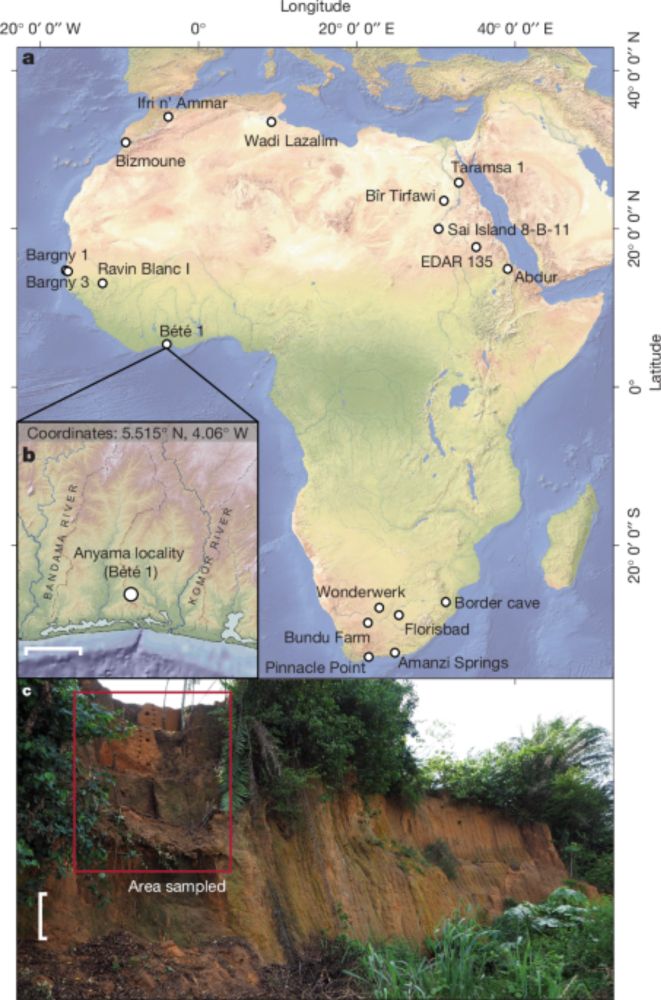
Humans in Africa’s wet tropical forests 150 thousand years ago - Nature
The identification of tools dated to the time of Homo sapiens associated with microfloral evidence of wet tropical forests indicates that West African forests were occupied by humans much earlier...
www.nature.com
February 26, 2025 at 4:13 PM
So HAPPY to see our new Nature paper out !!! Check it out !!!
Reposted by Mak Itambu
Cool to see our work covered in the New York Times!
Although we don't definitively say in our paper that this was a rainforest (as we don't have a rainfall proxy), the pollen, phytolith, and plant wax data all suggest wet adapted species and the site's location is in the rainforest biome today.
Although we don't definitively say in our paper that this was a rainforest (as we don't have a rainfall proxy), the pollen, phytolith, and plant wax data all suggest wet adapted species and the site's location is in the rainforest biome today.

Meanwhile, 150,000 years ago: hunter-gatherers thrived in rain forests, once considered too harsh for early Homo sapiens to survive. Here's my story [Gift link] nyti.ms/3EThoDL 🧪

Early Humans Thrived in Rainforests (Gift Article)
The discovery clashes with the traditional image of humans evolving on the savannas of East Africa.
nyti.ms
February 26, 2025 at 5:32 PM
Cool to see our work covered in the New York Times!
Although we don't definitively say in our paper that this was a rainforest (as we don't have a rainfall proxy), the pollen, phytolith, and plant wax data all suggest wet adapted species and the site's location is in the rainforest biome today.
Although we don't definitively say in our paper that this was a rainforest (as we don't have a rainfall proxy), the pollen, phytolith, and plant wax data all suggest wet adapted species and the site's location is in the rainforest biome today.
Reposted by Mak Itambu
Although not selected as finalists for the 2024 ArcGIS StoryMaps Competition (there were some amazing submissions), I am proud of the StoryMap we put together for our project in the Usambara Mountains of Tanzania. Check it out 👇

U·M·A·P·P
Usambara Mountains Archaeology and Palaeoecology Project
arcg.is
February 12, 2025 at 11:43 PM
Although not selected as finalists for the 2024 ArcGIS StoryMaps Competition (there were some amazing submissions), I am proud of the StoryMap we put together for our project in the Usambara Mountains of Tanzania. Check it out 👇
Archaeological surveys in Singida region, Tanzania


October 28, 2024 at 3:55 PM
Archaeological surveys in Singida region, Tanzania
