




MagMol research group
@magmol-ub.bsky.social
MagMol is a multidisciplinary research group at the University of Barcelona working on the possibilities of magnetic molecules.
Just published in @pubs.acs.org Inorganic Chemistry, Spin Coherence and Electron Spin Distribution of a Silver(II) S = 1/2 Molecular System Thank you to all collaborators @in2ub.bsky.social pubs.acs.org/doi/10.1021/...

Spin Coherence and Electron Spin Distribution of a Silver(II) S = 1/2 Molecular System
The spin–lattice relaxation time, spin coherence, and spin distribution have been studied through ac susceptometry, pulse EPR, and ultralow-frequency Raman spectroscopy on a silver(II)-derived molecul...
pubs.acs.org
June 11, 2025 at 3:36 PM
Just published in @pubs.acs.org Inorganic Chemistry, Spin Coherence and Electron Spin Distribution of a Silver(II) S = 1/2 Molecular System Thank you to all collaborators @in2ub.bsky.social pubs.acs.org/doi/10.1021/...
Monocrystal day at #ALBAsynchrotron using the XALOC line. @in2ub.bsky.social

March 13, 2025 at 8:42 AM
Monocrystal day at #ALBAsynchrotron using the XALOC line. @in2ub.bsky.social
Reposted by MagMol research group

Check out our last publication in Inorganic Chemistry about the role of THz vibrations in spin dynamics @acs.org @in2ub.bsky.social pubs.acs.org/doi/10.1021/...
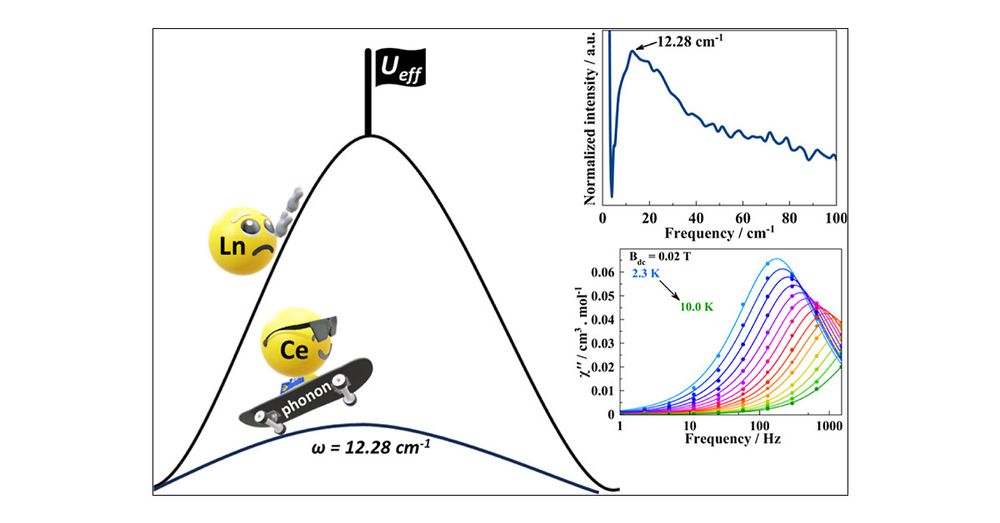
Cerium-Based Metal–Organic Frameworks: Unveiling the Role of Terahertz Vibrations in the Spin Relaxation Dynamics
The reaction between two equivalents of the Schiff base ligands N,N′-bis(3-methoxysalicylidene)ethylenediamine (H2L1) or enantiopure N,N′-bis(3-methoxysalicylidene)cyclohexane-1,2-diamine (H2L2) with one equivalent of Ce(NO3)3·6H2O in the presence of a bulky counteranion leads to the formation of chiral metal–organic frameworks (MOFs) whose channels encapsulate the counteranion, leading to the formation of compounds with the structural formulas {[Ce(NO3)2(L1)2]X·H2O}n, where X = ClO4– (1), PF6– (2), or BF4– (3), and {[Ce(NO3)2(L2)2]X·CH3CN}n, where X = ClO4– (4), PF6– (5), or BF4– (6), as well as the isostructural reference compound {Nd(NO3)2(L1)2]BF4·CH3CN}n (3Nd). A combination of static and dynamic magnetic measurements demonstrates the good isolation of the CeIII centers and a field-induced slow relaxation of the magnetization. Correlations between the temperature and field-dependent magnetic relaxation data and ultralow-frequency Raman spectroscopy reveal the presence of a vibronic barrier driving magnetic relaxation. Theoretical calculations have been performed to elucidate the nonparticipation of the electronic excited states in the main relaxation processes.
pubs.acs.org
March 4, 2025 at 11:51 AM
We are on the cover of Inorganic Chemistry with vibronic barriers in Ce(III) spin dynamics 🎉🧲 @acs.org @in2ub.bsky.social pubs.acs.org/toc/inocaj/c...

Inorganic Chemistry
This artwork represents the energy barrier an SMM must overcome to reverse its magnetization as a large snowy mountain. Under-barrier processes involving specific phonons can mediate magnetic relaxati...
pubs.acs.org
March 3, 2025 at 3:18 PM
We are on the cover of Inorganic Chemistry with vibronic barriers in Ce(III) spin dynamics 🎉🧲 @acs.org @in2ub.bsky.social pubs.acs.org/toc/inocaj/c...
Check out our last publication in Inorganic Chemistry about the role of THz vibrations in spin dynamics @acs.org @in2ub.bsky.social pubs.acs.org/doi/10.1021/...
Cerium-Based Metal–Organic Frameworks: Unveiling the Role of Terahertz Vibrations in the Spin Relaxation Dynamics
The reaction between two equivalents of the Schiff base ligands N,N′-bis(3-methoxysalicylidene)ethylenediamine (H2L1) or enantiopure N,N′-bis(3-methoxysalicylidene)cyclohexane-1,2-diamine (H2L2) with one equivalent of Ce(NO3)3·6H2O in the presence of a bulky counteranion leads to the formation of chiral metal–organic frameworks (MOFs) whose channels encapsulate the counteranion, leading to the formation of compounds with the structural formulas {[Ce(NO3)2(L1)2]X·H2O}n, where X = ClO4– (1), PF6– (2), or BF4– (3), and {[Ce(NO3)2(L2)2]X·CH3CN}n, where X = ClO4– (4), PF6– (5), or BF4– (6), as well as the isostructural reference compound {Nd(NO3)2(L1)2]BF4·CH3CN}n (3Nd). A combination of static and dynamic magnetic measurements demonstrates the good isolation of the CeIII centers and a field-induced slow relaxation of the magnetization. Correlations between the temperature and field-dependent magnetic relaxation data and ultralow-frequency Raman spectroscopy reveal the presence of a vibronic barrier driving magnetic relaxation. Theoretical calculations have been performed to elucidate the nonparticipation of the electronic excited states in the main relaxation processes.
pubs.acs.org
February 21, 2025 at 5:41 AM
Check out our last publication in Inorganic Chemistry about the role of THz vibrations in spin dynamics @acs.org @in2ub.bsky.social pubs.acs.org/doi/10.1021/...