




Lucía Gallego
@luciagallego.bsky.social
Reposted by Lucía Gallego

Great start to the week with our latest carpyridine findings out in @jacs.acspublications.org! Water and carpys now self-assemble together, forming linear stacks as revealed by micro-ED. Check it out: doi.org/10.1021/jacs...
@michelrickhaus.bsky.social @avj-chem.bsky.social @rickhauslab.bsky.social
@michelrickhaus.bsky.social @avj-chem.bsky.social @rickhauslab.bsky.social

A Supramolecular Nanosheet Assembled from Carpyridines and Water
The use of water as a solvent to facilitate supramolecular self-assembly and polymerization is well-documented; however, it is rare that water acts as a monomer that undergoes polymerization. We repor...
doi.org
May 19, 2025 at 4:48 PM
Great start to the week with our latest carpyridine findings out in @jacs.acspublications.org! Water and carpys now self-assemble together, forming linear stacks as revealed by micro-ED. Check it out: doi.org/10.1021/jacs...
@michelrickhaus.bsky.social @avj-chem.bsky.social @rickhauslab.bsky.social
@michelrickhaus.bsky.social @avj-chem.bsky.social @rickhauslab.bsky.social
Reposted by Lucía Gallego

Water impacts self-assembly. But what changes really?
In our latest @jacs.acspublications.org at 🇨🇭UNIGE, we ferret out vastly different organisations in wet vs dry solvents that lead to identical macrostructures
👉 doi.org/10.1021/jacs.4c17024 #pisky #chemsky
@rickhauslab.bsky.social
In our latest @jacs.acspublications.org at 🇨🇭UNIGE, we ferret out vastly different organisations in wet vs dry solvents that lead to identical macrostructures
👉 doi.org/10.1021/jacs.4c17024 #pisky #chemsky
@rickhauslab.bsky.social
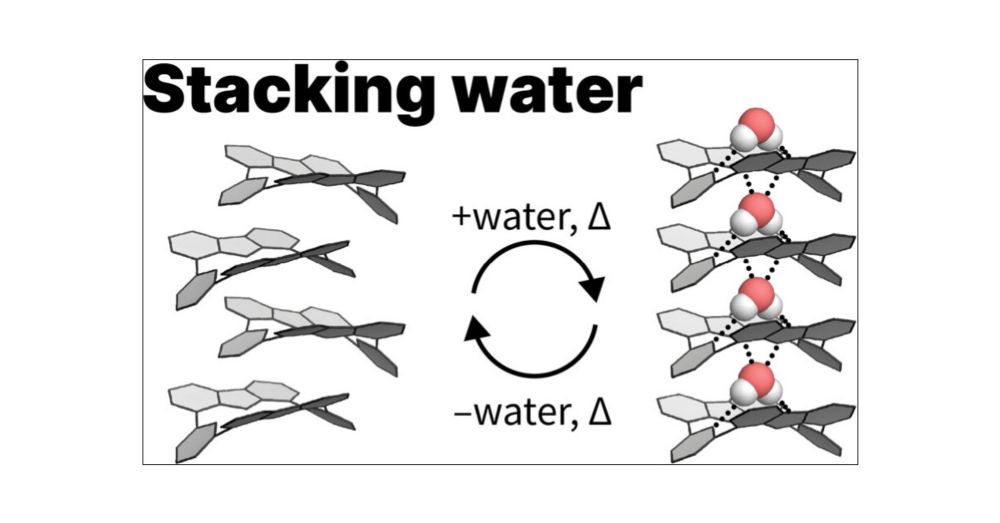
A Supramolecular Nanosheet Assembled from Carpyridines and Water
The use of water as a solvent to facilitate supramolecular self-assembly and polymerization is well-documented; however, it is rare that water acts as a monomer that undergoes polymerization. We repor...
doi.org
May 19, 2025 at 9:51 AM
Water impacts self-assembly. But what changes really?
In our latest @jacs.acspublications.org at 🇨🇭UNIGE, we ferret out vastly different organisations in wet vs dry solvents that lead to identical macrostructures
👉 doi.org/10.1021/jacs.4c17024 #pisky #chemsky
@rickhauslab.bsky.social
In our latest @jacs.acspublications.org at 🇨🇭UNIGE, we ferret out vastly different organisations in wet vs dry solvents that lead to identical macrostructures
👉 doi.org/10.1021/jacs.4c17024 #pisky #chemsky
@rickhauslab.bsky.social
Reposted by Lucía Gallego

My first post here comes with my latest work at the University of Zurich: Interrogating the anti-Insertion of Alkynes into Gold(III)! We explore the complex mechanism behind this apparently simple two-component reaction. Check it out in JACS Au pubs.acs.org/doi/10.1021/...
@uzhchemistry.bsky.social
@uzhchemistry.bsky.social

Interrogating the anti-Insertion of Alkynes into Gold(III)
Alkyne hydrofunctionalizations are a powerful strategy to efficiently build up structural complexity. The selectivity of these reactions is typically governed by the interaction between the alkyne and a metal-hydride, which commonly proceeds via a well-understood syn-insertion mechanism. In contrast, anti-insertions are far less common, with proposed mechanisms often extrapolated from literature precedents rather than grounded in direct experimental evidence. While gold complexes rank among the most efficient catalysts for such transformations, the mechanistic understanding of the key alkyne insertion step remains incomplete. In this study, we demonstrate that stable gold(III)-hydrides, featuring a (P∧N∧C) ligand, undergo selective insertion of alkynes to yield the corresponding anti-Markovnikov Z-vinyl complexes. A combination of control experiments, kinetic studies, and computational analyses reveals a nonradical, bimolecular insertion process, in which water plays a pivotal role by accelerating the reaction and potentially stabilizing a highly reactive, T-shaped gold(I) intermediate. Notably, this is the first demonstration of the insertion of both activated and unactivated terminal and internal alkynes into a gold(III)-hydride complex.
pubs.acs.org
February 28, 2025 at 7:58 AM
My first post here comes with my latest work at the University of Zurich: Interrogating the anti-Insertion of Alkynes into Gold(III)! We explore the complex mechanism behind this apparently simple two-component reaction. Check it out in JACS Au pubs.acs.org/doi/10.1021/...
@uzhchemistry.bsky.social
@uzhchemistry.bsky.social
Reposted by Lucía Gallego

🚨Fresh out🚨
We're especially proud of this one: Supramolecular chemistry lends a helping hand in developing new photo-generated molecular qubits. A fantastic collaboration with the @sabine-richert.bsky.social group!
www.nature.com/articles/s41...
We're especially proud of this one: Supramolecular chemistry lends a helping hand in developing new photo-generated molecular qubits. A fantastic collaboration with the @sabine-richert.bsky.social group!
www.nature.com/articles/s41...

Supramolecular dyads as photogenerated qubit candidates - Nature Chemistry
Molecular approaches in quantum information science are highly promising, but the synthesis and scale-up of suitable covalently linked moieties represent major challenges. Here it is demonstrated that...
www.nature.com
January 27, 2025 at 10:10 AM
🚨Fresh out🚨
We're especially proud of this one: Supramolecular chemistry lends a helping hand in developing new photo-generated molecular qubits. A fantastic collaboration with the @sabine-richert.bsky.social group!
www.nature.com/articles/s41...
We're especially proud of this one: Supramolecular chemistry lends a helping hand in developing new photo-generated molecular qubits. A fantastic collaboration with the @sabine-richert.bsky.social group!
www.nature.com/articles/s41...
Reposted by Lucía Gallego

Structure of a Supramolecular Water Copolymer
Authors: Joseph F. Woods, Kai Zhang, Joëlle Peterschmitt, Olivier Blacque, Céline Besnard, Gustavo Santiso-Quinones, Laura Samperisi, Andreas Vargas Jentzsch, Michel Rickhaus
DOI: 10.26434/chemrxiv-2024-twhrl
Authors: Joseph F. Woods, Kai Zhang, Joëlle Peterschmitt, Olivier Blacque, Céline Besnard, Gustavo Santiso-Quinones, Laura Samperisi, Andreas Vargas Jentzsch, Michel Rickhaus
DOI: 10.26434/chemrxiv-2024-twhrl
December 2, 2024 at 11:06 AM
Structure of a Supramolecular Water Copolymer
Authors: Joseph F. Woods, Kai Zhang, Joëlle Peterschmitt, Olivier Blacque, Céline Besnard, Gustavo Santiso-Quinones, Laura Samperisi, Andreas Vargas Jentzsch, Michel Rickhaus
DOI: 10.26434/chemrxiv-2024-twhrl
Authors: Joseph F. Woods, Kai Zhang, Joëlle Peterschmitt, Olivier Blacque, Céline Besnard, Gustavo Santiso-Quinones, Laura Samperisi, Andreas Vargas Jentzsch, Michel Rickhaus
DOI: 10.26434/chemrxiv-2024-twhrl