




Low Rank Jack
@lowrankjack.mathstodon.xyz.ap.brid.gy
Physicist, professor in UCLouvain, working on applied math, inverse problems in optics and astronomy for imaging, and compressive sensing theory and […]
[bridged from https://mathstodon.xyz/@lowrankjack on the fediverse by https://fed.brid.gy/ ]
[bridged from https://mathstodon.xyz/@lowrankjack on the fediverse by https://fed.brid.gy/ ]
I recently switched from the usual CMU latex fonts to Cochineal #fonts (a fork from the Crimson fonts) in my #latex documents (and those exported by #orgmode under #emacs). I really love this new font both for text and math equations. https://ctan.org/tex-archive/fonts/cochineal
What is your […]
What is your […]
Original post on mathstodon.xyz
mathstodon.xyz
December 19, 2025 at 7:14 AM
I recently switched from the usual CMU latex fonts to Cochineal #fonts (a fork from the Crimson fonts) in my #latex documents (and those exported by #orgmode under #emacs). I really love this new font both for text and math equations. https://ctan.org/tex-archive/fonts/cochineal
What is your […]
What is your […]
Reposted by Low Rank Jack
Atmospheric refraction, due to the different temperature/altitude profile in the atmosphere at different times of day...makes distant mountains appear taller or shorter.
The attached photo is a comparison of what I shot yesterday afternoon and this morning […]
[Original post on universeodon.com]
The attached photo is a comparison of what I shot yesterday afternoon and this morning […]
[Original post on universeodon.com]


December 6, 2025 at 9:02 PM
Atmospheric refraction, due to the different temperature/altitude profile in the atmosphere at different times of day...makes distant mountains appear taller or shorter.
The attached photo is a comparison of what I shot yesterday afternoon and this morning […]
[Original post on universeodon.com]
The attached photo is a comparison of what I shot yesterday afternoon and this morning […]
[Original post on universeodon.com]
Reposted by Low Rank Jack


November 17, 2025 at 10:42 AM
Reposted by Low Rank Jack

Wikipedia is celebrating its 25th anniversary in January, and our amazing creative teams in the Wikimedia Foundation put together this video that I love.
Fun fact! There are something like 500 attributions for images, sounds, and text in the video 🤯 […]
[Original post on wikimedia.social]
Fun fact! There are something like 500 attributions for images, sounds, and text in the video 🤯 […]
[Original post on wikimedia.social]
November 10, 2025 at 6:47 PM
Wikipedia is celebrating its 25th anniversary in January, and our amazing creative teams in the Wikimedia Foundation put together this video that I love.
Fun fact! There are something like 500 attributions for images, sounds, and text in the video 🤯 […]
[Original post on wikimedia.social]
Fun fact! There are something like 500 attributions for images, sounds, and text in the video 🤯 […]
[Original post on wikimedia.social]
L’écrivain Karim Kattan aux contributeurs de Wikipédia : "Une preuve de l’importance de ton travail : Elon Musk déteste ce que tu fais" Texte intégral ici […]
Original post on mathstodon.xyz
mathstodon.xyz
November 8, 2025 at 7:19 PM
L’écrivain Karim Kattan aux contributeurs de Wikipédia : "Une preuve de l’importance de ton travail : Elon Musk déteste ce que tu fais" Texte intégral ici […]
"Enhancing Your Beamer Presentations with SVG Figures and Inkscape Layers" https://laurentjacques.gitlab.io/post/enhancing-your-beamer-presentations-with-svg-figures-and-inkscape-layers/
Enhancing Your Beamer Presentations with SVG Figures and Inkscape Layers | Laurent Jacques
If like me you’re using Beamer to create slides in LaTeX, there’s a neat trick that helps you include SVG vector graphics—and even better, animate them progressively using Inkscape layers and Beamer’s overlay features like \pause or \onslide.
laurentjacques.gitlab.io
November 7, 2025 at 10:04 AM
"Enhancing Your Beamer Presentations with SVG Figures and Inkscape Layers" https://laurentjacques.gitlab.io/post/enhancing-your-beamer-presentations-with-svg-figures-and-inkscape-layers/
Reposted by Low Rank Jack
"Countries that slide from democracy toward autocracy tend to follow similar patterns. To measure what is happening in the United States, the Times editorial board has compiled a list of 12 markers of democratic erosion, with help from scholars who have studied this phenomenon. The sobering […]
Original post on mastodon.world
mastodon.world
October 31, 2025 at 12:24 PM
"Countries that slide from democracy toward autocracy tend to follow similar patterns. To measure what is happening in the United States, the Times editorial board has compiled a list of 12 markers of democratic erosion, with help from scholars who have studied this phenomenon. The sobering […]
Reposted by Low Rank Jack

This day 30 years ago - on Oct 26th 1995, #cpan (the Comprehensive Perl Archive Network) was announced to the world by Jarkko Hietaniemi – CPAN's Self-Appointed Master Librarian (OOK!), to the comp.lang.perl.announce newsgroup.
Happy Birthday, CPAN! […]
Happy Birthday, CPAN! […]
Original post on chaos.social
chaos.social
October 25, 2025 at 10:45 PM
This day 30 years ago - on Oct 26th 1995, #cpan (the Comprehensive Perl Archive Network) was announced to the world by Jarkko Hietaniemi – CPAN's Self-Appointed Master Librarian (OOK!), to the comp.lang.perl.announce newsgroup.
Happy Birthday, CPAN! […]
Happy Birthday, CPAN! […]
Reposted by Low Rank Jack

Largest study of its kind shows AI assistants misrepresent news content 45% of the time – regardless of language or territory. An intensive international study was coordinated by the European Broadcasting Union (EBU) and led by the BBC […]
Original post on infosec.exchange
infosec.exchange
October 22, 2025 at 6:08 PM
Largest study of its kind shows AI assistants misrepresent news content 45% of the time – regardless of language or territory. An intensive international study was coordinated by the European Broadcasting Union (EBU) and led by the BBC […]
@laurentduval Hi Laurent, I kind of remember you explained me once that, for the Hadamard transform, the concept of "frequency" should be careful defined and you possibly gave a reference then that I forgot. Do you remember it? Thank you ;-) (I post this question here as it could be of general […]
Original post on mathstodon.xyz
mathstodon.xyz
October 15, 2025 at 8:16 AM
@laurentduval Hi Laurent, I kind of remember you explained me once that, for the Hadamard transform, the concept of "frequency" should be careful defined and you possibly gave a reference then that I forgot. Do you remember it? Thank you ;-) (I post this question here as it could be of general […]
Reposted by Low Rank Jack
I've been using Goodnotes for handwritten notes and PDF annotation on iPad, but the latest version is full of all kinds of weird AI things. It's no longer as responsive as it used to be, and it is hard to trust that no information will leak to third parties. Any good alternatives?
August 31, 2025 at 1:17 PM
I've been using Goodnotes for handwritten notes and PDF annotation on iPad, but the latest version is full of all kinds of weird AI things. It's no longer as responsive as it used to be, and it is hard to trust that no information will leak to third parties. Any good alternatives?
(sigh) How many (conference) articles mention something like "due to the space limit, we leave the proof to the supplementary material" with this “supplementary document” nowhere available!
October 12, 2025 at 3:58 PM
(sigh) How many (conference) articles mention something like "due to the space limit, we leave the proof to the supplementary material" with this “supplementary document” nowhere available!
Back to the wonderful CIRM (my last time here was in 2018), in Marseille, France for the workshop on "Blind Inverse Problems in Imaging", organized by Luca Calatroni, Emmanuel Soubies, and Pierre Weiss. I'm eager to attend the seminars tomorrow. More information here […]
Original post on mathstodon.xyz
mathstodon.xyz
September 28, 2025 at 4:36 PM
Back to the wonderful CIRM (my last time here was in 2018), in Marseille, France for the workshop on "Blind Inverse Problems in Imaging", organized by Luca Calatroni, Emmanuel Soubies, and Pierre Weiss. I'm eager to attend the seminars tomorrow. More information here […]
Reposted by Low Rank Jack

"Finally Over: Google Blocks Sideloading of Android Apps" https://www.androidsage.com/2025/08/26/google-blocks-sideloading-of-android-apps/
Finally Over: Google Blocks Sideloading of Android Apps
Advertisements
Summary
Toggle
* Security & Safety Excuse to Eliminate Sideloading
* The Death of True Android Freedom
* Android Introduces Mandatory Developer Verification by September 2026
* What’s at stake?
* The Casualty List: Who Gets Hurt
* How the System Works
* The End of Open Android?
* How This Will This Essentially End Sideloading on Android?
* Conclusion: The End of Android as We Knew It
In a shocking betrayal of Android’s foundational principles, Google has announced what can only be described as a death blow to the open ecosystem that made Android the world’s most popular mobile platform. Under the guise of “security,” Google is implementing draconian developer verification requirements that effectively eliminate true sideloading freedom for millions, if not billions, of Android users worldwide.
Subscribe to Posts by Email
This isn’t security enhancement—it’s corporate control disguised as protection, marking the beginning of the end for Android’s open nature, starting with banning sideloading of Android apps.
It’s not the first time Google has attacked sideloading. It’s a systematic deprecation of an extremely useful feature that made Android what it is today. Prior to this, a new Google Play Integrity API was released to block apps from running on Android devices that do not meet certain Play Integrity checks including rooted, bootloader unlocked, custom ROMs, or phones that have even the Developer Options enabled.
This was further met with another obstacle, wherein app developers have the power to force Android app installations through Google Play Store only. The said apps wouldn’t even launch if not installed through Google Play Store.
Soon Sideloading will be added to the KilledByGoogle list.
## Security & Safety Excuse to Eliminate Sideloading
Google’s justification for this authoritarian overreach relies heavily on inflated statistics designed to terrify users. The company claims that sideloaded apps contain 50 times more malware than Google Play apps—a convenient statistic that conveniently ignores the fact that Google Play itself has been plagued by malicious apps for years.
This fearmongering narrative paints sideloading as an inherently dangerous activity, when in reality, it has been a cornerstone of Android’s appeal to power users, developers, and privacy-conscious individuals who refuse to be locked into Google’s walled garden.
Advertisements
The so-called “recent attacks” and “financial fraud” that Google references are being used as a pretext to eliminate one of Android’s last remaining advantages over iOS: true user freedom and choice in app installation.
All this came into light when Google published an article stating “A new layer of security for certified Android devices” – which, to be honest, seems like security disguised as surveillance.
## The Death of True Android Freedom
Starting in 2026, Google will require ALL apps installed on “certified Android devices” to be registered by “verified developers.” This Orwellian requirement sounds benign until you understand what it really means: **every single app you want to install must first receive Google’s blessing through their verification process.**
This is not developer verification—this is **Google gatekeeping**. Every independent developer, every open-source project, every privacy tool, and every alternative app that doesn’t align with Google’s commercial interests will now face bureaucratic barriers that didn’t exist before.
### Android Introduces Mandatory Developer Verification by September 2026
Google’s latest announcement strikes another blow against independent app developers.
Google is implementing a significant “security enhancement” for Android that will fundamentally change how apps are distributed. **Starting September 2026** , all apps installed on certified Android devices must be registered by verified developers.
The verification process involves **two key steps** :
#### Step 1: Identity Verification
* Provide personal details (name, address, email, phone)
* Organizations need D-U-N-S numbers and website verification
* Government ID may be required
#### Step 2: App Registration
* Prove app ownership with package names and signing keys
* Google Play developers will have automatic registration
* Off-Play distribution requires manual registration
#### Timeline and Rollout
The requirement launches in **Brazil, Indonesia, Singapore, and Thailand** in September 2026, with global expansion continuing through 2027. Early access begins October 2025, with full verification opening March 2026.
Advertisements
The rollout follows a careful timeline:
* **October 2025** : Early access testing begins
* **March 2026** : All developers gain access to the new console
* **September 2026** : Requirements launch in Brazil, Indonesia, Singapore, and Thailand
* **2027** : Global expansion planned
Google emphasizes maintaining Android’s openness while enhancing security, with special considerations for student and hobbyist developers through separate account types.
While Google claims to support student and hobbyist developers with “separate accounts,” the lack of concrete details suggests another empty promise. This verification system transforms Android from an open platform into a **walled garden** , potentially killing innovation from smaller developers who built Android’s success.
## What’s at stake?
Google claims this preserves “choice” and maintains Android’s “openness,” but this is corporate doublespeak at its finest. You can still “sideload” apps, they say—you just need Google’s permission first. This is like claiming you have freedom of speech while requiring government approval for every word you utter.
The new system creates a false choice: submit to Google’s verification bureaucracy or lose access to the apps you want. For many independent developers and users who value privacy and autonomy, this isn’t a choice at all—it’s surrender.
Google is establishing what they euphemistically call an “Android Developer Console” for non-Play developers. In reality, this a system designed to make app distribution more difficult and expensive for anyone who doesn’t want to play by Google’s rules.
While Google hasn’t explicitly outlined costs, their track record with Google Play Developer registration suggests this “verification” won’t be free. Independent developers, open-source contributors, and hobbyists will likely face:
* **Registration fees** that create barriers for small developers
* **Identity verification requirements** that compromise developer privacy
* **Ongoing compliance obligations** that drain time and resources
* **Arbitrary rejection risks** with little recourse for appeals
### The Casualty List: Who Gets Hurt
This verification requirement will disproportionately harm exactly the developers and users who have made Android valuable:
Advertisements
#### Independent Developers
Small developers who can’t navigate Google’s bureaucracy or afford verification costs will be pushed out of the ecosystem entirely.
#### Open Source Projects
Community-driven projects that rely on volunteer contributors will struggle with verification requirements that assume commercial development models.
#### Privacy-Focused Applications
Apps designed to protect user privacy from corporate surveillance will face additional scrutiny and potential rejection from Google’s verification process.
#### Regional and Niche Applications
Developers serving specific communities or regions may find the verification process unsuitable for their needs and resources.
#### Research and Educational Projects
Academic researchers and educational institutions may be unable to comply with commercial verification requirements.
### How the System Works
Beginning in October 2025, Google will launch an early access program for developers to test the new verification process. The company has created a streamlined Android Developer Console specifically for apps distributed outside the Play Store. Developers must complete several steps:
1. **Identity Verification** : Developers must prove their identity through Google’s verification process
2. **App Registration** : Package names and signing keys must be registered with Google
3. **Ongoing Compliance** : Maintain verified status to ensure app functionality
Notably, Google won’t review the content or functionality of these sideloaded apps—only the developer’s identity matters for the verification process.
## The End of Open Android?
Google’s announcement of mandatory developer verification for all Android apps represents a seismic shift in the mobile ecosystem. Starting in 2026, the search giant will require every Android app developer to verify their identity before their applications can be installed on certified devices—regardless of whether they distribute through the Play Store or alternative channels. This move marks perhaps the most significant departure from Android’s open philosophy since the platform’s inception, trading freedom for security in ways that could fundamentally alter how we think about mobile app distribution.
Advertisements
The new system operates on a simple premise: no unverified app will run on certified Android devices. Google compares this to “checking IDs at the airport,” positioning the requirement as a basic security measure rather than a restriction on freedom. However, the implications extend far beyond this airport analogy suggests.
## How This Will This Essentially End Sideloading on Android?
The implementation of Google’s developer verification system will dramatically alter how regular Android users interact with their devices, fundamentally changing the mobile experience in ways that many users may not immediately recognize. For years, Android users have enjoyed the freedom to install applications from any source—whether from alternative app stores like F-Droid, Aurora Store, or directly from developer websites.
This flexibility allowed users to access beta versions of apps, install region-locked applications, or try experimental software that wasn’t available through official channels. Under the new system, this entire ecosystem of alternative app distribution will be severely restricted, as only apps from verified developers will function on certified Android devices.
The impact on user choice and digital autonomy cannot be overstated. Currently, tech-savvy users can bypass Google’s restrictions and install any software they choose, accepting the security risks in exchange for complete control over their devices. This has enabled use cases ranging from installing ad-blocking browsers that aren’t allowed in the Play Store to running specialized productivity tools for niche industries. The verification requirement effectively removes this choice, forcing all users into Google’s security framework regardless of their technical expertise or risk tolerance. Users who previously could make informed decisions about which apps to trust will no longer have that option, as the decision is made for them at the system level.
The changes will particularly affect users in regions where official app availability is limited or where local developers create solutions for specific cultural or linguistic needs. Many international users rely on sideloading to access apps that aren’t available in their regional Play Store, while others use it to install apps from local developers who may not have the resources or desire to navigate Google’s verification process. Small developers creating apps for specific communities—such as accessibility tools, educational apps for local schools, or cultural applications—may find the verification requirements burdensome, potentially leaving their user communities without access to these specialized solutions.
Perhaps most significantly, the verification system eliminates what has been a key differentiator between Android and iOS: the ability to truly own and control your device. While Apple has always maintained strict control over iOS app installation, Android users have had an escape hatch through sideloading. This freedom attracted users who valued digital sovereignty and didn’t want to be locked into a single company’s vision of acceptable software. The new requirements move Android much closer to iOS’s walled garden approach, potentially eliminating one of the primary reasons users chose Android over Apple’s platform.
### Conclusion: The End of Android as We Knew It
Google’s developer verification requirement represents nothing less than the death of Android’s open ecosystem. Under the pretense of security, Google is implementing the same walled garden approach that Android users have long rejected in Apple’s iOS.
Android succeeded because it offered an alternative to corporate control over personal devices. By eliminating true sideloading freedom, Google is destroying the very foundation that made Android valuable to millions of users worldwide.
Advertisements
The verification requirement will make Android indistinguishable from iOS in the ways that matter most: user freedom, developer autonomy, and genuine choice in software installation. Google has chosen corporate control over user empowerment, and the Android ecosystem will never recover from this authoritarian overreach.
The message from Google is clear: your device belongs to them, not you. And if you want to install software they haven’t approved, you’re out of luck.
🔥Share This Article
View More on Latest
www.androidsage.com
September 18, 2025 at 5:47 AM
"Finally Over: Google Blocks Sideloading of Android Apps" https://www.androidsage.com/2025/08/26/google-blocks-sideloading-of-android-apps/
Reposted by Low Rank Jack


September 9, 2025 at 2:13 PM
Reposted by Low Rank Jack

#Mastodon does NOT need to verify you in ANY way!
The only verification happening is when you create an account and confirm your email, that’s it
Staff members can recognized by a badge on their profile right under the username(see image)
If someone does ask […]
[Original post on mstdn.social]
The only verification happening is when you create an account and confirm your email, that’s it
Staff members can recognized by a badge on their profile right under the username(see image)
If someone does ask […]
[Original post on mstdn.social]

August 31, 2025 at 1:33 PM
#Mastodon does NOT need to verify you in ANY way!
The only verification happening is when you create an account and confirm your email, that’s it
Staff members can recognized by a badge on their profile right under the username(see image)
If someone does ask […]
[Original post on mstdn.social]
The only verification happening is when you create an account and confirm your email, that’s it
Staff members can recognized by a badge on their profile right under the username(see image)
If someone does ask […]
[Original post on mstdn.social]
Just arrived in the wonderful city of Lyon, France, to begin a sabbatical year at ENS Lyon, working with Rémi Gribonval and Paulo Gonçalves' OCKHAM team [1]. The location is magnificent, and I am welcomed in the Collegium, the institute for advanced study of Lyon University [2], located inside […]
Original post on mathstodon.xyz
mathstodon.xyz
August 31, 2025 at 6:58 PM
Just arrived in the wonderful city of Lyon, France, to begin a sabbatical year at ENS Lyon, working with Rémi Gribonval and Paulo Gonçalves' OCKHAM team [1]. The location is magnificent, and I am welcomed in the Collegium, the institute for advanced study of Lyon University [2], located inside […]
Reposted by Low Rank Jack

Linux franchit les 6 % de parts de marché sur desktop : vers une adoption de masse ?
https://www.blog-nouvelles-technologies.fr/336627/linux-6-pourcent-part-marche-desktop-2025/
"C’est une statistique qui aurait semblé impensable il y a encore quelques années. Selon une étude menée par […]
https://www.blog-nouvelles-technologies.fr/336627/linux-6-pourcent-part-marche-desktop-2025/
"C’est une statistique qui aurait semblé impensable il y a encore quelques années. Selon une étude menée par […]
Original post on piaille.fr
piaille.fr
August 18, 2025 at 4:49 PM
Linux franchit les 6 % de parts de marché sur desktop : vers une adoption de masse ?
https://www.blog-nouvelles-technologies.fr/336627/linux-6-pourcent-part-marche-desktop-2025/
"C’est une statistique qui aurait semblé impensable il y a encore quelques années. Selon une étude menée par […]
https://www.blog-nouvelles-technologies.fr/336627/linux-6-pourcent-part-marche-desktop-2025/
"C’est une statistique qui aurait semblé impensable il y a encore quelques années. Selon une étude menée par […]
Reposted by Low Rank Jack

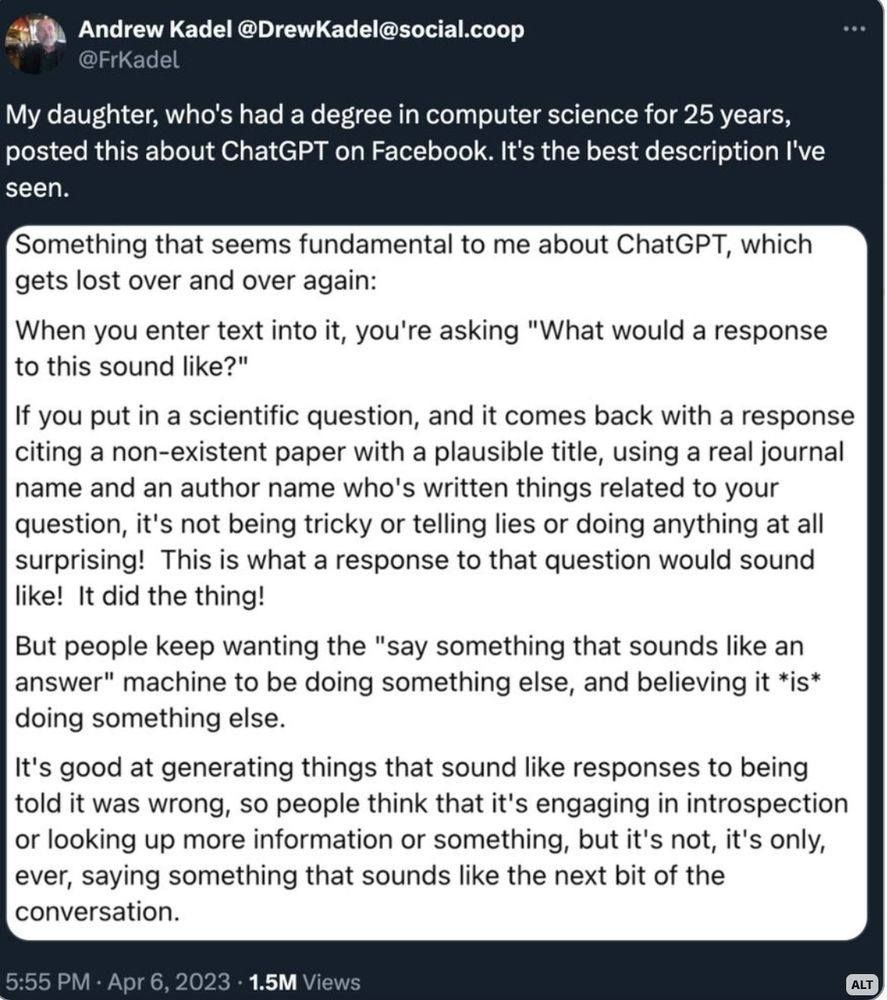
The only thing ChatGPT ever does.
August 14, 2025 at 7:35 PM
The only thing ChatGPT ever does.
Find a caption...

August 12, 2025 at 7:35 PM
Find a caption...
Reposted by Low Rank Jack

If you haven't seen this yet, watch.
It's an AI vid of the "grand opening" of the hideously gilded, wildly overpriced, Let Them Eat Cake future Trump Ballroom.
https://www.youtube.com/watch?v=nD_25aSMSFc&t=5s
It's an AI vid of the "grand opening" of the hideously gilded, wildly overpriced, Let Them Eat Cake future Trump Ballroom.
https://www.youtube.com/watch?v=nD_25aSMSFc&t=5s
August 9, 2025 at 11:35 PM
If you haven't seen this yet, watch.
It's an AI vid of the "grand opening" of the hideously gilded, wildly overpriced, Let Them Eat Cake future Trump Ballroom.
https://www.youtube.com/watch?v=nD_25aSMSFc&t=5s
It's an AI vid of the "grand opening" of the hideously gilded, wildly overpriced, Let Them Eat Cake future Trump Ballroom.
https://www.youtube.com/watch?v=nD_25aSMSFc&t=5s
Fun statistical observation: If X follows a Chi square distribution with k degrees of freedom, while the MGF Eexp(tX)] of X doesn't exist for t>1/2, I computed that, for k=3, and the cardinal hyperbolic sine sinhc(u):=sinh(u)/u that basically behaves like exp(u)/2u if u is large, then […]
Original post on mathstodon.xyz
mathstodon.xyz
August 3, 2025 at 4:58 PM
Fun statistical observation: If X follows a Chi square distribution with k degrees of freedom, while the MGF Eexp(tX)] of X doesn't exist for t>1/2, I computed that, for k=3, and the cardinal hyperbolic sine sinhc(u):=sinh(u)/u that basically behaves like exp(u)/2u if u is large, then […]
Currently at the "Sampling Theory and Applications" conference (#sampta25), enjoying great talks and the beautiful city of Vienna. https://sampta25.univie.ac.at

SampTA 2025
sampta25.univie.ac.at
July 30, 2025 at 7:11 AM
Currently at the "Sampling Theory and Applications" conference (#sampta25), enjoying great talks and the beautiful city of Vienna. https://sampta25.univie.ac.at
Reposted by Low Rank Jack
Microsoft, AWS, and even France-based OVHCloud say that they can't keep the US Government's hands off your data, if requested under the CLOUD Act.
👉 You can't guarantee data sovereignty using a provider that is subject to US law, even if your data is housed outside the US […]
👉 You can't guarantee data sovereignty using a provider that is subject to US law, even if your data is housed outside the US […]
Original post on mastodon.nz
mastodon.nz
July 28, 2025 at 2:06 AM
Microsoft, AWS, and even France-based OVHCloud say that they can't keep the US Government's hands off your data, if requested under the CLOUD Act.
👉 You can't guarantee data sovereignty using a provider that is subject to US law, even if your data is housed outside the US […]
👉 You can't guarantee data sovereignty using a provider that is subject to US law, even if your data is housed outside the US […]