



Leah Banellis
@leahbanellis.bsky.social
🏳️🌈 Postdoc at the Embodied Computation Group. Interested in brain-body interactions, interoception, consciousness, & mental health
The hard problem is solved - Thanks @naddenmark.bsky.social !

November 3, 2025 at 6:55 PM
The hard problem is solved - Thanks @naddenmark.bsky.social !
Incredibly impressed with the calibre of research by Ye Ella Tian showing the importance of multi-organ bodily health including immunometabolics (at Adriatica Summer School 🏖️)
#teamlab #mambolab #psychologywellbeing_ch #fraferri_78 #erasmus_uda
#teamlab #mambolab #psychologywellbeing_ch #fraferri_78 #erasmus_uda

September 10, 2025 at 8:31 AM
Incredibly impressed with the calibre of research by Ye Ella Tian showing the importance of multi-organ bodily health including immunometabolics (at Adriatica Summer School 🏖️)
#teamlab #mambolab #psychologywellbeing_ch #fraferri_78 #erasmus_uda
#teamlab #mambolab #psychologywellbeing_ch #fraferri_78 #erasmus_uda
Absolutely loved discussing our recent @natmentalhealth.nature.com paper on IhmCurious
YouTube channel (www.youtube.com/watch?v=dDTv...), thank you for having me! & to
@micahgallen.com @brainandstomach.bsky.social & the @the-ecg.bsky.social team for all their hard work 🧠
YouTube channel (www.youtube.com/watch?v=dDTv...), thank you for having me! & to
@micahgallen.com @brainandstomach.bsky.social & the @the-ecg.bsky.social team for all their hard work 🧠

July 31, 2025 at 8:50 AM
Absolutely loved discussing our recent @natmentalhealth.nature.com paper on IhmCurious
YouTube channel (www.youtube.com/watch?v=dDTv...), thank you for having me! & to
@micahgallen.com @brainandstomach.bsky.social & the @the-ecg.bsky.social team for all their hard work 🧠
YouTube channel (www.youtube.com/watch?v=dDTv...), thank you for having me! & to
@micahgallen.com @brainandstomach.bsky.social & the @the-ecg.bsky.social team for all their hard work 🧠
In summary, we identified a unique mental health signature of stomach-brain coupling. Applying pharmacological or mechanical methods which alter the gastric rhythm/brain coupling may refine diagnostic and therapeutic interventions remediating maladaptive body-mind connections.

July 30, 2025 at 9:53 AM
In summary, we identified a unique mental health signature of stomach-brain coupling. Applying pharmacological or mechanical methods which alter the gastric rhythm/brain coupling may refine diagnostic and therapeutic interventions remediating maladaptive body-mind connections.
Attentional and control networks contribute most to our psychiatric stomach-brain coupling result, suggesting specific attentional and inhibitory control pathways that are influenced by visceral-modulated psychopathology.

July 30, 2025 at 9:51 AM
Attentional and control networks contribute most to our psychiatric stomach-brain coupling result, suggesting specific attentional and inhibitory control pathways that are influenced by visceral-modulated psychopathology.
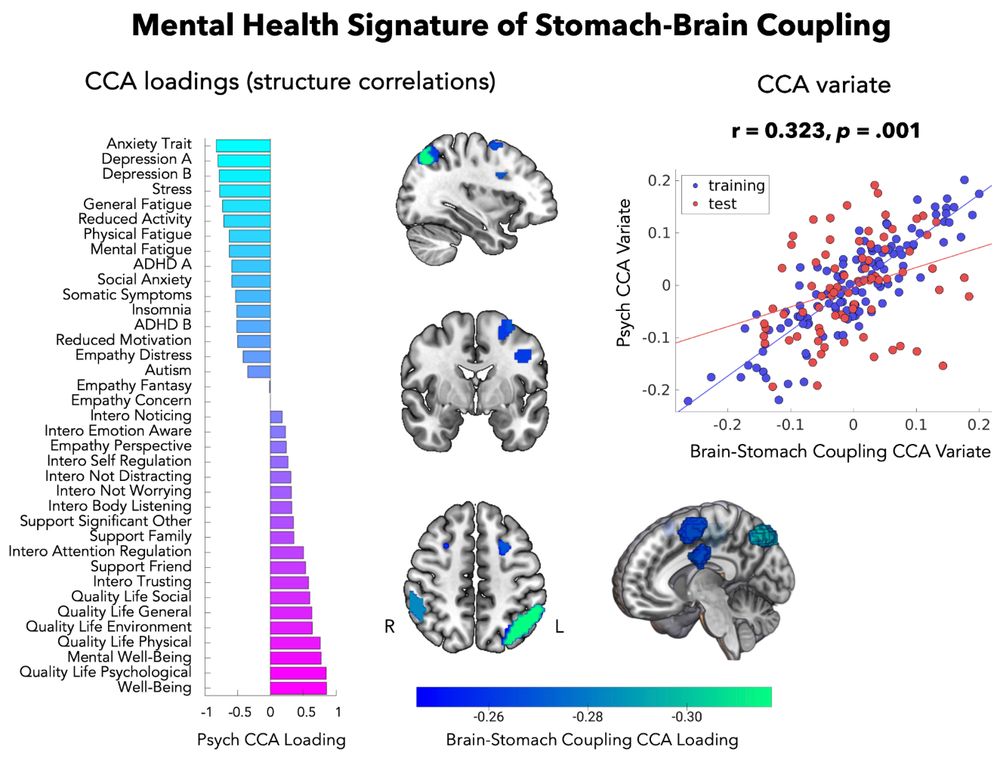
While many believe being ‘more in tune with your body’ improves mental health, we surprisingly found the opposite: worse mental health (higher anxiety, depression, stress, fatigue & reduced well-being)—with stronger stomach-brain connections.
July 30, 2025 at 9:51 AM
While many believe being ‘more in tune with your body’ improves mental health, we surprisingly found the opposite: worse mental health (higher anxiety, depression, stress, fatigue & reduced well-being)—with stronger stomach-brain connections.
Using a cross-validated Canonical Correlation Analysis, we uncover a psychiatric signature of stomach-brain coupling in fronto-parietal regions. We were surprised by what we found!

July 30, 2025 at 9:50 AM
Using a cross-validated Canonical Correlation Analysis, we uncover a psychiatric signature of stomach-brain coupling in fronto-parietal regions. We were surprised by what we found!
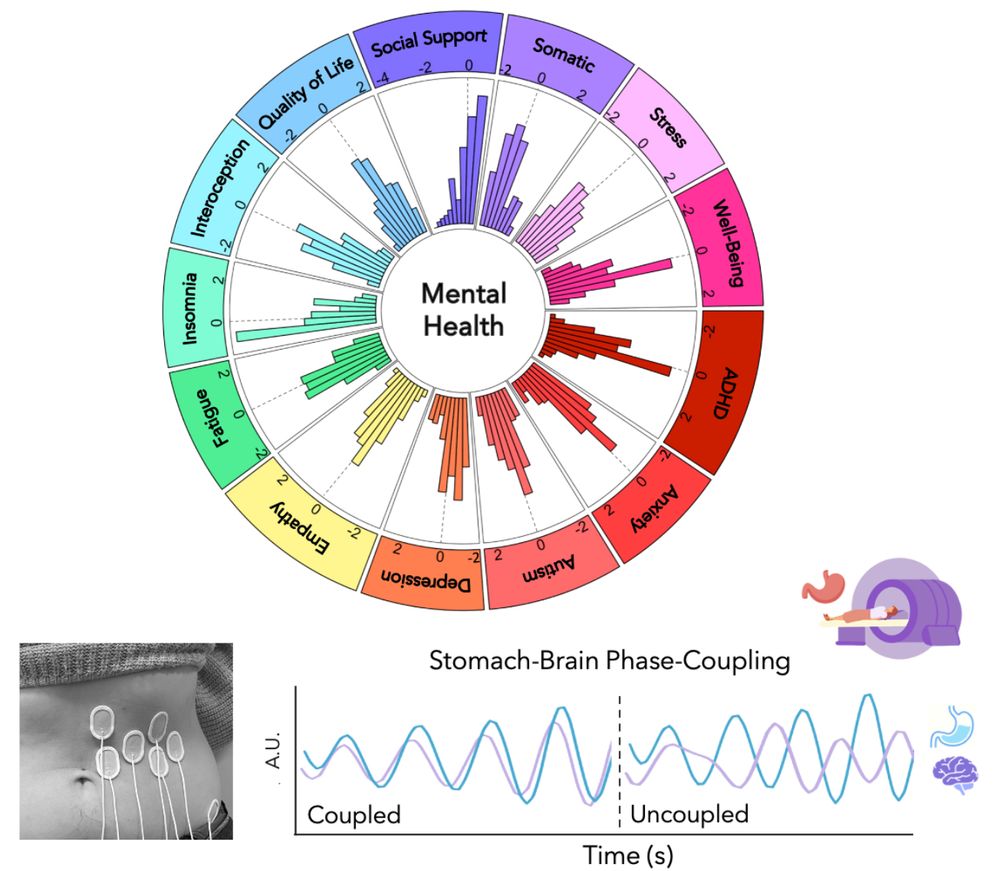
We identified highly individual mental health symptom profiles across 37 psychiatric scores including anxiety, depression, and stress - ranging from subclinical to clinically significant. As well as capturing individual differences in patterns of stomach-brain phase coupling.

July 30, 2025 at 9:50 AM
We identified highly individual mental health symptom profiles across 37 psychiatric scores including anxiety, depression, and stress - ranging from subclinical to clinically significant. As well as capturing individual differences in patterns of stomach-brain phase coupling.
Building on the exciting discovery of brain activity continuously waxing and waning with the pace of digestive contractions (i.e., the gastric rhythm) @brainandstomach.bsky.social.
We are the first to reveal diverse mental health consequences of increased stomach-brain coupling.
We are the first to reveal diverse mental health consequences of increased stomach-brain coupling.

July 30, 2025 at 9:49 AM
Building on the exciting discovery of brain activity continuously waxing and waning with the pace of digestive contractions (i.e., the gastric rhythm) @brainandstomach.bsky.social.
We are the first to reveal diverse mental health consequences of increased stomach-brain coupling.
We are the first to reveal diverse mental health consequences of increased stomach-brain coupling.
Got Butterflies in your Stomach? I am super excited to share the first major study of my postdoc @the-ecg.bsky.social - Now out in @natmentalhealth.nature.com! We report a multidimensional mental health signature of stomach-brain coupling in the largest sample to date www.nature.com/articles/s44...
July 30, 2025 at 9:49 AM
Got Butterflies in your Stomach? I am super excited to share the first major study of my postdoc @the-ecg.bsky.social - Now out in @natmentalhealth.nature.com! We report a multidimensional mental health signature of stomach-brain coupling in the largest sample to date www.nature.com/articles/s44...
Loving that my #ASSC conferences keep aligning with pride 🏳️🌈🏳️⚧️ (left #ASSC28 in Heraklion Crete, right ASSC in New York). Can we keep this up for Chile? @assc28.bsky.social


July 14, 2025 at 8:52 AM
Loving that my #ASSC conferences keep aligning with pride 🏳️🌈🏳️⚧️ (left #ASSC28 in Heraklion Crete, right ASSC in New York). Can we keep this up for Chile? @assc28.bsky.social
Loved presenting our Brain-Body tutorial🫀🫁🧠 at #ASSC28, great initiative & brilliant talk from @brainandstomach.bsky.social & awesome talks as always from @danlikesbrains.bsky.social & @marieloescher.bsky.social. Looking forward to the rest of the conference!

July 6, 2025 at 1:45 PM
Loved presenting our Brain-Body tutorial🫀🫁🧠 at #ASSC28, great initiative & brilliant talk from @brainandstomach.bsky.social & awesome talks as always from @danlikesbrains.bsky.social & @marieloescher.bsky.social. Looking forward to the rest of the conference!
Huge thanks to @micahgallen.com for all his support and supervision, and the entire ECG & BPP team, especially @jesperfischer.bsky.social & @acourtin.bsky.social for their expertise in computational modeling. Very grateful for the support of @lundbeckfonden.bsky.social & CFIN !

March 19, 2025 at 2:39 PM
Huge thanks to @micahgallen.com for all his support and supervision, and the entire ECG & BPP team, especially @jesperfischer.bsky.social & @acourtin.bsky.social for their expertise in computational modeling. Very grateful for the support of @lundbeckfonden.bsky.social & CFIN !
Using Bayesian statistics, we found further evidence against a relationship between cardiac & respiratory interoception—except in confidence.

March 19, 2025 at 2:34 PM
Using Bayesian statistics, we found further evidence against a relationship between cardiac & respiratory interoception—except in confidence.
Despite this, individuals overall sense of confidence (metacognitive bias) correlated across all three modalities, while metacognition itself was uncorrelated. This aligns with exteroceptive research, showing confidence as domain-general, but metacognitive efficiency as more task-specific.

March 19, 2025 at 2:33 PM
Despite this, individuals overall sense of confidence (metacognitive bias) correlated across all three modalities, while metacognition itself was uncorrelated. This aligns with exteroceptive research, showing confidence as domain-general, but metacognitive efficiency as more task-specific.
Cardiac 🫀and respiratory 🫁 performance were uncorrelated, both in terms of sensitivity—how well participants sensed heart rate or breathing resistance—and in precision—how stable their estimations were.

March 19, 2025 at 2:33 PM
Cardiac 🫀and respiratory 🫁 performance were uncorrelated, both in terms of sensitivity—how well participants sensed heart rate or breathing resistance—and in precision—how stable their estimations were.
We measured individual differences in cardiac 🫀 and respiratory 🫁 interoception, and auditory 👂 exteroception using advanced psychophysical techniques, which dissect performance across:
✅ Sensitivity
✅ Precision
✅ Confidence
✅ Metacognition
✅ Sensitivity
✅ Precision
✅ Confidence
✅ Metacognition

March 19, 2025 at 2:32 PM
We measured individual differences in cardiac 🫀 and respiratory 🫁 interoception, and auditory 👂 exteroception using advanced psychophysical techniques, which dissect performance across:
✅ Sensitivity
✅ Precision
✅ Confidence
✅ Metacognition
✅ Sensitivity
✅ Precision
✅ Confidence
✅ Metacognition
Is interoceptive sensing unified across internal organs? 🫀🫁 Our high-powered psychophysical study (N=241) suggests not. Bayesian evidence indicates interoceptive processes are largely modality-specific—challenging the idea of a unitary interoceptive sense.
🔗 Read here: osf.io/preprints/ps...
🔗 Read here: osf.io/preprints/ps...

March 19, 2025 at 2:31 PM
Is interoceptive sensing unified across internal organs? 🫀🫁 Our high-powered psychophysical study (N=241) suggests not. Bayesian evidence indicates interoceptive processes are largely modality-specific—challenging the idea of a unitary interoceptive sense.
🔗 Read here: osf.io/preprints/ps...
🔗 Read here: osf.io/preprints/ps...
I am extremely grateful for all the help and supervision from @micahgallen.com and @themindwanders.bsky.social, this project would not have been possible without them! As well as the extended @the-ecg.bsky.social & BPP team, and for the support of @lundbeckfonden and @CFIN_AU

October 28, 2024 at 4:04 PM
I am extremely grateful for all the help and supervision from @micahgallen.com and @themindwanders.bsky.social, this project would not have been possible without them! As well as the extended @the-ecg.bsky.social & BPP team, and for the support of @lundbeckfonden and @CFIN_AU
We are so excited to share this work! We've been fascinated by body-wandering and hope you will be too. For us, the next step is to expand into experimental manipulations of bodily thoughts, and real world studies using mobile sensing and interoceptive experience sampling!

October 28, 2024 at 4:02 PM
We are so excited to share this work! We've been fascinated by body-wandering and hope you will be too. For us, the next step is to expand into experimental manipulations of bodily thoughts, and real world studies using mobile sensing and interoceptive experience sampling!
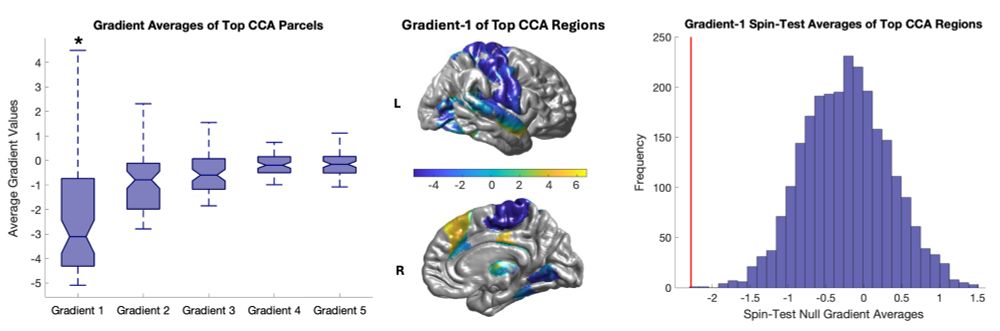
We also examined how this neural signature of body-wandering aligns with functional connectivity gradients. We found that body-wandering is linked to connectivity along the principal gradient, spanning the cortical hierarchy to connect somatomotor, cingulate, and frontal regions.
October 28, 2024 at 4:01 PM
We also examined how this neural signature of body-wandering aligns with functional connectivity gradients. We found that body-wandering is linked to connectivity along the principal gradient, spanning the cortical hierarchy to connect somatomotor, cingulate, and frontal regions.
We identified a unique brain signature of body-wandering, characterised by increased connectivity between somatomotor, interoceptive, and thalamocortical networks, using a robustly cross-validated Canonical Correlation Analysis.

October 28, 2024 at 4:00 PM
We identified a unique brain signature of body-wandering, characterised by increased connectivity between somatomotor, interoceptive, and thalamocortical networks, using a robustly cross-validated Canonical Correlation Analysis.
Interestingly, the psychophysiological underpinnings of 'bodily' and 'cognitive' ongoing thoughts were strongly anti-correlated:
🫀Embodied thoughts: ⬆️ negative affect, ⬆️ arousal, ⬇️ ADHD symptoms
🧠Cognitive thoughts: ⬇️ negative affect, ⬇️ arousal, ⬆️ depression symptoms
🫀Embodied thoughts: ⬆️ negative affect, ⬆️ arousal, ⬇️ ADHD symptoms
🧠Cognitive thoughts: ⬇️ negative affect, ⬇️ arousal, ⬆️ depression symptoms

October 28, 2024 at 4:00 PM
Interestingly, the psychophysiological underpinnings of 'bodily' and 'cognitive' ongoing thoughts were strongly anti-correlated:
🫀Embodied thoughts: ⬆️ negative affect, ⬆️ arousal, ⬇️ ADHD symptoms
🧠Cognitive thoughts: ⬇️ negative affect, ⬇️ arousal, ⬆️ depression symptoms
🫀Embodied thoughts: ⬆️ negative affect, ⬆️ arousal, ⬇️ ADHD symptoms
🧠Cognitive thoughts: ⬇️ negative affect, ⬇️ arousal, ⬆️ depression symptoms
Crucially, we found that higher levels of body-wandering were linked to more negative thoughts, especially those involving the heart, bladder, and skin. This suggests that focusing on bodily sensations during rest is associated with increased anxiety and negative affect.

October 28, 2024 at 3:59 PM
Crucially, we found that higher levels of body-wandering were linked to more negative thoughts, especially those involving the heart, bladder, and skin. This suggests that focusing on bodily sensations during rest is associated with increased anxiety and negative affect.
We first compared the cognitive vs body-related items (pink vs blue boxplots), finding that while interoceptive thoughts were overall less intense in frequency than typical cognitive dimensions, that respiratory sensations specifically dominated the interoceptive-axis.

October 28, 2024 at 3:59 PM
We first compared the cognitive vs body-related items (pink vs blue boxplots), finding that while interoceptive thoughts were overall less intense in frequency than typical cognitive dimensions, that respiratory sensations specifically dominated the interoceptive-axis.