



KunihikoKaneko
@kunikaneko.bsky.social
Scientist (Theoretical physicist: Chaos, Complex Systems, Universal Biology, Universal Anthropology). Professor at Niels Bohr Institute, Professor Emeritus at Univ of Tokyo
Our paper on enhanced enzyme diffusion as Maxwell demon has just been published: (2026) Phys. Rev. Lett. 136, 038401
journals.aps.org/prl/abstract...
journals.aps.org/prl/abstract...
Enzyme as Maxwell's Demon: Steady-State Deviation from Chemical Equilibrium by Enhanced Enzyme Diffusion
Enhanced enzyme diffusion (EED), in which the diffusion coefficient of an enzyme transiently increases during catalysis, has been extensively reported experimentally, although its existence remains un...
journals.aps.org
January 21, 2026 at 12:56 PM
Our paper on enhanced enzyme diffusion as Maxwell demon has just been published: (2026) Phys. Rev. Lett. 136, 038401
journals.aps.org/prl/abstract...
journals.aps.org/prl/abstract...
Our paper on robust differentiation with noise and slow epigenetic fixation is just out (Phys. Rev. Research 8, (2026) 013059) journals.aps.org/prresearch/a...
Evolution of robust cell differentiation under epigenetic feedback
In multicellular organisms, cells differentiate into multiple types as they divide. States of these cell types, as well as their numbers, are known to be robust to external perturbations, as conceptua...
journals.aps.org
January 21, 2026 at 12:07 PM
Our paper on robust differentiation with noise and slow epigenetic fixation is just out (Phys. Rev. Research 8, (2026) 013059) journals.aps.org/prresearch/a...
Our paper on fluctuation-response relationship in learning is just out. Tomoki Kurikawa and Kunihiko Kaneko, Fluctuation-learning relationship in recurrent neural networks,
Nature Communications 16, 9663 (2025)
www.nature.com/articles/s41...
Nature Communications 16, 9663 (2025)
www.nature.com/articles/s41...
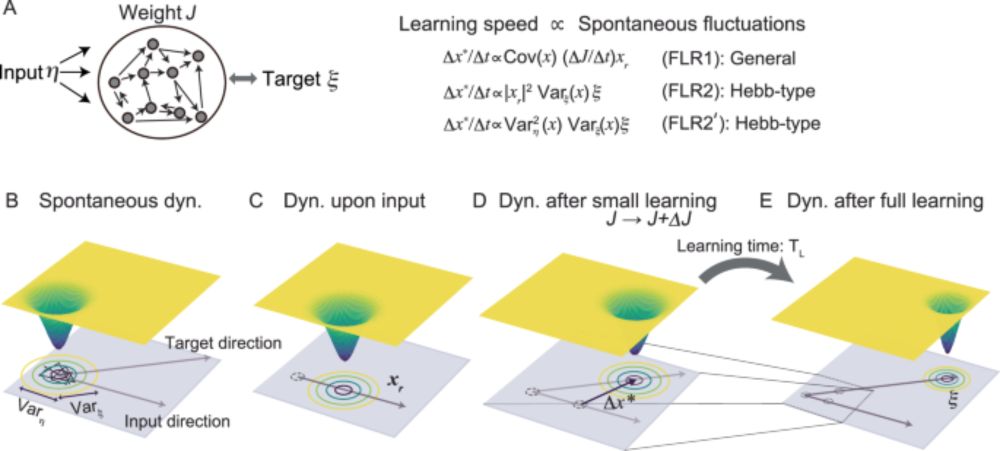
Fluctuation-learning relationship in recurrent neural networks - Nature Communications
Spontaneous neural activity has been experimentally linked to learning ability. Here, the authors derive theoretical formulae showing that higher variance along task-relevant directions accelerates le...
www.nature.com
November 10, 2025 at 11:22 AM
Our paper on fluctuation-response relationship in learning is just out. Tomoki Kurikawa and Kunihiko Kaneko, Fluctuation-learning relationship in recurrent neural networks,
Nature Communications 16, 9663 (2025)
www.nature.com/articles/s41...
Nature Communications 16, 9663 (2025)
www.nature.com/articles/s41...
"Universal Biology: The Physics of Life through the Macro-Micro Consistency Principle" will be soon published from Cambridge Univ Press. Brief introduction is here:https://cambridgeblog.org/2025/10/universal-biology/
October 3, 2025 at 12:56 PM
"Universal Biology: The Physics of Life through the Macro-Micro Consistency Principle" will be soon published from Cambridge Univ Press. Brief introduction is here:https://cambridgeblog.org/2025/10/universal-biology/
Our review on “central dogma” is just out: Nobuto Takeuchi and Kunihiko Kaneko, “Generalizing the central dogma as a cross-hierarchical principle of biology”, Phil. Trans. R. Soc. B 380: 20240296.
royalsocietypublishing.org/doi/10.1098/...
royalsocietypublishing.org/doi/10.1098/...

Generalizing the central dogma as a cross-hierarchical principle of biology | Philosophical Transactions of the Royal Society B: Biological Sciences
The central dogma of molecular biology, as originally proposed by Crick, asserts that
information passed into protein cannot flow back out. This principle has been interpreted
as underpinning modern u...
royalsocietypublishing.org
October 3, 2025 at 12:52 PM
Our review on “central dogma” is just out: Nobuto Takeuchi and Kunihiko Kaneko, “Generalizing the central dogma as a cross-hierarchical principle of biology”, Phil. Trans. R. Soc. B 380: 20240296.
royalsocietypublishing.org/doi/10.1098/...
royalsocietypublishing.org/doi/10.1098/...
As I just started bluesky, I post a few of my recent papers:
"A simple model for how species in soil shape their environment in a way that benefits their growth" Physical Review Research, 2025
doi.org/10.1103/Phys...
Riz Fernando Noronha, Kim Sneppen,&KK
"A simple model for how species in soil shape their environment in a way that benefits their growth" Physical Review Research, 2025
doi.org/10.1103/Phys...
Riz Fernando Noronha, Kim Sneppen,&KK
Modeling soil as a living system: Feedback between microbial activity and spatial structure
Soil is a complex, dynamic material with physical properties that depend on its biological content. We propose a cellular automaton model for self-organizing soil structure, where soil aggregates serv...
doi.org
June 26, 2025 at 7:52 PM
As I just started bluesky, I post a few of my recent papers:
"A simple model for how species in soil shape their environment in a way that benefits their growth" Physical Review Research, 2025
doi.org/10.1103/Phys...
Riz Fernando Noronha, Kim Sneppen,&KK
"A simple model for how species in soil shape their environment in a way that benefits their growth" Physical Review Research, 2025
doi.org/10.1103/Phys...
Riz Fernando Noronha, Kim Sneppen,&KK
Just out from Cambridge University Press: Theoretical Biology of the Cell by Takagi, Furusawa, Sawai & Kaneko. Covers theoretical tools for life dynamics, stochasticity & information, for cellular response, adaptation, morphogenesis, origin of life & more.
www.cambridge.org/core/books/t...
www.cambridge.org/core/books/t...

Theoretical Biology of the Cell
Cambridge Core - Biological Physics and Soft Matter Physics - Theoretical Biology of the Cell
www.cambridge.org
June 20, 2025 at 2:05 PM
Just out from Cambridge University Press: Theoretical Biology of the Cell by Takagi, Furusawa, Sawai & Kaneko. Covers theoretical tools for life dynamics, stochasticity & information, for cellular response, adaptation, morphogenesis, origin of life & more.
www.cambridge.org/core/books/t...
www.cambridge.org/core/books/t...
Reposted by KunihikoKaneko

Excited to share our latest paper published in PNAS!
We introduced a new theoretical framework, "evolutionary dynamical-systems game theory," to explain how rules for sustainable resource use self-organize.
🔗 www.pnas.org/doi/abs/10.1...
We introduced a new theoretical framework, "evolutionary dynamical-systems game theory," to explain how rules for sustainable resource use self-organize.
🔗 www.pnas.org/doi/abs/10.1...

Self-organized institutions in evolutionary dynamical-systems games | PNAS
Social institutions are systems of shared norms and rules that regulate people’s behaviors,
often emerging without external enforcement. They provi...
www.pnas.org
April 13, 2025 at 3:40 PM
Excited to share our latest paper published in PNAS!
We introduced a new theoretical framework, "evolutionary dynamical-systems game theory," to explain how rules for sustainable resource use self-organize.
🔗 www.pnas.org/doi/abs/10.1...
We introduced a new theoretical framework, "evolutionary dynamical-systems game theory," to explain how rules for sustainable resource use self-organize.
🔗 www.pnas.org/doi/abs/10.1...