




K S Narayan
@ksnarayanlab.bsky.social
experimentalist with interest in everything, majorly in device physics-energy science- bioelectronics at www.jncasr.ac.in/narayan
The analysis in this work will be important in neural prosthetics as the degree of degradation/changes in the circuit can be assessed using these techniques to effectively stimulate the tissue.
August 27, 2025 at 11:01 AM
The analysis in this work will be important in neural prosthetics as the degree of degradation/changes in the circuit can be assessed using these techniques to effectively stimulate the tissue.
The burst analysis along with pharmacological blockade can be used to study developing neural circuits and to quantify its properties. Neural circuits in the absence of external input as in the case of RP or AMD in the retina, change connections between cells.
August 27, 2025 at 11:01 AM
The burst analysis along with pharmacological blockade can be used to study developing neural circuits and to quantify its properties. Neural circuits in the absence of external input as in the case of RP or AMD in the retina, change connections between cells.
The neurotransmitter γ-aminobutyric acid (GABA), released by cells responsible for lateral communication in the retina is responsible for this change in wave areas as it changed from an excitatory to an inhibitory neurotransmitter. This change in the GABA effect is a hallmark of developing circuits.
August 27, 2025 at 11:01 AM
The neurotransmitter γ-aminobutyric acid (GABA), released by cells responsible for lateral communication in the retina is responsible for this change in wave areas as it changed from an excitatory to an inhibitory neurotransmitter. This change in the GABA effect is a hallmark of developing circuits.
In the late stages the waves shift to glutamatergic drive from bipolar cells and are spatially more localized. These were carried out using pharmacological blockade with burst analysis that allowed us to quantify the effects of these blockers.
August 27, 2025 at 11:01 AM
In the late stages the waves shift to glutamatergic drive from bipolar cells and are spatially more localized. These were carried out using pharmacological blockade with burst analysis that allowed us to quantify the effects of these blockers.
In the early stages (E8–E12): Waves are gap junction–mediated while being modulated by acetylcholine. These are slower, less organized, reflect immature electrical coupling between cells as the propagation is not mediated through chemical synapses.
August 27, 2025 at 11:01 AM
In the early stages (E8–E12): Waves are gap junction–mediated while being modulated by acetylcholine. These are slower, less organized, reflect immature electrical coupling between cells as the propagation is not mediated through chemical synapses.
The retina exhibits propagating SA waves before vision begins. These waves involve large groups of retinal ganglion cells (RGCs) firing in correlated bursts. A clear difference in the activity is observed in the early embryonic stage as compared to the later stage before hatching.
August 27, 2025 at 11:01 AM
The retina exhibits propagating SA waves before vision begins. These waves involve large groups of retinal ganglion cells (RGCs) firing in correlated bursts. A clear difference in the activity is observed in the early embryonic stage as compared to the later stage before hatching.
It also refines the connectivity of the network to make the system be prepared for inputs from the external world. the developing chick retina is used as a model system and studied in our lab. The main features of SA in Developing Chick Retina is the Presence of Retinal Waves.
August 27, 2025 at 11:01 AM
It also refines the connectivity of the network to make the system be prepared for inputs from the external world. the developing chick retina is used as a model system and studied in our lab. The main features of SA in Developing Chick Retina is the Presence of Retinal Waves.
Neural Retina is the main sensing part of the retina and is composed of several layers of interconnected neurons. Its appearance indicates that the network has developed enough intrinsic connectivity and excitability to sustain coordinated activity without external drive.
August 27, 2025 at 11:01 AM
Neural Retina is the main sensing part of the retina and is composed of several layers of interconnected neurons. Its appearance indicates that the network has developed enough intrinsic connectivity and excitability to sustain coordinated activity without external drive.
For instance in the case of a system like retina spontaneous activity emerges before fully mature external inputs (light) arrive. The vertebrate retina is one of the best-studied models for spontaneous activity during development.
August 27, 2025 at 11:01 AM
For instance in the case of a system like retina spontaneous activity emerges before fully mature external inputs (light) arrive. The vertebrate retina is one of the best-studied models for spontaneous activity during development.
Spontaneous activity (SA) in neural systems is a hallmark of living organisms. It typically refers to neural firing or oscillations that occur even in the absence of external stimuli. The onset of SA is a signature of a developing neural (or other excitable) network.
August 27, 2025 at 11:01 AM
Spontaneous activity (SA) in neural systems is a hallmark of living organisms. It typically refers to neural firing or oscillations that occur even in the absence of external stimuli. The onset of SA is a signature of a developing neural (or other excitable) network.
best wishes to Sinay who just moved out to @StingelinN at Georgia Tech as a post-doc..
January 14, 2025 at 6:50 AM
best wishes to Sinay who just moved out to @StingelinN at Georgia Tech as a post-doc..
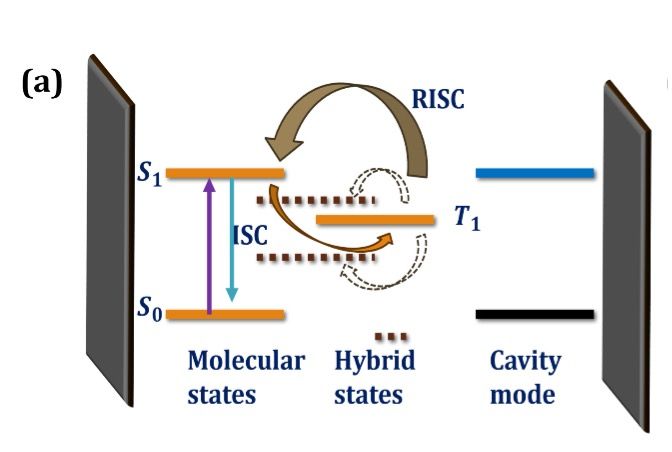
We observe significant splitting of the lower hybrid state leading to a modulation in decay rates. Time-resolved emission unveils detailed transition dynamics. These findings have potential implications for advancements in OLED and organic laser applications.
January 14, 2025 at 6:50 AM
We observe significant splitting of the lower hybrid state leading to a modulation in decay rates. Time-resolved emission unveils detailed transition dynamics. These findings have potential implications for advancements in OLED and organic laser applications.
A tuning of the cavity modes is required to align with the molecular exciton range. We tune the incidence angle (instead of thickness). This handle of incident and collection angles is useful to fine-tune the photon-exciton coupling regime. We carefully carry out this angle dependent measurements.
January 14, 2025 at 6:50 AM
A tuning of the cavity modes is required to align with the molecular exciton range. We tune the incidence angle (instead of thickness). This handle of incident and collection angles is useful to fine-tune the photon-exciton coupling regime. We carefully carry out this angle dependent measurements.
A promising alternative approach for simultaneously maintaining high oscillator strength and low ΔEST is the use of exciton-photon coupling-induced hybrid states. A large dipole moment and high binding energy of the Frenkel exciton in TADF molecules make them suitable in strong coupling regime.
January 14, 2025 at 6:50 AM
A promising alternative approach for simultaneously maintaining high oscillator strength and low ΔEST is the use of exciton-photon coupling-induced hybrid states. A large dipole moment and high binding energy of the Frenkel exciton in TADF molecules make them suitable in strong coupling regime.
The efficiency of the RISC process requires a minimization of the energy gap (ΔEST) between the first excited triplet state (𝑇1) and the first excited singlet state (𝑆1). However, reducing the ΔEST in organic molecules while maintaining enough oscillator strength with high quantum yield is not easy
January 14, 2025 at 6:50 AM
The efficiency of the RISC process requires a minimization of the energy gap (ΔEST) between the first excited triplet state (𝑇1) and the first excited singlet state (𝑆1). However, reducing the ΔEST in organic molecules while maintaining enough oscillator strength with high quantum yield is not easy