



Kat Kabotyanski
@kittykatkab.bsky.social
MD-PhD student @BCM, aspiring neurosurgeon-scientist 🧠👩🏼🔬 formerly @HumanConnectomeProject, @DukeUniversity
Affective disorders remain among the most prevalent and hardest to treat psychiatric conditions. Our study offers a potential path forward in identifying relevant neural targets for improved diagnosis, assessment, and treatment for these challenging conditions. (6/7)

October 28, 2024 at 10:17 PM
Affective disorders remain among the most prevalent and hardest to treat psychiatric conditions. Our study offers a potential path forward in identifying relevant neural targets for improved diagnosis, assessment, and treatment for these challenging conditions. (6/7)
This work is the first step towards my goal of developing multimodal models for detection of affective state. Integrating across behavioral, physiological, and neural measures, this approach would enable analysis of affect in a more scalable, objective, and time-resolved way. (5/7)

October 28, 2024 at 10:17 PM
This work is the first step towards my goal of developing multimodal models for detection of affective state. Integrating across behavioral, physiological, and neural measures, this approach would enable analysis of affect in a more scalable, objective, and time-resolved way. (5/7)
We applied a speech emotion recognition model to extract continuous valence and arousal values. We then mapped the emotion features to neural activity and found that positive affect correlated with increased high-frequency and decreased low-frequency power across all regions. (4/7)

October 28, 2024 at 10:17 PM
We applied a speech emotion recognition model to extract continuous valence and arousal values. We then mapped the emotion features to neural activity and found that positive affect correlated with increased high-frequency and decreased low-frequency power across all regions. (4/7)
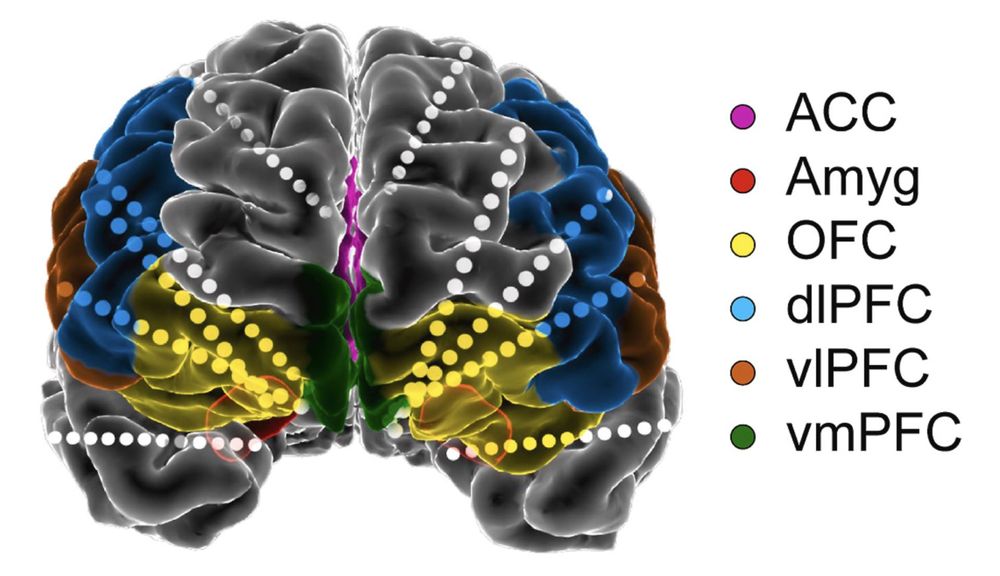
Instead, we used objective behavioral features to quantify emotion and identify neural biomarkers of emotional state. We recorded neural and audio data during daily social interactions in one patient participating in a clinical trial of DBS for treatment-resistant depression. (3/7)
October 28, 2024 at 10:17 PM
Instead, we used objective behavioral features to quantify emotion and identify neural biomarkers of emotional state. We recorded neural and audio data during daily social interactions in one patient participating in a clinical trial of DBS for treatment-resistant depression. (3/7)
Emotions are notoriously difficult to measure—they’re multi-dimensional and constantly changing. Traditional methods like self-report questionnaires are subjective and lack the temporal resolution needed to relate them to real-time neural dynamics. (2/7)

October 28, 2024 at 10:17 PM
Emotions are notoriously difficult to measure—they’re multi-dimensional and constantly changing. Traditional methods like self-report questionnaires are subjective and lack the temporal resolution needed to relate them to real-time neural dynamics. (2/7)
I’m excited to share our new paper in @brainstimj! We used natural human conversations to investigate the brain activity underlying emotional expression: https://www.brainstimjrnl.com/article/S1935-861X(24)00174-8/fulltext (1/7)

October 28, 2024 at 10:17 PM
I’m excited to share our new paper in @brainstimj! We used natural human conversations to investigate the brain activity underlying emotional expression: https://www.brainstimjrnl.com/article/S1935-861X(24)00174-8/fulltext (1/7)