



kenticisms
@kenticisms.bsky.social
Research into the past and present dialect, accent, proverbs and sayings of Kent. With some Kentish folklore and customs for added interest.
kenticisms will be taking a summer break. I have not been able to interact with this account in the way I would wish as I'm busy with other projects. Hopefully I can return to the account with more time and attention in a few months.

June 9, 2025 at 8:30 AM
kenticisms will be taking a summer break. I have not been able to interact with this account in the way I would wish as I'm busy with other projects. Hopefully I can return to the account with more time and attention in a few months.
The TONGUE was the projecting part of the COW or COWL of an OAST, which caused it to turn round when acted on by the wind.

June 6, 2025 at 6:01 AM
The TONGUE was the projecting part of the COW or COWL of an OAST, which caused it to turn round when acted on by the wind.
I came across a word in a 1960s Kent newspaper, which I hadn't seen before. TANT or TANTED meant 'faint, fainted' or sometimes 'tantrum'.

June 5, 2025 at 6:01 AM
I came across a word in a 1960s Kent newspaper, which I hadn't seen before. TANT or TANTED meant 'faint, fainted' or sometimes 'tantrum'.
Nicholas Wood (c1585-1630), the GREAT EATER OF KENT was born in Hollingbourne before becoming a farmer in Harrietsham. John Taylor wrote a small book detailing his feats, including "..did eat a whole sheep, of 16 shillings price, and raw at that, at one meal. Another time he eat 30 dozen of pigeons"
![Details from the front page of an old book written by John Taylor reading; To the Most Famous, Infamous, High and Mighty Feeder, Nicholas Wood, Great and Grand Gurmandizer of Harrisom [Harrietsham] in the County of Kent.](https://cdn.bsky.app/img/feed_thumbnail/plain/did:plc:debhak7qjrboc74gbhosc5e6/bafkreig4j7jcfhfp7e7f2cc2xokwemzarp5rijivwpyvkirzi64nfpfwam@jpeg)
June 2, 2025 at 6:00 AM
Nicholas Wood (c1585-1630), the GREAT EATER OF KENT was born in Hollingbourne before becoming a farmer in Harrietsham. John Taylor wrote a small book detailing his feats, including "..did eat a whole sheep, of 16 shillings price, and raw at that, at one meal. Another time he eat 30 dozen of pigeons"
The Field Naturalist (1833) says that the willow warbler also known as the willow wren "are partial to some kinds of fruit, but they will not touch cherries, although they are very commonly known in many parts of Kent and Surrey by the provincial name CHERRY CHOPPERS.

May 30, 2025 at 6:01 AM
The Field Naturalist (1833) says that the willow warbler also known as the willow wren "are partial to some kinds of fruit, but they will not touch cherries, although they are very commonly known in many parts of Kent and Surrey by the provincial name CHERRY CHOPPERS.
First published in The Kentish Gazette in 1771 "The Chathamites" paints a very unflattering portrait of 18C Chatham
Starting with the town's uniqueness before denigrating the locals morals, religions and military, finally a comparison to other Medway Towns, here are the first & last couple of verses
Starting with the town's uniqueness before denigrating the locals morals, religions and military, finally a comparison to other Medway Towns, here are the first & last couple of verses

May 29, 2025 at 6:01 AM
First published in The Kentish Gazette in 1771 "The Chathamites" paints a very unflattering portrait of 18C Chatham
Starting with the town's uniqueness before denigrating the locals morals, religions and military, finally a comparison to other Medway Towns, here are the first & last couple of verses
Starting with the town's uniqueness before denigrating the locals morals, religions and military, finally a comparison to other Medway Towns, here are the first & last couple of verses
An old rhyme is taken to indicate Kentish miles were longer than the statute mile;
Essex stiles, Kentish miles,
Norfolk wiles, many men beguiles
One theory was the bad state of Kentish roads meant miles seemed longer for travellers. However Notes & Queries (1895) suggests Kentish miles were longer;
Essex stiles, Kentish miles,
Norfolk wiles, many men beguiles
One theory was the bad state of Kentish roads meant miles seemed longer for travellers. However Notes & Queries (1895) suggests Kentish miles were longer;

May 26, 2025 at 6:01 AM
An old rhyme is taken to indicate Kentish miles were longer than the statute mile;
Essex stiles, Kentish miles,
Norfolk wiles, many men beguiles
One theory was the bad state of Kentish roads meant miles seemed longer for travellers. However Notes & Queries (1895) suggests Kentish miles were longer;
Essex stiles, Kentish miles,
Norfolk wiles, many men beguiles
One theory was the bad state of Kentish roads meant miles seemed longer for travellers. However Notes & Queries (1895) suggests Kentish miles were longer;
The Stinking Iris (Iris foetidissima) was known in Kent as DRAGON'S TONGUE. Its said to be found in woodland on the North Downs, especially around Boxley.

May 23, 2025 at 6:01 AM
The Stinking Iris (Iris foetidissima) was known in Kent as DRAGON'S TONGUE. Its said to be found in woodland on the North Downs, especially around Boxley.
A Dictionary of the Kentish Dialect has LERRY, LORRY, LURRY as a "jingling rhyme' spoken by mummers in their folk plays. However this cutting from a 1950s newspaper suggests that it had been extended to any fast speech which was intended to cause difficulty in being understood by others listening in

May 21, 2025 at 6:01 AM
A Dictionary of the Kentish Dialect has LERRY, LORRY, LURRY as a "jingling rhyme' spoken by mummers in their folk plays. However this cutting from a 1950s newspaper suggests that it had been extended to any fast speech which was intended to cause difficulty in being understood by others listening in
I found a couplet in 'English Folk-Rhymes' (1892) suggesting a friendly rivalry between Folkestone and Dover fisherman.
This old spelling of Folkestone, without the middle 'e' was used to further tease locals pointing out that this was an anagram of KENT FOOLS.
This old spelling of Folkestone, without the middle 'e' was used to further tease locals pointing out that this was an anagram of KENT FOOLS.
![There was a vale [whale] came down the flood ;
Folsteners (Folkstone men) couldn't catch un, but Doverers dud.](https://cdn.bsky.app/img/feed_thumbnail/plain/did:plc:debhak7qjrboc74gbhosc5e6/bafkreig3bru2bt76hgijo6gtsi4pwmvyim6okjzbscngxueykubpmhj7ve@jpeg)
May 16, 2025 at 6:01 AM
I found a couplet in 'English Folk-Rhymes' (1892) suggesting a friendly rivalry between Folkestone and Dover fisherman.
This old spelling of Folkestone, without the middle 'e' was used to further tease locals pointing out that this was an anagram of KENT FOOLS.
This old spelling of Folkestone, without the middle 'e' was used to further tease locals pointing out that this was an anagram of KENT FOOLS.
In the Kentish dialect poem 'Dick and Sal at Canterbury Fair' the White Hart ALUS or ALIS - alehouse, is mentioned;
An den we turn’d about agen,
An see an alis stan.
Sal thought it was de goat or hine,
I diden know fer my part;
But when we look’t apan de sign,
De readin was de White Hart.
An den we turn’d about agen,
An see an alis stan.
Sal thought it was de goat or hine,
I diden know fer my part;
But when we look’t apan de sign,
De readin was de White Hart.

May 14, 2025 at 6:01 AM
In the Kentish dialect poem 'Dick and Sal at Canterbury Fair' the White Hart ALUS or ALIS - alehouse, is mentioned;
An den we turn’d about agen,
An see an alis stan.
Sal thought it was de goat or hine,
I diden know fer my part;
But when we look’t apan de sign,
De readin was de White Hart.
An den we turn’d about agen,
An see an alis stan.
Sal thought it was de goat or hine,
I diden know fer my part;
But when we look’t apan de sign,
De readin was de White Hart.
A BANNICKING or BANNOCKING was a thrashing or beating - to give someone a "good hiding", as shown in this example from this 1950s newspaper snippet.

May 13, 2025 at 6:00 AM
A BANNICKING or BANNOCKING was a thrashing or beating - to give someone a "good hiding", as shown in this example from this 1950s newspaper snippet.
Dialect dictionaries record the Corn Marigold (Chrysanthemum segetum, Glebionis segetum) being known in Kent as a YELLOW BOTTLE. I also found a reference in The Complete Farmer (1807) of these flowers growing in the sandy soils around Sandwich also being known as BUDDLE and GOLDS.

May 9, 2025 at 6:01 AM
Dialect dictionaries record the Corn Marigold (Chrysanthemum segetum, Glebionis segetum) being known in Kent as a YELLOW BOTTLE. I also found a reference in The Complete Farmer (1807) of these flowers growing in the sandy soils around Sandwich also being known as BUDDLE and GOLDS.
A 1950s newspaper column mentions the dialect word BLY, meaning a likeness to someone. Although its origin is said to be a mystery it's actually recorded in The Dialect of Kent in the 14th Century as a look or feature, "This man has the bly of his brother".
Said to be from Old Frisian blie or bli.
Said to be from Old Frisian blie or bli.

May 7, 2025 at 6:05 AM
A 1950s newspaper column mentions the dialect word BLY, meaning a likeness to someone. Although its origin is said to be a mystery it's actually recorded in The Dialect of Kent in the 14th Century as a look or feature, "This man has the bly of his brother".
Said to be from Old Frisian blie or bli.
Said to be from Old Frisian blie or bli.
An 1877 edition of Notes & Queries records some local names for fossils and shark teeth found in the chalk pits around Gravesend - NIPPLE-RINGS, FILES, LARKS' TONGUES and WORMS.
An example of the cidaris fossil is pictured below (image from wikipedia).
An example of the cidaris fossil is pictured below (image from wikipedia).


May 5, 2025 at 6:01 AM
An 1877 edition of Notes & Queries records some local names for fossils and shark teeth found in the chalk pits around Gravesend - NIPPLE-RINGS, FILES, LARKS' TONGUES and WORMS.
An example of the cidaris fossil is pictured below (image from wikipedia).
An example of the cidaris fossil is pictured below (image from wikipedia).
This article from a 1900 edition of the Maidstone Journal has a description of May Day celebrations in the Loose Valley, near Maidstone, including the words to the May Day Carol.

May 1, 2025 at 6:01 AM
This article from a 1900 edition of the Maidstone Journal has a description of May Day celebrations in the Loose Valley, near Maidstone, including the words to the May Day Carol.
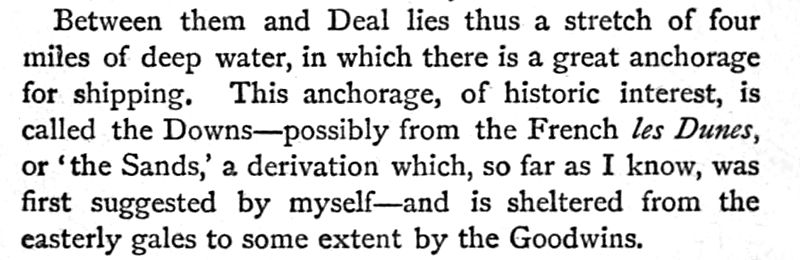
If you've wondered why the old sailing ship anchorage between the Goodwin Sands and Deal was called THE DOWNS. Treanor in his book "Heroes of the Goodwin Sands" suggests it may be from the French "les Dunes".
April 29, 2025 at 6:02 AM
If you've wondered why the old sailing ship anchorage between the Goodwin Sands and Deal was called THE DOWNS. Treanor in his book "Heroes of the Goodwin Sands" suggests it may be from the French "les Dunes".
The DOWNS off of Deal were of great importance as a safe anchorage for the Royal Navy, the Goodwin Sands formed a natural breakwater. Here their usefulness is stressed in Memorials of the Goodwin Sands (1890)

April 28, 2025 at 6:01 AM
The DOWNS off of Deal were of great importance as a safe anchorage for the Royal Navy, the Goodwin Sands formed a natural breakwater. Here their usefulness is stressed in Memorials of the Goodwin Sands (1890)
DOVER SOLE is not peculiar to the Dover area. The flatfish, also known as the common or black sole, is found from Norway to N. Africa, The Dover connection is a result of local fishermen cornering the market for supplying Victorian London. Americans then applied the 'brand name' to a different fish.

April 25, 2025 at 6:01 AM
DOVER SOLE is not peculiar to the Dover area. The flatfish, also known as the common or black sole, is found from Norway to N. Africa, The Dover connection is a result of local fishermen cornering the market for supplying Victorian London. Americans then applied the 'brand name' to a different fish.
A Dictionary of the Kentish Dialect recorded the superstition of GIFTS - white specks on a fingernail which was thought to foretell something coming.
![GIFTS [gifts] so. pl. White specks which appear on the finger nails and are supposed to indicate something coming, thus—
A gift on the thumb indicates a present.
" on the fore-finger indicates a friend or lover.
" on the middle finger indicates a foe.
" on the fourth finger indicates a visit to pay.
" on the little finger indicates a journey to go.
-W. F. S.](https://cdn.bsky.app/img/feed_thumbnail/plain/did:plc:debhak7qjrboc74gbhosc5e6/bafkreihrzdyu3ojvmlilarxf2absklzgeufjmwx7swuct6wosb52nf7uz4@jpeg)
April 24, 2025 at 6:01 AM
A Dictionary of the Kentish Dialect recorded the superstition of GIFTS - white specks on a fingernail which was thought to foretell something coming.
In the past I have found evidence of PITHER being used to mean 'to bother' and PITHERING to mean wandering about aimlessly, also I have seen where PITHERED meant being cramped up with cold. Here is another example from a 1950s newspaper of the use of PITHER, here meaning 'to crumble away'.

April 23, 2025 at 6:01 AM
In the past I have found evidence of PITHER being used to mean 'to bother' and PITHERING to mean wandering about aimlessly, also I have seen where PITHERED meant being cramped up with cold. Here is another example from a 1950s newspaper of the use of PITHER, here meaning 'to crumble away'.
Traditional Kentish Easter Day fare was Pudding Pies and Cherry Beer, and the young folk would go 'pudding pieing' as described in Brand's Popular Antiquities (1905). However "The Dover Road" (1922) bemoaned a decline in the delicacy.


April 17, 2025 at 6:01 AM
Traditional Kentish Easter Day fare was Pudding Pies and Cherry Beer, and the young folk would go 'pudding pieing' as described in Brand's Popular Antiquities (1905). However "The Dover Road" (1922) bemoaned a decline in the delicacy.
This 1950s newspaper snippet records JOUTERING as a Kentish form of arguing or nagging.

April 16, 2025 at 7:39 AM
This 1950s newspaper snippet records JOUTERING as a Kentish form of arguing or nagging.
Around Romney Marsh MARLED was used to describe to white flecks and streaks of fat within the lean sections of meat. It would be more commonly known as MARBLED today.
From Old Country and Farming Words (1880)
From Old Country and Farming Words (1880)
![Marled [marbled]. 'In both bullocks and sheep, the flesh of none that die with little fat within will taste well; the fine eating meat being that which is marled flesh and spreadwell' Kent (Romney Marsh).—xx. 266.](https://cdn.bsky.app/img/feed_thumbnail/plain/did:plc:debhak7qjrboc74gbhosc5e6/bafkreigetnomo26jo47tzmjs56p5kgxauaorgjyb6vibfd7fvdpbkizwty@jpeg)
April 11, 2025 at 6:00 AM
Around Romney Marsh MARLED was used to describe to white flecks and streaks of fat within the lean sections of meat. It would be more commonly known as MARBLED today.
From Old Country and Farming Words (1880)
From Old Country and Farming Words (1880)
This 1950s newspaper clipping translates a sentence that may have been heard in north Kent.

April 9, 2025 at 6:00 AM
This 1950s newspaper clipping translates a sentence that may have been heard in north Kent.